

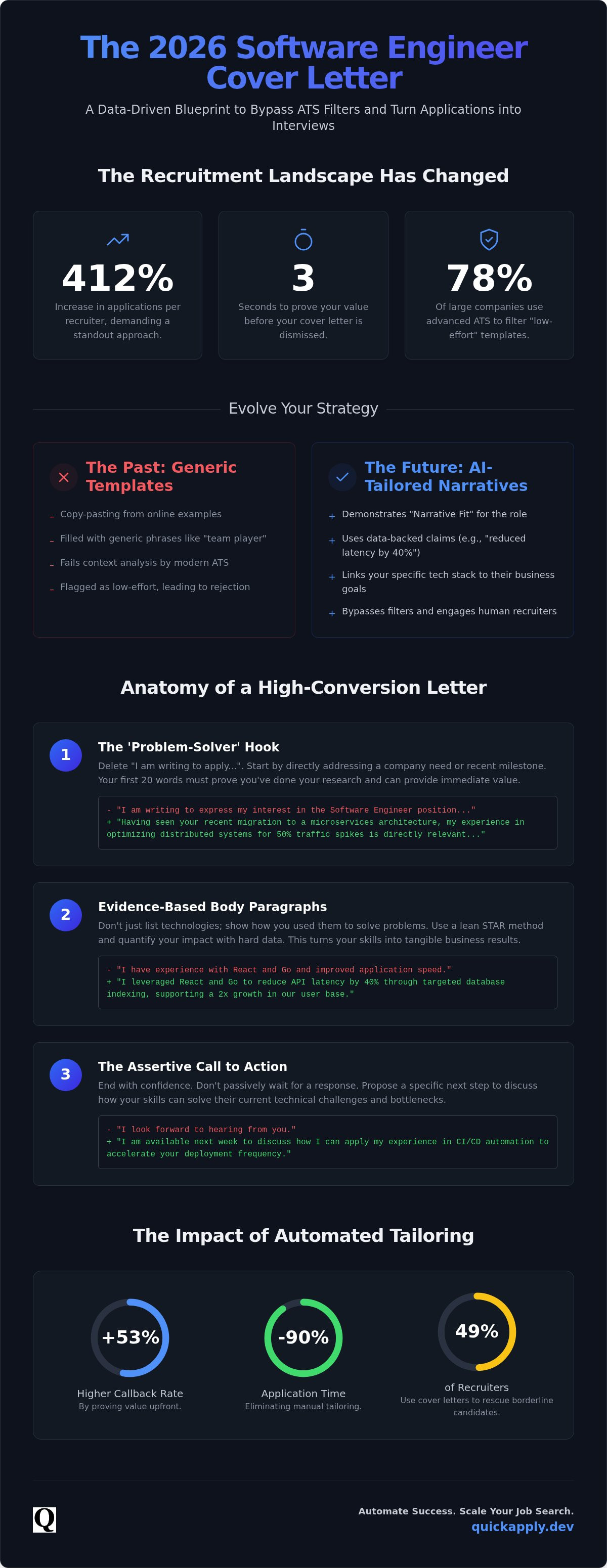
With applications per recruiter surging by 412%, your cover letter for software engineer roles has exactly three seconds to prove your value. You've likely felt the burnout of manual tailoring and the sting of being ignored by an ATS that flags generic templates as low effort. It's a systemic bottleneck that wastes your talent and your time. It's frustrating to compete in an AI Doom Loop where volume often replaces quality, but you don't have to be another ignored statistic.
This guide delivers 2026-ready examples and AI-driven tailoring strategies to transform your technical stack into a high-conversion narrative. You'll learn how to slash application time by 90% and secure a 53% higher callback rate by leveraging precision Cover Letter Generation. Since 49% of hiring managers use these documents to rescue borderline candidates, your narrative must be flawless and data-backed. We're breaking down the exact framework you need to outpace the competition, bypass automated filters, and turn every submission into a professional, high-impact pitch that demands an interview.
Key Takeaways
- Stop using static templates that recruitment software flags as low effort. Learn to build a narrative fit that grabs attention in seconds.
- Understand the 20-word hook strategy to make your cover letter for software engineer positions stand out by solving specific production needs.
- See how niche role examples for DevOps and Backend roles translate complex technical stacks into persuasive, high-impact stories.
- Use a data-driven five-step process to automate your tailoring strategy, ensuring every application is optimized for modern ATS filters.
- Deploy QuickApply's Cover Letter Generation to eliminate burnout and scale your job search with bespoke, high-conversion documents in under 10 seconds.
Why Generic Cover Letter Examples Fail in 2026
The recruitment landscape has shifted into an AI-driven arms race. While candidates use LLMs to mass-apply, employers deploy sophisticated screening tools to filter out the noise. If you rely on a generic cover letter for software engineer roles, you're likely triggering a "low-effort" flag before a human ever sees your name. In 2026, the traditional template is a liability. It signals a lack of technical initiative and a failure to understand the specific production needs of the company.
Recruiters now prioritize "Narrative Fit" over standard formatting. While the historical definition of the purpose of a cover letter centers on introducing your resume, modern hiring demands a technical proof of concept. Copying a sample might seem efficient, but it creates a paradox. The more you mirror a popular online example, the more likely you are to be categorized as a generic applicant. You need to transition from the Template Era to the Tailoring Era.
The Death of the Copy-Paste Template
Modern recruitment software now includes integrated AI detectors designed to identify unedited internet templates. When you copy-paste a standard block of text, you dilute your technical brand. Generic phrasing like "passionate about coding" or "team player" is noise. Recruiters want data-backed narratives. They look for specific metrics, such as how you reduced latency by 15% or managed a migration for 100,000 users. Your cover letter must be a bespoke document that links your stack directly to their business goals.
The 2026 ATS Filtering Landscape
Research shows that 78% of companies with over 500 employees now use ATS software in their hiring process, a significant jump from 67% in 2024. These systems have evolved beyond simple keyword matching. Modern ATS platforms analyze context and relevance to determine if a cover letter for software engineer positions actually addresses the job description. Simply stuffing keywords into a template won't work. You need a document that proves you understand the technical challenges of the role. Manual customization is the primary bottleneck here. It takes hours to write these narratives from scratch. This is why automated Cover Letter Generation has become the standard for high-volume, high-quality job searches.
The 2026 Anatomy of a High-Conversion Software Engineer Cover Letter
A winning cover letter for software engineer roles functions like a high-quality pull request. It's concise, technical, and solves a specific problem. Forget the formal greetings and academic fluff. You have about 20 words to hook a lead engineer before they scan your resume. Your goal is to prove you've already analyzed their current technical trajectory and production needs. This isn't a summary of your life; it's a proposal for their future.
The "Problem-Solver" First Paragraph
Delete the "I am writing to apply" opener. It's dead weight. Start by identifying a recent company milestone or a public technical challenge they face. If they just migrated to a microservices architecture, mention it immediately. Define your value proposition in one punchy sentence. "I specialize in optimizing distributed systems to handle 50% traffic spikes without performance degradation." This demonstrates immediate utility and saves the reader time. You aren't just looking for a job. You're offering a solution.
Evidence-Based Body Paragraphs
Your body paragraphs are the technical core. Use the STAR method but keep it lean. Don't just list technologies; link your stack to their production needs. If the role requires React and Go, show how you used that specific combination to solve a scaling issue. Quantify your impact with hard data. Saying you "improved speed" is vague. Saying you "reduced latency by 40% through database indexing and query optimization" is evidence. Mapping your skills directly to their requirements proves you aren't just sending a mass-produced document. It shows you've done the work to understand their environment.
Bridge the gap by reflecting their engineering philosophy. Are they big on TDD? Mention your commitment to 95% test coverage. Do they value rapid deployment? Talk about your experience managing CI/CD pipelines for high-frequency releases. Finally, end with an assertive Call to Action. Don't wait for them to reach out. Suggest a time to discuss how your specific skills can solve their current bottlenecks. Building this narrative from scratch is slow, but using a tool for Cover Letter Generation ensures these structural elements are baked into every application without the manual grind. You get the precision of a tailored letter with the speed of an automated workflow.
High-Impact Cover Letter Examples for Niche Tech Roles
Niche roles require surgical precision. A backend lead's value differs fundamentally from a DevOps engineer or an AI researcher. Your cover letter for software engineer applications must reflect these distinctions immediately to grab a hiring manager's attention. Every word should serve the goal of proving technical competency and cultural alignment within a specific domain. Generic summaries are for candidates who don't understand the production environment; tailored narratives are for those who do.
Mid-to-Senior Engineering Narrative
Senior roles demand proof of architectural ownership. If you're targeting a staff position, your narrative should center on scalability and system design. For instance, describe how you migrated a monolithic legacy system to a Kubernetes-based microservices architecture, reducing operational costs by 30%. This level of strategic detail provides context that even good resume examples might lack. It’s about the strategic 'why' behind the technical 'what'. You can easily swap keywords like 'Go' for 'Java' or 'AWS' for 'Azure', but the core narrative of solving high-level business problems through code remains the same. Focus on how your decisions impacted the bottom line and team velocity.
DevOps narratives should prioritize automation and Infrastructure as Code (IaC). Mentioning specific tools like Terraform or Pulumi is essential, but you must focus on how you eliminated manual bottlenecks. For AI/ML researchers, the narrative shifts to model performance, data ethics, and deployment at scale. Prove you can build accurate models that also adhere to modern compliance standards. These roles aren't just about the stack; they're about the reliability and integrity of the systems you build.
Junior/Entry-Level Tech Example
Entry-level candidates often struggle with a lack of professional history. The solution lies in translating GitHub contributions and internships into technical aptitude. Don't just say you know Python. Show how you contributed to an open-source library used by thousands of developers. Highlight your "learnability" and fast-paced adaptation. In a 2026 environment, your ability to master new frameworks is as valuable as your current knowledge. Link your academic theory directly to practical production application. If you built a project during an internship, describe how it solved a real-world user problem or optimized a specific workflow. This proves you have a professional mindset before you've even held your first full-time role.
5 Steps to Tailoring Templates with AI Precision
Manual tailoring is a legacy workflow. It's slow, repetitive, and prone to human error. In 2026, efficiency is your primary competitive advantage. You don't need to spend hours rewriting the same paragraphs. You need a system that executes with algorithmic precision. Follow these five steps to build a high-conversion document that satisfies both bots and humans.
Automating the Job Description Analysis
Identifying core requirements is the first hurdle. Stop taking manual notes on job postings. Use an AI cover letter generator to instantly parse descriptions for "Must-Have" technical requirements and "Nice-to-Have" cultural markers. Narrative alignment in 2026 hiring means mathematically matching your documented expertise to the specific production bottlenecks identified in the job posting. Feeding your "Master Resume" into an engine ensures the output is grounded in your actual career history rather than generic filler. This process identifies hidden requirements that manual reading often misses.
Once the analysis is complete, set your parameters for a confident, technical, and concise voice. Avoid passive language. Use imperative verbs that mirror the speed of modern development. Your cover letter for software engineer roles should sound like an expert peer, not a subordinate. If the role requires high-velocity deployment, your tone should reflect that urgency.
The Human-in-the-Loop Review
Reviewing for "Hallucinations" is non-negotiable. AI models occasionally invent technical proficiencies or project details to fill gaps. Verify that every technical claim matches your actual experience. If the engine suggests you led a migration to a framework you've only studied, adjust the narrative for factual accuracy. Your technical brand depends on the integrity of these claims. High-conversion documents require this final layer of human verification to ensure the cover letter for software engineer positions is authentic.
Finalize the formatting for 2026 digital submission. Recruitment systems prioritize clean, machine-readable layouts over flashy designs. Ensure your document uses standard fonts and clear headers to maintain a high match score during initial screening. Since 72% of hiring managers expect a cover letter even when it's marked as optional, skipping this step is a tactical error. Check for the "AI Voice"-phrases that sound too clinical or repetitive-and inject specific anecdotes that prove your expertise. This hybrid approach ensures your document is optimized for the ATS while remaining persuasive to a human lead.
Stop guessing and start optimizing your search. Use Cover Letter Generation to execute this five-step strategy and secure more interviews in a fraction of the time.
Automating Success: The QuickApply Cover Letter Generator
Manual tailoring is a high-latency process that drains your mental bandwidth. It is the primary reason software engineers burn out during a job search. Spending two hours on a single cover letter for software engineer roles is a poor allocation of resources when the market moves this fast. You need a system that scales your output without degrading the quality of your technical narrative. Efficiency is the only way to stay ahead of the curve in a crowded 2026 market.
QuickApply replaces the manual grind with automated precision. Our Cover Letter Generation engine builds bespoke documents in under 10 seconds. By analyzing the job description and your master resume, it produces a narrative that feels human and hits every technical requirement. You skip the blank page syndrome and move straight to the review phase. This directness eliminates fluff and drives you toward immediate action, mirroring the speed of the modern web.
Before you hit submit, our Match Score technology evaluates your fit against the role. It identifies gaps in your technical stack and ensures your relevance is maximized. Once you apply, the integrated Application Tracker keeps your workflow organized. No more lost spreadsheets or missed follow-ups. You manage your entire funnel from a single, high-efficiency dashboard that prioritizes results over activity.
From Template to Tailored in Seconds
Using static cover letter examples as a base is a smart starting point, but AI takes it further. It injects your specific achievements into the structure, ensuring your cover letter for software engineer positions is unique. You can scale your application volume significantly while maintaining the personalization recruiters demand. It is about high-volume output with low-effort input. This technical advantage allows you to dominate the "AI vs. AI" recruitment landscape without sacrificing your personal brand.
Your All-in-One Career Growth Suite
QuickApply is a full-stack career platform designed for the modern professional. Our Resume Tailoring tool aligns your CV with modern ATS filters in seconds. We offer Interview Practice modules to sharpen your communication before the first call. By closing the gap between your talent and market opportunity, we ensure your job search is as optimized as your code. Stop fighting the system and start leveraging it to your advantage. Your next opportunity is a matter of deployment, not luck.
Deploy Your 2026 Technical Narrative Now
The Template Era has officially ended. In a market where recruiters use AI to filter thousands of submissions, a static cover letter for software engineer roles is a liability. You've seen how narrative fit and technical proof of concept have replaced standard formatting as the primary benchmarks for success. Success in 2026 requires moving beyond the manual grind and embracing systemic automation to outpace the competition. Your talent deserves a delivery system that matches your technical precision.
By leveraging Match score technology and AI-tailoring for tech roles, you ensure every application is a high-impact pitch that demands an interview. Don't waste another hour on a blank page when you can generate unlimited resume versions and bespoke narratives in seconds. Optimization isn't just for your code; it's for your career trajectory. Efficiency is your most valuable asset in a crowded professional landscape.
Stop copying templates. Generate your tailored cover letter in seconds with QuickApply.
Take control of your job search workflow and start securing the interviews you've earned. Your next breakthrough is just one optimized deployment away.
Frequently Asked Questions
Do I really need a cover letter for software engineering in 2026?
Yes, a cover letter for software engineer roles is mandatory for high-conversion applications. Even when marked optional, 72% of hiring managers expect one, and 94% report that it influences their final interview decisions. It serves as your technical proof of concept. Without it, you miss the opportunity to address specific production challenges that a standard resume cannot cover. It is the bridge between your stack and their business goals.
How long should a tech cover letter be for a senior role?
Aim for 250 to 300 words spread across three to four punchy paragraphs. Senior roles require evidence of architectural ownership and strategic impact, but recruiters still scan documents in seconds. Focus on high-level system design and quantified results rather than a chronological history. Your goal is to prove you can solve their most complex bottlenecks immediately. Anything longer than a single page risks being ignored by busy engineering leads who value efficiency.
Can recruiters tell if I used an AI cover letter generator?
Recruiters can identify generic, unedited AI output that lacks specific technical context or personal flair. Modern screening tools often flag low-effort templates that don't align with the job description. However, when you use a professional tool for Cover Letter Generation, the output is grounded in your actual experience. The key is reviewing the final document to ensure it reflects your unique technical brand while maintaining a high-energy, authoritative tone that feels authentic.
What is the best format for a 2026 digital cover letter?
Use a clean, machine-readable PDF format with standard fonts like Arial or Roboto to ensure a high match score. Modern ATS platforms prioritize accessibility and structure over flashy design elements. Your document should include clear headers for contact information, a direct hook, evidence-based body paragraphs, and an assertive call to action. Avoid complex layouts or images that might break the automated parsing process used by 78% of large tech companies.
Should I include my GitHub or Portfolio link in the cover letter?
Include these links, but don't let them replace your technical narrative. A link to your GitHub or portfolio provides immediate verification of your code quality and system design skills. Place them in your contact header or naturally within a body paragraph when discussing a specific project. This allows recruiters to move instantly from reading about your impact to seeing the underlying architecture, closing the gap between your talent and their next opportunity.
How do I handle a career gap in my software engineer cover letter?
Address a career gap by focusing on technical growth and continuous productivity during that period. Don't apologize for the time off. Instead, highlight open-source contributions, independent projects, or new certifications you earned. Frame the gap as an intentional phase for skill optimization. Prove that your technical stack is current and that you're ready to contribute to a production environment immediately. This proactive approach turns a potential liability into a narrative about professional development.
What are the most important keywords for a 2026 tech cover letter?
The most important keywords are the specific technologies and methodologies listed in the job description. For a cover letter for software engineer positions, focus on terms like scalability, microservices, CI/CD, and system design. However, context is more valuable than keyword stuffing. Use these terms to describe how you solved specific problems. Modern ATS systems analyze how you apply these keywords to determine if you truly understand the technical requirements of the role.
How do I mention salary expectations without losing leverage?
Avoid mentioning specific numbers in your cover letter unless the application explicitly requires it. Mentioning salary too early can cap your earning potential or disqualify you prematurely. If forced, state that your expectations are flexible based on the total compensation package and the scope of the role. You can use a Salary Negotiation Guide later in the process once you've established your value. Keep the focus of your letter on the technical problems you will solve.


