

Sixty-two percent of employers now use AI to manage every stage of the hiring process. If you're still spending two hours manually tailoring a single document, you're bringing a knife to a software war. The 2026 market has evolved into an "AI vs. AI" landscape where generic templates are a liability. To stand out, you need a specialized ai resume writer for tech jobs that understands developer stacks and deployment cycles better than a standard LLM.
It's exhausting to be perfectly qualified yet remain invisible to ATS filters. You deserve a system that quantifies your technical impact without the mental drain of word-smithing bullet points. This guide promises to transform your workflow into a high-output Career OS. You'll learn to generate 90+ match scores for every application while slashing your manual effort. We'll break down how to beat modern filters, track every application version, and finally secure the interview invites your talent earns.
Key Takeaways
- Beat the double filter by optimizing for both high-speed ATS algorithms and the 6-second human recruiter scan.
- Leverage a specialized ai resume writer for tech jobs to decode complex tech stacks and identify hidden requirements using Natural Language Processing.
- Avoid the "ChatGPT trap" by choosing tools that maintain technical context and consistent formatting throughout your entire search.
- Implement a high-efficiency workflow using a Master Resume foundation to generate 90+ match scores in seconds.
- Upgrade to a full Career OS to track application versions and automate your path from initial draft to a senior dev role.
Beyond the Template: Why Tech Jobs Demand AI Precision in 2026
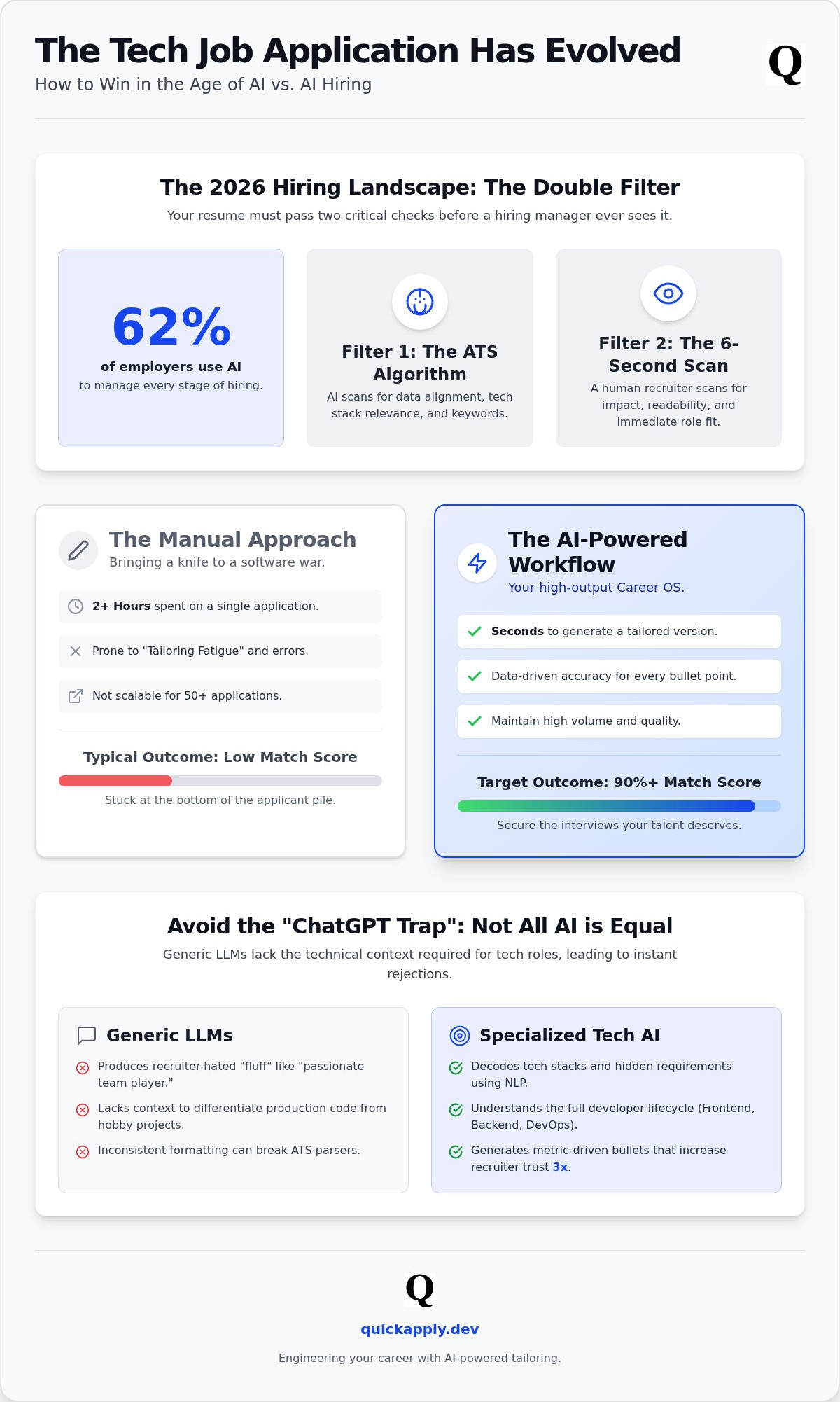
The 2026 tech job market isn't about who has the prettiest PDF. It's about data alignment. An ai resume writer for tech jobs is no longer a simple template generator. It's a specialized engine designed to bridge the gap between your git repository and a specific job description. By 2026, 62% of employers anticipate using AI for nearly all hiring stages. This shift means your resume must survive the "Double Filter." First, you have to satisfy the ATS algorithm. Second, you must impress a human recruiter who spends exactly six seconds scanning your profile for stack relevance.
Relying on standard ChatGPT prompts is a trap. Generic LLMs often produce "fluff" like "passionate team player" or "innovative thinker." Tech recruiters hate this. They want to see your proficiency in Go, Kubernetes, or React. Standard AI lacks the technical context to differentiate between a hobby project and production-level code. This is why recruiters now rely on "Match Scores." These percentages rank your fit before a human even opens your file. If your score is low, your application stays at the bottom of the stack.
The Evolution of ATS in 2026
Modern systems have moved beyond simple keyword matching. They use semantic search to understand that mentioning "Redux" implies "JavaScript" expertise. However, complex layouts still break parser logic. Stick to clean, machine-readable structures to ensure your data transfers correctly. The Applicant Tracking System acts as the primary gatekeeper in the tech hiring funnel. Understanding AI in the hiring process is essential for anyone trying to bypass these digital roadblocks.
Why Manual Tailoring is No Longer Scalable
The math of the current market is brutal. Applying to 50+ roles requires a level of speed that manual editing can't match. "Tailoring Fatigue" is real. When you spend hours tweaking one document, you're prone to errors. Swapping a Python library incorrectly can lead to an instant rejection. Optimization offers empowerment. Instead of guessing what a recruiter wants, use data-driven precision to take control of your career narrative. By automating the heavy lifting, you focus on the interview rather than the paperwork. You can't outwork an algorithm, so you must outsmart it.
- Speed: Generate tailored versions in seconds, not hours.
- Accuracy: Align every bullet point with the specific tech stack required.
- Volume: Maintain a high application rate without sacrificing quality.
Decoding the Tech Stack: How AI Resume Writers Analyze Job Descriptions
Tech job descriptions are data-heavy documents. A high-performing ai resume writer for tech jobs doesn't just scan for keywords. It deconstructs the entire stack. It separates the "must-have" core languages from the "nice-to-have" peripheral tools. Under the hood, the system parses the hiring manager's intent. It recognizes that a requirement for "AWS" likely necessitates knowledge of Terraform or CloudFormation in a modern DevOps context. While many tools claim to automate everything, separating AI hype from reality reveals that the most effective systems augment human expertise. These engines use Natural Language Processing (NLP) to identify hidden requirements. For example, a mention of "high availability" signals a need for distributed systems experience.
The "Match Score" algorithm compares your technical footprint against the employer's ideal persona. It looks for alignment in your developer lifecycle experience. If you're applying for a Backend role, the AI prioritizes database management over frontend frameworks. This level of precision is why manual prompting often fails. To see how this works in real-time, you can use automated resume tailoring to audit your own stack alignment and bridge the gap between your profile and the JD.
Mapping Skills to the Developer Lifecycle
The AI categorizes your experience into functional buckets. It maps your skills across Frontend, Backend, DevOps, and Cloud infrastructure. It also identifies soft skills essential for engineers. It understands that a "Senior Engineer" role requires mentorship and collaboration. It balances technical prowess with terms like "code reviews" and "system design." This approach avoids the trap of "Keyword Stuffing." It maintains a natural voice that satisfies both the bot and the human reviewer. You remain an engineer, not a collection of buzzwords.
The Power of Metric-Driven Bullets
Recruiters value proof. Metric-driven bullets increase recruiter trust by 3x compared to vague descriptions. The AI utilizes the XYZ formula: Accomplished [X] as measured by [Y], by doing [Z]. It turns "wrote code in Go" into "optimized latency by 40% using Go." Even if you haven't tracked every metric, a specialized ai resume writer for tech jobs can extract quantifiable impact from the scope of your projects. This transforms a passive list of duties into an active record of achievement that resonates with technical leadership.
Specialized AI Resume Tailors vs. Generic LLMs: Choosing Your Tool
Using a general-purpose LLM like ChatGPT to handle your career is a high-risk gamble. While these models are impressive, they are often a job search trap for engineers. They struggle with consistent formatting, specific tech-stack hierarchy, and the "AI-speak" that recruiters spot instantly. A dedicated ai resume writer for tech jobs is built on logic layers that prioritize technical accuracy over creative prose. You don't need a poet; you need a precision instrument that understands the difference between a library and a framework.
General AI models also suffer from the Context Window problem. Halfway through a session, they may forget specific bullet points or start hallucinating details from their training data. This leads to inconsistent versions of your professional history. Data security is another major concern. When you feed your resume into an open model, your personal data often becomes training fodder. Specialized tools offer enterprise-grade privacy, ensuring your career history remains your own. Following expert advice on AI resume writing is critical to ensure you're leveraging technology safely and effectively.
The Hallucination Risk in Tech
General AI doesn't understand the nuances of a developer's stack. It might add "Java" to your experience because you mentioned "JavaScript," which is a fast way to fail a technical screen. Inventing certifications or inflating version numbers is professional suicide. Dedicated tech tailors prevent this by grounding their output in your verified Master Resume. The AI acts as your co-pilot, not a ghostwriter. It optimizes your existing impact rather than making up stories that you can't defend in an interview.
Workflow Efficiency Comparison
Efficiency is the ultimate metric. Manual prompting takes 15 minutes of back-and-forth per application. One-click tailoring takes 15 seconds. If you're applying to 20 roles, that's the difference between a productive afternoon and a wasted day. Managing multiple versions in file folders is a legacy process that slows you down. Modern platforms connect your writer directly to an application tracker. For a deeper look at the market, check out The Best AI Resume Builders of 2026: Stop Building, Start Tailoring to find the right fit for your stack. Switching to a specialized ai resume writer for tech jobs is the most logical move for any serious applicant.
From Draft to Dev Role: A High-Efficiency Workflow for Tech Applicants
Success in the 2026 market depends on your ability to treat your job search like a software deployment pipeline. You aren't just sending a document; you're shipping a solution. Efficiency is the only metric that matters when 62% of employers use AI to screen candidates. This high-efficiency workflow ensures you never waste time on low-probability applications while maintaining a 90+ match score for every role you target.
The process begins with the Master Resume. This is your technical foundation. It contains every library, framework, and cloud provider in your arsenal. Don't worry about length here; this is your source of truth. Once your foundation is solid, move to Job Description Ingestion. Paste the JD into your tool so the AI can identify the specific engineering problems the company needs to solve. This is where the ai resume writer for tech jobs earns its keep. It performs real-time tailoring, adjusting your bullet points and technical summaries to hit peak alignment in seconds. Finally, sync your cover letter to ensure your narrative matches your optimized resume and use an automated tracker to iterate based on which versions get the most hits.
Optimizing the Professional Summary
You have exactly three seconds to hook a recruiter before they move to the next candidate. Tailor your intro to the specific engineering problem the company is solving. If they need a scaling expert, your summary should lead with distributed systems, not generic leadership traits. A perfect tech summary balances deep stack expertise with a product-driven mindset. To master this, review our guide on How to Tailor Your Resume to a Job Description: The 2026 AI Strategy.
Managing the Application Pipeline
Automation is the only way to stay competitive in a high-volume market. Since the average cost-per-hire has reached $4,700, companies are more aggressive with their filters than ever. An automated tracker is essential to prevent version confusion and track your interview conversion rates. Use match scores to prioritize high-probability opportunities and ignore the noise. You can find more tactical advice in our resource on Mastering the Job Application Process: A Comprehensive How-To Guide. To start optimizing your own pipeline today, you can access our automated application tracker and take control of your search.
- Ingest: Feed the JD into the system for instant analysis.
- Tailor: Generate a role-specific version in under 15 seconds.
- Track: Monitor every version to see what resonates with hiring managers.
QuickApply: Engineering Your Career with AI-Powered Tailoring
QuickApply isn't another generic template builder. It is a specialized Career OS engineered by tech professionals who have sat on both sides of the interview table. While standard tools focus on aesthetics, this ai resume writer for tech jobs focuses on technical alignment and deployment logic. It solves the fragmentation problem by centralizing your entire search. You get instant resume tailoring, automated cover letter generation, and a robust application tracker in a single dashboard. The platform provides a "Match Score" advantage, giving you a recruiter’s-eye view of your document before you ever hit submit. This allows you to debug your resume for specific ATS filters before they can reject you. By 2026, 44% of organizations already use AI for resume screening; you can't afford to submit an unoptimized file.
The 2026 market demands more than just getting hired. You need a strategy for long-term growth that spans your entire professional lifecycle. This specialized ai resume writer for tech jobs ensures that your technical narrative is consistent across every touchpoint, from the initial scan to the final offer. By treating your career as a system to be optimized, you eliminate the guesswork that plagues traditional job searches.
The Career OS Framework
Most tools abandon you the moment you sign an offer letter. QuickApply stays with you. The Promotion Roadmap helps you prepare for your next career move before you even start your first day at a new company. It identifies the skills and milestones needed for your next level. Additionally, our Salary Negotiation Guides use AI to analyze market data, ensuring you aren't leaving money on the table. In a year where 93% of recruiters plan to increase their AI usage, you need an ally that works as hard as the systems screening you. For inspiration on how to structure your profile for maximum impact, see Good Resume Examples for 2026: The AI-Ready Guide to Getting Hired in Tech.
Interview Ready: The Final Step
Tailoring your resume is only half the battle. You have to defend your bullets in the room. QuickApply includes integrated interview practice tools to help you prep for both technical rounds and behavioral screens. The system syncs your optimized resume bullets with potential interview talking points, ensuring your narrative remains consistent. This eliminates the disconnect between what's on the page and what you say in the call. You'll enter every meeting with a data-backed confidence that generalist tools simply can't provide. It's time to stop guessing and start engineering your success. Start tailoring your tech resume with QuickApply today and turn your technical expertise into a competitive advantage.
Upgrade Your Career Pipeline
The 2026 job market is an algorithmic battlefield. You can't win with manual tailoring or generic AI prompts that hallucinate your technical stack. Success requires a specialized ai resume writer for tech jobs that understands the nuances of developer infrastructure and deployment cycles. By moving from a static document to a dynamic Career OS, you eliminate the friction of application fatigue and ensure your talent is never lost in a digital filter.
Efficiency isn't just a goal; it's your biggest competitive advantage. QuickApply delivers 90+ Match Score Optimization and an Integrated Application Tracker to keep your search moving at the speed of the modern web. This system was built specifically for Tech Professionals who value their time and demand precision. Stop fighting the software and start leveraging it to secure your next role.
Automate your tech job search with QuickApply and take control of your professional future today. You've built the skills; now let the right technology open the doors.
Frequently Asked Questions
Is it ethical to use an AI resume writer for tech jobs?
Yes, it's ethical to use an ai resume writer for tech jobs to optimize your professional presentation. You aren't fabricating experience; you're translating your existing skills into the specific language recruiters use. Since 51% of organizations already use AI for recruiting, using a tool to align your data is simply leveling the playing field. It's an efficiency play that ensures your actual talent isn't ignored by a poorly tuned algorithm.
Will an AI-tailored resume pass the ATS?
Yes, provided the tool uses clean formatting and semantic keyword alignment. Modern Applicant Tracking Systems in 2026 are highly sophisticated. They look for stack relevance and experience hierarchy rather than just exact word matches. A specialized writer ensures your file is machine-readable and prioritizes the specific technologies mentioned in the job description. This removes the technical friction that often leads to automatic rejections for qualified engineers.
How is QuickApply different from just using ChatGPT?
ChatGPT is a generalist LLM that often lacks technical depth and consistent formatting. QuickApply is a specialized Career OS built specifically for the tech industry. It uses dedicated logic to map developer stacks and prevent hallucinations like invented certifications. Unlike a chatbot, it integrates your resume with an application tracker and interview practice tools. It maintains your professional context across every version without the context window drift found in generic AI.
Can recruiters tell if I used an AI resume writer?
Recruiters generally can't tell if you use a high-quality tool that focuses on tailoring rather than generation. They only spot "AI-speak" when candidates use generic prompts that result in fluff like "passionate innovator." Specialized tools focus on technical precision and metric-driven bullets. If your resume accurately reflects your skills and uses standard engineering terminology, it looks like a well-crafted professional document. Results matter more than the tool used to achieve them.
Does the AI help with technical cover letters too?
Yes, QuickApply includes automated cover letter generation that syncs with your tailored resume. It extracts the core requirements of the job description to create a narrative that justifies your technical fit. The system ensures your tone remains professional and engineering-focused. This eliminates the need to spend an hour drafting a unique letter for every role. You get a consistent, data-backed narrative across your entire application package in seconds.
How do I get a 100% match score for software engineering roles?
Achieving a high match score requires perfect alignment between your Master Resume and the job description. Start by ensuring every required technology in the JD is reflected in your technical foundation. The AI then optimizes your bullet points to emphasize the specific frameworks and deployment environments the company values. While a 100% score is the target, anything above 90% typically triggers a recruiter review. Focus on technical accuracy over keyword stuffing.
What is the best way to track multiple AI-tailored resumes?
Use an integrated application tracker rather than a manual spreadsheet or file folders. QuickApply centralizes every version of your resume and links it to the specific job post. This allows you to see which versions are generating the most interview invites. Managing 50+ unique applications manually is a recipe for error. A centralized system provides a data-driven view of your pipeline, allowing you to iterate on your strategy based on real performance.
Can AI help me quantify my impact if I don’t have hard data?
Yes, an ai resume writer for tech jobs can help you quantify impact by analyzing the scope and scale of your projects. It uses industry benchmarks to estimate performance improvements based on the technologies you used. For example, if you migrated a legacy database to a modern cloud stack, the AI can frame that as a latency reduction or cost-saving measure. It turns descriptive tasks into achievement-oriented metrics that increase recruiter trust by demonstrating your product mindset.


