

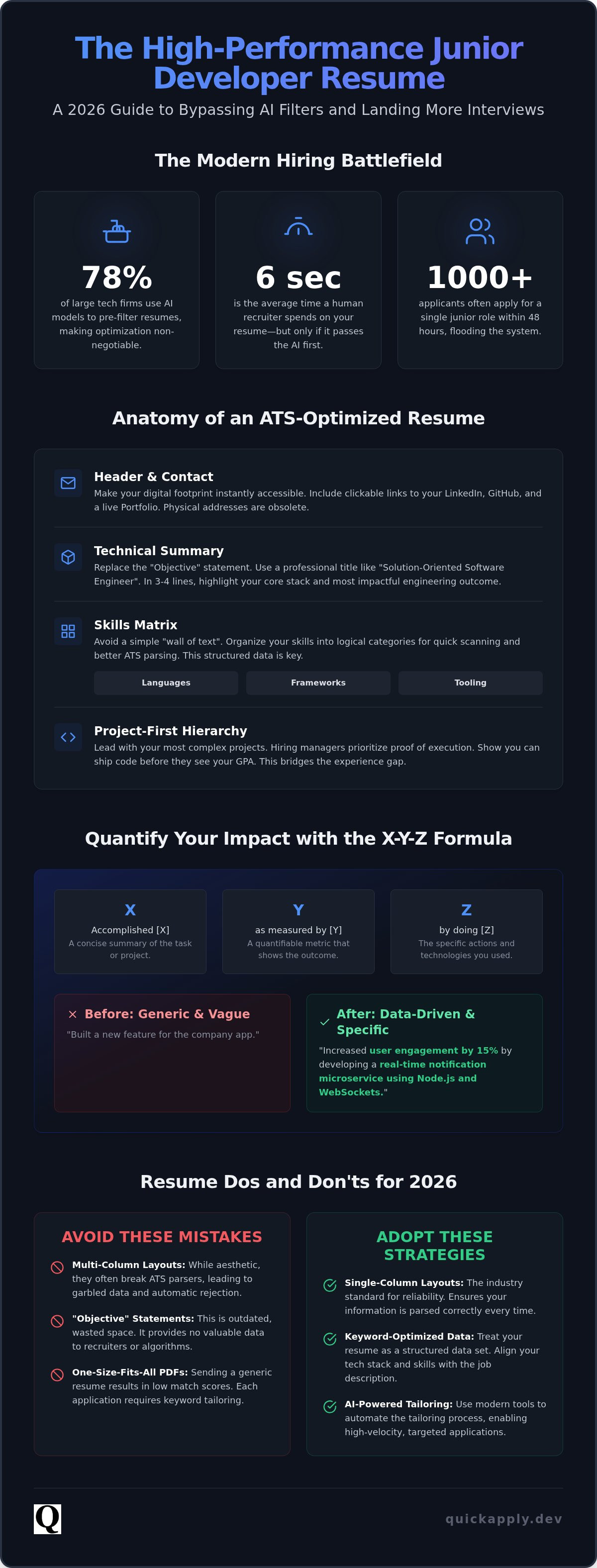
78% of large tech firms now use AI models to pre-filter resumes before a human ever sees them. In the 2026 market, your code isn't the only thing that needs to be optimized; your application does too. Recruiters spend an average of six seconds on their first glance, meaning if your layout isn't built for speed, you've already lost. It's exhausting to spend hours manual-tailoring every application only to be ghosted by an automated filter because you lacked a specific keyword. You have the technical talent, but the experience paradox and outdated templates are keeping your inbox empty while entry-level salaries for developers hit an average of $100,265.
You need a system that works as hard as your scripts do. We're going to master the anatomy of a high-conversion junior developer resume and show you how to automate your application strategy for the current tech landscape. This guide provides proven entry-level software developer resume examples that bypass the digital gatekeepers and land you more interviews in less time. We'll break down the shift toward skills-based hiring, the importance of single-column layouts, and the exact steps to turn your personal projects into professional-grade proof points. Stop guessing and start deploying a resume that actually converts.
Key Takeaways
- Learn how to structure your document using top-tier entry-level software developer resume examples that prioritize single-column layouts and ATS-friendly formatting.
- Master the X-Y-Z formula to transform generic project tasks into high-impact engineering outcomes that quantify your technical value.
- Bridge the experience gap by strategically positioning open-source contributions and freelance projects as professional-grade technical experience.
- Shift from manual applications to high-velocity automation by leveraging AI-powered tools for instant resume tailoring and systemic tracking.
- Secure a competitive edge in a crowded 2026 market by treating your resume as a keyword-optimized data set rather than a static PDF.
The 2026 Entry-Level Developer Resume Landscape
Entry-level software development is no longer about who has the most prestigious degree. It's about who survives the first 48 hours. In the current market, popular junior roles frequently attract 1000+ applicants in two days. This volume makes manual human review impossible for the initial phase. Companies have pivoted, treating The Anatomy of a High-Performance Junior Resume as a structured data set rather than a creative document. If your strategy relies on sending a static PDF to dozens of companies, you're already behind the curve.
Recruiter dashboards now prioritize AI match scoring to manage the influx. These systems analyze your tech stack against the job description in milliseconds. A "one-size-fits-all" approach results in immediate rejection because it lacks the specific semantic density required for a high match score. You aren't just writing for a person; you're writing for an algorithm that values precision and technical relevance over flowery prose. Efficiency is the only way to stay visible.
The 6-Second Rule vs. The AI Filter
The classic eye-tracking study showed recruiters spend an average of six seconds on a resume. In 2026, the AI filter is the real gatekeeper you must satisfy first. Large tech firms use sophisticated models to stack-rank candidates based on specific skills before a human ever sees a name. Your layout matters less than how well your data maps to their required stack. The 2026 ATS landscape is an AI-driven ecosystem where semantic relevance and skill-based filtering determine visibility before a human ever enters the loop. High-performance entry-level software developer resume examples focus on this technical alignment to ensure they actually reach a human desk.
Why Traditional Templates Fail in 2026
Traditional templates are a liability in a high-volume market. The "Objective" statement is dead. It's wasted space that offers zero useful data to a recruiter or an automated system. Replace it with a punchy Technical Summary that lists your core stack and engineering outcomes immediately. Multi-column layouts are another common failure point. While they might look aesthetic to the eye, they often break modern parsing algorithms, leading to garbled data in the recruiter's database. This technical friction can lead to an automatic "no" before your skills are even evaluated.
Stick to single-column, reverse-chronological formats. They are the industry standard for reliability and ensure your information remains intact during the parsing process. For visual reference on what works in the current market, check out these good resume examples designed for the AI-ready landscape. Efficiency wins every time. Don't let a bad template hide your good code.
Decoding the Anatomy of a High-Performance Junior Resume
Your resume is a technical specification for your career. It needs to be clean, functional, and optimized for rapid data extraction. Start with a header that acts as a functional API endpoint. Include your LinkedIn, a clickable GitHub profile, and a live portfolio link. Physical addresses are obsolete; your digital footprint is the only location that matters in a global market. Recruiters need to see your code with one click, not search for it.
Adopt a project-first hierarchy. In 2026, hiring managers prioritize proof of execution over academic credentials. By leading with your most complex builds, you provide immediate evidence of your technical capabilities. This approach separates high-performing entry-level software developer resume examples from generic applications that bury their best work under graduation dates. Show them you can ship code before they even see your GPA.
Crafting a Results-Driven Technical Summary
Stop calling yourself an "aspiring" developer. It signals a lack of professional confidence. Use professional titles like "Solution-Oriented Software Engineer" or "Full-Stack Developer." Your summary should be three to four punchy lines that highlight your primary stack and your most significant engineering outcome. If you built a microservice that handled 5,000 concurrent requests, mention it in the first 50 words. This triggers the ATS "Match" signals that recruiters use to filter the top 5% of candidates from the noise.
The Skills Section: Beyond Keyword Stuffing
A wall of text is a parsing nightmare for modern systems. Organize your skills into a logical matrix: Languages, Frameworks, and Tooling. This structure allows recruiters to scan your stack in seconds. Don't ignore "soft" technical skills like Git version control, Agile methodology, and CI/CD pipelines. These indicate you're ready to contribute to a professional codebase on day one. To maximize your impact, use AI resume tailoring to reorder these skills based on the specific requirements of each job description. Matching the employer's priority list is the fastest way to the top of the stack.
Manually reconfiguring these sections for every application is a massive time sink that kills your momentum. Smart developers use automated resume tailoring to ensure every version of their document is perfectly aligned with the target role's technical requirements without wasting hours on manual edits.
Examples of ATS-Optimized Sections for 2026
High-velocity hiring demands high-impact documentation. If your bullets read like a list of chores, you won't survive the first scan. Effective entry-level software developer resume examples shift the focus from what you did to what you achieved. You need to prove that your code solves problems, even if those problems were solved in a classroom or a small-scale freelance gig. Passive language is a rejection magnet; precision is your only defense.
Experience Bullets: Task vs. Impact
Replace generic tasks with engineering outcomes. Using strong action verbs is mandatory for bypassing semantic filters. Words like Architected, Engineered, Optimized, or Deployed carry significantly more weight than "Helped" or "Assisted." These choices signal that you took ownership of the technical outcome. Modern recruiters also look for evidence of your workflow efficiency, so mentioning your use of AI tools is now a standard requirement for competitive candidates.
| Task-Based (Weak) | Impact-Based (Strong) |
|---|---|
| Wrote code for a website. | Architected a responsive React dashboard that improved data visualization speed by 15%. |
| Used AI to help write tests. | Leveraged GitHub Copilot to accelerate unit testing coverage by 20% across three microservices. |
| Worked on a group project. | Engineered a real-time chat interface using Socket.io and Node.js for a team of four developers. |
Studying high-performing entry-level software developer resume examples shows that the "X-Y-Z" formula is your best tool for quantifying results without a corporate background: Accomplished [X] as measured by [Y], by doing [Z]. For example, "Optimized database queries [X] reducing latency by 30% [Y] through the implementation of Redis caching [Z]." This specific structure provides the concrete data points that AI filters and human reviewers crave during their six-second scan.
Project Descriptions that Sell
Every project in your portfolio should follow the Problem-Solution-Stack format. Start with the specific challenge you faced, explain your engineering solution, and list the modern tech stack used, such as React, Node, or AWS. This provides context for your technical decisions and shows you understand the "why" behind the code. Don't hide your collaborative work; university group projects should be framed as "Team Engineering Environments" to demonstrate your readiness for professional agile sprints.
Every project description must include a "Live Demo" link. Recruiters don't have the time to clone your repository and build it locally just to see if it works. A live URL allows for instant verification of your UI/UX skills and functional logic. It's the difference between a theoretical claim and a verified engineering achievement that moves you to the next round.
The Entry-Level Experience Paradox: How to Fill the Gaps
The 2026 job market presents a systemic glitch: entry-level roles requiring two years of professional experience. It's a contradiction that stalls many careers, but savvy developers bypass this hurdle by reframing their technical history. Stop apologizing for your lack of a corporate title. High-performance entry-level software developer resume examples succeed because they treat code as currency, regardless of who signed the paycheck. If you've shipped functional code, you have experience. The goal is to present it with the same authority as a senior engineer.
Treating Projects as Work History
Stop listing your projects in a separate, secondary section. If you built a functional application that solves a specific user problem, it belongs in your experience section. This shift signals to the ATS that you have a track record of deployment. Avoid generic Netflix or Spotify clones; recruiters in 2026 want to see unique problem-solving. Follow these three steps to reframe your builds:
- Step 1: Identify a real-world problem. Solve a niche issue, such as a local inventory tracker or a custom API for a specific dataset. This proves you can identify technical needs.
- Step 2: Document the architecture. Detail the technical hurdles you cleared. Focus on how you handled state management, database normalization, or cloud deployment.
- Step 3: Format it as a job entry. Use a title like "Independent Software Engineer" or "Project Lead." List your impact bullets exactly as you would for a traditional employer.
Leveraging Open Source and Contributions
Open source contributions are the ultimate proof of work. When you submit a pull request to a major repository, you're proving you can navigate a professional codebase and pass a peer review. List these as valid engineering experience. Mention the specific repository, the nature of your contribution, and the technology involved. Don't overlook technical documentation as a skill. It proves you can communicate complex logic to other engineers, a trait highly valued in remote-first environments.
Success requires a broad strategy that goes beyond the document itself. You need to understand mastering the job application process to ensure your reframed experience reaches the right eyes. Hackathons and academic capstone projects should follow this same logic. Treat them as engineering case studies rather than school assignments. Place them prominently if they represent your most technically advanced work to date.
Filling these gaps and tailoring your history for every job is a slow process that limits your reach. Use the QuickApply application tracker to manage your high-volume outreach and track which reframed projects are generating the most interview requests.
Automating the Application Loop with QuickApply
Applying to 50 jobs manually is legacy behavior. It's slow, prone to error, and ultimately a losing strategy in a market where 1,000 applicants compete for a single junior role within 48 hours. You can't win a high-velocity game with manual processes. Efficiency in 2026 means treating your job search like a deployment pipeline. You must automate repetitive tasks so you can focus on the interviews that actually matter. Technical talent is only half the battle; the other half is systemic execution.
QuickApply provides the technical infrastructure for this automation. Instead of spending hours tweaking bullet points, you can leverage AI to align your experience with job requirements instantly. This isn't just about speed; it's about precision. By analyzing high-performance entry-level software developer resume examples, the system identifies the exact semantic gaps in your draft and bridges them in seconds. You stop guessing what the recruiter wants and start delivering exactly what the algorithm prioritizes.
Tailoring at Scale
The Match Score is your most valuable filter. It allows you to prioritize applications where your current stack has the highest probability of success. QuickApply’s AI scans job descriptions to identify missing technical keywords and required frameworks you might have overlooked. Within 30 seconds, you have a tailored version of your resume that speaks the employer's specific language. This process extends to your supporting documents as well. The platform generates custom, context-aware cover letters that reflect your technical voice without sounding like a generic bot. Start tailoring your resume with AI precision to stop wasting time on manual edits.
Managing the Pipeline
A high-volume strategy is useless without data. Tracking your "Applied vs. Interview" ratio is your most important metric. If your conversion rate is low, your resume needs better optimization. If your volume is low, your pipeline is stalled. QuickApply’s built-in Application Tracker allows you to manage interview stages across LinkedIn, Indeed, and direct company portals from a single source of truth. This eliminates the friction of jumping between tabs and keeps your outreach consistent.
Staying organized prevents missed opportunities and keeps your momentum high. Seeing your progress visualized in a centralized dashboard provides a psychological boost that manual spreadsheets can't match. It transforms a chaotic job hunt into a managed engineering project. You aren't just applying to jobs; you're optimizing a conversion funnel. High-quality entry-level software developer resume examples only get you so far; consistent, tracked execution is what actually lands the offer.
Deploy Your Career at Scale
The 2026 tech market doesn't reward manual effort; it rewards systemic efficiency. You've seen how top-tier entry-level software developer resume examples leverage single-column layouts and impact-driven metrics to bypass AI filters. Success now requires more than just clean code. It requires a high-velocity application strategy that matches the speed of modern recruiting. By reframing your projects as professional experience and quantifying your engineering outcomes, you position yourself as a day-one contributor.
Stop wasting hours on tedious manual edits. Stop manual editing and start tailoring your resume with QuickApply to leverage an AI-powered Match Score and an integrated application tracker. Our platform allows you to tailor resumes in seconds; ensuring every submission is optimized for the specific role. You have the talent to build the future. Now use the right tools to ensure you're part of it. Your first six-figure engineering role is a matter of optimization, not luck.
Frequently Asked Questions
Do I need a summary on an entry-level software developer resume?
Yes, you need a Technical Summary to anchor your document. Replace the outdated "Objective" with 3-4 lines that define your primary tech stack and your most significant engineering achievement. This section serves as a metadata layer for both recruiters and AI filters. High-performance entry-level software developer resume examples use this space to trigger immediate match signals. It’s about establishing your professional identity as a solution-oriented engineer before they even see your education.
Should I include my GPA on my resume in 2026?
Omit your GPA unless it is 3.5 or higher. In the 2026 market, hiring teams prioritize skills and verified project outcomes over academic metrics. If you have significant open-source contributions or freelance work, use the space to detail those instead. A high GPA is a secondary proof point that doesn't carry the same weight as a deployed application. Focus on what you can build, not how well you tested in a classroom.
How long should a junior developer resume be?
Keep your resume to exactly one page. Efficiency is the standard in the tech industry; a multi-page document for a junior role signals a lack of prioritization. Use a clean, single-column layout to ensure every line of code and every project bullet delivers maximum impact. If your content exceeds one page, audit your bullet points for fluff. Every word must earn its place by proving technical competence or project success.
Can I use AI to write my resume bullets?
You should use AI to optimize your resume bullets. Manual tailoring is too slow for the 2026 application volume crisis. Tools like QuickApply allow you to generate precise, keyword-optimized descriptions that align with specific job requirements in seconds. The key is ensuring your AI-generated content reflects your actual technical contributions. Don't just use generic AI; use a system built for tech professionals that understands engineering context and outcomes.
What technical skills are most in-demand for entry-level roles in 2026?
Hiring teams currently prioritize a mix of foundational languages and specialized modern infrastructure. You must demonstrate proficiency in these core areas to pass automated filters:
- Languages: Python, JavaScript, Java, and Rust.
- Cloud: AWS and Azure deployment.
- AI: Experience with LLM APIs and agentic workflows.
- DevOps: Git version control and Docker containerization.
Focusing on these specific technologies ensures your profile aligns with the skills-first filtering used by over 60% of enterprise recruiters.
How do I handle the "years of experience" requirement as a new grad?
Treat your most advanced projects as professional history to bypass the experience paradox. If you built a functional tool or contributed to a major open-source repository, format it as a job entry. Use titles like "Independent Developer" or "Project Lead" to show you've managed a full development lifecycle. Recruiters want to see that you can ship code in a professional environment, regardless of whether you were a full-time employee or a student.
Is a PDF or Word document better for ATS compatibility?
Use a text-based PDF for maximum reliability across different Applicant Tracking Systems. Research shows 53% of recruiters prefer PDFs, while 43% favor .docx files. Avoid "flattened" PDFs or image-based files that AI scanners can't read. Reviewing entry-level software developer resume examples shows that a text-searchable, single-column PDF ensures your data maps correctly to the recruiter’s dashboard. This technical choice prevents your application from being discarded due to parsing errors.
Should I include non-tech jobs (like retail or service) on my resume?
Include non-tech jobs only if you can bridge the gap to engineering soft skills. A retail role that involved team leadership or process optimization can prove you're ready for an Agile environment. However, these should never take precedence over technical projects. If you have enough engineering proof points to fill a page, omit the service industry roles. Prioritize the content that directly correlates with the specific tech stack listed in the job description.


