

Spending three hours manually tweaking a single resume is a legacy process that's costing you the job. In the 2026 tech market, failing to use a high-performance ai resume tailoring tool means you're essentially invisible to recruiters. It's exhausting to pour your expertise into an application only to receive an automated rejection minutes later. Managing dozens of resume versions in local folders while guessing which keywords might satisfy an algorithm is a productivity drain you can't afford.
You deserve a system that works as hard as your code. This guide reveals how to align your profile with specific job descriptions in seconds, ensuring your technical expertise actually reaches a human desk. By focusing on high-impact match scores, you can bypass digital gatekeepers and secure more interview invites with a fraction of the manual effort. We'll explore how to move beyond basic keyword stuffing and build an automated, organized workflow that turns your job search into a precision-engineered career engine.
Key Takeaways
- Stop chasing keywords and use semantic alignment to satisfy modern NLP-based recruiting systems.
- Deploy a specialized ai resume tailoring tool to contextually re-weight your technical experience in seconds.
- Prioritize platforms that understand coding frameworks and languages to ensure your match score hits the recruiter's threshold.
- Automate your entire pipeline by integrating cover letter generation and application tracking into a unified career engine.
The Evolution of Job Applications: Why Generic Resumes Fail in 2026
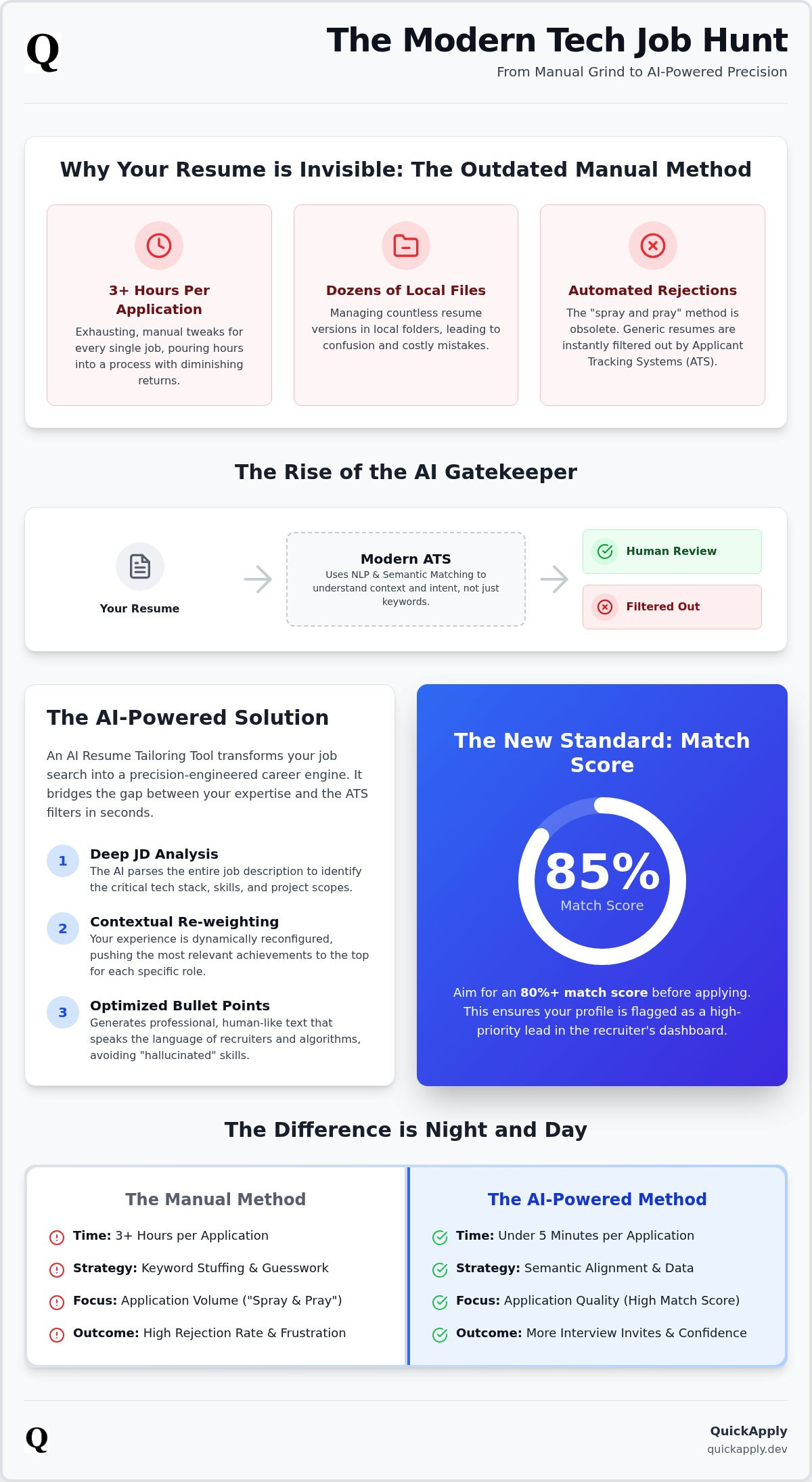
The "spray and pray" method is dead. In 2026, sending a generic resume to fifty different job postings is a guaranteed path to the rejection pile. Modern recruiting has evolved into a high-speed data matching game where volume is the enemy of results. Recruiters no longer scan for simple keyword counts; they deploy sophisticated algorithms to find semantic alignment. Your resume is no longer just a document for human eyes. It is a machine-parseable data set that must satisfy an AI gatekeeper before a human ever sees it. Relying on a single version of your resume creates a massive statistical disadvantage. You are essentially bringing a knife to a drone fight.
The Rise of AI-First Recruiting
Most companies now rely on an advanced Applicant Tracking System (ATS) to filter the noise. These systems don't just look for "Java" or "AWS" anymore. They analyze how your tech stack experience integrates with the specific architectural needs of the role. Generic AI builders often fail here because they produce "hallucinated" skills or awkward phrasing that triggers red flags. Even a "perfect" resume gets rejected if it doesn't mirror the specific technical nuances of the job description. To win, you must optimize for the machine first. This requires an ai resume tailoring tool that understands the difference between a list of buzzwords and a coherent technical narrative.
Semantic Matching vs. Keyword Stuffing
Recruiting bots in 2026 look for context and intent, not just tags. Semantic matching allows an ATS to understand that "scaling microservices" implies experience with high-availability systems, even if those exact words aren't in your bullet points. If your resume lacks this contextual depth, you'll fail the match score threshold. Keyword stuffing is an obsolete tactic that modern NLP (Natural Language Processing) easily detects and penalizes. You need a dynamic career data model that can be reconfigured instantly for every application. Success depends on moving past static PDFs and embracing a system that contextually aligns your experience with the recruiter's specific intent. Using a dedicated ai resume tailoring tool ensures your bullet points are re-weighted to highlight the exact expertise a specific team is hunting for.
What is an AI Resume Tailoring Tool? Bridging the Talent-ATS Gap
An ai resume tailoring tool is a sophisticated system for semantic career alignment that bridges the gap between your raw skills and the digital filters of modern tech firms. It doesn't just replace words; it contextually reconfigures your professional history to meet the specific intent of a job description. By utilizing advanced LLMs like GPT-4o, these tools generate professional, human-like bullet points that highlight your expertise without the mechanical feel of older software. This technology transforms your static resume into a dynamic asset that speaks the language of recruiters and algorithms alike.
The Core Mechanics of AI Tailoring
The process starts with a deep parse of the job description. The AI identifies the specific tech stack, leadership requirements, and project scopes hidden within the text. It separates "Must-Have" skills from "Nice-to-Have" extras to ensure your profile hits the most critical marks first. Once the intent is extracted, the tool re-weights your experience. If a role demands "high-scale infrastructure," your work with AWS and load balancing moves to the top of your bullet points. It's a surgical approach to Optimizing Your Resume for ATS, ensuring your most relevant achievements are the first thing a recruiter sees. This level of precision is impossible to achieve manually at scale.
Why Match Scores are the New Standard
In the 2026 market, "Match Scores" have replaced the traditional gut feeling of applying. These scores provide a data-driven compatibility rating between your profile and the role. High-performance tools analyze your technical depth against the JD requirements to calculate a percentage. You should aim for an 80%+ match score before you ever hit the submit button. This ensures your application is flagged as a high-priority lead in the recruiter's dashboard. Using match scores to identify the best-fitting opportunities saves you from wasting hours on roles where you lack the core architectural experience. It's the ultimate filter for job search efficiency.
Stop managing 50 different resume versions in local folders. Switch to a dynamic system that treats your career data as a modular asset. You can start tailoring your tech resume today to see exactly how your skills stack up against the industry's top roles.
Evaluating AI Resume Tailors: Key Features for Tech Professionals
Choosing the right ai resume tailoring tool is an engineering decision. You aren't just looking for a text editor; you're selecting a technical ally that understands the nuances of your stack. In a market saturated with generic builders, tech professionals require a platform that recognizes the difference between a library and a framework. Precision beats volume every single time. While some competitors promise to auto-apply to millions of jobs, this "spray and pray" automation often results in low-quality matches and instant rejections. Your goal is a high-conversion pipeline, not just a high-volume one.
Tech-Specific Parsing Capabilities
A standard AI might see "Java" and "JavaScript" as related terms. For a backend developer, that's a catastrophic error. Your tool must have the technical literacy to distinguish between these languages, as well as niche certifications and complex cloud architecture experience. High-performance tailoring involves more than just swapping words. It requires tailoring your resume to a job description with AI in a way that emphasizes your specific contributions to engineering projects. If the tool can't parse your Kubernetes clusters or your experience with distributed systems, it isn't fit for a tech career.
Workflow Integration: Tracker & Tracker Tools
Efficiency isn't just about the resume; it's about the entire lifecycle of the application. You need an automated system to manage your pipeline and keep your sanity intact. Managing 50 versions of a PDF in a local folder is a relic of the past. A modern ai resume tailoring tool should include an integrated application tracker that syncs every resume version with its specific job ID. This ensures you always know which version of your profile a recruiter is looking at when they call. A centralized dashboard allows you to move from a high match score to interview practice without losing momentum. This level of organization turns a chaotic job search into a streamlined career engine.
Look for these essential features when evaluating your options:
- Match Scores: Real-time feedback on your compatibility with a role.
- Integrated Cover Letter Generation: Contextual letters that match your tailored resume.
- Interview Prep Tools: Practice modules based on the specific job description you just targeted.
- Application Tracker: A single source of truth for your entire search history.
The 5-Minute Tailoring Workflow: Maximizing Your Application Volume
Efficiency is the difference between a job offer and a full inbox of rejections. You don't need another resume builder; you need a high-velocity ai resume tailoring tool to handle the heavy lifting. In 2026, the goal is to submit high-quality applications at scale without burning out. This workflow eliminates the manual grind and replaces it with a streamlined, five-step process designed for the modern tech market.
- Step 1: Upload your master resume. This serves as the single source of truth for your entire career history.
- Step 2: Paste the Job Description URL. The AI analyzes the intent and technical requirements instantly.
- Step 3: Review the Match Score. Look at the suggested tweaks to see where your profile needs more architectural depth.
- Step 4: Generate a matching cover letter. Ensure your narrative aligns perfectly with the tailored resume.
- Step 5: Track the application. Log the submission in your dashboard and set automated follow-up reminders.
Optimizing the Master Resume
Your master resume is the raw data set the AI uses to build your tailored versions. To maximize flexibility, structure your data with precision. Use the STAR method (Situation, Task, Action, Result) for your bullet points. This provides the AI with the context it needs to rephrase your experience for different roles. Before you start, review these good resume examples for 2026 to ensure your baseline meets current technical standards. A clean, machine-ready structure allows the algorithm to extract your expertise without friction or "hallucinations."
Iterating for Perfection
AI handles the alignment, but you provide the final verification. Always review the suggested tweaks before exporting. If your match score is below 80%, you may need to add more detail to your master profile. Learn how to tailor your resume to a job description without sacrificing your unique professional voice. The goal is semantic alignment, not a complete rewrite. Once the resume is locked, generate a matching cover letter. This ensures your entire application package speaks with a consistent, results-driven tone that resonates with both recruiters and hiring managers.
Stop wasting hours on a single application. Start your first tailored application in under five minutes and see your match score climb.
Beyond the Resume: QuickApply’s Integrated Career Automation
Landing the interview is only half the battle. Your ai resume tailoring tool got you past the ATS, but now you need to convince a human panel. QuickApply doesn't stop at the PDF. It functions as a full-stack career engine designed to manage your professional trajectory from application to promotion. This integrated approach ensures that the narrative built during the tailoring phase carries through to your live performance. You've already optimized your data for the machine; now it's time to optimize your delivery for the team. Efficiency in the job search means nothing if you can't close the deal in the final round.
Mastering the Interview with AI
QuickApply’s interview practice tools bridge the gap between a high match score and a signed offer. The system uses your tailored resume data to simulate technical and behavioral panels specific to the role. It generates custom questions based on the exact skills emphasized in your application. If the role focuses on distributed systems, your practice session will reflect that architectural depth. For those seeking real-time support during the call, consider Final Round AI as a real-time copilot alternative. This level of preparation turns a high-pressure conversation into a controlled execution of your career strategy. You can iterate on your responses until your delivery matches the technical authority of your profile.
Securing the Win: Negotiation and Promotions
The work continues after the verbal offer. Your value is at its highest during the final stages of the hiring process. QuickApply provides a salary negotiation guide tailored to current 2026 tech benchmarks. This data-driven resource empowers you to maximize your total compensation without the guesswork. You shouldn't leave money on the table because you lacked market data. Once you land the role, use the platform to build a promotion roadmap. This long-term planning tool helps you track achievements and align your daily output with the requirements for your next career level. It's about continuous productivity and systemic growth. You aren't just looking for a job; you're building a sustainable career infrastructure that evolves with the market.
Start tailoring your tech resume for free with QuickApply and take control of your entire career pipeline today. Stop guessing and start executing with a tool built for the modern tech professional.
Master the 2026 Tech Market
The 2026 tech landscape requires a shift from manual effort to strategic automation. You've learned that semantic alignment beats keyword stuffing and that a high match score is your primary ticket to a recruiter's desk. Managing your career search shouldn't be a second full-time job. By integrating a high-performance ai resume tailoring tool into your workflow, you eliminate the friction of manual customization and replace it with precision-engineered results. You can now tailor resumes in seconds with GPT-powered precision while managing your entire pipeline through an integrated application tracker and interview practice suite.
QuickApply is built specifically for tech professionals and students who value their time and expect their tools to do the same. This ecosystem provides the technical depth required to distinguish your cloud architecture experience or specific coding frameworks from the noise. It's time to stop fighting the algorithm and start leveraging it to your advantage. Focus your energy on the interview while our system handles the alignment.
Stop Building, Start Tailoring with QuickApply
Your expertise is ready for the next level. Use the technology designed to get you there and secure the interviews you deserve.
Frequently Asked Questions
Is using an AI resume tailoring tool considered cheating?
Using an ai resume tailoring tool is not cheating; it's a strategic optimization of your professional data. Recruiters prioritize finding the best technical fit, and these tools ensure your expertise is presented in a language their systems understand. You are responsible for the accuracy of the content. The AI simply handles the semantic alignment that manually takes hours to perfect. It's a competitive advantage for those who value efficiency.
Can ATS detect AI-written resumes in 2026?
Modern ATS platforms prioritize semantic intent and technical relevance over authorship detection. In 2026, high-performance AI generates professional, human-like descriptions that are indistinguishable from manual writing. The risk isn't detection; it's poor quality. Using a sophisticated tool ensures your bullet points remain technically accurate and contextually relevant. Focus on the match score rather than worrying about algorithmic detection, as recruiters only care about your ability to solve their problems.
How much time does it actually save per application?
AI tailoring reduces the time spent on a single application from several hours to under thirty seconds. Manual customization involves tedious keyword research and bullet point rephrasing that drains your productivity. An automated system handles these tasks instantly, allowing you to increase your application volume without sacrificing quality. This speed enables you to apply to fifty roles with the same precision that once required a full week of manual labor.
Do I need a different resume for every single job I apply to?
Yes, a generic resume is a statistical liability in the 2026 tech market. Sending the same document to every role results in a low match score and instant rejection by automated filters. Every job description has unique technical nuances and architectural requirements. You need to re-weight your experience for every submission to ensure your most relevant projects are highlighted. Tailoring is no longer optional; it's the standard for serious candidates.
How does a match score help me prioritize my job search?
The match score serves as your primary metric for job search efficiency. It identifies which roles are worth your time by calculating your compatibility with the job description. High-tier candidates prioritize roles where they hit an 80% match score or higher. This data-driven approach prevents you from wasting energy on low-probability leads. By focusing on high-scoring opportunities, you increase your interview conversion rate while reducing total manual effort.
What is the difference between an AI resume builder and a tailor?
An AI resume builder creates a document from scratch using basic templates. An ai resume tailoring tool contextually aligns your existing career data with a specific job description. Builders focus on visual structure, while tailors focus on semantic relevance and technical weighting. For tech professionals who already have a master resume, the tailoring tool is the more powerful asset. It transforms your static history into a dynamic, role-specific marketing engine.
Does QuickApply support software engineering and data science roles specifically?
QuickApply is engineered specifically for software engineering, data science, and specialized tech roles. The platform understands the technical distinctions between different frameworks, languages, and cloud architectures. Whether you are a backend developer or a machine learning engineer, the system recognizes your stack and aligns it with the recruiter's specific intent. This niche focus ensures your technical expertise is never lost in translation or generalized by a generic algorithm.
Can I track my applications across LinkedIn, Indeed, and company sites in one place?
Yes, QuickApply includes an integrated application tracker that serves as the single source of truth for your entire pipeline. You can log applications from LinkedIn, Indeed, and direct company portals in one centralized dashboard. This system keeps your resume versions synced with specific job IDs and sets automated follow-up reminders. Consolidating your search into one platform eliminates the chaos of managing local folders and disorganized spreadsheets.


