
With over 140,000 software engineering job postings active but a 7.0% unemployment rate for computer science graduates, your manual application process is a liability. You've likely spent hours drafting personalized messages only to face silence or immediate ATS rejection. It's time to stop treating every application like a creative writing project. Using an ai cover letter for software engineer allows you to shift from manual labor to high-speed optimization. This isn't just about saving time. It's about winning a statistical game where the odds are currently stacked against generalists.
You're tired of translating complex technical skills into recruiter-speak while dodging automated filters. We'll show you how to master technical application automation to generate high-converting cover letters in seconds. You'll learn the exact strategy to submit 10+ high-quality applications daily and significantly increase your interview invite rates. We'll break down the latest 2026 trends and show you how to align your resume content perfectly with every job description to ensure you stay ahead of the curve.
Key Takeaways
- Stop wasting time on manual outreach; learn why generic letters are immediate disqualifiers in the 2026 AI-filtered hiring market.
- Master the "Technical Hook" and "Evidence Bridge" to align your profile mathematically with specific job descriptions.
- Deploy an ai cover letter for software engineer tool to bypass prompt engineering fatigue and secure superior data privacy.
- Build a high-volume pipeline that identifies latent keywords and hidden technical requirements through automated JD analysis.
- Transition seamlessly from application to offer by using your tailored output to drive focused technical interview preparation.
Why Generic Cover Letters are Obsolete in the 2026 Tech Market
The 2026 tech hiring landscape is a high-volume, AI-filtered battlefield. In January 2026 alone, there were over 140,000 job postings for software engineers in the United States. With computer science graduate unemployment sitting at 7.0%, the market is hyper-competitive and unforgiving. One-size-fits-all letters are immediate disqualifiers. Technical recruiters don't want to hear about your "passion" for coding in a vacuum. They want to see specific stack synergy between your documents and their requirements. An ai cover letter for software engineer roles isn't just a convenience; it's a survival tool for the modern developer. While the history of the cover letter suggests it was once a polite, hand-written introduction, today's version is a data-driven alignment document designed for machine readability.
The 'Black Hole' of Manual Applications
Manual writing is a bottleneck that kills your career momentum. If you're still drafting every letter from scratch, you're likely limiting your reach to two or three applications per week. This approach fails the math of modern hiring. You can't win a volume game with manual labor. Spending hours on rejected manual drafts takes a massive psychological toll that leads to burnout before you even land an interview. To stay competitive, you must adopt a tailor resume to job description approach that scales. Automation allows you to submit dozens of high-quality, targeted applications without sacrificing your mental health or your weekends. Efficiency is your only path to an offer letter.
Recruiter Expectations for Software Engineers
Tech leads and hiring managers have zero patience for fluff. They look for evidence of specific project impact and immediate technical utility. If the job description mentions Python or machine learning, those terms must appear in your cover letter within the first two sentences. Highlighting your specific technical stack synergy immediately is non-negotiable. Recruiters use automated tools to scan for these links before a human ever sees your name. Technical Alignment is the mathematical synchronization of your professional history with a specific job's technical requirements. In 2026, your ai cover letter for software engineer positions must act as a bridge between your GitHub repository and the company's tech stack. If the data doesn't match, you don't exist in their system. Stop writing stories and start building technical bridges.
The Anatomy of a High-Converting AI Cover Letter
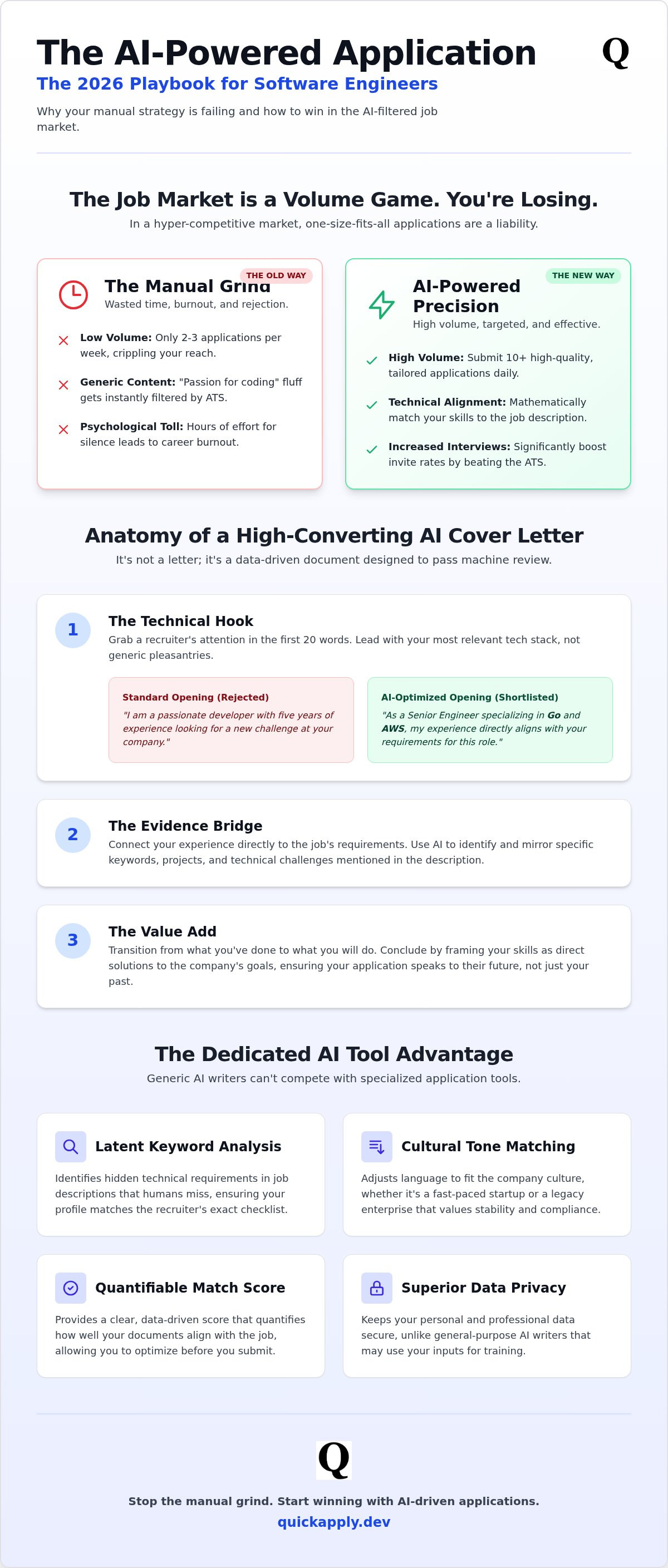
A high-converting ai cover letter for software engineer isn't a traditional letter. It's a structured data packet designed for high-speed technical review. While some experts argue that AI is making cover letters obsolete, the reality is that it's transforming them into high-precision alignment tools. To win in 2026, you need three core components: The Technical Hook, The Evidence Bridge, and The Value Add. Humans often miss latent keywords buried in job descriptions. AI identifies these hidden patterns instantly to ensure your profile matches the recruiter's specific checklist. This approach shifts the focus from creative writing to mathematical alignment.
Engineering culture varies wildly between a fast-paced startup and a legacy enterprise. A startup prioritizes "zero-to-one" builds and rapid deployment. An enterprise values scalability, security, and compliance. Your AI tool must adjust its output to match these distinct environments. The Match Score serves as your primary benchmark for quality. It quantifies how well your document mirrors the technical and cultural requirements of the job description. If your score is low, your application remains at the bottom of the automated stack. Using a match score allows you to iterate on your draft until it meets the high standards of modern technical recruiters.
The Technical Hook: Grabbing a Senior Dev's Attention
Your first 20 words dictate your success. Don't waste them on generic introductions. Lead with your most relevant stack using AI precision. If the role requires React, Go, and AWS, these terms must appear immediately. This directness signals competence to technical reviewers who value their time. Contrast these two openings:
- Standard Opening: "I am a passionate developer with five years of experience looking for a new challenge at your company."
- AI-Optimized Opening: "As a Senior Engineer specializing in Go and AWS, I recently scaled a React-based microservices architecture to support 100k concurrent users."
The optimized version provides immediate proof of utility. It answers the recruiter's most pressing question before they finish the first sentence.
The Evidence Bridge: Connecting Resume to JD
The Evidence Bridge synthesizes complex data from your portfolio to answer specific requirements. You shouldn't just list skills; you must prove them with quantifiable metrics. An ai cover letter generator can pull a "20% latency reduction" stat from your resume and map it directly to a performance-focused requirement. This creates a unified brand. Your cover letter and resume must speak the same language. If your resume is data-heavy but your letter is vague, you lose credibility. Consistency across all documents is critical for conversion. AI ensures that your tone remains professional and results-driven throughout the entire application package.
AI Writer vs. Dedicated Cover Letter Generator: Which Wins?
Using a general-purpose chatbot for your job search is like trying to debug a distributed system with a hammer. It's the wrong tool for a high-precision task. While MIT's guide to using AI for cover letters suggests these tools are useful for brainstorming, professional engineers need more than a generic text generator. An ai cover letter for software engineer generator must be purpose-built to handle the complexities of technical stacks and recruiter filters. Generic LLMs lack the deep integration required to sync your resume data with specific job requirements. They require endless prompt engineering that ultimately kills your productivity.
Dedicated career automation platforms solve the "hallucination" problem by using your actual career data as a source of truth. They offer integrated Match Scores that provide immediate feedback on your alignment. This isn't just about generating text; it's about deploying a strategic document that passes 2026 ATS authenticity checks. Manual prompting is a productivity killer that keeps you stuck in the "drafting" phase. You need a system that moves as fast as the market. Dedicated tools prioritize data privacy and security, ensuring your professional history isn't used to train public models without your consent.
The Problem with Generic ChatGPT Prompts
Generic prompts produce hallucinated results that recruiters spot instantly. If your AI claims you have five years of experience with a framework released last year, your credibility is gone. Maintaining document formatting with raw AI output is a manual nightmare. You'll spend more time fixing margins and font sizes than actually applying. Raw LLM outputs often fail 2026 ATS authenticity checks because they rely on predictable linguistic patterns. Recruiters now use detection tools to filter out low-effort, bot-generated fluff. You can't afford to look like another generic entry in a database of thousands.
The QuickApply Advantage: Built for Optimization
Specialized tools utilize RAG (Retrieval-Augmented Generation) to ensure every claim in your letter is backed by your actual project history. This technology eliminates the risk of technical hallucinations. You can combine the best ai resume builder 2025 features with automated letter generation to create a perfectly synchronized application set. Consider the math. You can spend 30 minutes engineering the perfect prompt for a single application, or you can spend 30 seconds on automated tailoring. When you're managing a high-volume search, that time difference is the margin between an interview and a rejection. Deploying a dedicated ai cover letter for software engineer ensures your application is optimized for speed and accuracy.
5 Steps to Automate Your Technical Application Workflow
Efficiency in a high-volume market requires a systemic approach. You can't just spray and pray. You need an automated pipeline that maintains quality while increasing output. Scaling your ai cover letter for software engineer production involves five distinct phases that mirror a standard development pipeline. This workflow ensures every document is optimized for both the algorithm and the human reviewer.
- Step 1: Centralize your core technical resume and project portfolio. Treat these documents as your source code repository. Having a single, verified data source prevents the AI from hallucinating details about your experience.
- Step 2: Scan the JD for hidden technical requirements. Use AI analysis to parse the job description. Recruiters often bury specific stack needs or preferred methodologies in the middle of dense paragraphs that humans frequently overlook.
- Step 3: Generate and fine-tune the tone. Move beyond a generic draft. Adjust the linguistic style to match the specific company culture, whether it's a legacy enterprise or a disruptive startup.
- Step 4: Sync with an automated tracker. Never lose track of a submission. Integrating your generation tool with a tracker ensures you know exactly when and where you applied.
- Step 5: Prioritize networking energy. Use the Match Score as your guide. If a role shows a 90% or higher alignment, that is where you should invest manual effort in LinkedIn outreach or referrals.
Fine-Tuning for Different Tech Cultures
A FAANG recruiter expects different signals than a CTO at a seed-stage startup. Large enterprises look for compliance, scale, and specific methodology expertise. Startups want to see "zero-to-one" impact and a bias for action. You must adjust your AI output to reflect these cultural nuances. Don't just list responsibilities. Prompt the engine for impact metrics like reduced latency or increased deployment frequency. Use these cover letter examples to establish a baseline for different company tiers. Precision here prevents your application from feeling like a generic bot-written draft.
Scaling to 50+ Applications a Week
Your job search is a funnel. To land one offer, you might need 10 interviews, which requires 50+ high-quality applications. Automation allows you to target Reach, Match, and Safety roles simultaneously without sacrificing quality. High Match Scores must be maintained across this massive volume to ensure you pass the initial ATS gate. Use an integrated application for job tracker to prevent duplicate submissions and manage follow-ups. This systematic approach turns a chaotic search into a manageable engineering project. You can automate your application workflow today to stop wasting time on manual data entry and start focusing on technical interviews.
Beyond the Draft: Closing the Loop with Career Automation
Generating a high-converting ai cover letter for software engineer roles is only the beginning of your technical lifecycle. The document serves as your initial handshake, but the interview is where you close the deal. Don't treat your automated application as a fire-and-forget task. Every claim made by the AI must be backed by your actual technical depth. If your letter highlights a specific microservices migration or a 20% latency reduction, be ready to defend those architectural decisions in real-time. Career automation isn't about faking skills. It's about surfacing your most relevant experience at the exact moment a recruiter needs to see it.
QuickApply isn't just a document builder. It's a long-term career management tool designed to move you through the entire hiring funnel. Once your tailored application secures the invite, you must shift your focus to execution. This includes everything from technical practice to the final salary negotiation. In a market where senior US engineer costs have surpassed $200,000, you cannot afford to leave your compensation to chance. Optimization should be a continuous process that extends from your first application to your final signature on the offer letter.
Prepping for the Technical Interview
Use your AI-generated letter as a blueprint for your interview preparation. The "Evidence Bridge" you built during the application phase contains the specific metrics and tech stacks the hiring team cares about most. Connect these letter claims to final round ai practice sessions to refine your verbal delivery. Real-time interview practice ensures you can articulate the "why" behind every technical decision mentioned in your tailored profile. Consistency between your written claims and your interview performance is what converts a high Match Score into a job offer.
Long-Term Career Growth and Promotion
Career automation tools help you build a promotion roadmap for the future. Once you've landed the role, continue using these systems to track your project impact and market value. This data becomes invaluable during performance reviews and future salary negotiations. Transition from a persistent job seeker to an in-demand technical specialist who understands their worth in a competitive landscape. You've mastered the art of the ai cover letter for software engineer positions. Now, apply that same optimization mindset to your entire professional trajectory. High-volume output with low-effort input is the only way to stay ahead of the curve in 2026.
Stop writing, start applying with QuickApply.
Dominate the 2026 Tech Job Market
The era of manual, one-size-fits-all applications is officially over. To secure a role in a hyper-competitive landscape, you must prioritize technical alignment over creative storytelling. Using an ai cover letter for software engineer ensures your profile is mathematically synchronized with recruiter expectations and ATS filters. You've learned that dedicated automation tools provide superior precision compared to generic chatbots; this allows you to bypass prompt engineering fatigue. By centralizing your project data and leveraging integrated match scores, you shift from being a passive applicant to a high-speed strategist.
Success in 2026 requires a system that moves as fast as the industry. QuickApply is tailored specifically for technical stacks, ensuring your expertise in React, Go, or AWS is always front and center. Our platform is 95% faster than manual writing and features an integrated application tracker to manage your high-volume pipeline. Stop fighting the algorithm and start using it to your advantage. Scale your job search with QuickApply’s AI Cover Letter Generator and take control of your professional future. Your next senior engineering role is just an automated workflow away.
Frequently Asked Questions
Will recruiters know if I used an AI cover letter generator?
Not if you use a high-quality tool that prioritizes technical alignment over generic fluff. Recruiters look for specific evidence of project impact and tech stack synergy. If your letter provides technical proof points rather than robotic cliches, it passes as professional outreach. Avoid generic LLM outputs that rely on predictable linguistic patterns. High-precision tools ensure your voice remains professional and data-driven.
How do I make an AI cover letter sound more like me?
Feed the generator your actual project history and specific metrics from your portfolio. The tool uses your career data as the source of truth, ensuring the output reflects your unique technical voice. You can adjust the tone settings for FAANG or startup environments to match your professional personality. Authentic personalization comes from the data you provide, not the manual sentences you write.
Does an AI cover letter help pass the ATS?
Yes, because it mathematically aligns your profile with the job description. An ai cover letter for software engineer roles identifies latent keywords that humans often miss. This synchronization ensures your documents move through the initial automated filters and reach a human reviewer. Alignment is the key to surviving the 2026 hiring algorithm.
Should I still include a cover letter if the job posting says it is optional?
Always include one to maximize your competitive advantage. "Optional" is a test of your interest and professionalism in a hyper-competitive market. Since automation reduces the effort to seconds, there's no logical reason to skip a step that can increase your interview invite rate. Every extra data point you provide is another chance to win.
How much technical detail should I include in an AI-generated letter?
Prioritize high-impact technical metrics and specific stack synergy. Mention the exact frameworks and languages required by the job description, such as Python or Machine Learning. Focus on your project results, like latency reduction or deployment frequency, rather than just listing responsibilities. Technical reviewers value data over narrative every time.
Can I use AI to tailor my cover letter for remote tech jobs?
Absolutely, and you should focus on remote-specific skills like asynchronous communication and distributed system management. The tool can emphasize your experience with tools like Slack, Jira, and GitHub in a remote environment. This tailoring signals that you're ready for the unique challenges of hybrid or remote work models. Remote roles are rarer in 2026, so precision is critical.
What is a good Match Score for a software engineering application?
Aim for a Match Score of 85% or higher before submitting. This benchmark ensures that your document has sufficient keyword density and technical alignment to pass current ATS filters. If your score is lower, use the tool to iterate on your draft until you hit the optimization target. Treat your Match Score like a deployment readiness check.
Is it better to use a free AI writer or a paid subscription for cover letters?
A dedicated career automation platform offers superior accuracy and privacy over generic free writers. Professional tools use RAG technology to prevent technical hallucinations and ensure your data isn't used to train public models. Investing in a specialized system saves hours of prompt engineering and produces higher-converting results. Quality output requires a tool built for the task.


