

Why are you still manually rewriting bullet points while an algorithm decides your career path? Stop treating your resume like a creative writing project. You have the talent, yet your applications vanish into the ATS black hole because they lack the specific keywords a machine is programmed to find. Learning how to quickly tailor resume for multiple jobs is no longer a luxury; it is a survival skill for the digital-first professional.
This is the 2026 efficiency playbook. You are about to learn how to use AI to align your profile with job descriptions in seconds. We are moving past manual edits and into the era of algorithmic optimization. Landing an interview is now a matter of technical alignment, not just effort. This guide previews the high-tech tools and streamlined workflows you need to generate high match scores and bypass filters. You will learn to automate the tedious parts of the hunt so you can focus on the interviews that matter. It is time to stop guessing and start winning with a system built for speed.
Key Takeaways
- Understand how modern ATS functions as a semantic search engine to bypass outdated keyword stuffing filters.
- Learn how to quickly tailor resume for multiple jobs using AI-driven Outcome-Based Rewriting for technical achievements.
- Identify the efficiency gap between generic chat interfaces and dedicated automation tools to eliminate prompt engineering.
- Implement a streamlined 4-step workflow using Match Scores to target high-probability opportunities instantly.
- Use centralized application tracking to manage high-volume pipelines and maintain persistent career data.
Why Your Generic Resume Fails the 2026 ATS Test
The 2026 job market is an algorithmic battlefield. Your static PDF isn't just a document anymore; it's a data set waiting to be parsed. Most candidates fail because they treat an Applicant Tracking System (ATS) like a simple filing cabinet. It isn't. Modern systems are sophisticated semantic search engines that analyze the relationship between your skills and the company’s specific business problems. A generic resume is a statistical liability. If you aren't optimizing for these neural networks, your application is effectively invisible.
Old-school keyword stuffing triggers immediate red flags in current systems. 2026 parsers recognize forced repetition and lack of context. They look for outcome alignment. Recruiters now use AI to rank you based on how your previous results match their specific project needs. This reality makes learning how to quickly tailor resume for multiple jobs a non-negotiable part of your professional workflow. You cannot win a high-tech game with low-tech tools.
The Evolution of Semantic Matching in Hiring
Modern hiring platforms understand the context behind your job titles. They know that a "Senior Developer" at a startup implies different responsibilities than the same title at a legacy bank. These systems look for conceptual relevance. If a job description emphasizes high-scale distributed systems, your resume must frame your tech stack around those specific outcomes. Simply listing Java or AWS isn't enough. You need to demonstrate the context of your expertise to satisfy the algorithm's semantic requirements.
The Cost of Manual Tailoring in a High-Volume Market
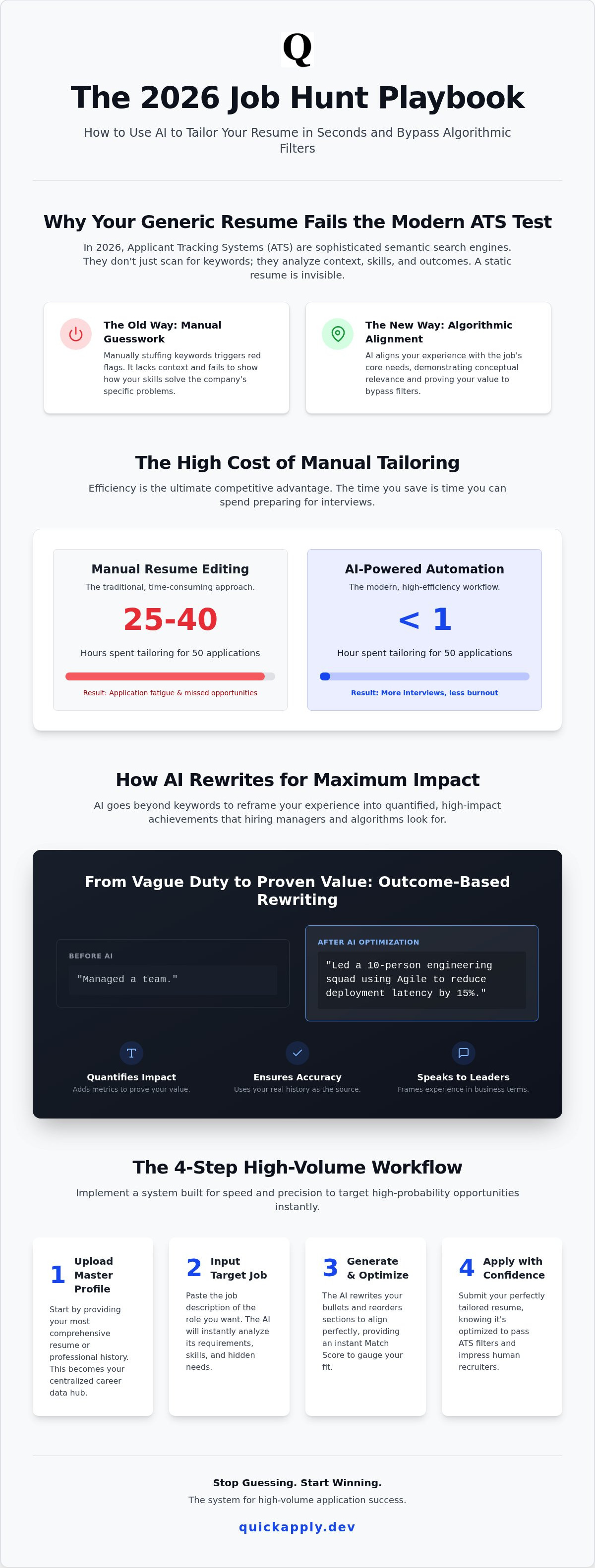
Efficiency is your only path to success in a crowded market. Consider the math. Manually editing a resume for 50 applications takes roughly 25 to 40 hours of focused labor. This manual grind leads to application fatigue, which degrades the quality of your submissions. You lose the psychological edge needed for interviews. In tech, speed is a competitive advantage. Early applicants often secure the first screening slots. Discovering how to quickly tailor resume for multiple jobs allows you to hit the market while the opportunity is fresh. You need a system that delivers high-volume output with low-effort input to stay ahead of the curve.
The Mechanics of AI Resume Tailoring: Beyond Keywords
AI resume tailoring is not a glorified find-and-replace function. It is a sophisticated extraction and alignment process. In 2026, the goal is to map your professional DNA directly onto a company's specific pain points. The software identifies hard skills, soft skills, and experience levels with surgical precision. It then restructures your data to ensure the most relevant information hits the recruiter's eyes first. This is how to quickly tailor resume for multiple jobs without losing the technical nuance that makes you a top-tier candidate.
Efficiency doesn't mean sacrificing your voice. The best systems use your actual history to build a bridge toward the new role. They reorder sections based on priority, moving a specific project to the top if it matches the target job's core requirements. You remain authentic, but your presentation becomes optimized for the digital gatekeepers. If you want to see this in action, you can automate your resume tailoring to ensure every application is a perfect algorithmic match.
NLP and Skill Extraction: How the AI Thinks
Natural Language Processing (NLP) allows the AI to read between the lines. It doesn't just look for the word "React." It understands that expertise in Next.js or Remix implies a deep understanding of the React ecosystem. The AI identifies conceptual relevance and "hidden" keywords. These are the terms recruiters search for in their internal databases but often forget to list in the public job post. By identifying these clusters, the AI positions you as the candidate who naturally fits the team's existing tech stack.
Rewriting Bullets for Maximum Impact
Outcome-Based Rewriting is where the real conversion happens. A standard bullet point like "Managed a team" is too vague for a 2026 high-growth environment. The AI transforms this into "Led a 10-person engineering squad using Agile to reduce deployment latency by 15%." This shift does three things instantly:
- It quantifies your impact using metrics derived from your existing data.
- It proves technical accuracy by keeping your real experience at the center.
- It speaks the language of leadership that hiring managers demand.
The system suggests these metrics based on industry benchmarks and your specific role history. It ensures you aren't just listing duties, but proving value. This level of detail is how to quickly tailor resume for multiple jobs while maintaining a 90% or higher match score across diverse job portals. You get the speed of automation with the precision of a professional editor.
Dedicated AI Tools vs. ChatGPT: The Efficiency Gap
Stop treating your career like a prompt engineering experiment. Generic chat interfaces are linguistic predictors, not career automation engines. While a general LLM can write a poem or summarize a meeting, it lacks the structural logic required for high-stakes hiring. Using a general-purpose bot to figure out how to quickly tailor resume for multiple jobs often leads to "hallucinations." These are instances where the AI fabricates certifications or technical proficiencies you don't actually possess. In a technical interview, those fabricated details become a massive liability. Efficiency requires a purpose-built engine that stays grounded in your verified professional history.
Formatting is the silent killer of the manual AI approach. Copying raw text blocks from a chat window into a document editor destroys the underlying metadata that modern parsers rely on. These "dirty" text blocks often trigger parsing errors, making your perfectly tailored content unreadable to the machine. Dedicated platforms solve this by generating clean, structured exports that maintain data integrity. You need a system that understands the difference between a header and a bullet point at the code level. This technical precision ensures your profile remains visible throughout the entire recruitment pipeline.
The Prompt Fatigue Trap
Manual prompting fails to scale. Attempting to manage 20 or more applications per day through a chat interface is a recipe for burnout. You spend more time refining your "Act as a recruiter" prompt than actually applying. Results are also inconsistent; a prompt that worked yesterday might produce garbage today due to model updates. Dedicated platforms like QuickApply remove the middleman. By automating the prompt layer, these tools deliver 100% consistency across every version. You simply upload the job description and receive an optimized match score instantly. This is the only way to maintain high-volume output without sacrificing quality.
ATS-Ready Formatting and Data Integrity
Data privacy is the final frontier of the efficiency gap. Public LLMs often use your input to train their next iteration, effectively making your personal career history part of a public data set. Professional career platforms utilize encrypted environments to protect your data. This allows you to maintain a Master Resume as your single source of truth while generating unlimited tailored versions for different roles. You get the benefit of AI-driven optimization without the risk of data leakage. Standard PDF and Word exports from these tools are pre-validated for ATS readability, ensuring your technical stack and achievements are indexed correctly every single time.
The 4-Step Workflow for High-Volume Application Success
High-volume application success is about systemization. You need a repeatable process that eliminates friction and maximizes output. This is how to quickly tailor resume for multiple jobs without losing your mind or your weekend. By following a structured workflow, you move from a reactive search to a proactive, data-driven strategy. The goal is to spend less time on administrative tasks and more time on high-value interview preparation. Efficiency isn't just about speed; it's about maintaining a high standard of quality across every submission.
- Step 1: Centralize your career data. Build a master profile that acts as your single source of truth. This repository should contain every project, tech stack detail, and metric you've ever achieved. Persistent access to this data allows the AI to pull the most relevant facts for any specific role instantly.
- Step 2: Analyze the job description. Feed the target JD into the AI engine. The system identifies the core requirements, required seniority, and latent keywords that human eyes often miss.
- Step 3: Execute the tailor function. Let the algorithm map your master data to the JD's requirements. It restructures your bullet points to emphasize the exact outcomes the recruiter is looking for.
- Step 4: Validate the output. Perform a final 60-second sanity check. Ensure the technical nuances are correct and the tone remains professional. You are the final quality control in this automated pipeline.
This workflow turns a multi-hour chore into a 90-second task. You can start tailoring your applications today to see how a streamlined system changes your daily productivity. Stop treating each application like a new project and start treating your job search like a scalable operation.
Decoding the Match Score
A 90% Match Score isn't just a vanity metric. It's a signal that your profile sits in the top tier of the candidate pool. Modern systems use this score to triage thousands of applicants. If your score is low, the AI identifies the specific skill gaps between your history and the job requirements. This allows you to bridge those gaps by highlighting transferable skills you might have overlooked. Use the Match Score to prioritize your energy. Focus your deepest efforts on the roles where your technical alignment is already high.
Automating the Cover Letter to Match
A tailor resume to job description ai strategy is only half the battle. You need a cover letter that echoes the same technical wins. The AI links your specific achievements directly to the company's mission statement. It avoids the generic, robotic fluff that recruiters ignore. Instead, it uses punchy, direct language to prove you understand their business problems. This unified approach ensures your entire application package speaks with a consistent, authoritative voice that demands an interview invite.
Scaling Your Career Growth with QuickApply
QuickApply isn't just a point solution; it's a full-stack career automation ecosystem. While mastering how to quickly tailor resume for multiple jobs is the entry point, the real value lies in systemic optimization. You need a platform that manages your entire professional trajectory. From the first application to the final salary negotiation, every step should be data-driven and frictionless. This is about moving from a job seeker to a career strategist. You're building a persistent profile that evolves with your career goals.
The system integrates your tailored outputs into a centralized dashboard. This ensures that the technical wins you highlighted in your resume are preserved and leveraged throughout the hiring process. You aren't just sending documents; you're executing a high-speed strategy. Every tailored resume becomes a building block for your professional brand. This approach eliminates the redundant labor of starting from scratch with every new opportunity.
Managing the Pipeline: The Application Tracker
Scaling your search requires impeccable organization. If you're applying to 10 jobs a day, "application amnesia" is a real threat. You need to know exactly which version of your resume was sent to which company. The built-in Application Tracker solves this instantly. It logs every submission, version, and match score in a single view. This transparency is critical when you start receiving calls for interviews.
Use the tracker to set automated reminders for follow-ups. In a high-volume pipeline, timing is everything. The system ensures you never miss a touchpoint, keeping you top-of-mind for recruiters. This level of automation is the only way to manage a high-volume search without sacrificing professional standards. It turns a chaotic process into a streamlined operation that respects your time.
From Tailored Resume to Signed Offer
The utility of your tailored data doesn't end at the application. Use your optimized resume as the foundation for final round ai practice. The platform identifies potential interview questions based on the specific job description and your highlighted achievements. You enter the room prepared for the exact technical and behavioral queries the hiring manager will prioritize. This is how to quickly tailor resume for multiple jobs while simultaneously preparing for the final stage.
Once you secure the offer, the ecosystem provides a Salary Negotiation Guide rooted in real-world tech data. You don't have to guess your market value. Finally, use the Promotion Roadmap to plan your next move within the new organization. Efficiency is the bridge between where you are and where you want to be. QuickApply ensures that bridge is built on a foundation of data and speed.
Master the Algorithmic Advantage
The 2026 job market demands a shift from manual labor to systemic automation. You've seen why generic resumes fail and how semantic search engines prioritize outcome-based alignment. By moving beyond basic keyword stuffing and adopting a structured, AI-driven workflow, you position yourself as a top-tier candidate in any recruiter's database. Learning how to quickly tailor resume for multiple jobs is the single most effective way to reclaim your time while increasing your interview volume.
It's time to stop fighting the filters and start working with them. QuickApply offers the full-stack ecosystem needed to dominate the modern hunt. You can tailor resumes in seconds, leverage AI-powered match scores for instant feedback, and manage your entire pipeline with an integrated application tracker. This technical precision ensures your expertise is never lost in the shuffle of a high-volume market.
Stop Building, Start Tailoring with QuickApply today. Your next career milestone is just an optimized application away. You have the talent; now you have the system to prove it.
Frequently Asked Questions
Is it ethical to use AI to tailor my resume?
Using AI to align your experience with job requirements is a legitimate optimization strategy. It's no different than using a professional editor or a spellchecker. You're simply ensuring your real achievements are framed in a language the hiring system understands. Ethics only become a concern if you use the technology to fabricate skills you don't actually possess.
Will an ATS reject my resume if it detects AI was used?
Modern ATS platforms prioritize relevance and data structure over the origin of the text. They don't penalize resumes for being "AI-generated" as long as the formatting is clean and the content is accurate. In fact, using a dedicated tool helps you avoid the parsing errors that often lead to automatic rejection in 2026 systems.
How much should I change on my resume for each job description?
Focus your energy on the top 20% of the document. You don't need to rewrite your entire history for every application. Prioritize the professional summary, the skills section, and the top bullet points of your most recent role. Learning how to quickly tailor resume for multiple jobs allows you to make these high-impact changes in seconds without over-engineering every line.
Can I use AI to tailor my resume for a career change?
AI is exceptionally good at identifying semantic links between different industries. If you're moving from project management to software engineering, the tool can reframe your organizational wins into technical leadership terms. It highlights the underlying competencies and transferable skills that make you qualified for the new path, even if your job titles don't match perfectly.
Does AI resume tailoring work for FAANG companies?
FAANG recruiters deal with massive applicant volumes, making high match scores critical for visibility. These companies use advanced proprietary systems that look for specific outcome alignment and technical benchmarks. Using AI ensures your resume meets these criteria, moving you from the initial algorithmic scan to a human recruiter's desk in a highly competitive environment.
What is the best AI tool for resume tailoring in 2026?
The best tools are those that offer a full-stack ecosystem beyond simple text generation. Look for platforms like QuickApply that provide automated tailoring, built-in application tracking, and real-time match scores. This combination provides the most efficient path through the modern recruitment lifecycle without the need for manual, repetitive prompting.
How do I ensure my AI-tailored resume stays truthful?
Start with a master profile that contains only verified facts and metrics as your single source of truth. When the AI suggests edits, it should only pull from this pre-validated data to prevent hallucinations. Always perform a final 60-second sanity check to ensure the technical nuances are accurate. You remain the final authority on your professional history.
Can AI help me find the right keywords if they aren’t in the job description?
Advanced AI identifies "latent" keywords through semantic clustering. These are terms that recruiters expect to see based on the job title but often forget to include in the public posting. By analyzing thousands of similar roles, the system suggests relevant technologies and methodologies that strengthen your profile's conceptual relevance. This is how to quickly tailor resume for multiple jobs while appearing more qualified than the job description even requires.


