

Why are you still spending two hours manually tailoring a resume that an algorithm will reject in six seconds? With 78% of large tech firms now using AI to pre-filter candidates, the traditional application process is dead. It's exhausting to master Python 3.14.7 and Node.js 26.7.0 only to be ghosted by an automated gatekeeper. You have the technical talent, but your entry level software engineer resume isn't clearing the signal-to-noise threshold. It's time to stop guessing and start optimizing for the machine.
This guide provides the 2026 blueprint for building a high-signal resume that bypasses ATS filters and secures interviews. You'll learn how to replace generic bullet points with the quantifiable data recruiters demand. We breakdown the exact structure needed to highlight your projects and technical authority, even if you lack a traditional work history. Forget manual tailoring. We're showing you a faster, smarter way to manage high-volume applications and turn a crowded market into your personal competitive advantage.
Key Takeaways
- Understand why modern ATS has evolved from keyword scanning to semantic matching and how to hit the match scores recruiters demand.
- Build a high-signal entry level software engineer resume by categorizing your technical stack and avoiding the "kitchen sink" trap that kills credibility.
- Optimize your header with deep links to GitHub and portfolios to provide immediate proof of your problem-solving capabilities.
- Master the 5-step tailoring process to align your projects with the senior-level expectations often hidden in junior job descriptions.
- Scale your application strategy to hit the critical 48-hour window for new postings while maintaining algorithmic precision.
Why Your Entry-Level Resume is Getting Ghosted in 2026
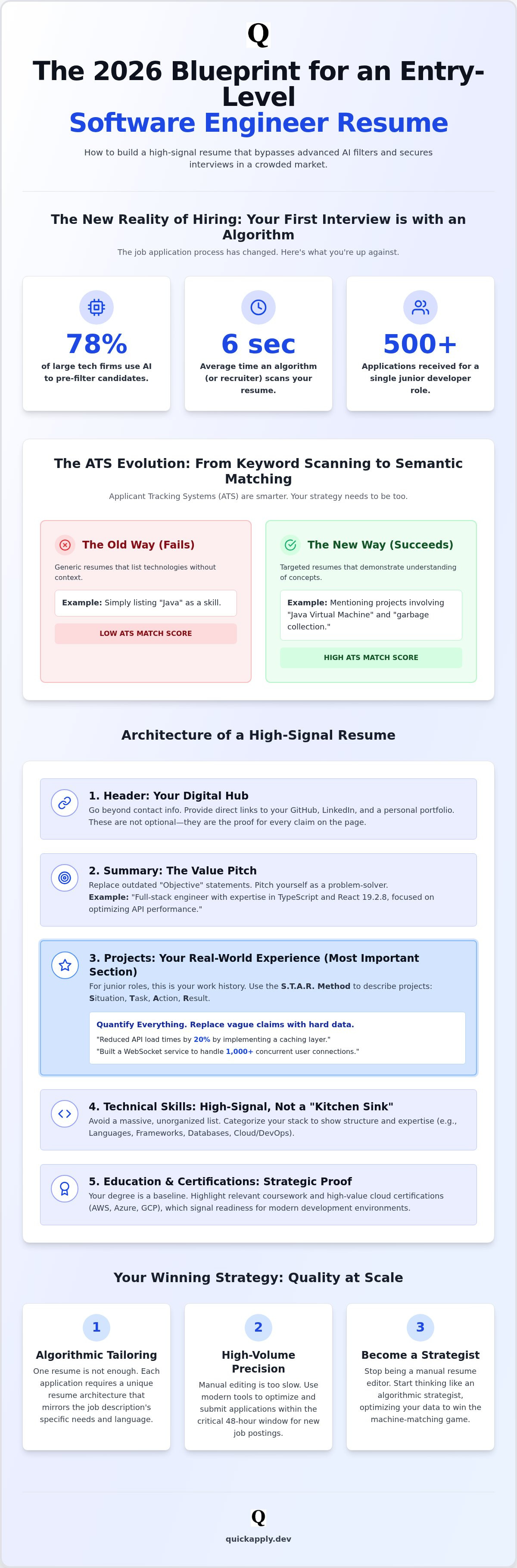
Your entry level software engineer resume isn't failing because you lack talent. It's failing because it's invisible. In 2026, the barrier to entry is no longer a human gatekeeper; it's an algorithm designed to find reasons to say "no." Recruiters for junior roles now face a crushing volume of over 500 applications per vacancy. They spend an average of six seconds on an initial scan. If your resume doesn't signal immediate technical relevance, it's deleted before a human ever reads your name.
Modern Applicant Tracking Systems (ATS) have evolved into advanced semantic matchers. They don't just look for "Python" anymore. They analyze the relationship between your skills, projects, and the specific needs of the engineering team. This creates the "Experience Paradox." Companies list roles for 0-2 years of experience but expect a document that demonstrates senior-level technical precision. In 2026, the "Black Hole" of job applications is the algorithmic void where high-potential talent is discarded by semantic filters before a human recruiter ever sees a single line of code.
The ATS Gatekeeper: How Algorithms Filter Junior Talent
Semantic search is the new standard. If a job description mentions the Java Virtual Machine, the AI expects to see related concepts like memory management or garbage collection. Listing "Java" as a standalone keyword is no longer enough. Generic resumes that attempt to cover every possible tech stack lack the depth required for high-precision matching. You need to verify your ATS resume score against the specific job description to ensure your technical signals are actually being received.
The Volume Trap: Why One Resume Version is Not Enough
Applying to ten jobs with a single document is a losing strategy. The statistical reality of the 2026 market demands quality at scale. Every application requires a unique resume architecture that mirrors the specific nuances of the target role. While manual editing is too slow for the current pace of hiring, automated optimization allows you to maintain high-volume output without sacrificing accuracy. You must pivot from being a manual editor to an algorithmic strategist. If you don't tailor your entry level software engineer resume for every single submission, you're essentially choosing to stay invisible.
Architecture of a High-Signal Junior Developer Resume
Your entry level software engineer resume must prioritize machine-readability above all else. In 2026, complex multi-column layouts and heavy graphics are liabilities. These elements confuse semantic parsers and lead to immediate rejection. Use a clean, single-column structure that guides both AI and human eyes to your technical evidence. Your header is no longer just contact info; it's a navigation bar for your digital presence. Include active links to your GitHub, LinkedIn, and a personal portfolio. These aren't optional extras. They serve as the production environment for every claim you make on the page.
The summary section is your elevator pitch. Move away from outdated objective statements that focus on what you want. Instead, pitch yourself as a problem solver ready to contribute. A high-signal summary might look like: "Full-stack engineer with expertise in TypeScript and React 19.2.8, focused on optimizing API performance and scalable architecture." This approach signals immediate value to the engineering team. When mapping out your layout, reviewing modern web developer resume examples can help you visualize how to balance white space with technical density for maximum impact.
Prioritizing Projects: Proving Competence Without a Job Title
If you lack professional work history, your projects section is your real experience section. Recruiters want to see unique problem solvers or complex full-stack applications that demonstrate architectural understanding. Stop listing basic tutorial clones. Use the STAR method to describe your code. Define the Situation, specify the Task, describe the Action, and quantify the Result. If you reduced load times by 20% or handled 1,000 concurrent requests, state it clearly. Link every project to a live demo and documented source code. This provides immediate proof of your technical competence.
Education and Certifications: Beyond the Degree
Your degree is the baseline, not the differentiator. Highlight only the specific coursework that aligns with the job description. In the 2026 market, specialized certifications in AWS, Azure, or GCP carry significant weight for junior roles. They signal that you're prepared for cloud-native development environments. If you attended a bootcamp, list it alongside your degree to show a hybrid background of theory and rapid skill acquisition. Managing dozens of versions of this layout is difficult, so using an application tracker helps keep your high-volume strategy focused and data-driven.
The Technical Skills Stack: High-Signal Only
Stop treating your skills section like a laundry list. Listing 30 languages doesn't make you look versatile; it makes you look like you've mastered nothing. An entry level software engineer resume needs high-signal categorization to survive the six-second scan. Deep expertise in a single modern stack, such as React 19.2.8 paired with Node.js 26.7.0, carries significantly more weight than a surface-level familiarity with five different ecosystems. Depth proves you can build production-ready software while breadth often just proves you can follow a basic tutorial.
Group your expertise into logical buckets to satisfy semantic search requirements and help recruiters find what they need instantly:
- Languages: Python 3.14.7, TypeScript, Java.
- Frameworks: React 19.2.8, Node.js 26.7.0, Django 6.1.
- Cloud Platforms: AWS (Lambda, S3), Azure, Google Cloud.
- Tools: Git, Docker, Kubernetes, GitHub Copilot.
In 2026, proficiency with AI-assisted development tools is a baseline requirement. Include "AI-Assisted Development" as a dedicated skill category. List specific tools like GitHub Copilot, Cursor, or specialized LLM prompt engineering for code. This signals that you understand modern productivity multipliers and can ship code with the speed today's market demands. It shows you're not just a coder, but an engineer who knows how to optimize their own development pipeline.
Mastering the Stack: Depth Over Breadth
Building a high-signal entry level software engineer resume requires a T-Shaped approach. You need a broad awareness of the tech ecosystem but a deep, specialized mastery of your primary stack. Grouping your skills logically prevents the "Kitchen Sink" trap and makes your profile machine-readable for semantic ATS. If you're unsure how to prioritize your expertise, audit your current draft against good resume examples to see how successful candidates balance technical density with layout clarity. Ensure your Python 3.14.7 skills are supported by relevant frameworks like Django 6.1 or Flask 3.1.3 to maximize your match score.
Soft Skills for Engineers: Communicating Technical Complexity
Soft skills must be demonstrated through technical context, not listed as empty buzzwords. "Teamwork" is a filler word. "Agile and Scrum collaboration" is a professional skill. Highlight your technical writing ability by referencing the comprehensive READMEs and system documentation found in your GitHub repositories. Even at the entry level, demonstrating "System Design" thinking shows you understand how your code interacts with larger infrastructure. These high-signal markers prove you can function within a professional engineering organization from day one without heavy hand-holding. They transform you from a student into a peer.
Algorithmic Tailoring: Winning the Match Score Game
Recruiters don't read resumes; they scan match scores. A match score is the algorithmic percentage fit assigned to your profile by an ATS before a human ever sees your name. If the job description (JD) emphasizes "distributed systems" and "asynchronous programming," but your entry level software engineer resume only mentions "coding," your score will bottom out. To win, you must tailor your resume to a job description using a high-precision 5-step strategy that mirrors the JD's specific technical vocabulary. This isn't about keyword stuffing. It's about ensuring your skills are semantically aligned with the company's tech stack.
Stop using passive language like "responsible for writing code." High-signal candidates quantify their impact with surgical precision. Turning a vague task into a measurable achievement transforms your profile. For example, "improved latency by 20% by optimizing SQL queries" tells a recruiter exactly what you can do for their infrastructure. It proves you understand the relationship between code quality and system performance. When you speak the language of metrics, you eliminate the guesswork for the hiring team.
Quantifying Impact: Using Data in Your Bullet Points
Use the Google XYZ Formula to structure every bullet point: "Accomplished [X] as measured by [Y], by doing [Z]." This framework forces you to focus on results. If you're working on personal projects, find metrics in load times, test coverage, or user counts. For instance, "Reduced server response time by 15% through the implementation of Redis caching on a high-traffic project." Numbers are the universal language of technical recruiters. They provide concrete proof of your competence in a way that adjectives never can.
Using AI for Precision Tailoring
Generic ChatGPT resumes often fail in 2026 because they lack the specific technical context required for modern semantic matching. They produce "hallucinated" skills that don't match your actual portfolio. Instead, use QuickApply to generate role-specific versions of your entry level software engineer resume in seconds. Our system identifies the exact match score you need to hit to clear the ATS threshold. This ensures your technical tone remains consistent across your resume and cover letter, projecting an image of a prepared, high-velocity engineer.
Don't leave your application to chance. Start building your high-signal profile and get your match score now to see how you rank against the competition.
Automating the Grind: Scaling Your Application Strategy
Speed is the final variable in the 2026 hiring equation. For most junior roles, the first 48 hours of a job posting are the only window that matters. High-volume hiring environments mean the first batch of qualified applicants often saturates the interview pipeline. You can't afford to spend three days "perfecting" one version of a document. You must apply fast and apply with algorithmic accuracy. Your entry level software engineer resume is a tool that needs to be deployed at scale, not a craft project. If you aren't in the first wave of applicants, you're likely already too late.
Tracking Applications: Managing the Funnel
Treat your job search like a high-performance sales CRM. If you're submitting fifty applications and receiving zero callbacks, your conversion rate is zero. This is a technical failure, not a personal one. It usually indicates a mismatch between your technical signals and the semantic filters of the ATS. Use a dedicated application tracker to monitor which versions of your resume are performing. Stop guessing which roles might work. Set aggressive daily targets for tailored applications. Manage your follow-ups with the same precision you use for your version control. Data doesn't lie; if the funnel is empty, your strategy needs an immediate pivot.
Continuous Optimization: The Living Resume
Your resume is a living system, not a static PDF file. A/B test different versions of your entry level software engineer resume to determine which technical projects generate the highest match scores. If your Python 3.14.7 projects aren't gaining traction, pivot your focus to your React 19.2.8 or Node.js 26.7.0 expertise. Update your skills section every week as you ship new code or master emerging frameworks. Leverage AI cover letter generators to ensure your technical tone remains consistent across every touchpoint. This maintains your professional authority while eliminating the manual editing that slows your momentum.
Closing the loop requires moving from submission to interview practice without missing a beat. Once the algorithm clears you, the human evaluation begins. Automate the administrative grind of the application process. This frees your bandwidth to focus on the high-value tasks: passing the technical screen and negotiating your first six-figure salary. Efficiency isn't just about saving time. It's about winning the numbers game in a market that doesn't wait for manual effort. Stop fighting the system and start using it to your advantage.
Master the Algorithmic Advantage
The 2026 job market doesn't reward manual effort; it rewards systemic optimization. You've learned how to pivot from a static document to a high-signal entry level software engineer resume that speaks the language of semantic ATS. By prioritizing project depth over a "kitchen sink" skills list and quantifying your impact with the Google XYZ formula, you've already bypassed the majority of the competition. Success in this high-volume landscape requires a shift from being a manual editor to becoming an algorithmic strategist.
Don't let the administrative grind slow your momentum. The difference between an ignored application and a scheduled interview is often just a few percentage points on a match score. You need to move as fast as the technology you build. Stop building, start tailoring with QuickApply's AI Resume Builder. Our system allows you to tailor your resume in seconds, provides a real-time Match Score for every job, and tracks all your applications in one integrated dashboard. You have the technical talent to thrive in this AI-driven market. Now you have the tools to ensure the world sees it. Start optimizing today and secure the interview you've earned.
Frequently Asked Questions
Do I need a summary on an entry-level software engineer resume?
Yes, you need a summary to pitch your technical value instantly. Avoid outdated objective statements about what you want from the company. Instead, use two punchy sentences to highlight your primary stack and your readiness to solve complex engineering problems.
Should I include my GPA on my resume in 2026?
Include your GPA only if it is 3.5 or higher and you graduated within the last twelve months. In the 2026 market, recruiters prioritize your GitHub contributions and project architecture over academic metrics. If your technical portfolio is strong, your GPA becomes a secondary data point.
How long should an entry-level software engineering resume be?
Keep your entry level software engineer resume to exactly one page. Efficiency is a core engineering value; if you can't communicate your impact concisely, recruiters assume you lack focus. Use a clean, single-column layout to maximize every inch of white space for high-signal technical data.
What are the best projects to put on a junior developer resume?
Prioritize projects that solve real-world problems or demonstrate full-stack architectural depth. A unique API integration or a performance-optimized application beats a generic tutorial clone every time. Ensure every project links to a live demo and documented source code to provide immediate proof of competence.
Can I use AI to write my software engineer resume?
Use AI for algorithmic tailoring and match score optimization, but avoid generic ChatGPT output. Modern ATS can detect low-effort, AI-generated fluff that lacks specific technical context. Use specialized tools to ensure your resume remains high-signal while moving at the speed of the 2026 market.
How do I list skills I'm still learning?
Group these under a "Familiar with" or "Currently Learning" sub-header in your skills section. Don't claim mastery of a language if you can't pass a live coding challenge in it. Honesty protects your credibility, but showing a trajectory of continuous learning signals a growth mindset to hiring managers.
Is a PDF or Word document better for ATS?
A text-based PDF is the 2026 standard for technical applications. It preserves your formatting across all devices while remaining fully readable by semantic ATS parsers. Avoid using "image-only" PDFs or complex graphic designs that might confuse the machine-learning models used in the screening process.
How do I handle having no professional experience?
Elevate your projects and open-source contributions to the "Experience" section of your entry level software engineer resume. Treat these as your job. Use the STAR method to quantify your results, such as "reduced API latency by 15%" or "managed state for 500+ concurrent users," to prove you can deliver professional-grade code.


