

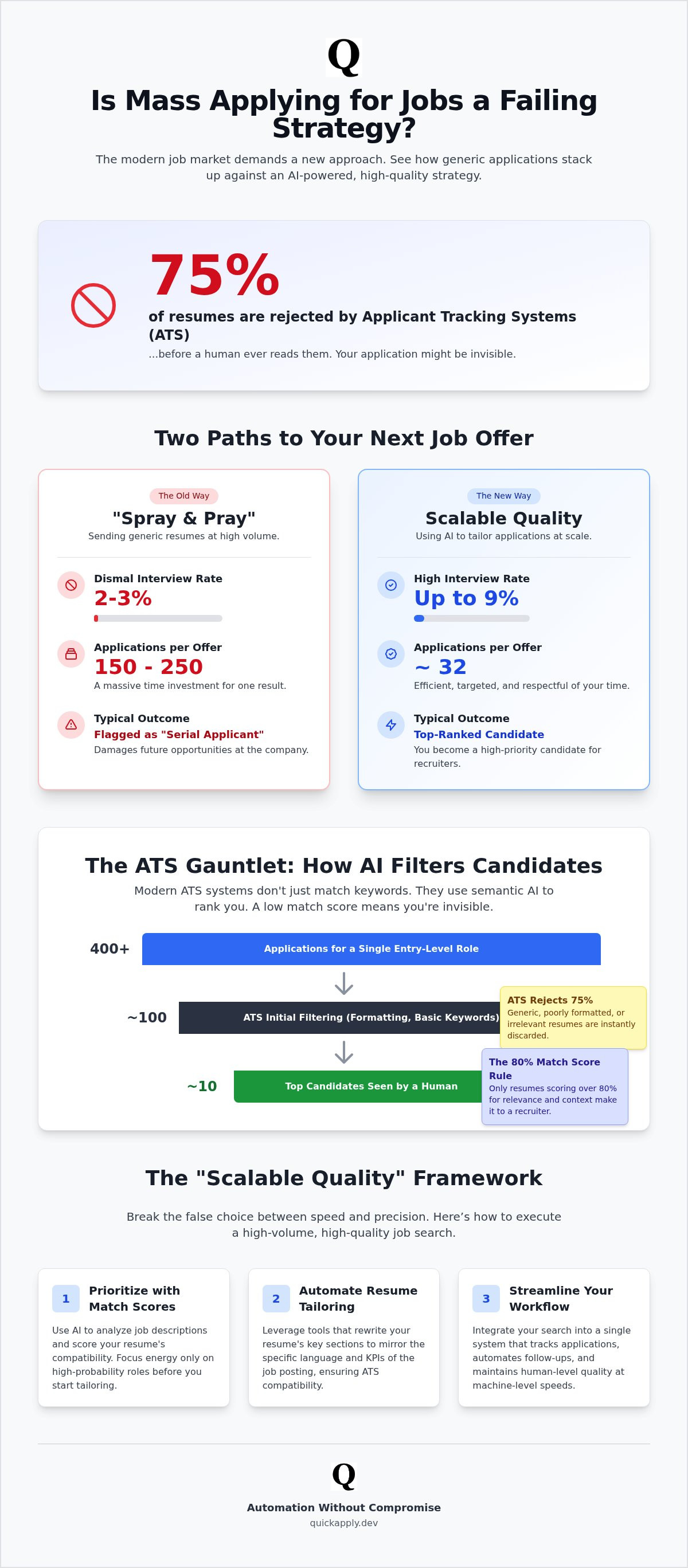
75% of resumes are rejected by applicant tracking systems before a human ever reads them. In a market where entry-level roles now receive 400 or more applications, you have to ask: is mass applying for jobs a bad strategy? Sending generic resumes results in a dismal 2% to 3% interview conversion rate. It's a massive waste of your most valuable resource: time. You feel like a nameless number in a database because, without a technical edge, you are.
We understand the grind of manual tailoring and the sting of recruiter ghosting. The old "spray and pray" method is a failing relic of a slower era. This article promises to show you how to use AI to apply at scale without sacrificing the quality recruiters demand. You'll learn how to leverage match scores and automated tailoring to jump to a 9% conversion rate. We are diving into the 2026 efficiency truth to turn your job search into a high-output, systematic engine that wins.
Key Takeaways
- Identify why the "spray and pray" method triggers immediate recruiter rejection and how to pivot to a high-relevance model.
- Discover how modern ATS thresholds filter out low-match candidates and determine if your current approach to is mass applying for jobs a bad strategy.
- Break the false choice between speed and precision by implementing the "Scalable Quality" framework designed for the 2026 job market.
- Learn to use AI-powered Match Scores to prioritize high-probability roles before spending a single second on manual tailoring.
- Streamline your entire application workflow with automated tools that maintain human-level quality at machine-level speeds.
The 'Spray and Pray' Trap: Why Generic Mass Applying Fails
The "Spray and Pray" method is a relic of a slower era. It involves blasting the same unedited resume to dozens of job boards in a single sitting. You feel productive because the application counter is climbing. In reality, you're just adding noise to an already congested system. Recruiter review times have plummeted. Most generic resumes are discarded within three seconds. If your document doesn't mirror the specific language of the job description, it's gone. Is mass applying for jobs a bad strategy when you're using this outdated approach? Absolutely. It's a high-effort, low-reward cycle that burns through your mental energy without moving the needle.
This cycle leads to a brutal psychological toll. You're putting in hours of "work" and receiving zero feedback. It feels like shouting into a void. By August 2026, the job market has become a paradox. While there are roughly 1.1 unemployed people per job opening, the volume of applications has doubled since 2022. Recruiters are drowning. They manage 40% more open roles than they did just a few years ago. They aren't looking for "good" candidates; they're looking for reasons to hit "reject." Generic applications provide those reasons instantly.
The Red Flags Recruiters See in Generic Applications
Recruiters need to find a match fast. A generic "Professional Summary" is the first sign of a low-effort applicant. Using phrases like "passionate professional seeking a challenge" is a waste of digital ink. It says nothing about your ability to hit their specific KPIs. If you haven't re-contextualized your past roles to fit the new job's "DNA," the recruiter won't do it for you. They see a lack of keyword alignment and move on. Understanding effective job search methods requires recognizing that your resume is a marketing document, not a historical record. If the marketing doesn't match the product description, the buyer walks away.
Why 'Quantity Only' is a Losing Game
Is mass applying for jobs a bad strategy if you only focus on the volume? The data suggests it's a statistical trap. Generic applications result in a 2% to 3% interview rate. Tailored applications reach 7% to 9%. To get one job offer via mass-applying, you typically need 150 to 250 applications. A targeted search requires an average of only 32. Efficiency isn't just about how many buttons you click. It's about conversion.
Beyond the low success rate, you risk permanent damage to your professional reputation. Modern Applicant Tracking Systems (ATS) track every version of every resume you've ever submitted to a specific company. If a firm sees you've applied to ten different departments with the same generic file, you're flagged as a "serial applicant." You become a low-priority candidate. You aren't just wasting today's time; you're poisoning your future opportunities at that organization.
The ATS Reality: How Low-Quality Volume Triggers Rejection
Most job seekers believe a human recruiter eventually sees their resume. In 2026, that's rarely true. 75% of resumes are rejected by Applicant Tracking Systems (ATS) before a human ever reviews them. These systems aren't just filing cabinets; they're sophisticated gatekeepers designed to eliminate noise. When you consider is mass applying for jobs a bad strategy, you must account for the "threshold effect." If your resume doesn't hit a specific match percentage, usually 80% or higher, it remains invisible. You aren't just being ignored. You're being algorithmically filtered out of the process entirely.
Applying without precision is a form of professional shadow-banning. Every time you submit a generic file, you're building a history of low-relevance in a company's database. Recruiters now manage 93% more applications than they did in 2021. They rely on ATS rankings to survive the volume. A flawed mass apply job search strategy creates a digital trail of "not a fit" labels that can haunt your future applications. Efficiency isn't found in the number of clicks, but in the visibility of your data.
Algorithmic Filtering in 2026
Simple keyword matching is dead. Modern ATS uses semantic AI to analyze the context of your experience. It understands the difference between listing a skill and demonstrating it through achievements. If the system detects keyword stuffing, it penalizes your ranking. Your formatting also plays a critical role. Non-standard layouts or complex headers often break the parser. When the AI can't read your data, it assigns a zero score. High-volume strategies fail when they ignore these technical constraints. You need a system that ensures your data is readable and relevant every single time.
Winning the Ranking Game
Match Scores are the new currency of the job market. Top-tier companies use these scores to decide which 10 candidates out of 400 get a phone screen. If you aren't in that top tier, your application is dead on arrival. This is why tailoring your resume to a job description is no longer optional. AI tailoring bridges the gap between your experience and the job's needs by translating your career history into the specific technical dialect the recruiter's ATS expects. To beat the algorithm, you need to see what it sees. Use a tool that provides a real-time match score to verify your relevance before you hit submit.
Quality vs. Quantity: Debunking the False Choice
Conventional wisdom says you must choose between speed and precision. Career coaches often suggest deep networking or hand-crafting every sentence of a single application. In a 2026 market where 27.4% of LinkedIn listings are "ghost jobs," relying on a handful of applications is a high-stakes gamble. You need volume to overcome the statistics. You also need precision to bypass the filters. If you wonder is mass applying for jobs a bad strategy, the answer depends entirely on your tech stack. Generic volume is definitely hurting your chances of finding your next job, but slowing down to a crawl is equally dangerous.
We call the solution "Scaleable Quality." It's a framework that treats job hunting like a high-performance sales funnel. Instead of choosing between 100 generic resumes or 1 perfect manual one, you use automation to tailor resume to job description with AI in seconds. This approach allows you to hit the 7% to 9% conversion rate of tailored applications while maintaining the output of a high-volume search. Data shows that a targeted strategy requires an average of 32 applications to secure a hire. Automation makes reaching that number a one-day task rather than a month-long ordeal.
The Efficiency Frontier
Calculate your time-cost. Spending two hours on a single manual application is a poor ROI. If that role turns out to be a ghost job, you've wasted a significant portion of your week. AI-assisted applications move the needle by shifting your focus from "production" to "validation." The goal is to find the sweet spot: applying to 10 to 15 highly tailored roles per day. This volume keeps your pipeline full without triggering the "serial applicant" red flags associated with unedited mass submissions. Optimization is about maximizing your interview invitations per hour spent.
Leveraging AI for Competitive Advantage
Precision at scale requires the right tools. Use an AI cover letter generator to maintain a personal touch without the manual grind. Your role changes from a writer to an editor. You review the AI's output, verify the skill alignment, and hit submit. This process ensures brand consistency across dozens of customized resumes. You aren't just applying; you're deploying a fleet of optimized documents designed to win the ranking game. In 2026, the competitive advantage belongs to those who automate the tedious to focus on the strategic.
How to Execute a High-Volume, High-Quality Job Search
Stop guessing and start engineering. Execution is the only thing that separates a successful hire from a frustrated applicant. If you're still asking is mass applying for jobs a bad strategy, you're looking at the wrong metric. Volume without a system is chaos. Volume with a technical framework is a competitive advantage. You need to transform your search from a manual chore into a high-speed pipeline that delivers consistent results.
Follow this five-step protocol to dominate the 2026 market:
- Step 1: Define Target 'DNA'. Cluster your target roles by core competencies. This focus ensures your AI prompts generate highly relevant tailoring every time.
- Step 2: Filter with Match Scores. Don't waste time on long shots. Only proceed if the role aligns with your existing skill set.
- Step 3: Automate the Grunt Work. Use software to handle resume formatting and cover letter drafting. These are administrative tasks, not creative ones.
- Step 4: Monitor Every Interaction. Use data to see which resume versions are getting hits. If your response rate drops, pivot your keywords immediately.
- Step 5: Simulate the Interview. Once the system generates an invite, use AI-driven tools to run mock sessions based on the specific job description.
The Power of the Match Score
Precision is your filter for high-volume success. Don't apply to every posting you see on LinkedIn. Target roles where you hit a 70% match score or higher. This threshold drastically increases your interview conversion rate because you're speaking the exact technical dialect the ATS expects. If you find a role you want but your score is low, use that data. The Match Score identifies specific skill gaps. Use these insights to address those weaknesses in your next portfolio project or certification before you submit.
Systematic Application Tracking
A job application tracker is non-negotiable for high-volume searches. You cannot manage 15 tailored applications a day in your head. You need to monitor follow-up timelines and recruiter responses with surgical precision. Tracking allows you to identify patterns. If one resume version wins at startups but fails at enterprise firms, you have the data to adjust. This systematic approach turns a job hunt into a predictable process rather than a game of luck. Ready to build your own efficiency engine? Start optimizing your application pipeline today.
Scaling Your Career with QuickApply: Automation Without Compromise
You've seen the data. The old way is dead. If you're still wondering is mass applying for jobs a bad strategy, remember that volume only fails when it lacks relevance. QuickApply fixes the relevance gap. It is the technical bridge between your talent and market opportunities. We built an efficiency engine that allows you to scale without losing the human touch recruiters expect. This is automation without compromise. It is designed for those who value their time and demand results. You are no longer a number in a database. You are the candidate who always has the right keywords at the right time.
QuickApply functions as a savvy, tech-literate ally in a volatile market. By utilizing smart technology, you bypass the "spray and pray" dilemma entirely. We provide the tools to out-compete the market through systematic optimization. You don't just apply. You deploy a fleet of optimized documents that win the ranking game. This is the competitive advantage you need to navigate the 2026 landscape with confidence.
Beyond the Application
True career growth doesn't stop once you sign the offer letter. QuickApply is more than just a document generator; it is a full-stack career management platform. Use our Salary Negotiation Guide to maximize your total compensation during the final stages of the hiring process. Map out your next internal move with the Promotion Roadmap. QuickApply turns a tedious manual process into a streamlined technical workflow. It ensures you remain ahead of the curve long after the initial job search ends. We provide the infrastructure for your entire professional trajectory.
Join the Efficiency Revolution
Stop building resumes. Start tailoring opportunities. Using the best ai resume builder 2025 features, our users apply five times faster than those using manual methods. More importantly, they see a 3x higher response rate. By shifting from a 3% conversion rate to a 9% conversion rate, you aren't just working harder. You're working smarter. This high-volume, low-effort input is the consistent signature of a modern professional. The future of career growth is automated. Join the savvy, time-conscious candidates who have already mastered complex systems. Optimize your career now.
Master Your Application Engine
The 2026 job market demands a technical edge. You've seen the data: generic volume triggers immediate algorithmic rejection, while manual tailoring is a slow path to burnout. The answer to whether is mass applying for jobs a bad strategy lies entirely in your execution. If you combine high volume with AI-driven precision, you aren't just applying; you're winning the ranking game. It's about working at the speed of the market, not the speed of your keyboard.
High-volume success requires a systematic approach. Utilize AI-powered Match Scores to prioritize roles where you have a high probability of an interview. Automate the administrative grind by using tools that tailor resumes in seconds while maintaining human-level quality. By using an Integrated Application Tracker, you turn your job search into a data-driven process that eliminates the guesswork. Efficiency is your only path to a higher conversion rate and a faster hire.
Stop spraying and praying. Start tailoring with QuickApply.
The future belongs to those who automate the tedious to focus on the strategic. Take control of your career pipeline and start winning today.
Frequently Asked Questions
Is it bad to apply for multiple jobs at the same company?
It depends entirely on the alignment of the roles. Applying for two similar engineering positions shows a clear career focus. Applying for marketing, sales, and engineering roles simultaneously signals desperation. Modern ATS tracks your entire submission history. If you look like you're clicking every available button, you risk being dismissed as a non-serious candidate by the internal recruiting team.
Does mass applying lead to being blacklisted by recruiters?
You won't be blacklisted in a global sense, but you can be flagged within a specific company's database. Recruiters see every version of the resume you've submitted. If you have dozens of rejected applications for unrelated roles at one firm, they will stop reviewing your files. This is why is mass applying for jobs a bad strategy when you ignore relevance. It poisons your future chances at top-tier organizations.
How many job applications per day is too many?
The limit is your ability to maintain quality. Applying to 10 to 15 highly tailored roles per day is the sweet spot for a high-output search. If you're hitting 50 or 100 applications, you're likely sending generic, low-value documents. High volume only works if the Match Score for each role remains above your target threshold. Efficiency is about conversion, not just activity.
Can ATS tell if I used AI to tailor my resume?
ATS is built to find skill matches, not to detect AI signatures. These systems prioritize relevance and technical readability above all else. If your resume accurately reflects your experience while mirroring the job description's dialect, the AI origin is irrelevant. Focus on the quality of the output. A well-tailored AI resume is always superior to a poorly written manual one.
Should I use the same cover letter for every job?
Never send a generic cover letter. Recruiters spot a template within seconds and view it as a lack of interest. Use an AI cover letter generator to create a unique document for every submission. This ensures your value proposition aligns with the specific needs of the hiring manager. It provides a personal touch at scale without requiring hours of manual labor.
How do I increase my response rate when applying to many jobs?
Prioritize your Match Score before hitting submit. Only apply to roles where your resume scores 70% or higher against the job description. This filter ensures you are only competing for roles where you are a legitimate technical fit. High-volume searches fail when they ignore this fundamental law of relevance. Precision is the only way to break through the noise.
Is 'easy apply' on LinkedIn a bad strategy?
It is a low-conversion strategy because the barrier to entry is too low. Since it requires zero effort, you are competing with thousands of other low-effort applicants. To win with Easy Apply, you must still upload a tailored resume rather than relying on your default profile. Don't let the convenience of the button trick you into skipping the optimization step.
What is the best way to track a high volume of job applications?
Use an integrated application tracker to manage your pipeline. Spreadsheets are too slow and often lead to manual data entry errors. A dedicated tracker monitors your follow-up timelines and recruiter responses automatically. This data allows you to pivot your strategy instantly when you notice a drop in your response rates. Systematize your search to maintain momentum.


