

In 2026, the "one application per company" rule is obsolete. Many job seekers still hesitate, asking is it bad to apply to multiple roles at the same company because they fear looking desperate or triggering an ATS red flag. You're right to be concerned about your digital footprint. With recruiters now handling 93% more applications than they did in 2021, a lack of focus can quickly lead to a silent rejection. Traditional manual methods are too slow and risky for this high-volume environment.
We're here to optimize your search. You'll discover the exact threshold for multi-role applications and how to leverage AI match scores to ensure every submission is a strategic win rather than a shot in the dark. We will break down how modern systems like Workday and Greenhouse track your history. You will learn the specific number of roles that keep you safe, the method for tailoring resumes at scale, and the logic required to dominate the 2026 job market without hurting your reputation.
Key Takeaways
- Stop wondering is it bad to apply to multiple roles at the same company. Modern hiring teams view multi-applying as a signal of genuine interest when executed with precision.
- Realize that Applicant Tracking Systems (ATS) aggregate your history into one dashboard. Recruiters see every role you have targeted and your current status for each.
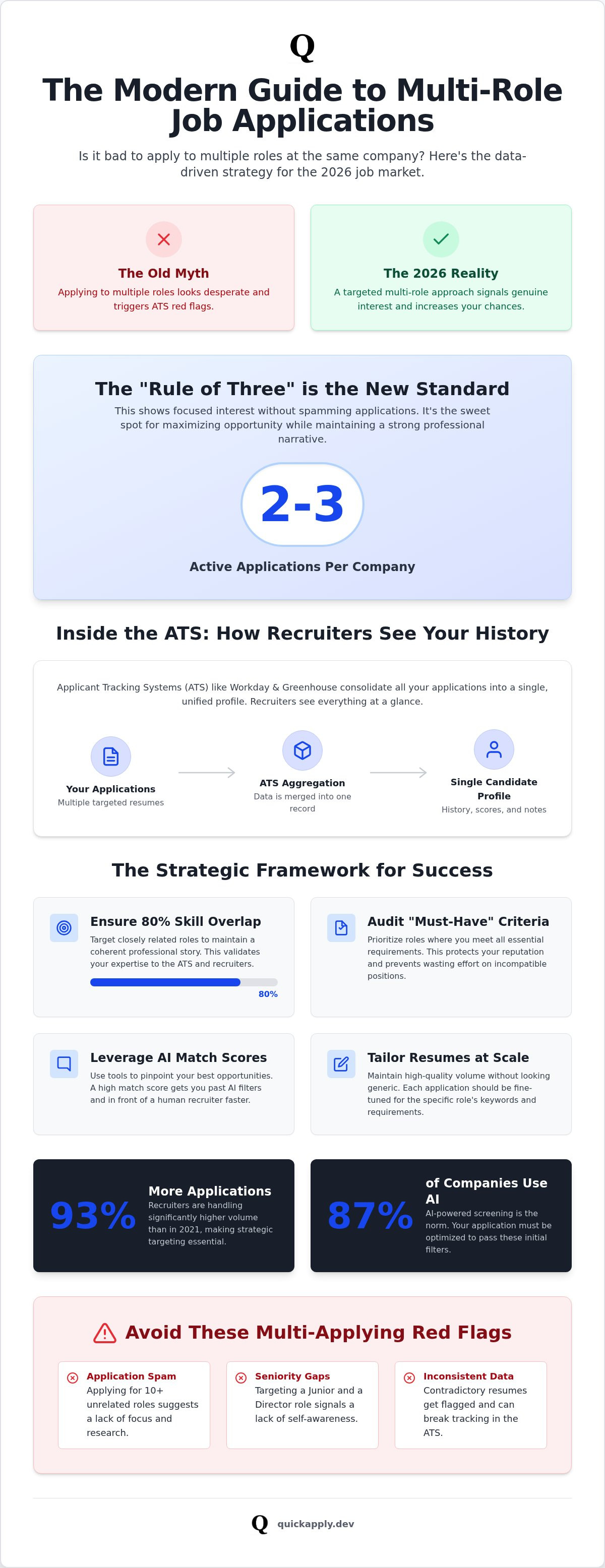
- Limit your activity to 2-3 active applications per company. Ensure an 80% skill overlap between roles to keep your professional narrative coherent.
- Audit openings and prioritize roles where you meet the "Must-Have" criteria. This prevents wasted effort on incompatible positions and protects your reputation.
- Use AI Match Scores to pinpoint your best opportunities. Generate tailored resumes in seconds to maintain high-quality volume without looking desperate.
The Reality of Applying to Multiple Roles: Is It Actually Bad?
Stop letting outdated career advice dictate your 2026 job search. The short answer is no. It's not inherently bad to target several positions within one organization. In the current high-volume tech hiring landscape, the "desperation" myth has been replaced by the "strategic candidate" reality. Recruiters don't view multiple applications as a sign of weakness. They see a candidate who is genuinely invested in the company's mission and culture. If you've done your research, you know the company is the right fit. Why would you limit your chances to a single opening?
The "Rule of Three" is the new standard for 2026 job seekers. Targeting up to three relevant roles shows focus while maximizing your surface area for success. It's a data-driven approach that acknowledges the complexity of modern corporate structures. You aren't just a resume in a pile; you're a multi-faceted professional whose skills likely overlap across several internal teams. When you wonder is it bad to apply to multiple roles at the same company, remember that silence is often the result of being too cautious, not too bold.
The Shift in Recruiter Mindsets
Recruiters now operate with a high-tech, collaborative mindset. They rely on an Applicant Tracking System (ATS) to view your entire submission history at a glance. Talent acquisition teams are no longer siloed. They actively share high-quality profiles across different departments. If you're a "silver medalist" for a Backend Engineer role, that same recruiter might fast-track you for a Platform Engineering opening. Being the runner-up for one team makes you a frontrunner for another. While specialized roles require a tight match, generalist skills allow for broader targeting across adjacent squads.
When Multi-Applying Becomes a Red Flag
There is a logical threshold you must respect to maintain credibility. Passion turns into spam the moment you hit double digits. Applying for 10 or more unrelated roles is a major red flag. It suggests you're blasting resumes without any regard for fit. Seniority gaps are another common pitfall. Don't apply for a Junior Associate role and a Director position in the same week. This signals a total lack of self-awareness regarding your own career level. Finally, audit your data consistency. If different resume versions contain contradictory skills or conflicting employment dates, the system will flag your profile for manual review. Stay consistent to stay competitive.
Inside the ATS: How Companies See Your Multiple Applications
Hiring software is more sophisticated than most job seekers realize. When you submit a resume, you aren't just sending a file; you're creating a permanent entry in a centralized database. Modern systems like Workday and Greenhouse use profile aggregation to link every interaction you have with a brand to a single dashboard. This means recruiters see every role you've ever pursued, your interview scores, and even the reasons for previous rejections. When people ask is it bad to apply to multiple roles at the same company, they often fail to account for this radical transparency.
AI filters now handle the heavy lifting. Approximately 87% of companies currently use AI in their hiring process to assist with screening and sourcing. These systems generate a "Match Score" based on keyword density and skill alignment. If your profile shows high scores for three different engineering roles, it validates your expertise. If you apply for unrelated roles, your Match Score drops, and you risk being filtered out before a human even sees your name. Consistency in your core data is non-negotiable. Use the same email, LinkedIn URL, and phone number for every submission to ensure the system merges your data correctly.
The Single Candidate Profile
Applicant Tracking Systems are designed to eliminate redundancy. Workday operates on a per-company instance basis, meaning your history is private to that specific employer but fully visible to their entire HR team. Greenhouse uses an auto-merge feature that prioritizes your oldest profile to maintain record consistency. If you apply for Job B using a different email than you used for Job A, you create a duplicate profile. This triggers "Resume Ghosting," where the system fails to track your progress or breaks referral links. Your first application often sets the baseline for your candidate profile, so make it count.
Recruiter Dashboards and Notes
Hiring managers don't just see your resume; they see a timeline of your engagement. They leave internal feedback and interview notes that follow you across every future application. This visibility allows them to see if you were a "strong maybe" or a "hard pass" in previous rounds. To navigate this complex web of data, you need to stay organized. Using an automated job application tracker helps you maintain a clear record of which versions of your resume were sent where. You can optimize your submission strategy by ensuring every new application builds on the success of the last one rather than contradicting it.
The Strategic Framework for Multi-Role Success
Applying to multiple roles requires a surgical approach. It isn't just about volume; it's about coherence. You must identify positions with at least an 80% skill overlap to maintain a believable professional identity. If you target roles that are too disparate, you trigger the "desperation" flag. Stick to a maximum of 2-3 active applications per company. This limit ensures you remain a high-priority candidate without cluttering the recruiter's dashboard. High-volume hiring in 2026 demands that you move fast, but you must move with intent.
Focus your efforts on different teams within the same functional area. For example, applying for a Backend Engineer role on the Payments team and another on the Infrastructure team is a power move. You are demonstrating deep functional expertise while showing flexibility in how that expertise is applied. To pull this off effectively, you must use a tailor resume to job description ai for every single submission. Generic resumes are the fastest way to get filtered out by the automated screening tools used by nearly 90% of modern enterprises.
Targeting Adjacent Skill Sets
Pivoting between roles like Frontend and Fullstack requires precision. You can't lose credibility by presenting two different versions of your professional history. If you are applying for a Software Engineer role and a Site Reliability Engineer (SRE) position, your core tech stack must remain consistent. Don't claim to be a Go expert on one resume while omitting it entirely from another. Recruiters see both versions on their dashboard. Highlight how your existing skills solve the specific problems of each role rather than inventing new competencies for each click.
The Power of a Consistent Narrative
Your applications need a "Core Story" that bridges the gap between your target roles. This narrative should explain why your specific background makes you an asset to the company's broader mission. Using an ai cover letter generator allows you to reference each team's specific objectives without starting from scratch. It's about efficiency, not laziness. Avoid the common copy-paste trap in your professional summary. A summary that mentions "Payments" when you are applying for "Infrastructure" is a self-inflicted wound. When you ask is it bad to apply to multiple roles at the same company, the answer depends entirely on your ability to stay organized and consistent across every digital touchpoint.
Step-by-Step: How to Apply to Multiple Roles the Right Way
Execution is everything. Start by auditing the company’s current career portal. Shortlist a maximum of three roles that align with your verified skills. If you're still asking is it bad to apply to multiple roles at the same company, the answer lies in your selectivity. Blasting every open req is a mistake. Selecting the top three shows intent. This limit keeps your candidate profile clean and professional in the eyes of the talent acquisition team.
Analyze the "Must-Have" requirements versus the "Nice-to-Have" fluff. If you don't meet the core technical requirements for all three roles, drop the outliers immediately. You need a high Match Score for each submission to survive the initial AI sweep. Tailor each resume version to emphasize the specific nuances of each team. This isn't about changing your history. It's about highlighting the most relevant parts of it for a specific audience.
Analyzing Job Descriptions for Overlap
Identify shared keywords across your shortlisted roles. These are your non-negotiables. They must appear in every version of your resume to maintain a consistent profile. Next, spot the unique identifiers for each team. Use good resume examples as a template to structure these variations. One role might prioritize "Scalability," while another focuses on "Security." Adjust your bullet points to reflect these priorities while keeping your core tech stack identical.
Space out your submissions. Don't hit "Apply" three times in sixty seconds. Wait 24 to 48 hours between each application. This simple delay prevents your activity from looking like a bot-driven attack on the ATS. Track your status for each role meticulously. You must know exactly which version of your story you told to which team to avoid confusion during the initial recruiter screen.
Preparing for the 'Why Both?' Interview Question
Expect the question. A recruiter will eventually ask why you've targeted multiple departments. Frame this as a passion for the company's overall mission. Explain how your versatility allows you to contribute to different departmental goals. You aren't desperate; you're adaptable. Turning this potential trap into a strength shows professional maturity. It proves you've considered how your skills fit into the broader corporate ecosystem.
Ready to scale your search without the manual grind? Automate your application strategy now and secure your next role with precision.
Automate the Multi-Role Strategy with QuickApply
Executing a multi-role strategy manually is a recipe for burnout. You need a system that moves as fast as the ATS it's trying to penetrate. QuickApply provides the technical leverage required to apply to several positions without the friction of manual editing. When you're questioning is it bad to apply to multiple roles at the same company, the answer depends on your ability to maintain quality at scale. Our AI Match Score analyzes your profile against the job description to tell you exactly where you fit best. Don't waste effort guessing which of the three roles is your strongest lead. Let the data drive your decision making.
Narrative consistency is your greatest asset. If your resumes across different applications don't align, you will fail the recruiter "smell test." QuickApply ensures that your core professional identity remains intact while highlighting the specific keywords that each hiring manager needs to see. By automating the tailoring process, you eliminate the risk of contradictory information that often plagues manual multi-role attempts. You stay strategic, stay focused, and stay ahead of the competition.
Efficiency Over Effort
Manual resume tweaking is a relic of the past. QuickApply generates tailored resumes and cover letters for each role in seconds. This ensures you maintain a high-velocity search without sacrificing the precision that modern recruiters expect. The best ai resume builder 2025 focuses on tailoring, not just building. Our system ensures your tech stack and core story remain consistent across every version while highlighting the unique nuances of different teams. You get the benefits of volume without the risk of looking like an unfocused candidate.
Winning the Numbers Game
Scaling your search across multiple companies requires a centralized command center. Use our job application tracker to manage your status across every organization you target. This isn't just about applying to more jobs. It's about applying smarter to the right ones. With the average time to fill a high-demand role now sitting at 44 days, you can't afford to wait on a single lead. By increasing your precision, you gain a massive statistical advantage. Applications per job opening have doubled since 2022, so standing out requires a combination of speed and relevance. You can now achieve high-volume output with low-effort input. This is the bridge between your talent and the opportunities you deserve. Start tailoring your applications with QuickApply today. and secure your competitive edge in the 2026 market.
Scale Your Search with Precision
The 2026 hiring landscape rewards those who move with speed and surgical precision. You now understand that the old "one and done" rule is dead. By targeting 2-3 roles with high skill overlap and maintaining a consistent digital profile, you signal genuine interest and professional versatility. Recruiters don't want desperation; they want a high-value asset who fits their culture across multiple teams. Success comes to those who leverage the right systems to stay organized.
Stop worrying whether is it bad to apply to multiple roles at the same company and start treating your search like the optimization problem it is. Use data to your advantage. Our AI Match Score identifies your best opportunities, while our system lets you tailor resumes for multiple roles in seconds. You can manage every submission through a centralized tracker for all your applications to ensure you never miss a beat or a follow-up. This high-tech approach ensures you stay ahead of the curve.
Stop guessing and start applying with QuickApply’s AI precision.
The modern job market is complex, but your strategy doesn't have to be. It's time to secure the role you deserve.
Frequently Asked Questions
Will applying to two roles at once hurt my chances?
No, applying to two roles won't hurt your chances as long as they are functionally related. Recruiters view this as a sign of genuine interest in the company's mission. Modern talent acquisition teams are structured to share top-tier candidates across different departments. You just need to ensure your skills align with both descriptions to maintain a high match score and pass the initial automated screening.
How many jobs is too many to apply for at one company?
Applying for more than three roles at a single company is the threshold where you risk looking unfocused. Exceeding this "Rule of Three" can trigger spam filters in an ATS like Workday or Greenhouse. It suggests you are blasting resumes rather than targeting specific needs. Stick to a maximum of three active applications to keep your candidate profile professional and your narrative coherent.
Can recruiters see if I applied for other positions?
Recruiters have full visibility into your entire application history via their centralized dashboard. Modern hiring software aggregates all your submissions into one candidate profile. They see every role you've pursued, your current status, and any internal notes left by previous hiring managers. This transparency means you must remain consistent with your data and professional story across every interaction with the organization.
What happens if I get interviews for two different roles at the same company?
You must be transparent and inform both recruiters if you land interviews for different roles. Companies usually prefer to coordinate these rounds to optimize their hiring process. Be ready to explain how your versatile skill set solves problems for both teams. This honesty demonstrates professional maturity and prevents scheduling conflicts. It also proves you're a high-demand candidate with multiple internal stakeholders interested in your talent.
Should I use the same resume for every role at the same company?
You must never use the exact same resume for every role. While your core history remains identical, you need to adjust the emphasis and keywords to match each unique job description. Tailoring your bullet points ensures you hit the specific technical requirements for each team. This approach maximizes your AI match score and proves to recruiters that you've actually read the requirements for each specific opening.
Is it better to apply for multiple roles or just the one I want most?
Applying for 2-3 relevant roles is statistically superior to targeting just one. It increases your surface area for success without cluttering the recruiter's dashboard. In 2026, recruiters are handling 93% more applications than they did in 2021, so you need multiple paths to get noticed. Ensure each role has at least an 80% skill overlap to maintain your credibility as a specialist rather than a generalist.
Does applying to multiple roles make me look desperate?
Applying to multiple roles only looks desperate if the positions are unrelated or at conflicting seniority levels. When candidates ask is it bad to apply to multiple roles at the same company, they often fear this red flag. Avoid applying for both Junior and Lead roles simultaneously. As long as your target positions follow a logical career trajectory, recruiters will interpret your activity as a high-intent interest in their brand.
What should I do if I'm rejected for one role but still active for another?
Continue your active application process with full confidence. A rejection from one team is often specific to their current headcount or niche technical needs. It doesn't blacklist you from the rest of the company. Your active profile remains visible in the ATS, and other hiring managers can still see your value. Stay professional, keep your tracker updated, and focus on delivering high-impact answers in your remaining interviews.


