

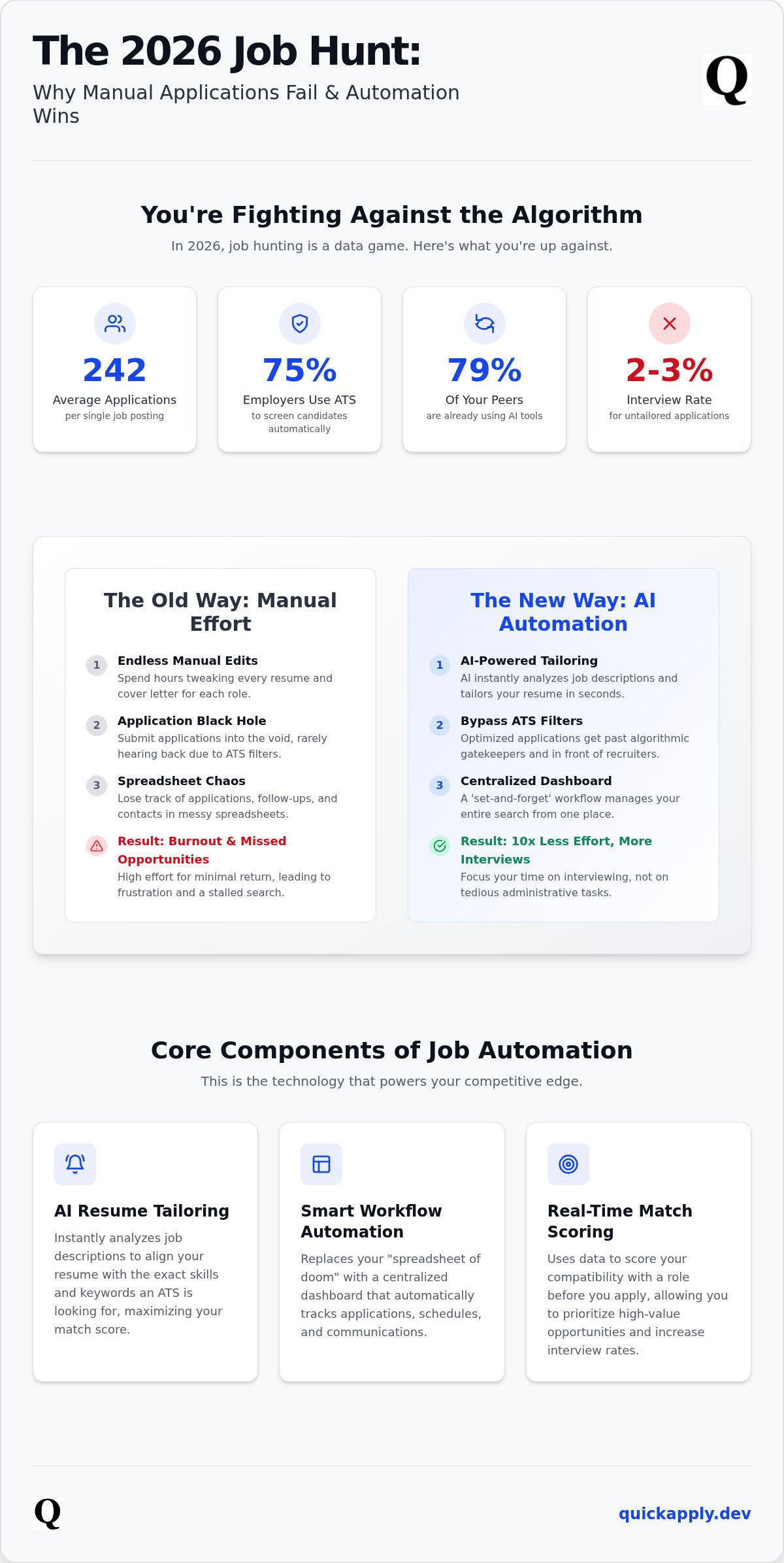
In 2026, job hunting is a data-optimization problem, not a writing exercise. If you're still manually tweaking every bullet point for every job description, you've already lost the race to a script. The average job posting now pulls in 242 applications. With 75% of employers using automated screening, your manual effort is likely hitting a digital wall. Leveraging job application automation tools isn't just a shortcut anymore. It's the only way to remain competitive in a market where 79% of your peers are already using AI to outpace you.
We know the frustration of spending hours on a single application only to be met with total silence. It's a broken system that rewards volume over sincerity. This guide promises to flip the script. You'll discover how to leverage AI-powered automation to apply for more roles, bypass ATS filters, and land interviews with 10x less manual effort. We'll walk through building a streamlined, 'set-and-forget' application workflow and a centralized dashboard to manage your entire career movement. It's time to stop playing by the old rules and start using the tools designed to win.
Key Takeaways
- Stop wasting hours on manual edits. In 2026, automation is the only way to bypass algorithmic gatekeepers and secure interviews at scale.
- Modern job application automation tools eliminate the need for manual tailoring by instantly aligning your resume with specific ATS requirements.
- Move beyond generic AI prompts. Purpose-built career engines provide a more efficient path than manual ChatGPT interactions.
- Create a centralized, 'set-and-forget' workflow to manage your entire career search without losing track of a single application.
- Use real-time match scoring to prioritize high-value roles and maximize your interview conversion rates with minimal manual input.
The End of Manual Job Hunting: Why You Need Automation in 2026
The 2026 job market isn't a meritocracy; it's an algorithmic filter. With the average job posting attracting 242 applications, human recruiters no longer provide the first pass. They've outsourced that task to machines. If you're still manually tweaking every bullet point for every role, you're playing a losing game. High competition meets aggressive gatekeeping, and the old "spray and pray" method is now a statistically guaranteed failure. In fact, untailored applications currently see an interview conversion rate of only 2-3%. You can't outwork a script with manual labor.
The hidden cost of manual tailoring is more than just wasted time. It's opportunity loss and psychological burnout. While you spend three hours perfecting a single cover letter, an automated competitor has already submitted 50 optimized applications. This isn't just about speed; it's about mental bandwidth. Transitioning from a "job seeker" to a "career optimizer" means treating your search like a high-efficiency pipeline. You don't need to work harder. You need to deploy job application automation tools that handle the repetitive data entry while you focus on the high-value work of interviewing.
The ATS Evolution: Why Simple Resumes Fail
Modern Applicant Tracking Systems (ATS) have evolved far beyond simple keyword matching. They now utilize advanced Natural Language Processing (NLP) to rank candidates based on contextual relevance and semantic intent. Your experience might be perfect, but if it isn't formatted for these specific models, you'll never cross the "Match Score" threshold. This is why using an ats resume checker has become the essential first line of defense for tech pros. Without a high compatibility score, your resume stays in the digital "black hole" regardless of your actual talent.
The Competitive Advantage of AI-Powered Speed
In a fast-moving market, being the first applicant provides a massive statistical advantage. Hiring managers often begin screening as soon as the first batch of qualified resumes arrives. Job application automation tools allow you to maintain quality at a scale that's impossible for humans to match. You can send dozens of tailored applications in the time it used to take to finish one. This isn't just about volume; it's about empowerment. By automating the tedious parts of the process, you take control of the hiring narrative. You aren't begging for a job; you're using smart technology to bridge the gap between your talent and the right opportunity.
Core Components of Job Application Automation Tools
Modern job application automation tools function as the operating system for your professional life. These systems don't just store documents; they actively manage the tailoring, tracking, and submission of your data across the web. While legacy platforms focus on simple storage, a 2026-grade automation engine acts as a digital agent. It handles the low-value, repetitive tasks of form-filling and formatting, allowing you to focus on interview performance. This shift from manual labor to systemic management is the defining characteristic of the modern tech search.
The heart of this technology is the "Tailoring Engine." This moves beyond simple keyword stuffing. It's a sophisticated analysis of semantic intent. By generating context-aware narratives, these tools ensure your professional story aligns perfectly with a company's specific needs in seconds. This ensures a high-volume output that maintains a high-quality signature, effectively bridging the gap between your technical skills and a recruiter's rigid requirements.
AI Resume Tailoring: The 2026 Standard
Effective 2026 hiring relies on precise alignment. Utilizing a modern ai resume builder allows you to analyze job descriptions for core competencies instantly. This technology moves beyond basic editing to perform AI-driven alignment. It ensures your resume reflects the exact technical stack and soft skills requested by the Applicant Tracking System. However, sophistication is key. Academic research from Stanford highlights the potential for algorithmic bias in automated hiring systems. High-tier automation tools help you navigate these systemic hurdles by ensuring your data is presented in a way that maximizes visibility without triggering rejection filters. It's where factual accuracy meets maximum keyword density.
Smart Trackers and Workflow Automation
Stop using the "spreadsheet of doom" to manage your career search. A centralized job application tracker provides real-time status updates and automated funnel management. Integration with browser extensions allows for one-click data scraping from any major job board. This creates a seamless workflow where you know exactly where every application stands without manual data entry. If you want to reclaim your time and dominate the tech market, consider deploying QuickApply to manage your entire application pipeline with precision.
Comparing the Top Automation Strategies for Tech Pros
You've decided to automate. Now you face a choice: duct-tape a workflow together with general-purpose AI or deploy a dedicated engine. Many tech pros fall into the "Prompt Engineering" trap. They spend hours crafting instructions for ChatGPT, essentially replacing one form of manual labor with another. This isn't optimization. It's just a different kind of friction. True efficiency requires a system that understands the technical landscape without constant hand-holding. You need a tool that acts as an agent, not a chatbot.
Purpose-Built Tools vs. General AI
Relying on a chatgpt resume strategy is a liability. General models often hallucinate skills or invent experiences to fit a template. They lack the deep, tech-specific databases required to distinguish between nuanced roles like Platform Engineering and Cloud Architecture. Purpose-built job application automation tools solve this by using verified technical taxonomies. They also prioritize data privacy. Your personal information shouldn't be training data for a public LLM. A dedicated career engine keeps your data secure while providing match scores that general AI can't replicate. This allows you to target roles where you have a statistical advantage.
The 'Full-Stack' Career Platform
A real career operating system handles the entire funnel. It doesn't stop at the "Submit" button. You need an ai interview assistant to convert those automated applications into signed offers. The best systems integrate follow-up automation and long-term Promotion Roadmaps. This ensures you're not just finding a job, but building a trajectory. Look for tools that offer salary negotiation guides as part of the package. This moves the needle from "getting hired" to "getting paid what you're worth." Automation should support your entire professional lifecycle, not just the entry point.
Analyze the ROI. The cost of a monthly subscription is negligible compared to the cost of a prolonged search. If job application automation tools shorten your unemployment cycle by even ten days, the financial gain is massive. In 2026, the fastest candidate usually wins. Don't let a manual workflow be the reason you miss out on a high-six-figure role. Use technology to buy back your time and secure your market value. Efficiency is the only competitive edge that matters in a saturated market.
How to Build Your 2026 Automation Workflow
Efficiency isn't an accident. It's an architecture. To survive the 2026 market, you need a multi-layered stack that operates without your constant attention. Stop treating your search like a weekend hobby. Start treating it like a production-grade pipeline. By building a systematic workflow, you move from the chaos of manual browsing to the precision of a career optimizer. This is how you reclaim your time and dominate the tech market.
A high-performance automation workflow follows five critical steps:
- Audit: Use an ats resume checker to ensure your master document is machine-readable and optimized for NLP parsers.
- Filter: Automate discovery. Set Boolean alerts for entry level remote jobs and niche tech hubs to find roles before they're saturated.
- Tailor: Deploy job application automation tools to align your resume with specific job descriptions in seconds.
- Track: Monitor your conversion rates. Centralize your data to see exactly where you're losing candidates in the funnel.
- Close: Use AI-driven interview practice to master the final round and secure the offer.
Optimizing Your Master Resume
Your master resume is your source code. It must be clean and modular. Focus on "Core Pillars"-your immutable achievements and technical stack. Avoid complex layouts, icons, or graphical elements that break Applicant Tracking Systems. If a machine can't read your data, a human will never see it. Stick to standard headings and chronological structures. This ensures your job application automation tools can extract and reformat your data accurately for every unique submission. A clean master file is the foundation of quality at scale.
Daily Automation Habits
Master the "15-Minute Morning." While others spend hours browsing LinkedIn, you review a pre-vetted list of roles with high Match Scores. Apply to 10 jobs before your first cup of coffee. By prioritizing roles where your probability of success is highest, you maximize ROI and minimize search fatigue. This systemic approach turns the job search from a source of anxiety into a background process that runs while you live your life. It's about high-volume output with low-effort input. Deploy QuickApply as your career operating system and start applying at scale today.
QuickApply: The Most Efficient Path to Your Next Tech Role
QuickApply is the operating system for your professional life. It isn't just another builder; it's a high-performance career engine designed for software engineers and tech grads who value their time. While other job application automation tools focus on simple storage, QuickApply focuses on conversion. By automating the high-friction parts of the search, you move from a passive seeker to an active optimizer. This is the final step in building a 2026-grade career pipeline.
The power of our platform lies in the Match Score. Stop guessing which roles are worth your effort. Our AI-powered scoring system analyzes your technical stack against real-world job descriptions to identify where you have a statistical advantage. You apply where the data says you'll win. This intelligence eliminates the "spray and pray" anxiety and replaces it with a results-driven strategy. You get more interviews with 10x less manual effort because you're targeting the right opportunities from the start.
From Application to Offer
Tailoring is the primary bottleneck in any search. QuickApply breaks it. Our tailoring engine outperforms generic builders by generating context-aware narratives and resume versions in one click. Our ai cover letter generator ensures every submission sounds like a human wrote it, not a bot. This isn't just about speed; it's about quality at scale. Real-world users report reducing application time by 90%, reclaiming hours of manual labor for high-value interview preparation. We handle the boring stuff so you can focus on closing the deal.
Beyond the Hire: Your Career Roadmap
Most job application automation tools abandon you once the application is sent. QuickApply stays with you through the entire lifecycle. Use our salary negotiation guide to maximize your total compensation during the offer stage. Don't leave money on the table because you lacked the data to back your worth. Once you've secured the role, the Promotion Roadmap helps you plan your next move within the company. It's a systemic approach to long-term career growth. You aren't just finding a job; you're building a trajectory. Join the future of professional optimization and get started with QuickApply today.
Deploy Your Career Operating System
The 2026 job market rewards the efficient. Manual application methods are a relic of the past, leaving you vulnerable to algorithmic rejection and mental burnout. By integrating job application automation tools into your daily workflow, you transform your search from a chaotic chore into a precision-engineered pipeline. You've learned how to audit your master resume, leverage semantic tailoring, and bypass the digital black hole of legacy systems. Now, it's time to execute.
QuickApply provides the high-tech edge you need to dominate. With AI-powered match scoring and a 90% reduction in application time, you can focus on high-stakes interview performance rather than low-value data entry. Our platform doesn't just get you through the door; it equips you with tech-specific interview and salary negotiation tools to secure the compensation you deserve. Apply smarter, not harder. Start tailoring with QuickApply now. Your next major career move is just one optimized click away. Take control of your trajectory and start winning today.
Frequently Asked Questions
Are job application automation tools safe to use?
Yes, provided you choose reputable platforms that prioritize data encryption and user privacy. High-quality job application automation tools act as your personal agent and don't sell your professional data to third parties. Always verify that the tool uses secure connections and has clear data handling policies. Using a dedicated career engine is often safer than feeding personal info into public, general-purpose AI chatbots.
Will recruiters know if I used AI to tailor my resume?
Not if you use a sophisticated tailoring engine that maintains your unique professional voice. While many hiring managers use AI detection, these tools typically flag generic, low-quality content. High-tier automation focuses on semantic alignment and keyword optimization of your actual experience. The goal isn't to fabricate skills but to ensure your real-world expertise is parsed correctly by the employer's screening algorithms.
How do I choose the best AI resume builder for tech jobs?
Prioritize builders that offer tech-specific databases and deep semantic analysis of engineering roles. Avoid generic tools that simply swap synonyms. The best choice for software developers is a system that understands the nuances between different frameworks, languages, and architectures. Look for features like real-time match scoring and automated formatting that specifically preserves ATS readability for complex technical resumes.
Can automation tools help me get remote tech jobs?
Yes, by allowing you to monitor and apply to niche remote-first boards the millisecond roles go live. Automation gives you a massive speed advantage in the global remote market where competition is highest. You can set specific filters for timezone-aligned roles and deploy tailored applications instantly. This ensures you're always in the first batch of candidates, which is a critical statistical advantage for remote positions.
Do automated application trackers sync with LinkedIn and Indeed?
Elite trackers utilize browser extensions to scrape data directly from major boards like LinkedIn and Indeed with a single click. This eliminates the "spreadsheet of doom" and manual data entry. These job application automation tools centralize your search by pulling in job titles, company names, and application dates into one dashboard. This allows you to monitor your conversion funnel and follow-up status without switching between multiple tabs.
What is a good match score for a job application?
Aim for a match score of 80% or higher before hitting submit. A score in this range indicates that your resume has the necessary keyword density and semantic alignment to pass most modern ATS filters. While a perfect 100% isn't always required, falling below the 70% threshold significantly increases your risk of automatic rejection. Use the score as a go/no-go signal to prioritize your highest probability opportunities.
Is it worth paying for a job application automation tool?
The ROI is measured in shortened unemployment cycles and reclaimed time. If a tool costs a small monthly fee but helps you secure a high-six-figure role even one week faster, the financial gain is massive. For tech pros, the cost of manual labor and missed opportunities far outweighs the subscription price. It's an investment in your career's "operating system" that pays dividends in total compensation.
How does AI cover letter generation work for specific roles?
The engine performs a cross-analysis between the job description and your master resume to identify the most relevant overlap. It then constructs a context-aware narrative that highlights your specific contributions to those core competencies. This isn't a generic template; it's a targeted document that addresses the company's specific pain points. It ensures your cover letter is both professionally written and perfectly aligned with the recruiter's requirements.


