

What if your lack of a corporate job title is actually your greatest competitive advantage in the 2026 labor market? You likely feel unqualified compared to peers with legacy internships. You're tired of being ghosted by algorithms that ignore your freelance hustle. It's a systemic bottleneck. With 82% of companies using AI to screen candidates, traditional formats are obsolete. Learning how to write a resume with no corporate experience is no longer about filling space. It's about strategic optimization and technical translation.
We know the frustration of seeing your skills ignored by a machine. This guide promises to fix that. You'll learn to translate school projects and personal ventures into high-impact data points that beat the ATS. We'll provide the strategy to build a professional-grade resume that prioritizes your actual output over a corporate name. We'll explore the hybrid resume structure, the move toward skills-first hiring, and the exact methods to solve the AI paradox without being dismissed by the 49% of managers looking for robotic footprints.
Key Takeaways
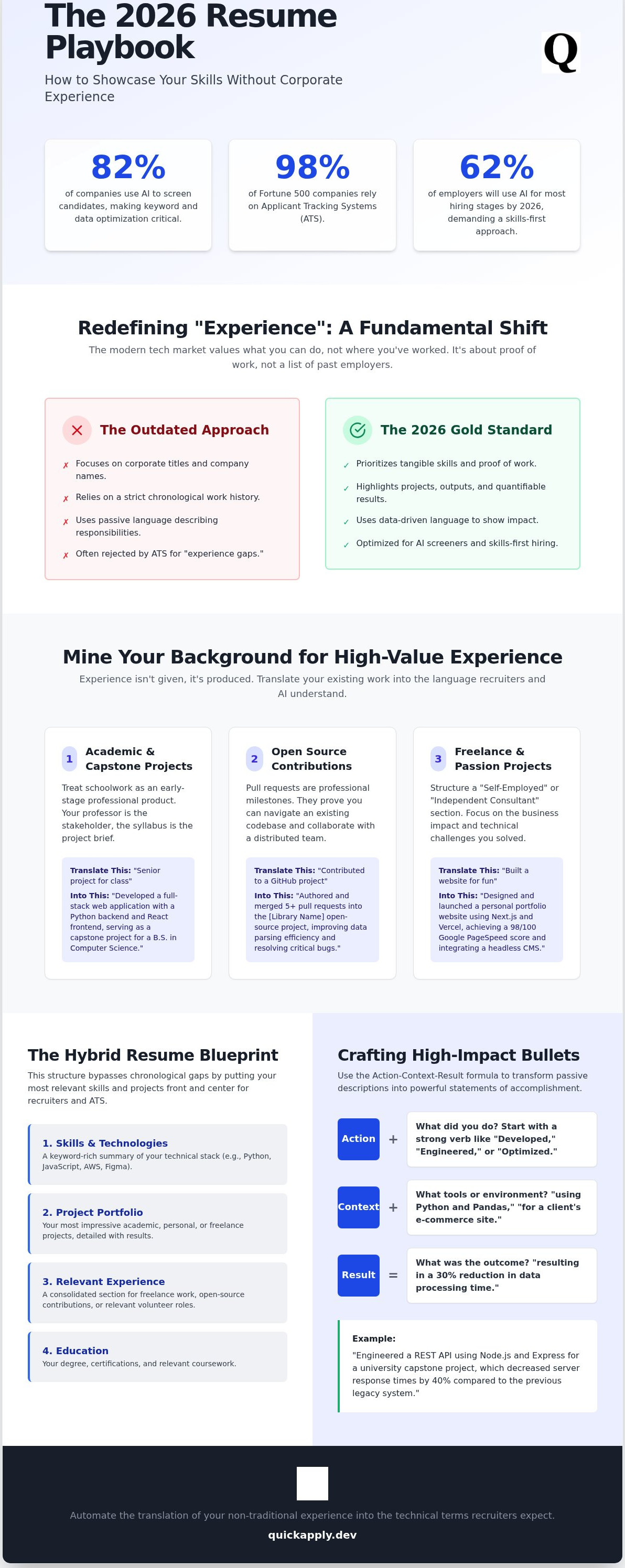
- Shift your focus from corporate titles to tangible proof of work. Modern tech hiring prioritizes your actual outputs over legacy company names.
- Master how to write a resume with no corporate experience by treating academic projects as professional products. This shift turns schoolwork into high-value experience.
- Adopt a hybrid resume structure to highlight skills and projects. This format bypasses the gaps in a traditional chronological history that often trigger ATS rejections.
- Use the Action-Context-Result formula to build high-performance bullet points. Eliminate passive language and replace it with data-driven results that prove your competence.
- Leverage AI-powered tailoring to bridge the gap between your current skills and job descriptions. Tools like QuickApply automate the translation of non-traditional experience into technical terms recruiters expect.
Redefining Experience: No Corporate Title Needed in 2026
Corporate experience is a legacy metric. It's a proxy for skill, not the skill itself. In the current market, recruiters care about your outputs, not just your tenure. If you are struggling with what a resume is supposed to look like without a 9-to-5 history, reframe your thinking. Your resume is a technical spec sheet of your capabilities. Mastering how to write a resume with no corporate experience requires you to view your lack of baggage as a competitive advantage. You're adaptable. You're a digital native. You've built your own path instead of following a scripted one.
The Skills-First Revolution
Industry leaders like Google and Apple have already dismantled the requirement for traditional degrees and titles. They hire for skill. Technical assessments and live coding challenges now act as the primary gatekeepers, allowing talent to bypass legacy filters. Competence-based hiring is the 2026 gold standard. It defines a candidate by their documented ability to execute specific tasks rather than their previous employer's brand name. With 62% of employers expecting to use AI for most hiring stages by 2026, your ability to demonstrate these skills digitally is paramount.
Proof of Work vs. Professional History
A well-maintained GitHub repository or a portfolio of freelance projects often provides more data than a generic internship. There is a massive difference between doing the job and holding the title. Recruiters in 2026 look for the former. Transition from a passive "wait for experience" mindset to an active "build experience" model. If you've solved a problem, shipped a product, or managed a community, you have experience. This shift is essential when learning how to write a resume with no corporate experience. You aren't asking for permission to be professional. You're presenting proof that you already are.
Your goal is to optimize for the system. Over 98% of Fortune 500 companies use Applicant Tracking Systems (ATS) to manage their hiring. These systems don't feel sentiment. They look for keywords and data. By focusing on proof of work, you provide the high-volume data points these systems require to rank you as a top-tier match. You are no longer an unqualified candidate. You're a high-efficiency solution waiting to be deployed.
Mining Your Background: 4 Non-Corporate Sources of High-Value Experience
Stop looking for "jobs." Start looking for "outputs." Experience isn't something you're given; it's something you produce. If you're figuring out how to write a resume with no corporate experience, your history is likely full of unmined value. You just need to extract the data. Recruiters in 2026 don't care about where you sat for eight hours a day. They care about what you shipped. By identifying the specific technical and organizational challenges you've already conquered, you can build a profile that rivals any mid-level professional.
Academic and Capstone Projects
Your senior project isn't schoolwork. It's an early-stage professional product. Treat your professor as a stakeholder and your syllabus as a project brief. Focus on the tech stack. If you built a data visualization tool using Python, the grade is irrelevant. The functionality is everything. Include links to live demos or technical documentation. This provides immediate proof of competence that a simple job title cannot match. You can automate this translation process by letting AI identify the professional keywords hidden in your project descriptions.
Open Source and Community Contributions
Contributing to a major library counts as team experience. Pull requests are professional milestones. They show you can navigate a codebase you didn't build. Community feedback acts as peer review. This social proof validates your skill set to recruiters. It proves you can collaborate in a distributed environment and handle technical critique. These contributions are often the fastest route into in-demand entry-level careers that prioritize actual capability over corporate pedigree.
Freelancing and the Passion Project
Structure a "Self-Employed" or "Independent Consultant" section. Highlight specific client wins. Name your own projects to give them professional weight. Focus on the business side of the work. Emphasize deadlines, requirement gathering, and delivery. This shows you understand the commercial reality of tech work. If you managed a small-scale e-commerce site for a local business, you didn't just "help out." You managed a digital storefront. Highlighting these results is the key to mastering how to write a resume with no corporate experience.
Volunteer work also offers high-stakes technical challenges. Migrating a non-profit's database or securing their network is a massive project. These are not "hobbies." They are professional engagements with real-world consequences. Document them with the same rigor you would use for a paid position. Quantify your impact. If you reduced server costs by 20% for a local charity, that number belongs at the top of your bullet points. Efficiency is the universal language of 2026 hiring.
The Hybrid Resume Format: Structuring for Maximum Impact
Traditional resume structures are built for middle management, not emerging talent. The standard reverse-chronological format is a liability when you lack a corporate history. It highlights empty space instead of capability. Conversely, a purely functional resume often triggers recruiter skepticism. It looks like you're hiding a lack of activity. In 2026, the Hybrid (Combination) format is the optimal solution. It balances the what of your skills with the how of your projects. This approach satisfies both the automated scanners looking for keywords and the human reviewers looking for context.
When learning how to write a resume with no corporate experience, your page hierarchy is your most powerful tool. Place your Skills and Projects sections above your Education. Recruiters spend an average of six seconds on an initial scan. If they have to scroll past a university name to find your tech stack, you've already lost. Front-load the value. This layout signals that you are ready to produce results immediately, regardless of your previous employment status.
The Skills-Forward Header
Categorize your skills instead of using a generic, comma-separated block. It's unreadable for humans and inefficient for ATS. Organize by technical category to allow hiring managers to verify your stack instantly:
- Languages: Python, JavaScript, SQL, C++
- Frameworks: React, Node.js, Django, TensorFlow
- Tools: Docker, Kubernetes, Git, AWS, Azure
Look at good resume examples to see how this layout functions in a modern tech environment. Ensure your primary keywords appear in the top 25% of the document. This is the prime real estate where search algorithms and human eyes focus first. High-density keyword placement in this zone significantly increases your match score and ensures you pass the initial technical filters.
The Projects Section as "Professional Experience"
Elevate your projects to the status of professional experience. Treat them with the same weight as a job. Use titles that reflect your actual contribution. Lead Developer, Capstone Project carries more weight than Student Project. Include dates to demonstrate the duration of your technical commitment. This provides a timeline of growth. For every major entry, add a Technical Environment line. List every language and tool used in that specific project. This creates a dense keyword environment that satisfies tech-heavy ATS filters while proving you know how to integrate tools into a cohesive workflow.
Mastering how to write a resume with no corporate experience is a design challenge. You're building a system to deliver information as fast as possible. By using a hybrid structure, you eliminate the friction between your potential and a recruiter's decision. You're not just a candidate. You're a solution formatted for immediate deployment. This strategy ensures you aren't filtered out before you even get a chance to speak.
Writing High-Performance Bullets: Translating Projects into Professional Results
Stop describing tasks. Start describing impact. When you're learning how to write a resume with no corporate experience, the quality of your bullet points is the difference between an interview and the trash folder. Recruiters don't want to know what you were told to do. They want to know what you actually achieved. The Action-Context-Result (ACR) formula is your primary tool for this transformation. Every line must start with a high-impact verb. "Developed," "Optimized," or "Architected" beats "Responsible for" every time. This shift moves the focus from your status as a student or freelancer to your status as a producer.
Mastering how to write a resume with no corporate experience requires a shift from a student mindset to a results-oriented mindset. You're no longer documenting your education. You're advertising your capabilities. By framing your non-traditional work through the lens of professional achievement, you eliminate the perceived risk of hiring someone without a corporate background.
Quantifying the Unquantifiable
Data is the universal language of 2026 hiring. If you built a web app for a class, don't say you "made a website." Say you "Architected a full-stack platform using React, reducing API latency by 15% through optimized database queries." Turn a vague task into a metric-driven achievement by identifying the scope of the problem and the scale of your solution. If you managed a 5-person capstone team, you didn't just "work together." You "Led a cross-functional team of 5 to deliver a production-ready MVP within a 12-week sprint cycle." Even if your user base was just your classmates, describe the scale. "Built for 1,000+ potential concurrent users" shows you understand load and scalability.
The Tech-Savvy Dialect
Speak the recruiter's language. Even in personal projects, apply professional methodologies. Did you use Git for version control? That's "Implemented version control and CI/CD pipelines." Did you meet weekly to discuss features? That's "Agile methodology." Avoid fluff like "passionate" or "hardworking." These are subjective and unverified. Focus on the "How." Detail the specific tools and methodologies used to solve the problem. This technical precision signals that you're already integrated into the professional tech ecosystem.
You must tailor resume to job description requirements for every application. If a job emphasizes cybersecurity, your bullet points should highlight the encryption and authentication protocols you used in your projects. If they want cloud experience, focus on your AWS or Azure deployments. You can use our Resume Tailoring tool to automate this process, ensuring your project outcomes match the specific technical needs of the employer. This strategy effectively bridges the gap between your non-traditional background and the high-performance expectations of a corporate tech role.
Automating the Gap: How QuickApply Bridges Skills to Tech Roles
Manual resume construction is a high-latency process that entry-level candidates can't afford. When you're applying for dozens of roles, hand-crafting every bullet point is a bottleneck. It's inefficient. Most candidates have the raw talent but lack the corporate dialect required to trigger a recruiter's interest. Solving how to write a resume with no corporate experience isn't just about what you say. It's about how you format that data for machine consumption. QuickApply acts as a technical bridge. It translates your academic and freelance outputs into high-density professional results.
The 2026 job market requires speed. If you're spending hours on a single application, you're falling behind the curve. Automation allows you to scale your outreach while maintaining precision. This isn't about generic templates. It's about systemic optimization. You are refining your authentic experience to meet specific algorithmic requirements. This approach ensures you remain competitive in a landscape where 82% of companies use AI to review resumes.
AI-Powered Resume Tailoring
Upload your raw project list. Let the AI refine the impact. Our system identifies the technical nuances in your schoolwork and converts them into corporate-ready achievements. This ensures your non-corporate background hits every required keyword for a specific tech role. Utilizing a tailor resume to job description ai strategy is the only way to consistently pass modern ATS filters. The AI calculates a match score for every role. It tells you exactly which skills to emphasize and which to deprioritize. It eliminates the guesswork from the application process.
Managing the Entry-Level Volume
Entry-level searches are high-volume by nature. You need a system to manage the chaos. Use our Application Tracker to monitor your progress and stay organized. Don't waste energy on manual spreadsheet tracking. Pair your optimized resume with an ai cover letter generator to create a cohesive professional narrative. This allows you to focus your mental bandwidth on interview prep while the software handles the repetitive paperwork.
Efficiency is your primary competitive advantage. By automating the gap between your skills and employer expectations, you bypass the traditional gatekeepers. You're no longer just learning how to write a resume with no corporate experience. You're deploying a high-tech solution to a legacy problem. This approach ensures your talent is seen by the right people at the right time. Your productivity remains high. Your effort remains low.
Deploy Your Competitive Advantage
Legacy hiring filters are obsolete. You don't need a corporate internship to prove your value in the 2026 market. By prioritizing proof of work and using a hybrid format, you bypass gatekeepers who value titles over actual capability. Learning how to write a resume with no corporate experience is simply a matter of technical translation. You've already built the projects; now you must format that data for the algorithms that decide your future.
Optimization is the only way to scale your search effectively. Don't waste hours on manual edits that don't convert. Start tailoring your project-based resume with QuickApply AI to secure a competitive edge. Our system offers AI-powered match scoring for tech roles and generates tailored documents in seconds. You can manage every high-volume lead with the built-in job application tracker. The infrastructure for your success is already built. Stop waiting for permission and start shipping your professional profile. You're ready for the next level.
Frequently Asked Questions
Can I put school projects on a resume if I have no job experience?
Yes, you can and should include school projects as professional entries. Treat your capstone or senior projects as client deliverables. Focus on the technical environment, such as the specific languages or frameworks used, and quantify the results. This approach provides the technical evidence recruiters need when evaluating candidates. It effectively transforms academic work into a demonstration of professional competence.
How do I pass an ATS if I do not have a previous job title?
Passing an ATS without a job title requires strategic keyword placement in your projects and skills sections. Use descriptive roles like "Lead Developer" for your personal projects. Algorithms look for specific technical terms and methodologies, not just company names. By populating your resume with relevant software and tools, you ensure the system recognizes your proficiency. This is a core component of how to write a resume with no corporate experience.
Is it okay to have a two-page resume with no corporate experience?
Stick to a single page for your initial resume. Density is more valuable than volume in the entry-level market. A two-page document often contains fluff that dilutes your strongest technical points. Focus on your most impactful projects and high-density skill blocks. Recruiters spend less than ten seconds on an initial scan. A concise, one-page layout ensures they see your best work immediately without unnecessary scrolling.
What should I put in the "Experience" section if I have never worked?
Label this section "Technical Experience" or "Project History" instead of "Professional Experience." This allows you to include open-source contributions, volunteer technical work, and significant academic projects. Every entry should follow the Action-Context-Result formula. This structure proves you can execute tasks and deliver value even without a corporate payroll history. It turns your background into a series of professional milestones.
How do I list freelance work on my resume?
List freelance work under a "Self-Employed" or "Consultant" heading. Group your projects by client or technical outcome to show a track record of delivery. Use professional verbs to describe your interactions, such as "Negotiated requirements" or "Deployed solutions." This demonstrates self-management and client communication skills. It bridges the gap between individual hobby projects and professional service delivery in a commercial environment.
Should I include my GPA if I lack professional experience?
Only include your GPA if it is 3.5 or higher. In 2026, skills-based hiring prioritizes your portfolio and technical assessments over academic metrics. If your GPA doesn't meet that threshold, use that space for an additional project or a more detailed skills section. Your ability to ship code or manage a system is a much stronger signal to recruiters than a classroom average.
What are the best skills to list for a tech resume with no work history?
Focus on high-demand technical skills like Python, cloud computing, and cybersecurity. Include foundational methodologies such as Agile or Scrum to show you understand professional workflows. These keywords are essential when learning how to write a resume with no corporate experience. They signal to both the ATS and human reviewers that you possess the modern toolkit required for immediate deployment in a tech role.
How does an AI resume tailor help someone with no experience?
An AI resume tailor acts as a technical translator for your non-traditional background. It analyzes job descriptions to identify the exact keywords your resume is missing. By using match scoring, the tool tells you which projects to highlight for specific roles. It automates the process of rephrasing academic jargon into professional bullet points. This ensures your profile is optimized for efficiency and maximum impact.


