

Why are you treating your entry level software engineer cover letter like a high school book report when it should be a production-ready README? Most junior developers fail because they summarize their past instead of proving their future utility. You're likely facing the experience paradox: you need a job to get experience, but you need experience to get the job. It's a systemic loop that leaves talented engineers stuck behind automated filters and silent recruiters.
We're here to break that cycle. This 2026 guide provides the high-impact templates and AI-driven strategies you need to bypass the "no experience" barrier. You'll learn to refactor your project history into a compelling technical narrative that resonates with hiring managers. We're moving beyond generic fluff to offer a clear, repeatable framework for your applications. By the end of this article, you'll have the confidence to present your personal repositories as high-value assets, significantly increasing your interview invite rates. Stop guessing what recruiters want and start deploying a cover letter that works as hard as your code.
Key Takeaways
- Stop writing summaries and start delivering technical proof of concepts through a strategic entry level software engineer cover letter.
- Identify "hidden experience" in your GitHub repositories and capstone projects to demonstrate value when you don't have a professional title.
- Use a specific technical hook to grab recruiter attention and bypass the cultural fit AI filters used in the 2026 market.
- Eliminate academic fluff and "walls of text" to ensure your message is consumed and understood in seconds.
- Implement high-speed tailoring strategies to scale your application volume without sacrificing quality or impact.
Why the Entry Level Software Engineer Cover Letter Still Matters in 2026
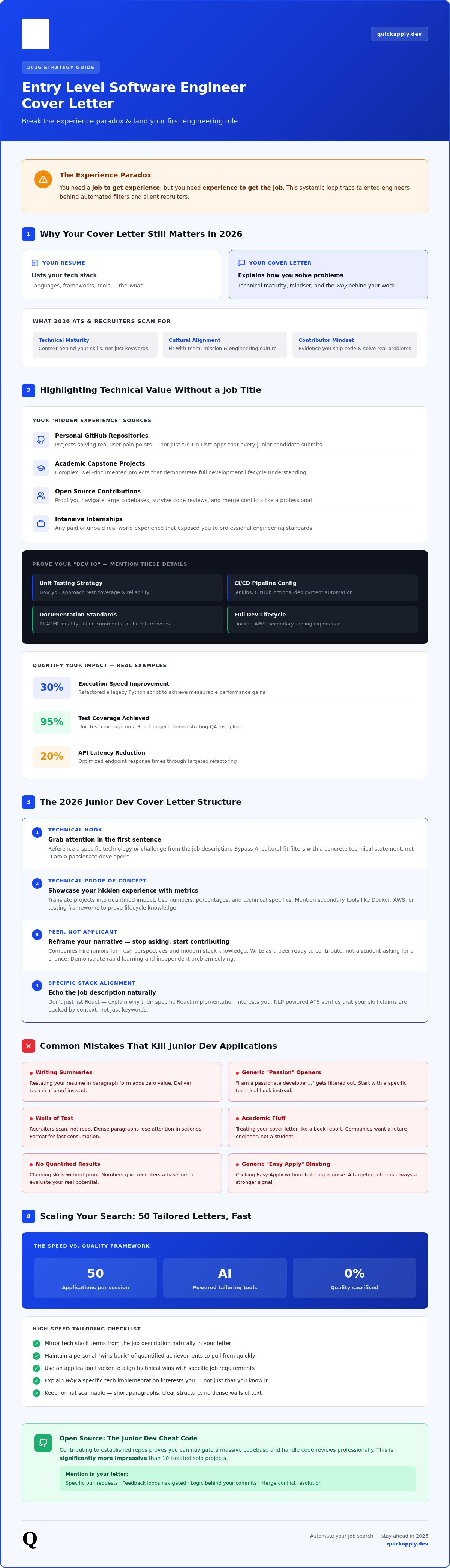
Your resume lists your stack. Your entry level software engineer cover letter explains how you use it to solve business problems. In 2026, the job market is saturated with automated applications and generic profiles. Recruiters now deploy sophisticated AI scanners that look for more than just a list of languages. They seek technical maturity, cultural alignment, and evidence of a contributor mindset. A strong letter provides the "why" behind your technical "what," transforming you from a row in a database into a human engineer ready to ship code.
Technical storytelling is your most effective tool for bridging the experience gap. It allows you to frame your academic or personal projects as professional-grade work. Instead of claiming you know Python, describe how you refactored a legacy script to improve execution speed by 30%. This approach provides the technical proof-of-concept recruiters crave. It differentiates you from the thousands of candidates clicking "Easy-Apply" without a second thought. You aren't just looking for any job; you're demonstrating why you're the specific solution to their engineering challenges.
The "Experience Paradox" and How to Break It
The experience paradox is a logic error in modern hiring. You need a job to get experience, but you need experience to get the job. You can break this loop by shifting your narrative. Companies hire junior developers because they want fresh perspectives, high adaptability, and knowledge of modern stacks. Stop acting like a student asking for a chance. Start acting like a peer ready to contribute to their codebase. Focus on your ability to learn fast and solve problems independently. Using a cover letter builder helps you maintain this professional, results-driven tone across dozens of applications without losing your edge. It optimizes the manual grind so you can focus on technical interviews.
Bypassing the Initial Scanners
Scanners are the first gatekeepers of your career. The 2026 ATS doesn't just look for keywords; it analyzes the relationship between your skills and the company's specific needs. A tailored resume to job description is only half of the equation. Your entry level software engineer cover letter must echo that alignment to maximize your match score. Mention the specific tech stacks from the job description naturally. If the role requires React, don't just list it. Explain why their specific implementation of React interests you. Modern systems use natural language processing to verify if your claims are backed by context. Mentioning secondary tools like Docker, Jenkins, or specific AWS services alongside your primary stack proves you understand the full development lifecycle.
Highlighting Technical Value Without Professional Experience
You don't need a corporate payroll history to prove you can write production code. Your entry level software engineer cover letter should act as a technical dossier that showcases your "hidden experience." This includes intensive internships, complex academic capstones, and active personal repositories. Stop showcasing "To-Do List" apps. Every junior has one. Instead, prioritize projects that solve actual user pain points or address technical bottlenecks. Demonstrate your "Dev IQ" by mentioning the boring but critical aspects of engineering. Mention your unit testing strategy, your documentation standards, or how you configured a CI/CD pipeline. These details prove you understand the full software development lifecycle.
Quantify your impact with concrete metrics. Did your refactor reduce API latency by 20%? Did you achieve 95% test coverage on a React project? Numbers provide a baseline for your skill level and give recruiters a tangible metric to evaluate your potential. If you're struggling to organize these achievements, using an application tracker can help you align your technical wins with specific job requirements across multiple roles.
The Power of Open Source Contributions
Contributing to established repositories is a cheat code for junior devs. It proves you can navigate a massive codebase and handle code reviews without taking them personally. Mention specific pull requests in your letter. Describe the feedback loop you navigated and the logic behind your commits. This positions you as a collaborator who understands professional engineering standards. It's significantly more impressive than ten isolated solo projects that never saw a peer review or a merge conflict.
Showcasing Your GitHub and Portfolio
Use your cover letter to narrate your most impressive repository. Don't just link to it; explain the "why" behind your technical decisions. If you chose Go for a backend service because of its concurrency model, say so. If you deployed a React frontend on AWS using S3 and CloudFront, highlight that infrastructure choice. Link these decisions to the potential needs of the hiring company. If they use a similar stack, you've already proven you can operate within their ecosystem. This level of specificity is what lands interviews in 2026.
The 2026 Junior Dev Cover Letter Structure
Architecture matters in code and in your entry level software engineer cover letter. A disorganized letter signals a disorganized engineer. You need a modular structure that allows for rapid customization while maintaining a high-impact core. Recruiters in 2026 spend less than six seconds on an initial screen. Your layout must guide their eyes toward your technical competence instantly. Forget the three-page essays. You need a lean, performance-optimized document that hits four specific marks: a technical hook, a problem-solving core, a culture-add proof point, and a confident call to action.
Writing the Perfect Hook
Stop using the "I am writing to apply" template. It's a waste of prime real estate. Start with a direct connection to the company’s current technical trajectory. Try an opening like, "I was impressed by [Company]’s recent move to serverless architecture for their payment gateway." This shows you've done your research and understand their stack. Connect your specific niche interest, whether it's Fintech or Cybersecurity, to the problems they are solving today. If you need inspiration, review these cover letter examples to see how professional-grade openings are constructed. A strong hook validates your interest and sets the tone for a peer-level technical conversation.
Structuring the Technical Body
The core of your letter should use the STAR method to detail a single, high-impact project. Focus on the "Action" phase. What code did you actually ship? Explain the "Why" behind your tech stack choices. If you picked Go over Node.js for a specific microservice, justify that decision based on performance or concurrency needs. This demonstrates architectural thinking. It proves you can translate requirements into functional code. Use a concise list to break down your contributions:
- Situation: The specific bottleneck or problem you identified.
- Task: Your role in the solution.
- Action: The specific languages, frameworks, and logic you implemented.
- Result: The measurable outcome of your work.
Finally, address the "Culture Add" by highlighting your curiosity. Mention a new tool or methodology you mastered in a high-pressure environment, like a 48-hour hackathon. Close with a confident call to action. Suggest a technical discussion about their upcoming roadmap rather than just asking for an interview. This reframes the interaction as a meeting of two engineers rather than a plea for employment. It shows you're ready to hit the ground running on day one.
Common Mistakes That Kill Junior Dev Applications
Your entry level software engineer cover letter is a technical document, not a personal diary. Many candidates sabotage their chances by clinging to an academic mindset. In a professional environment, your 4.0 GPA is a vanity metric. Hiring managers care about your ability to ship functional code and navigate a sprint. If your letter focuses on your coursework rather than your contributions, it goes into the trash. Shift your focus from "what I want to learn" to "what I can contribute." Companies aren't schools; they're businesses looking for a return on their investment in your salary.
Presentation is just as critical as content. Avoid the "Wall of Text" at all costs. Recruiters scan documents for keywords and technical signals. They don't read every word of a five-paragraph block. Use short, punchy paragraphs that mirror the QuickApply tone to keep the reader engaged. Additionally, stop using a single generic template for every application. Sending the same letter to a massive enterprise like Google and a five-person seed-stage startup is a major red flag. It proves you don't understand the different technical challenges and cultural needs of these distinct environments.
Managing the Tone: Confidence vs. Humility
Desperation is a repellent. You aren't a student begging for a chance; you're a capable junior engineer ready to solve problems. Own your technical journey. If a project failed or you hit a massive roadblock, describe how you debugged and iterated. This shows resilience and technical maturity. Use active, high-impact verbs to describe your work. Don't say you "worked on" a database. Say you "Architected" the schema, "Optimized" the queries, or "Refactored" the legacy logic. These words signal authority and competence.
The Danger of Generic AI Prompts
A raw ChatGPT output is a digital red flag. Recruiters can spot the repetitive patterns and robotic transitions of a generic AI letter from a mile away. The secret isn't avoiding AI; it's using a sophisticated tailor resume to job description ai strategy. This ensures your technical skills are mapped directly to the job requirements without losing your personal "voice." Use AI to generate the structure and optimize the keywords, then manually inject your specific project details to prove authenticity. To ensure your applications always hit the mark, use a professional Cover Letter Generation tool to automate the tailoring process with precision.
Scaling Your Search: How to Tailor 50 Letters in 50 Minutes
Success in the 2026 job market is a function of both volume and precision. You cannot rely on a single perfect application. You also cannot win by spamming generic templates that trigger automated rejection filters. The most efficient engineers treat their job search like a deployment pipeline. You need to scale your output while maintaining a high-quality entry level software engineer cover letter for every role. This balance is impossible to achieve manually without burning out or sacrificing your technical practice time.
QuickApply acts as the IDE for your career. Our AI cover letter generator eliminates the manual grind of writing from scratch. By analyzing your unique profile against specific job descriptions, it generates a tailored draft in seconds. Use the Match Score feature to identify roles where your skills are a 90% or higher fit. This allows you to prioritize high-probability opportunities first. Once you've applied, the built-in Application Tracker ensures you never lose track of a lead or double-apply to the same firm. It's about systemic automation that puts you ahead of the curve.
Using AI as Your Career Copilot
Stop staring at a blank cursor. Connect your GitHub data and the job description to get a perfectly aligned draft instantly. You can iterate with the AI to highlight specific project components that match the company’s requirements. If a role emphasizes AWS, the copilot ensures your cloud projects take center stage. This workflow saves hours of manual typing. You can redirect that energy toward LeetCode, building new features, or preparing for high-stakes interviews. High-volume output with low-effort input is the only way to navigate a crowded digital market.
Final Checklist Before You Hit Submit
Automated speed requires a final manual verification. Before hitting submit, run through this technical checklist to ensure zero errors in your deployment:
- Verify the Stakeholder: Check for specific mentions of the hiring manager or the engineering team.
- Link Validation: Ensure your LinkedIn and GitHub links are active and point to a professional, updated profile.
- Stack Alignment: Double-check that your tech stack mentions match the job description exactly.
- Call to Action: Confirm your closing suggests a technical discussion rather than a generic plea for an interview.
Precision is the difference between an invite and a silent rejection. Deploy your applications with confidence and let the technology handle the heavy lifting. You've optimized your code; now it's time to optimize your career path.
Deploy Your Engineering Career with Precision
You now have the structural framework to transform a generic application into a high-impact technical pitch. Remember that your entry level software engineer cover letter is a proof-of-concept for your future value. Focus on technical storytelling. Prioritize real-world problem solving over academic metrics. Use modular structures to maintain speed without sacrificing depth. The experience paradox is a hurdle, not a wall, and you have the tools to scale it.
Efficiency is your greatest competitive advantage in a crowded market. Manual tailoring is a legacy process that slows your momentum. QuickApply provides the modern infrastructure you need to scale your reach. With AI-powered match scoring and unlimited cover letter versions built specifically for tech professionals, you can apply to dozens of roles with surgical accuracy. Stop letting manual paperwork block your path to production.
Generate your tailored tech cover letter in seconds with QuickApply and take control of your career trajectory. Your first development role is within reach; it's time to automate the grind and start building. We'll see you in the codebase.
Frequently Asked Questions
Is a cover letter required for an entry-level software engineer job?
Yes, unless the application system specifically blocks it. An entry level software engineer cover letter is your primary tool for bypassing the experience paradox. It provides the narrative context that a resume lacks. Use it to prove you're a contributor who understands the business side of code. Without this document, you're relying solely on keywords to survive the initial ATS scan.
How long should a junior developer cover letter be?
Your letter should never exceed one page. Aim for 250 to 350 words of high-impact content. Recruiters spend seconds on the initial screen. They want to see density, not fluff. Focus on three modular sections: a technical hook, a problem-solving core, and a call to action. Efficiency in your writing reflects efficiency in your code. Keep it short and performance-optimized.
What should I put in my cover letter if I have no internships?
Highlight your personal repositories and capstone projects. Treat your best GitHub repo like a professional internship. Describe the technical challenges you overcame and the architectural decisions you made. Mention specific languages like Go or Rust and explain why you chose them. If you lack a corporate title, prove your value through functional, documented, and tested personal code.
Can I use an AI generator to write my software engineering cover letter?
You can, but avoid generic prompts for an entry level software engineer cover letter. A raw AI output lacks the technical specificity needed for a high-match score. Use a specialized tool to generate a baseline that aligns your skills with the job description. Then, manually refactor the draft to include your specific project metrics. This approach combines systemic automation with authentic human engineering expertise.
Should I include my GitHub link in my cover letter?
Absolutely. Your GitHub is your portfolio of proof. Place it near your contact information or mention a specific repo when discussing a technical achievement to drive immediate traffic to your code. When you discuss a project, link directly to the relevant repository or pull request. This allows hiring managers to verify your technical skills instantly. It turns your letter into an interactive README for your career.
How do I address a cover letter if I don’t know the hiring manager’s name?
Address it to the "Engineering Hiring Manager" or "Technical Recruiting Team." Avoid generic, non-technical greetings that feel like legacy corporate jargon. If you can identify the specific squad or department, use that instead. Directing your letter to a technical peer shows you've researched the company's internal structure and understand where you fit in the stack.
What technical skills are most important to mention in 2026?
Prioritize cloud-native development, AI integration, and automated testing. In 2026, companies expect juniors to understand the full deployment lifecycle. Mention your experience with Docker, Kubernetes, or specific AWS services. Proving you can write unit tests and navigate CI/CD pipelines signals that you're ready to ship production code on day one without constant oversight from senior engineers.
How do I explain a career change into software engineering in my cover letter?
Position your previous career as a strategic asset. Don't apologize for your background. Instead, explain how your prior experience in fields like finance or logistics informs your technical logic. Focus on the transferable skills of system analysis and problem-solving. Show how you've applied these skills to your new stack to become a more versatile and mature developer.


