

Why are you still spending four hours tailoring a single resume when a machine can do it better in four seconds? Finding the best ai for job applications 2026 is no longer a luxury; it's a requirement for any tech professional who values their time. You're qualified and your stack is modern, yet you're likely still getting ghosted by black-box ATS filters. Managing 50 plus applications across dozens of platforms isn't a career strategy; it's a manual labor trap that drains your cognitive energy. You know the traditional process is broken, and it's time to stop wasting your talent on administrative friction.
This guide promises to help you reclaim 90% of your search time while actually increasing your interview callback rates. We'll show you how to use precision engineering to bypass filters and land high-paying roles. You'll get a direct look at the elite tools for resume tailoring, automated tracking, and data-driven salary negotiation that will secure your next major career jump. We're breaking down exactly how to automate the tedious parts of your hunt so you can focus on the only thing that matters: the interview.
Key Takeaways
- Stop wasting time on manual entries; learn how to navigate the 2026 AI-ATS arms race where precision beats volume.
- Discover the best ai for job applications 2026 to automate resume tailoring while maintaining a sharp, tech-specific edge.
- Build a complete career stack that handles everything from cover letter generation to real-time interview coaching.
- Secure higher starting salaries using data-driven negotiation guides instead of relying on corporate averages.
- Transition from simple application tracking to a full promotion roadmap to ensure long-term professional growth.
The 2026 Job Market: Why Manual Applications Are Obsolete
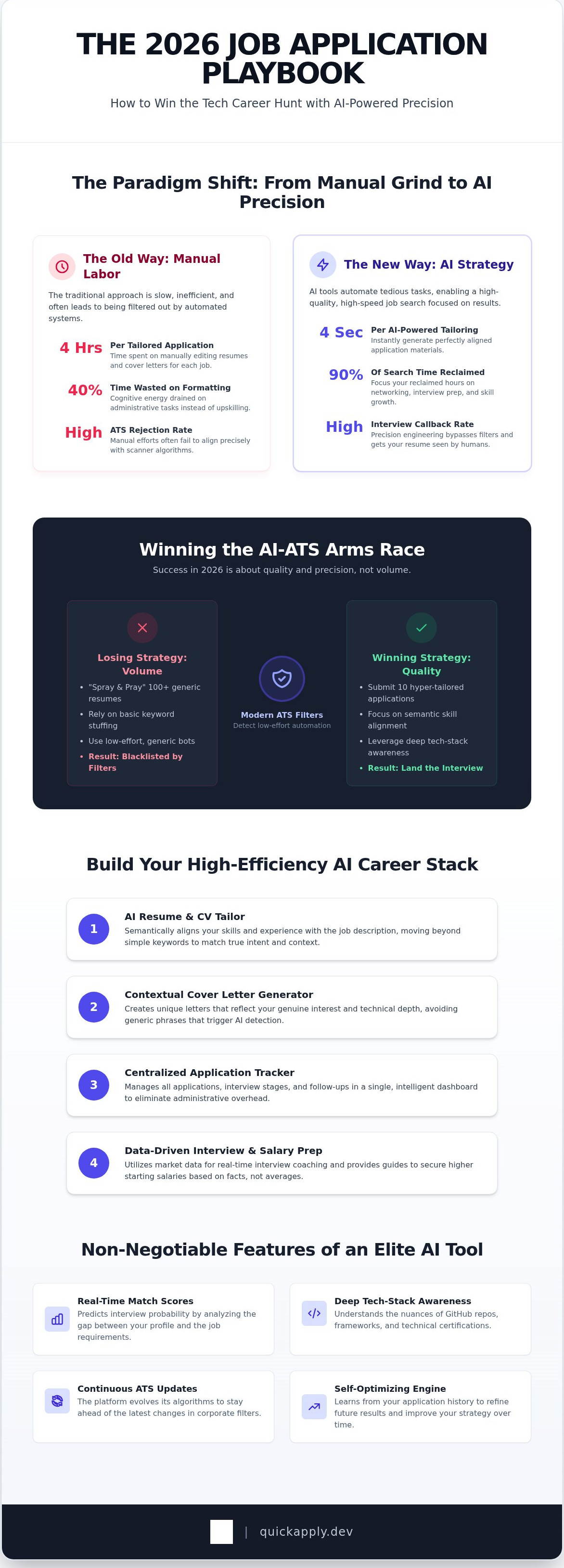
The job search has evolved into a precision engineering challenge. In 2026, recruiters have deployed sophisticated AI systems to detect low-effort automation. If you use a generic bot to "spray and pray" your resume across 500 listings, you're effectively blacklisting yourself. This is the AI-ATS Arms Race. It's a high-stakes game where the best ai for job applications 2026 must be subtle, technical, and hyper-accurate. Manual applications can't keep up with the speed of the market, and low-grade automation can't survive the filters.
Success now requires shifting from keyword stuffing to semantic skill alignment. Recruiters are no longer looking for a simple list of tools. They're looking for proof of implementation and architectural understanding. If your application doesn't reflect the specific technical nuances of the role, it won't even reach a human screen. Precision tailoring is the only way to bypass modern filters and prove you're the right fit for high-end tech sectors.
The Rise of AI-Driven ATS Filters
Modern ATS platforms analyze intent and context. They don't just scan for keywords; they evaluate the relationship between your skills and the company’s specific tech stack. Generic LLM prompts leave distinct "AI fingerprints" that signal a lack of effort to a trained recruiter's toolset. For specialized tech roles, your resume needs a deeper level of technical alignment. You must prove you understand the "why" behind the code, not just the "how." Filters are now smart enough to recognize when a resume has been lazily generated without actual thought.
The Volume vs. Quality Paradox in Tech Hiring
In the 2026 landscape, quality is the only metric that matters. Sending 100 generic applications is a waste of your bandwidth and the recruiter's time. Consider these factors of the modern search:
- Efficiency: 10 tailored applications consistently beat 100 generic ones in interview callback rates.
- Time Waste: Tech pros often spend 40% of their search time on manual formatting. That's hours of lost productivity that could be spent on upskilling.
- Precision: You must tailor resume to job description requirements with surgical accuracy to survive the first five seconds of an AI scan.
Relying on the best ai for job applications 2026 allows you to maintain this high-quality output without the manual grind. It's about working smarter, not harder, to secure the roles that actually matter. By automating the alignment process, you ensure every submission is a strike instead of a shot in the dark.
Evaluating the Top AI Job Application Tools of 2026
The 2026 landscape is divided into four primary categories: Builders, Tailors, Trackers, and Career Managers. To find the best ai for job applications 2026, you must look for tools that offer deep tech-stack awareness rather than generic text generation. Accuracy and ease of use are non-negotiable. While fragmented tool stacks were common in previous years, the current market favors all-in-one platforms that maintain a consistent data thread from the first application to the final negotiation.
Subscription-based SaaS models deliver higher ROI than one-off purchases. They provide continuous updates to match evolving ATS algorithms and build a long-term data profile of your career. This centralized approach eliminates the friction of moving data between disconnected apps. You need a system that learns from your application history to refine your future results, turning your job search into a self-optimizing engine.
Resume Tailoring vs. Auto-Apply Bots
Auto-apply bots are a relic of a high-volume, low-quality era. They focus on form-filling speed but ignore content quality. This is why tailor resume to job description ai is the modern gold standard. A bot might click "Submit" 100 times, but if the PDF isn't optimized for the specific role, it's a wasted effort. Technical roles require tools that understand the nuances of GitHub repositories and specialized certifications. You need a system that translates your commits into quantifiable business value, not just a list of keywords.
The Essential Feature Set for Tech Professionals
High-performance tools must include specific technical capabilities to be effective in 2026. Modern systems prioritize data over aesthetics to ensure your profile reaches a human recruiter.
- Match Scores: These predict your interview probability by analyzing the gap between your profile and the job requirements.
- ATS-Clean PDF Export: Fancy designs are often the enemy of the machine. Your output must be readable by every major ATS without parsing errors.
- Browser Extensions: A "one-click" workflow on LinkedIn or Indeed is essential for maintaining momentum.
Efficiency is the goal. If you're looking for a tool that integrates these features into a single dashboard, you should explore high-performance career automation to see how it streamlines your workflow. Managing your search shouldn't be a full-time job; it should be a background process that delivers results while you focus on your actual work.
Building Your AI Career Stack: Beyond the Resume
Your resume is your entry point, but it's not a complete strategy. In 2026, a standalone document is a vulnerability. You need a full-stack career infrastructure. This ecosystem includes cover letters, tracking systems, and scoring algorithms that work in sync. Reviewing good resume examples shows that the most successful candidates treat their search like a product launch. They don't just apply; they deploy. Finding the best ai for job applications 2026 is about more than just finding a tool; it's about building a system.
Using the best ai for job applications 2026 means moving beyond simple text generation. It's about data synchronization. Your tracker should feed your cover letter generator, which should then inform your interview prep. This creates a feedback loop that sharpens your profile with every submission. Efficiency isn't just about speed; it's about the technical cohesion of your entire application funnel.
Cover Letter Automation That Doesn’t Sound Like a Bot
Recruiters can spot a generic LLM prompt from a mile away. If your letter starts with "To Whom It May Concern," you've already lost. Use an ai cover letter generator that prioritizes technical specificity over corporate fluff. Inject your GitHub contributions or specific architectural wins into the narrative. The 2026 trend favors short, punchy letters that prove value instantly. Don't write a memoir. Write a technical pitch that demonstrates you've researched the company's current challenges.
Integrating Application Tracking and Match Scores
Chaos is the enemy of the high-end job search. If you're managing 50 plus roles, a spreadsheet isn't enough. Use Kanban boards to visualize your funnel from initial application to final offer. This visual clarity allows you to spot bottlenecks in your process. Match Scores are your most critical KPI. They help you decide where to invest your cognitive energy. If a role has a 95% match score, spend an extra ten minutes on the cover letter. If it's a 60% match, let the automation handle it and move on. These scores analyze semantic overlap between your technical history and the job's requirement parameters. Efficiency is about resource allocation.
Post-interview momentum is equally vital. Automate your follow-up emails to maintain a professional presence without manual effort. Use AI to draft messages that reference specific technical points discussed during the interview. This closes the loop and keeps you top-of-mind for the hiring team while you focus on your next technical challenge.
Mastering the Full Lifecycle: Interview Prep to Salary Negotiation
Landing the interview is a milestone, not the finish line. In 2026, the competitive gap widens during the live conversation. You've used the best ai for job applications 2026 to get through the door; now you must use it to close the deal. Transitioning from candidate to hire requires a shift in strategy. You need to move from passive alignment to active persuasion. Most applicants fail here because they treat the interview as a separate event rather than the final stage of a technical funnel.
Efficiency doesn't stop at the "Submit" button. To truly optimize your career, you must automate the preparation process. This ensures that when you finally speak to a hiring manager, your responses are backed by data and structured for maximum impact. You aren't just looking for a job; you're engineering a career move that maximizes your market value from day one.
Real-Time Interview Practice Tools
Modern interview prep has moved beyond static question lists. High-performance tools like final round ai provide real-time coaching to help you navigate behavioral and technical hurdles. Use AI to build a "story bank" of your technical projects. This system indexes your past architectural wins and GitHub contributions, allowing you to recall specific data points instantly. Mock interviews now simulate the scrutiny of a senior engineer, identifying weak points in your logic or communication before the actual meeting. This level of preparation turns a high-pressure environment into a predictable execution of your narrative.
AI-Powered Salary Negotiation and Promotion Roadmaps
Negotiation is a data game. Don't rely on generic salary aggregates that don't account for your specific tech stack. Use AI to benchmark your skills against real-time national data to understand your true leverage. Drafting a negotiation script with AI allows you to ask for higher compensation without the emotional friction that often leads to underselling. It provides the logical framework to justify your worth based on the technical value you'll deliver.
The best ai for job applications 2026 also looks beyond the start date. Use a promotion roadmap to plan your first 90 days. This proactive approach sets clear KPIs and technical milestones, ensuring you're positioned for a lead role or salary bump within your first year. If you're ready to move from applicant to high-earning professional, secure your next high-paying tech role with a system designed for end-to-end success. Stop guessing your value and start proving it with a data-driven career strategy.
QuickApply: The High-Efficiency Engine for Modern Tech Careers
Manual application workflows are a legacy system. You don't need another generic form filler; you need a high-performance engine. QuickApply is the best ai for job applications 2026 because it treats your career like a deployment pipeline. It automates the administrative friction while keeping your technical profile sharp and accurate. It's built for digital natives who demand speed without sacrificing the precision needed for elite engineering roles.
The "Tailor in Seconds" promise isn't just marketing. It's a functional reality. By mapping your specific tech stack to complex job descriptions, QuickApply ensures your resume passes every semantic filter. You stop being a name in a database and start being the obvious solution to a recruiter's problem. This tool is a long-term investment in your trajectory, moving you from the initial hunt to the final negotiation with data-backed confidence.
Why Tech Professionals Choose QuickApply
Generalist tools don't understand the difference between React and Vue, or AWS and Azure. QuickApply was built by tech professionals who know the nuances of systems and code. Instead of juggling five different apps for tracking, tailoring, and practicing, you get a single, high-efficiency dashboard. This all-in-one approach eliminates data silos. Your application history directly informs your interview practice sessions and your salary negotiation guide. It's an unapologetic focus on optimization that saves you hundreds of hours over the course of your career.
Getting Started: From Student to Senior Engineer
Setup is designed for speed. Import your existing resume and set up your profile in under a minute. Within the first 60 seconds, you can run your first match score check against any live job listing. This instant feedback tells you exactly where you stand before you even click apply. The match score analyzes your technical alignment so you only focus on high-probability opportunities.
The platform isn't just for the search; it's for the growth that follows. Use the Promotion Roadmap feature to plan your next level while you're still settling into your new role. Stop building manual resumes and start tailoring your future. Optimize your career with QuickApply today and take the most efficient path to your next high-paying role. Secure your competitive advantage with the only tool designed for the modern technical landscape.
Take Control of Your Career Pipeline
The 2026 job market doesn't reward manual effort; it rewards systemic efficiency. You've seen how precision tailoring and semantic alignment are the only ways to bypass modern filters. Fragmented tools waste your bandwidth and disrupt your focus. You need a unified engine that provides match score precision and manages your entire trajectory from the first application to the final promotion roadmap. Relying on the best ai for job applications 2026 isn't about cutting corners. It's about engineering a competitive advantage that places you in the top 1% of candidates. You're a tech professional; your job search should reflect that level of technical sophistication.
Stop fighting the system and start mastering it. You have the skills, but the administrative grind is holding you back from the interviews you deserve. Join the thousands of tech pros optimizing their career with QuickApply to access resume tailoring in seconds and end-to-end career management. Your next high-paying role is waiting for the right technical alignment. Build your future with a platform designed for the speed of the modern web.
Frequently Asked Questions
What is the best AI for job applications in 2026?
QuickApply stands as the best ai for job applications 2026 because it integrates end-to-end career management into a single, high-performance dashboard. Unlike generic tools, it focuses on technical semantic alignment for software engineers and data professionals. It automates the administrative friction of the search while maintaining the high quality required to bypass sophisticated ATS filters. This efficiency ensures you spend your time on interviews rather than manual data entry.
Can recruiters tell if I used AI to tailor my resume?
Recruiters can identify generic AI-generated text, but they cannot detect high-quality semantic tailoring. Recruiters often flag resumes that use basic LLM prompts because they leave behind distinct fingerprints like repetitive phrasing and a lack of technical depth. Professional tailoring tools prioritize technical accuracy and specific project metrics over fluff. When you use a system that aligns your actual experience with the job description, the result looks like it was written by an expert.
Do AI resume builders actually work for Applicant Tracking Systems (ATS)?
Yes, provided they output clean, machine-readable PDFs without complex formatting. Effective AI tools prioritize parsing compatibility over visual design. Modern ATS platforms in 2026 utilize semantic analysis to evaluate your technical history. If your resume builder focuses on clean data structures and keyword-to-skill mapping, it will successfully navigate these filters. Avoid builders that rely on heavy graphics or non-standard fonts, as these often cause parsing errors that lead to automatic rejection.
Is it better to use an auto-apply bot or a resume tailor?
Precision tailoring is significantly more effective than high-volume auto-apply bots in the 2026 market. Auto-apply bots focus on volume but often trigger spam filters because they submit generic profiles. In contrast, a resume tailor ensures every application is hyper-relevant to the specific role. Using the best ai for job applications 2026 to customize your documents allows you to maintain a high-quality standard while still applying at a much faster pace than manual methods.
How does an AI match score help my job search?
A match score acts as a priority filter, telling you which applications deserve more of your cognitive energy. The match score analyzes the semantic overlap between your resume and the job listing. It predicts your interview probability by identifying missing skills or experience gaps before you hit submit. This allows you to focus your efforts on roles where you have a 90% plus match, maximizing your return on time invested. It turns the search into a data-driven strategy.
What features should I look for in an AI job application tracker?
Look for a tracker that includes Kanban visualization, automated follow-up drafts, and browser extension integration. A high-performance tracker should do more than just list company names. It needs to sync with your browser to capture job details in one click and provide automated alerts for follow-up emails. Visualizing your funnel through stages like Applied and Interviewing helps identify where your process is stalling. Integration with your tailoring tool is essential to ensure your data stays synchronized.
Are paid AI job search tools worth the subscription cost?
Yes, because the time saved and the potential for a higher starting salary provide a massive ROI. Subscription-based tools offer continuous updates to match evolving ATS algorithms and provide end-to-end support from prep to negotiation. The cost is negligible compared to the weeks of manual labor saved or the thousands of dollars gained through a data-driven salary negotiation guide. Investing in a professional-grade tool signals that you value your time and are serious about your trajectory.
How can AI help with tech interview preparation?
AI helps by simulating technical scrutiny and coaching you through behavioral responses in real-time. Modern tools use your technical history to create mock interview scenarios that mirror the expectations of senior engineers. They help you build a story bank of your architectural wins and project metrics, ensuring you can recall data points under pressure. Real-time coaching identifies patterns in your communication, such as logic gaps, allowing you to refine your delivery before you ever step into the final round.


