

In the 2026 tech market, landing a top-tier role isn't about how much you know. It's about how well you execute under the analytical gaze of an automated screening system. You've likely spent weeks grinding technical problems, yet the actual conversation still feels like a high-stakes gamble. Integrating a professional ai interview practice tool into your routine solves the crushing anxiety of unpredictable questions and the struggle to articulate your impact using the STAR method.
Stop wasting hours on generic prep that doesn't match your specific job description. These tools transform your preparation from passive reading into a high-fidelity simulation. By using smart technology to mirror real-world hiring loops, you build the muscle memory needed to handle any curveball a recruiter throws your way. It's the difference between hoping for the best and knowing you're the best candidate in the pipeline.
This article teaches you how to leverage data-driven simulations to predict exact interview questions and refine your answers for maximum impact. We'll explore how to optimize your performance through high-volume practice, ensuring you secure your next role with total confidence. Discover the system that turns interview uncertainty into a streamlined path toward your next signed offer.
Key Takeaways
- Understand why traditional memorization is obsolete and how to navigate the AI-led screening systems of the 2026 tech landscape.
- Leverage an ai interview practice tool to decode hidden job requirements and simulate high-stakes recruiter interactions before your first call.
- Upgrade your STAR method responses by using automated feedback to inject quantifiable data and technical impact into every career story.
- Treat your preparation like a technical sprint by integrating high-volume simulations with an automated application tracker for maximum efficiency.
The 2026 Tech Interview: Why Traditional Prep is Obsolete
The 2026 tech market moves at the speed of an API call. Traditional prep methods, like reading archived blog posts or rehearsing in front of a mirror, are systemic failures. Companies have automated their side of the table. They use sophisticated algorithms to analyze your background before you even say hello. If your preparation isn't as high-tech as their screening process, you're already behind. You're bringing a manual mindset to a digital-first battlefield.
Modern hiring pipelines rely on how AI is used to automate the initial evaluation of candidates. Recruiters don't just look for keywords. They look for data-driven evidence of impact. Generic "top 10" question lists fail because they can't replicate the specialized, role-specific queries generated by an LLM analyzing a unique job description. You need an ai interview practice tool that adapts to the specific technical requirements of the role you're targeting. Anything less is a waste of your time.
The AI vs. AI Hiring Landscape
Recruitment is an optimization problem. Companies use AI to find the 1 percent who fit their exact technical stack and culture. Your resume is likely already tailored by AI. Your verbal performance must maintain that same precision. Relying on manual mock interviews is a bottleneck. Human feedback is inconsistent, biased, and slow. Smart technology provides the objective, instant feedback required to survive first-round automated screenings. It ensures your spoken impact matches your digital footprint.
From Memorization to Simulation
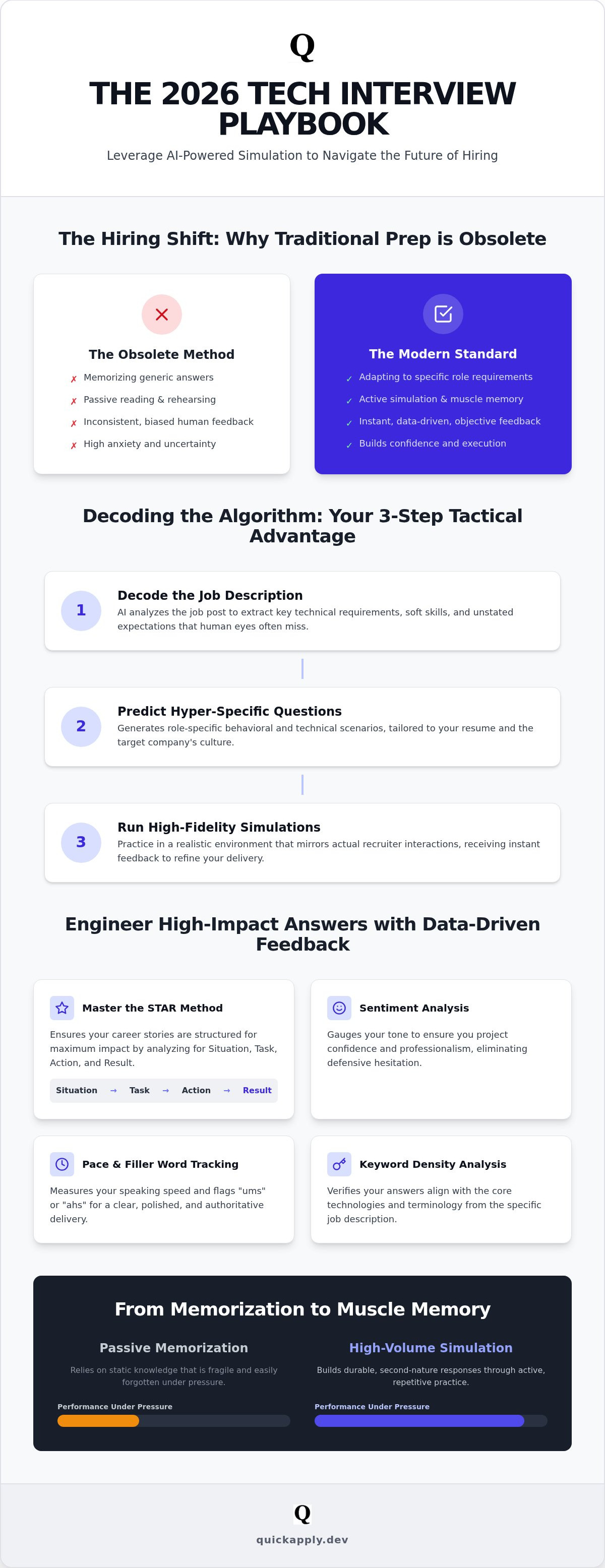
Thinking on your feet is a myth in high-stakes tech rounds. Success comes from pattern recognition. You don't need to memorize answers. You need to simulate the environment until the execution becomes mechanical. An ai interview practice tool allows for high-volume simulation, exposing you to hundreds of variations of technical and behavioral prompts. This creates an active feedback loop where you refine your delivery in real-time. Move away from passive reading. Focus on building the muscle memory that converts technical knowledge into signed offers. Efficiency is the only metric that matters.
Decoding the Algorithm: How an AI Interview Practice Tool Works
An ai interview practice tool is an NLP engine designed to deconstruct job descriptions and simulate high-fidelity recruiter interactions. It's your tactical advantage in an environment where companies are already automating aspects of the job recruitment process. This technology doesn't just generate a list of questions. It analyzes the semantic structure of a job posting to predict exactly where a hiring manager will probe for weaknesses. It bridges the gap between what you've done and what the employer needs to hear.
LLMs identify latent requirements that human eyes often miss. These are the unstated expectations buried in the syntax of a JD. If a posting mentions "scaling distributed systems" alongside "cross-functional collaboration," the algorithm recognizes a specific need for stories regarding technical trade-offs during rapid growth. By aligning your resume data with these signals, the tool predicts behavioral questions tailored to your specific career trajectory. It ensures your preparation isn't just broad; it's surgical.
JD Analysis and Question Prediction
Automation extracts technical requirements and soft skill expectations in seconds. Instead of generic prompts, you receive role-specific scenarios. You might be asked to describe a time you managed technical debt under a tight deadline or how you handled a critical deployment failure. By 2026, these tools also integrate company culture data into mock sessions. They simulate the specific values of a firm, from aggressive startup environments to established FAANG protocols. To see this in action, you can explore how an interview practice module bridges the gap between your history and their future.
Instant Feedback and Scoring
Feedback is immediate and data-driven. The tool measures your responses against the STAR method (Situation, Task, Action, Result) to ensure logical flow. It analyzes several key metrics:
- Sentiment Analysis: Determines if your tone projects confidence or defensive hesitation.
- Pace and Filler Words: Tracks your speaking speed and the frequency of "um" or "like" to ensure professional delivery.
- Keyword Density: Verifies that you're hitting the technical markers the recruiter's screening AI is programmed to find.
This process results in an Interview Match Score. It's a quantitative measure of your readiness that replaces guesswork with data. AI coaching then suggests specific phrasing improvements. It might tell you to replace a vague "I helped the team" with "I architected a solution that reduced latency by 30%." This turns your career stories into high-impact assets that resonate with technical decision-makers.
Beyond the STAR Method: Engineering High-Impact Answers
The STAR method is a legacy framework. In 2026, it's the bare minimum. For FAANG-level roles, structure alone won't save you. Recruiters and hiring managers now look for architectural depth and systemic impact that standard templates often obscure. You must use an ai interview practice tool to bridge the gap between basic storytelling and high-impact engineering narratives. It's about moving from "I did this" to "I optimized this system under these specific constraints."
Refining your explanations for different audiences is vital. A recruiter needs to hear high-level impact and core technical keywords. A hiring manager needs to hear about the trade-offs between consistency and availability. AI tools help you pivot your stories depending on who is across the table. They also prepare you for curveball questions designed to break your logic. These simulations ensure you can defend your technical choices when the pressure is highest. You'll stop reacting and start executing.
The 'Action' Phase: Highlighting Technical Ownership
AI identifies the technical signals that actually matter. It sifts through your history to find moments where you made critical architectural trade-offs. It isn't enough to say you were part of a team. You must define your specific agency within that group. Technical Ownership is the demonstrated ability to take accountability for a system's lifecycle, from architectural trade-offs to long-term maintenance and performance. By highlighting ownership, you prove you aren't just a ticket-taker, but a driver of technical excellence.
Quantifying Results with AI Precision
Vague achievements are the death of a tech interview. Claims like "improved performance" are functional noise. An ai interview practice tool forces you to find the data. It prompts you to remember metrics you've overlooked, like ROI or specific latency improvements. Every story needs a hard number to anchor it in reality.
- Replace "saved money" with "reduced cloud spend by $12k monthly through instance rightsizing."
- Replace "scaled the app" with "architected a load-balancing strategy that handled a 5x spike in concurrent users."
- Replace "improved latency" with "reduced P99 latency by 45ms using Redis caching."
A/B testing your answers allows you to compare different versions of the same story. You can see which narrative delivers the most quantifiable impact. This iterative process turns your career history into a series of high-value case studies. It ensures every word you speak adds to your Interview Match Score. You don't just tell them what you did; you prove what you're worth.
High-Volume Simulation: The Path to Interview Execution
Interviewing is an execution skill. You don't master a new framework by reading documentation; you build projects. The same logic applies to hiring. Reading "top 10 questions" lists is passive and ineffective. High-volume simulation is active and results-driven. An ai interview practice tool allows you to treat your preparation like a high-intensity sprint. It moves you past the theory and into the realm of muscle memory. You aren't just learning what to say. You're training your brain to deliver it under pressure.
Efficiency requires focus. Use an automated job application tracker to identify which roles in your pipeline deserve the most simulation time. Prioritize high-value targets. The goal is to reach "The Wall," that point where your brain stops searching for the right words and starts executing proven patterns. Ten mock sessions will always outperform ten hours of reading. Stop consuming content and start producing performance.
Setting Up Your AI Simulation Lab
Professional prep requires a structured environment. Follow this three-stage cycle: Draft, Simulate, Refine. This system eliminates guesswork and ensures every minute spent practicing contributes to your final score.
- Step 1: Link your tailored resume to the target job description to ensure the prompts are relevant and specific to the role's technical requirements.
- Step 2: Run a 30-minute "blind" simulation without notes. This replicates the actual pressure of the call and exposes your true readiness.
- Step 3: Analyze the AI feedback for "filler words" and technical gaps. Identify exactly where your logic faltered or where your delivery lost momentum.
Iterative Refinement for Tech Roles
Don't settle for "good enough." Re-run specific questions until your Match Score hits 90%. This iterative approach allows you to practice for different interviewer personas. A recruiter wants to hear about culture and high-level wins; a CTO wants to hear about architectural trade-offs and systemic impact. Building this "Confidence Buffer" through repetition ensures you remain calm when the stakes are high. You're not just practicing to get it right. You're practicing so you can't get it wrong. Use a professional ai interview practice tool to automate your path to a signed offer.
QuickApply: The Integrated Suite for Career Dominance
QuickApply isn't just a point solution. It's a closed-loop system for career optimization. Most tech professionals fail because they juggle disconnected tools for their resume, their tracking, and their practice. This fragmentation creates friction and narrative drift. QuickApply eliminates this bottleneck by connecting the entire application lifecycle. It's the only platform that ensures your verbal performance in the room matches the high-impact data on your screen.
By using an integrated ai interview practice tool, you move beyond isolated prep. You're building a systemic advantage. The platform uses the same technical signals to tailor your resume and generate your practice prompts. This ensures your career stories are consistent, data-driven, and optimized for the specific algorithm screening you. You're not just applying for jobs. You're architecting a path to a signed offer through total technical alignment.
From Resume Tailoring to Final Round
Efficiency requires a unified data strategy. The specific technical wins identified during your AI resume tailoring phase become the core pillars of your interview rehearsal. QuickApply's ecosystem ensures you never lose track of these value propositions. Insights from your AI cover letter generator feed directly into your talking points. This creates a cohesive narrative that reinforces your technical ownership. You aren't guessing what the recruiter wants to hear. You're delivering the exact evidence you've already proven on paper.
Your 2026 Career Roadmap
Landing the role is only the beginning of the optimization loop. The 2026 tech market demands continuous readiness. QuickApply provides the tools to manage your professional trajectory long after the final round. Use the built-in application tracker to maintain visibility on your pipeline. Once you're in the door, leverage the platform for salary negotiation guides and promotion roadmaps. This isn't a temporary fix; it's an "always-ready" engine for career growth. It keeps you ahead of the curve in a volatile market.
Stop wasting hours on manual processes that don't scale. Your time is your most valuable asset. Use a professional ai interview practice tool to automate the tedious parts of the search and focus on what matters: execution. High-volume practice leads to high-impact results. The system is ready. The only variable left is your willingness to use it. Stop prepping. Start executing.
Secure Your Competitive Edge in 2026
The 2026 tech market rewards execution over effort. You've learned that traditional memorization is a systemic failure in an era of automated screening. Success requires moving beyond the basic STAR method and embracing high-volume simulation. By using a professional ai interview practice tool, you transform your preparation into a data-driven engine that predicts recruiter behavior and refines your technical impact.
Efficiency is your greatest asset. QuickApply provides the only integrated suite designed for this level of career automation. You get precise resume-to-interview alignment and an integrated application tracker built specifically for tech professionals. This system eliminates the friction of disconnected tools and ensures your verbal performance matches your digital footprint. It's time to stop reacting to the market and start dominating your pipeline.
Optimize your interview execution with QuickApply's AI tools and take control of your professional trajectory. You have the skills; now you have the system to prove them. Your next role is within reach when you lead with confidence and smart technology.
Frequently Asked Questions
Is an AI interview practice tool better than a human mock interview?
An ai interview practice tool is superior for high-volume simulation and objective feedback. Human mock interviews are limited by availability, cost, and personal bias. AI provides instant, data-driven analysis of your technical logic and delivery 24/7. It allows you to practice hundreds of variations of a single question until your execution is mechanical. This consistency is impossible to achieve with human coaches who can't provide the same volume of patterns.
How does QuickApply's interview tool differ from basic ChatGPT prompts?
QuickApply provides a specialized ecosystem that basic ChatGPT prompts cannot replicate. It uses JD-to-resume alignment to generate role-specific technical scenarios. Unlike generic chatbots, this tool tracks your progress via an Interview Match Score and integrates with an automated application tracker. It identifies latent requirements in job descriptions to ensure your talking points hit the exact markers recruiters are programmed to find. You're using a professional system, not a general-purpose language model.
Can AI tools help with coding interviews or just behavioral questions?
These tools are designed to refine how you articulate technical logic and architectural trade-offs. While you use an IDE for coding, the ai interview practice tool helps you explain the "why" behind your code. It prepares you to defend your technical choices to a CTO or hiring manager. This verbalization is often the deciding factor in senior roles where communication of technical impact is as vital as the syntax itself.
Will recruiters know if I used an AI tool to prepare my answers?
Recruiters won't know because the tool trains your brain, not a script. You aren't memorizing AI-generated text. You're building muscle memory through repetitive simulation. The process refines your natural delivery and helps you internalize your career stories. By the time you reach the actual interview, your responses feel authentic and confident. It's the difference between reading a script and being a subject matter expert who has mastered their narrative.
How many mock sessions do I need to feel confident for a tech interview?
Target at least 10 full mock sessions for each high-priority role in your pipeline. Reaching a consistent Match Score of 90% or higher is the benchmark for true readiness. This volume of practice ensures that your delivery remains stable even when you face high-pressure curveball questions. Repetition builds a confidence buffer that allows you to focus on the technical nuances of the conversation rather than struggling to find the right words.
Does the tool provide feedback on my tone and body language?
Professional systems use sentiment analysis and pace tracking to evaluate your delivery. They monitor for filler words like "um" or "like" and analyze your speaking speed to ensure you project authority. These tools provide objective data on your vocal confidence and tone. By identifying these non-verbal patterns, you can refine your presence to match the technical precision of your answers. It's a complete audit of your interview performance.
Can I use the tool for remote interview practice specifically?
Remote interview simulation is a core feature of these tools. They replicate the digital-first environment where most technical screens occur in 2026. Practicing through your webcam with an AI interface helps you master eye contact with the lens and professional framing. This specific comfort level is essential for succeeding in the remote hiring loops used by FAANG and top-tier startups. You're training in the same environment where you'll be evaluated.
How much does a professional AI interview practice tool cost in 2026?
Pricing for professional tools typically follows a subscription model based on the level of integration and simulation volume. Some platforms offer monthly access while others provide comprehensive career suites that include resume tailoring and application tracking. You should evaluate the value based on the time saved and the increased probability of securing a high-salary role. Check specific platform details to find a plan that aligns with your current job search intensity and goals.


