

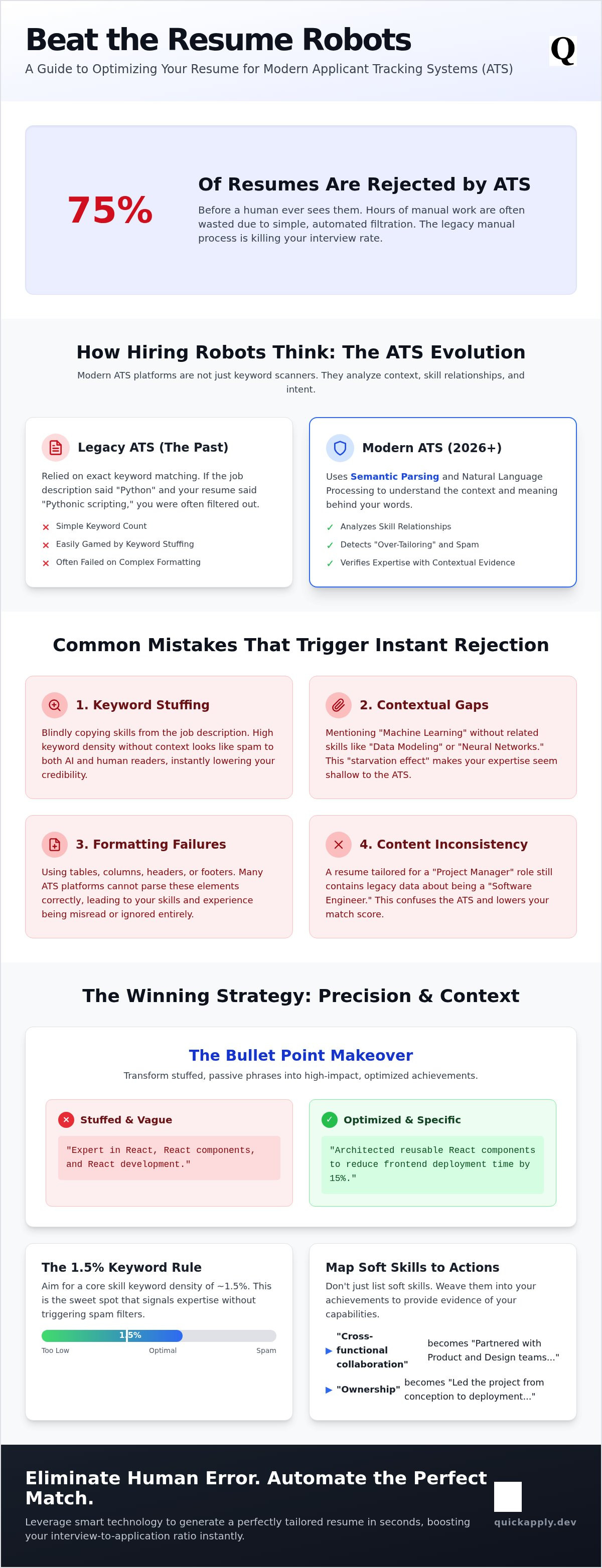
75% of resumes are rejected by an Applicant Tracking System before a human eye even scans them. You're likely spending hours manually re-writing bullet points only to receive an automated rejection email. It's a massive time sink that yields zero ROI. Most tech professionals fail because they fall into common resume tailoring mistakes that trigger instant filtration. You're working harder, but the legacy manual process is actually killing your interview rate.
It's time to stop guessing and start optimizing. We'll identify the critical errors that confuse modern ATS platforms and show you exactly how to fix them. You'll learn to balance precise keyword optimization with human readability without the fear of keyword stuffing penalties. This guide provides a repeatable system for passing filters and automating a perfect match in seconds. We're moving past slow, manual edits toward a high-speed strategy that scales your career growth. You'll gain a competitive advantage by leveraging smart technology to boost your interview-to-application ratio instantly.
Key Takeaways
- Identify why common resume tailoring mistakes trigger instant rejections from sophisticated AI-driven filters in the 2026 job market.
- Avoid the precision trap by balancing keyword density with contextual evidence to bypass modern ATS spam detection.
- Eliminate formatting failures that break technical parsing, ensuring your data is read correctly by every system.
- Align your tailored achievements with your public professional brand to maintain credibility and avoid consistency flags.
- Leverage automation to generate a perfect match score in seconds, replacing tedious manual edits with high-speed precision.
The High Cost of Manual Resume Tailoring Mistakes in 2026
Success in the current job market isn't about how hard you work; it's about how well you optimize. Most candidates define tailoring as changing a few bullet points to match a job description. In reality, resume tailoring mistakes represent the technical gap between your manual edits and what an automated system actually extracts. When you edit by hand, you're prone to inconsistent formatting and mismatched terminology that triggers an immediate rejection.
The 2026 recruitment landscape is dominated by AI-driven gatekeepers. Modern Applicant Tracking Systems (ATS) are no longer simple databases. They're sophisticated filters that reject up to 75% of resumes before a human recruiter even sees them. If you're spending 45 minutes manually tweaking a single application, you're trapped in a low-volume, high-effort cycle. This manual labor trap limits your reach and forces you into the "Rejection Loop," where minor technical errors lead to instant, automated ghosting.
The Evolution of ATS: Beyond Simple Keywords
Legacy systems looked for exact keyword matches. If the job asked for "Python" and you wrote "Pythonic scripting," you often failed. Modern systems like Workday and Greenhouse now focus on semantic intent. They analyze the relationship between your skills and your achievements to verify expertise. These platforms can even identify "over-tailoring," where a candidate's resume looks too identical to the job description, flagging it as suspicious. Semantic Parsing is the process of using natural language processing to understand the context and meaning of text rather than just identifying isolated keywords.
The Hidden Danger of "One-Size-Fits-Most" Templates
Static resumes are a liability. Even if you update the job title, leaving irrelevant legacy data in your professional summary confuses the AI match score. A system sees "Project Manager" in the header but "Software Engineer" in the body and drops your ranking. You need to move away from the traditional "Master Resume" and adopt "Dynamic Versioning." This approach ensures every byte of data on the page serves a specific purpose. It eliminates the noise that causes parsing errors and low interview rates. Precision is the only way to win in a crowded digital market.
Keyword Stuffing vs. Contextual Gaps: The Precision Trap
Precision is everything in a high-speed job market. Blindly copying the "Skills" section from a job description into your resume footer is a fatal error. This lazy tactic is one of the most visible resume tailoring mistakes that recruiters and modern AI detectors spot instantly. High keyword density without context triggers spam filters. If your document is 10% keywords, it's unreadable to humans and suspicious to machines. You want to be a candidate, not a database entry.
You also face the "Starvation" error. This occurs when you focus so much on exact matches that you miss the semantic synonyms modern systems expect. Modern systems use semantic clusters to verify expertise. If a JD mentions "Machine Learning," the AI also expects to see "Data Modeling" or "Neural Networks." Omitting these creates a starvation effect. Your match score drops because the system perceives a lack of depth in your technical stack. You must balance hard skills with high-impact action verbs like "Architected," "Optimized," or "Scaled" to prove your impact.
The 1.5% Rule: Optimizing for Density and Flow
Keywords shouldn't just sit in a list. They must live within your professional experience. Aim for a density of approximately 1.5% for your core skills. This ensures the system recognizes your expertise without flagging you for manipulation. Map your achievements directly to the JD's language by weaving the required tools into your success stories. It creates a narrative of competence that satisfies both the bot and the human recruiter.
| Stuffed Bullet Point | Optimized Bullet Point |
|---|---|
| Used Python for Python coding and Python scripting tasks daily. | Streamlined backend processing by 20% using Python-based automation scripts. |
| Expert in React, React components, and React development. | Architected reusable React components to reduce frontend deployment time by 15%. |
Mapping Soft Skills for Technical Roles
In 2026, technical prowess alone isn't enough to secure an interview. Recruiters prioritize "cross-functional collaboration" and "ownership." Don't just list these as traits. Show them. Translate technical jargon into business value to satisfy the ATS and the hiring manager. For software engineers, keywords like "Code Review Culture" or "Agile Mentorship" are often missed but highly rewarded. Product managers often overlook "Stakeholder Alignment" or "GTM Strategy." These are the hidden requirements that separate a senior candidate from a junior one. Understanding these nuances is difficult to do manually, but you can use a real-time match score to identify these gaps before you hit submit.
Formatting Failures That Kill Your ATS Score
Visual appeal is a trap for the uninformed candidate. You might spend hours perfecting a sleek, modern layout, but aesthetic complexity often leads to technical failure. Statistics show that 70% of ATS rejections are caused by formatting errors rather than a lack of qualifications. If the system cannot parse your data, your experience effectively doesn't exist. These resume tailoring mistakes are invisible to you but fatal to your application. A machine doesn't care about your color palette; it cares about data structure.
Multi-column layouts are the most common offenders. Most parsers read from left to right across the entire page. When you use columns, the AI frequently merges the text into a garbled mess. It reads the first line of the left column and the first line of the right column as a single sentence. This destroys the context of your achievements. Stick to a single-column format to ensure your narrative remains intact. Similarly, avoid placing critical contact information in headers or footers. Many legacy systems ignore these areas entirely, leaving you with a "missing contact info" flag before a human even sees your name.
The PDF vs. DOCX debate has a clear winner in 2026. While modern systems are more capable than their predecessors, DOCX remains the gold standard for parsing accuracy. PDFs can occasionally suffer from character encoding issues that turn your bullet points into unreadable symbols. If the job portal doesn't explicitly demand a PDF, submit a DOCX file to maximize your compatibility score.
Why Visual Design Can Be Your Worst Enemy
Recruiters spend six seconds on an initial scan, but the ATS spends milliseconds. Images, logos, and charts are invisible to these systems. If you use a progress bar to show your "80% proficiency" in Python, the bot sees nothing. It cannot quantify a graphic. You lose the keyword credit and the match score suffers. Use high-contrast, text-based layouts. Replace skill graphics with clear, written proficiency levels to ensure the machine registers every competency.
Standardizing Section Headings for AI Clarity
Creativity in your headings is a liability. AI expects standard labels to categorize your career history. Using "Where I Have Been" instead of "Professional Experience" can confuse the parser, leading it to misfile your work history as "Other" or "Volunteer Work." Use the MM/YYYY date format for every entry. Systems use this specific structure to calculate your total years of experience. Deviating from this standard can result in the system undercounting your tenure. Review these good resume examples to see how to structure your document for maximum AI clarity.
The Logic of Alignment: Avoiding Content Inconsistency
Efficiency requires more than just high-speed editing. It demands systemic consistency. One of the most damaging resume tailoring mistakes is the "Liar Trap." This happens when your tailored document contradicts your public digital footprint. Recruiters in 2026 use automated tools to cross-reference your resume against your LinkedIn profile in seconds. If your resume claims you're a senior DevOps engineer while your LinkedIn profile highlights your frontend expertise, you trigger a red flag. You haven't just tailored your resume; you've created a discrepancy that looks like a fabrication. This inconsistency suggests you're desperate rather than qualified.
Maintaining a "Core Brand" is the solution to this precision-speed trap. Avoiding common resume tailoring mistakes means understanding that your resume is part of a larger ecosystem. Your fundamental skills and professional identity must remain static while your specific achievements shift to meet the job description. You're a technical lead who drives results. The specific languages you emphasize are the variables. Tailoring too far erodes your professional identity and makes you look like a "jack of all trades, master of none." You shouldn't try to be everything to everyone. Focus on the 80% of your experience that's consistent and optimize the remaining 20% for the specific role. This balance ensures you pass the ATS without failing the human trust test.
Synchronizing Your Resume with Your Digital Presence
Your LinkedIn profile acts as your "Master Profile." It should be broad enough to encompass your entire career while specific enough to support your tailored applications. Use the "Summary" section to act as a bridge. It should explain your versatility and highlight how your diverse skills solve complex business problems. This prevents confusion when a hiring manager clicks your profile link after reading a tailored resume. A well-crafted cover letter builder can further reinforce this narrative. It provides the space to connect the dots between your public profile and the specific requirements of the job. This ensures your story remains cohesive across every digital touchpoint.
Tracking Your Tailored Versions
Applying to 50 jobs with 50 different resumes is a logistical nightmare. Forgetting which version you sent to which recruiter is a high-risk error that many candidates overlook. If you get an interview call and reference the wrong set of achievements, the conversation ends before it starts. Manual spreadsheets are legacy tools that fail at scale. They're slow, prone to human error, and impossible to maintain during a rapid-fire search. High-volume tech searches require an automated job application tracker to manage your history. You need to see exactly which version of your resume was used for every submission at a glance. Efficiency is about knowing your data as well as you know your code.
Don't let a version control error kill your momentum. You can automate your application tracking to ensure you always have the right data ready for the interview.
Eliminating Human Error: How QuickApply Automates the Perfect Match
Manual effort is a legacy bottleneck. You don't have 45 minutes to waste on a single application. QuickApply replaces slow, error-prone edits with a high-speed AI Resume Tailor. It analyzes job descriptions to extract the semantic intent and hidden requirements that human eyes often miss. By automating the process, you eliminate the common resume tailoring mistakes that keep qualified talent in the rejection pile. You gain the precision of an algorithm with the speed of a modern development tool.
The Match Score is your competitive advantage. It acts as a pre-flight check for your application. You'll know exactly how an ATS will rank your document before you hit the "Apply" button. This data-driven approach allows you to move from a mindset of "Applying" to one of "Strategizing." Instead of shouting into the void, you use saved time for high-value interview preparation. You aren't just sending more resumes; you're sending better ones. This shift in workflow increases your ROI and shortens your job search cycle.
Tailoring at Scale Without Losing Quality
QuickApply generates unique, context-aware versions of your resume in seconds. It doesn't just swap titles. It rewrites achievements to align with the specific business problems mentioned in the job description. This is essential for aggressive career transitions where you need to pivot your narrative rapidly. It positions QuickApply as the essential bridge between using the best ai resume builder 2025 and achieving actual hiring success. You get unlimited versions that maintain your core brand while optimizing for every specific filter.
Beyond the Resume: The Full Career Growth Suite
Success requires a cohesive ecosystem. QuickApply integrates tailored cover letters and interview practice into a single, high-efficiency workflow. You use the Match Score to prioritize roles where you have a statistical advantage. This ensures you spend your energy on the opportunities most likely to convert into offers. Stop fighting legacy systems with manual tools. Take control of your career trajectory with software built for the 2026 market. Start tailoring your resume with AI precision today and experience the speed of modern recruitment.
Take Control of Your Career Velocity
The era of manual resume editing is officially over. You've seen how legacy processes and common resume tailoring mistakes trigger automated rejections before a human recruiter even scans your name. Precision matters more than effort in the 2026 job market. Success requires a strategic balance between semantic context and technical compatibility. You can't afford to waste hours on a single application when your competition is moving at the speed of AI. Every minute spent on manual formatting is a minute lost to interview preparation.
Stop fighting the system with outdated tools. Leverage our AI-powered Match Score to verify your compatibility in seconds. Our integrated Application Tracker keeps your search organized while you focus on landing the offer. You deserve a workflow that scales with your ambition. Stop making manual mistakes, tailor your resume with QuickApply now. Your next big role is within reach. Start optimizing your career trajectory today and let smart technology bridge the gap between your talent and your next major opportunity.
Frequently Asked Questions
What is the biggest resume tailoring mistake job seekers make?
The biggest error is prioritizing keyword volume over contextual evidence. Job seekers often list skills in a vacuum, which triggers spam filters. You need to prove competence through results, not just labels. This is one of the most common resume tailoring mistakes that leads to immediate disqualification. Every skill mentioned must be backed by a specific achievement in your professional experience section to satisfy both bots and human recruiters.
Can an ATS tell if my resume was tailored by AI?
Sophisticated ATS platforms in 2026 evaluate semantic intent and narrative flow rather than just identifying AI patterns. High-quality automation produces content that is indistinguishable from human writing because it follows logical professional structures. If your resume provides genuine value and reflects your actual experience, the system treats it as a high-quality submission. The focus should be on the accuracy of the match rather than the tool used to generate it.
How many keywords should I include in a tailored resume?
Target between 8 and 15 core keywords per job description. You should aim for a keyword density of approximately 1.5% to ensure the system registers your expertise without flagging you for manipulation. Don't just hunt for exact matches. Include semantic synonyms that demonstrate a deep understanding of your technical stack. This approach satisfies modern NLP-based parsers that look for comprehensive knowledge rather than just specific strings of text.
Should I tailor my resume for every single job application?
You must tailor every application to remain competitive in a high-volume market. Sending a generic resume is a low-ROI strategy that usually results in automated ghosting. While manual tailoring is a massive time sink, using automation allows you to produce high-precision versions in seconds. This ensures you maintain a high interview-to-application ratio without sacrificing your personal time. Efficiency is about applying smarter, not just applying more often.
Does formatting really matter for an ATS in 2026?
Formatting is critical because it dictates how a machine interprets your career history. 70% of ATS rejections stem from parsing errors caused by complex layouts like multi-column designs or text boxes. Systems read from left to right, and non-standard structures garble your data. Use a clean, single-column, high-contrast layout to ensure every byte of information is extracted correctly. Precision in formatting is just as important as precision in content.
What happens if my resume and LinkedIn profile do not match?
Inconsistency between your resume and LinkedIn profile triggers trust flags during the background check phase. Recruiters use automated tools to cross-reference these documents instantly. If your achievements or titles vary significantly, you look like a "Liar Trap" candidate. Maintain a consistent "Core Brand" on your public profile while using tailored resumes to highlight the specific skills most relevant to each individual job description you pursue.
Is it better to use a PDF or a Word document for my resume?
DOCX is the superior choice for parsing accuracy in 2026. While PDFs are visually stable, they occasionally suffer from character encoding issues that turn your text into unreadable symbols for an ATS. Unless a portal specifically demands a PDF, stick to a standard Word document. This ensures the system extracts your keywords and dates with 100% accuracy, preventing the technical errors that often lead to early-stage rejection.
How do I avoid looking like I am keyword stuffing?
Avoid keyword stuffing by weaving required skills into your achievement-oriented bullet points. Never use a "hidden" white-text list or a raw skills dump at the bottom of the page. These are legacy resume tailoring mistakes that modern systems easily detect and penalize. Instead, use action verbs like "Architected" or "Optimized" to provide context for your technical skills. This proves you didn't just see the keyword; you actually used it.


