

Fewer than 40% of software engineers negotiate their first offer, yet those who do earn an average of $24,479 more annually. You've spent years mastering complex systems and optimizing code, but you're likely treating your compensation as a fixed variable rather than a technical problem to solve. Effective salary negotiation for software engineers isn't about being greedy or aggressive; it's about data-driven leverage. You know the market is volatile. The fear of an offer being rescinded is real. But 73% of employers expect a counter-offer. Accepting the first number isn't being safe. It's leaving a five-figure sum on the table.
This guide provides the 2026 protocol to maximize your total compensation package. We'll demystify RSU valuations and help you navigate the latest pay transparency laws across 16 states. You'll learn to treat negotiation as the final deployment in your career workflow. We'll break down the specific levers for base salary, equity grants, and sign-on bonuses. By the end of this article, you'll have the confidence to secure an offer that reflects your true market value. It's time to stop guessing and start calculating.
Key Takeaways
- Shift your perspective from social anxiety to technical optimization by identifying the delta between initial offers and maximum budget allocations.
- Master the 2026 Total Compensation formula to accurately value base salary, performance bonuses, and volatile RSU grants in a shifting market.
- Execute a data-driven salary negotiation for software engineers by leveraging real-time market benchmarks and professional urgency.
- Implement a high-efficiency 5-step protocol to deflect salary questions during screens and maintain leverage through the final offer stage.
- Streamline your career growth by integrating your Application Tracker with a dedicated Salary Negotiation Guide to manage competing deadlines.
The Engineering Mindset Gap: Why You Are Underpaid
Stop viewing a job offer as a binary outcome. It's a data point within a range. The engineering mindset gap is the delta between your current offer and the maximum budget allocated for the headcount. Most developers view a job offer as a social contract. They fear conflict or rejection. In reality, salary negotiation for software engineers is a technical optimization problem. You're debugging a compensation package, not asking for a favor. If you treat the offer as a fixed constant, you're failing the final test of the interview process.
The statistical reality is stark. Industry data shows that 85% of recruiters expect a counter-offer. They build "wiggle room" into the initial number. Despite this, only 25% of candidates actually provide a counter-offer. This disconnect creates a massive efficiency loss for the talent. Falling into the "Gratitude Trap" costs the average engineer over $500,000 in lifetime earnings. Feeling "just happy to be here" is a bug in your career logic. You aren't being greedy. You're correcting a market inefficiency and ensuring the firm pays the correct price for your output.
The Cost of the Scarcity Mindset
Scarcity drives bad deployments. Fear of rescission makes you accept low-ball offers instantly, but rescissions are statistically rare for professional software roles. This initial low base salary isn't a one-time error; it compounds. Every future raise, annual bonus, and 401(k) match scales off that starting number. Salary negotiation is the final stage of career optimization. If you skip this step, you're shipping unoptimized code to production. You're effectively paying the company a "timidity tax" every single pay period.
Recruiter Psychology vs. Engineering Logic
Recruiters operate within pre-approved salary bands. When they say "the budget is fixed," they're often running a standard negotiation script, not stating a physical constraint. They want to close the ticket quickly and within the lower quartile of the band to save the company money. Your goal is to move the needle toward the upper limit. Understanding negotiation strategies helps you shift from a defensive posture to a value-alignment model. You aren't begging for more. You're ensuring the system reflects the correct market price for your specific skill set. Recruiters respect candidates who use data to justify their worth. It signals that you'll bring that same analytical rigor to the engineering team.
Decoding Total Compensation: Tech Salary Bands in 2026
Total Compensation (TC) is a multi-variable equation. In 2026, looking at base salary alone is a rookie mistake. A competitive offer consists of four primary components: Base, Bonus, Equity, and Benefits. Base salary covers your burn rate. Bonuses reward performance. Equity provides the upside. Benefits protect your health and time. To build data-driven negotiation leverage, you must calculate the net present value of the entire package. Don't let a high base salary blind you to a poor equity grant.
Recruiters use sign-on bonuses as a one-time patch. If they can't hit your base salary target due to rigid bands, they'll offer a lump sum to bridge the gap. It's an easy win for them because it doesn't compound. For you, it's immediate liquidity. Don't overlook bespoke perks. Remote flexibility, high-end equipment budgets, and learning stipends are high-value, low-cost levers for the employer. In 2026, these are standard expectations, not extraordinary requests.
Understanding Equity and Vesting Schedules
RSUs are the standard for public tech firms. They're effectively cash with a vesting timer. For startups, you'll likely deal with ISOs or NSOs. ISOs have tax advantages but require more capital to exercise. NSOs are simpler but taxed as ordinary income. Always check the "cliff." A standard 1-year cliff means you get zero equity if you leave before month 12. Vesting frequency also matters. Monthly vesting is superior to quarterly as it reduces your risk profile. This technical depth is essential for mastering the job application process and securing your future.
Non-Monetary Levers for 2026
Title is a career multiplier. Negotiating for a "Senior" or "Staff" prefix can shave years off your promotion roadmap. It sets a higher baseline for your next role. Regarding time off, unlimited PTO often benefits the company by removing liability from their balance sheet. Accrued PTO is often more valuable as it's a guaranteed payout upon exit. For startup roles, demand a "change of control" clause. This ensures your equity accelerates or stays protected if the company is acquired. Successful salary negotiation for software engineers requires looking beyond the dollar sign to the legal fine print.
Before you sign, ensure your offer matches the 2026 market reality. You can use a Salary Negotiation Guide to verify if your equity grant aligns with current industry standards.
Data vs. Intuition: Building Your Negotiation Leverage
Intuition is a liability in a high-stakes deployment. You don't push code based on a "feeling," so don't accept a salary based on one. Generic career sites fail because they aggregate data across unrelated industries and outdated tech stacks. For salary negotiation for software engineers, you need granular, real-time metrics. With 16 states now requiring pay transparency in 2026, the data is on your side. Proving you are a "top-band" candidate starts before the offer arrives. Use AI resume tailoring to align your experience with the specific requirements of the role. When your background mirrors the job description with high precision, the recruiter's justification for a lower-tier offer vanishes.
Leverage comes from alternatives. If you have a current role, that is your "No-Offer" fallback. It is your floor. If you're currently employed, you have zero pressure to accept a sub-optimal package. Use "Offer Deadlines" to create professional urgency. If Company A provides a deadline, use it to accelerate the timeline at Company B. This isn't a game; it's a synchronization of processes. It forces the recruiter to reveal their maximum budget to avoid losing you to a competitor. Recruiters expect this behavior from high-demand talent.
The Competing Offer Strategy
Multiple offers provide the strongest leverage. When managing them, maintain "cautious excitement" to keep bridges intact. Don't frame it as a bidding war. Frame it as a search for the best market alignment. If you only have one offer, use the "Market Data" approach. Script the conversation: "I'm excited about the team, but the current numbers don't align with the market standard for this tech stack and level." Research shows that 85% of people who counter-offer receive a better deal. Use that statistical advantage to secure your value.
Validating Your Market Value
Specialized databases provide the only data that matters in 2026. Generic sites lack the nuance of specific tech stacks and seniorities. For salary negotiation for software engineers, your "Match Score" is your primary evidence for a higher tier. By mastering how to tailor resume to job description with AI, you've already proven you are a low-risk, high-output hire. Use that alignment to justify the top of the salary band. Recruiters pay a premium for candidates who require less onboarding and offer immediate technical value. Don't settle for the median when your data proves you are an outlier.
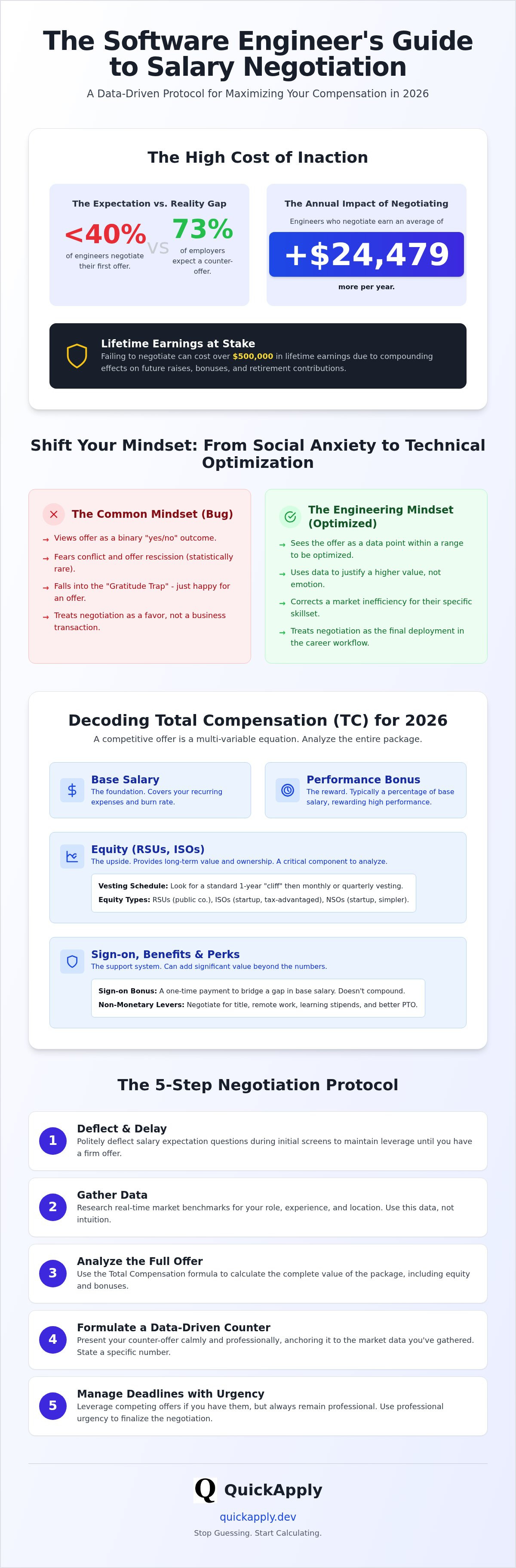
The 5-Step Protocol for Maximizing Your Tech Offer
Successful salary negotiation for software engineers requires a systematic execution of the final funnel stage. You've already optimized your resume and cleared the technical rounds. Now, you must execute the close. This protocol treats the offer stage as a state machine. Each step moves you closer to an optimized total compensation package while minimizing the risk of friction. Stop guessing and start following a proven script designed for the 2026 market.
Step 1 begins with deflection. You must avoid naming a number during the initial recruiter screen. If you anchor too low, you lose your ceiling. If you anchor too high, you risk being filtered out before proving your value. Step 2 occurs when the offer finally arrives. Express "cautious excitement." This signals you're interested but not sold. Step 3 is your 24-hour deep dive. Use this time to audit the TC components and verify the data against current 2026 benchmarks. Step 4 is the delivery of your counter-offer via email. This ensures precision and removes emotional volatility from the exchange. Finally, Step 5 is the close. You provide a final number that, if met, triggers an immediate acceptance.
The Deflection Script
Recruiters often push for salary expectations early to protect their budget. Your goal is to turn the question back on them. When asked for your range, respond with: "I'm focused on finding the right fit and am open to a competitive market offer. What is the range allocated for this level?" This forces the recruiter to reveal the band first. If they persist, stay firm. Tell them you need to understand the full scope of the role before discussing compensation. For those still in the interview phase, utilizing Final Round AI: Mastering the Interview can help you navigate these high-pressure conversations in real time.
The Counter-Offer Email Template
Email is superior to phone calls for technical negotiations. It allows you to present a structured, data-backed argument without the pressure of an immediate verbal response. Your email should follow a four-part structure: Gratitude, The Data, The Ask, and The Commitment. Start by thanking them for the offer. Transition into your market research, citing specific 2026 benchmarks for your tech stack. Present your ask clearly, whether it's a higher base or an increased equity grant. End with a commitment: "If we can reach $X, I am ready to sign today." This removes the "Is this your final number?" trap by making the finish line explicit. To ensure your counter-offer is bulletproof, download our Salary Negotiation Guide to access pre-built templates for every scenario.
Closing the deal isn't about winning a fight. It's about aligning two parties on a fair market price. By following this protocol, you transform a stressful social interaction into a high-efficiency business transaction.
QuickApply: Automating Your Path to Maximum Compensation
Manual negotiation is a legacy process. High-performing engineers in 2026 use systemic automation to bridge the gap between an initial offer and a final signature. QuickApply transforms the final stage of your job search into a streamlined deployment. By treating salary negotiation for software engineers as a technical workflow, you eliminate the emotional friction that leads to underpayment. You've used data to build the software; now use it to build your wealth.
The QuickApply Salary Negotiation Guide removes the guesswork from the counter-offer stage. It provides the exact scripts and data-driven logic required to move the needle on base salary and equity grants. Integrating your Application Tracker with negotiation deadlines ensures you never lose leverage. When multiple offers arrive, the system tracks expiring windows and prompts you to trigger the next stage of the protocol. It is a command center for your career, designed to manage high-stakes closing processes without active effort.
Beyond the Hire: Long-term Career Growth
Your optimization doesn't stop once the contract is signed. Transitioning from "New Hire" to "Promotion Track" should happen on day one. QuickApply’s Promotion Roadmap ensures your first day is the start of your next raise. By tracking your technical achievements automatically, you prepare for the next performance review before it even appears on the calendar. This proactive approach mirrors the efficiency of our AI Cover Letter Generator: Automate Your Path, which secures the interviews that lead to these high-value offers. Continuous productivity requires a system that works while you focus on the code.
Start Your Optimized Career Hunt
Setup your automated career command center in minutes. QuickApply offers a complete suite of tools to handle everything from resume tailoring to the final salary handshake. We guarantee efficiency from the first application to the final signature. Don't leave your market value to chance or recruiter goodwill. Use the tools designed by engineers for engineers to secure the compensation you deserve. The market is volatile, but your strategy shouldn't be. Secure your true market value now and stop leaving five-figure sums on the table. It's time to deploy your career at scale.
Secure Your Market Value with Data
Closing the gap between a standard offer and your true market value requires a technical approach. You've seen that salary negotiation for software engineers is a data-driven protocol, not a personality contest. By decoding total compensation and following a precise 5-step execution, you ensure no money is left on the table. Treating your career as an optimization problem is the only way to stay ahead in a volatile 2026 market.
Don't let a scarcity mindset or unoptimized scripts cap your lifetime earnings. Leverage modern automation to manage the high-stakes closing process. Utilize data-backed negotiation scripts and AI interview practice to handle tough recruiter calls with absolute confidence. Once you sign, maintain your momentum with Promotion roadmaps that track your path to the next level from day one. You've spent years mastering complex systems; now it's time to master the system that pays you.
It's time to treat your career like the high-performance engine it is. Maximize your offer with QuickApply’s Salary Negotiation Guide and take control of your professional trajectory today. You've built the value. Now, secure the payout.
Frequently Asked Questions
When is the best time to negotiate a software engineer salary?
The best time to negotiate is after you receive a verbal offer but before you sign any documents. Don't discuss specific numbers during the interview stages. Once the company confirms they want to hire you, the power dynamics shift in your favor. They've already invested weeks of engineering time in your candidacy. Use this window to execute your data-driven protocol and optimize your total compensation.
Can a company rescind a job offer if I try to negotiate?
Rescissions are statistically rare for professional software roles and usually only happen due to unprofessional behavior. 73% of employers expect candidates to negotiate. If you provide a polite, data-backed counter-offer, you're acting like a savvy professional, not a risk. Companies spend thousands on recruitment. They won't scrap a top candidate over a polite request for market alignment that reflects your true value.
How do I negotiate salary if I don’t have a competing offer?
Use market data as your primary leverage. Cite pay transparency laws in 16 states and benchmarks from specialized tech databases to justify your ask. Frame the conversation around market parity rather than personal need. If you've proven you're a top-tier candidate through technical rounds, the recruiter knows replacing you will cost more than the salary delta you're requesting. Data is your leverage when a competing offer isn't available.
What is a typical sign-on bonus for a software engineer in 2026?
Sign-on bonuses are one-time payments used to bridge gaps between base salary bands. In 2026, these are standard levers for recruiters to close high-demand candidates. If a company is rigid on base pay, pivot to the sign-on bonus. It's a low-friction way for HR to meet your total compensation targets without impacting long-term budgets. This liquidity can offset relocation costs or replace unvested equity from your current role.
How do I value RSUs vs. a higher base salary?
Base salary provides immediate liquidity while RSUs offer long-term upside. In a volatile market, prioritize base for stability if you're risk-averse. However, for high-growth tech firms, equity grants often make up a significant portion of total compensation for senior roles. Calculate the net present value of the vesting schedule. Don't accept paper money without checking the cliff and vesting frequency. Balance your immediate needs against potential future wealth.
Should I negotiate my salary over email or on the phone?
Email is superior for technical salary negotiation for software engineers. It allows you to present a structured, data-backed argument without the pressure of a real-time response. It creates a paper trail and ensures your logic is relayed accurately to the hiring manager. Use phone calls only for initial cautious excitement or to finalize a verbal agreement after the email exchange has established the primary terms of the deal.
What if the recruiter says the salary band is non-negotiable?
Pivot to other levers if the base salary band is truly capped. Negotiate for a higher equity grant, a performance-based bonus, or an accelerated vesting schedule. You can also request non-monetary perks like remote flexibility or a dedicated learning stipend. Every headcount has a total budget. If the base bucket is full, look for the overflow in other compensation categories to maximize your total value without hitting the band limit.
How do I negotiate for a higher job title instead of more money?
A higher title is a career multiplier that justifies a future raise. If the cash offer is firm, request a title change from Software Engineer to Senior Software Engineer. This sets a higher baseline for your promotion roadmap. It signals to the market that you've already cleared a higher technical bar. This makes your next salary negotiation for software engineers significantly easier because your market value is tied to a more senior tier.


