

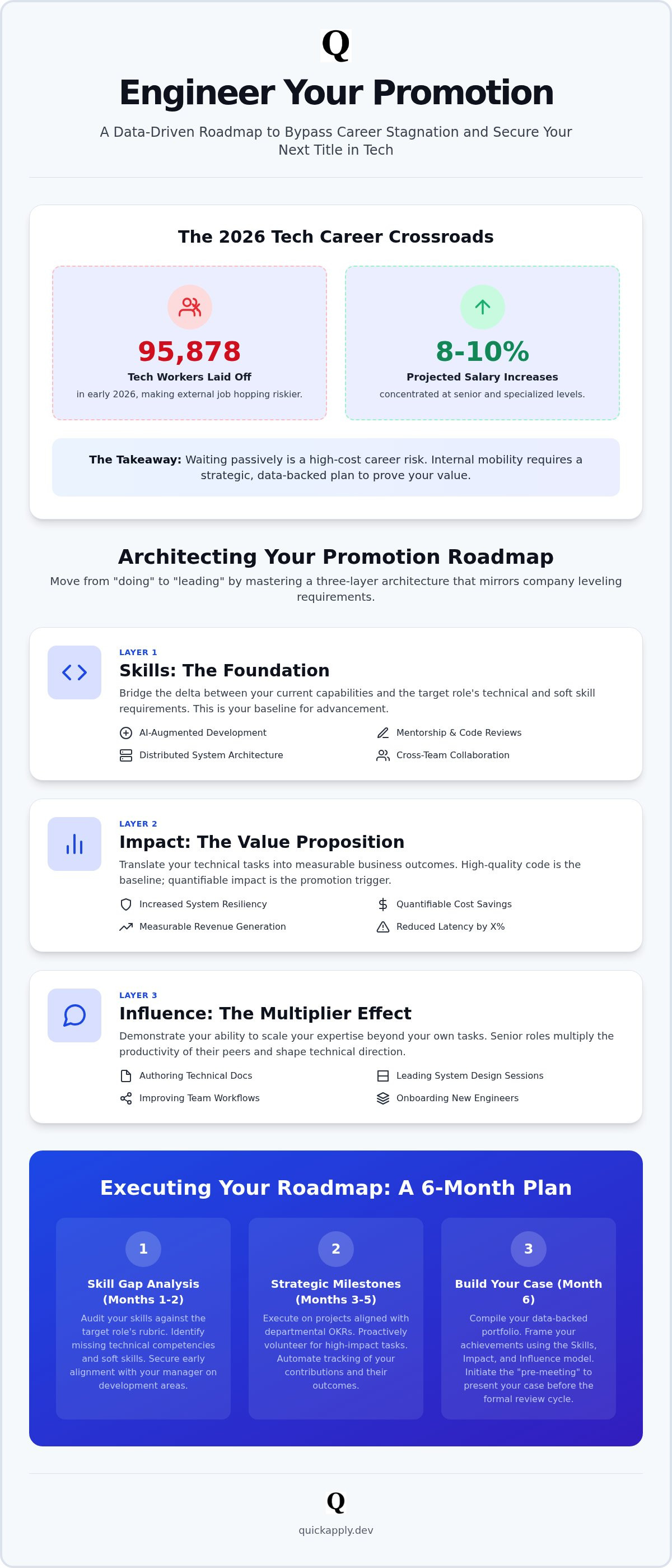
In a market where 95,878 tech workers were laid off in early 2026, waiting for your manager to notice your extra effort isn't just passive; it's a career risk. You're likely already handling senior-level tickets while stuck with a mid-level salary. This quiet promotion trap happens because most engineers lack a clear, data-backed system to prove their readiness for the next tier. You know you're delivering value, but without a structured career promotion roadmap, that value stays invisible during performance reviews.
Stop waiting for a raise and start engineering your ascent with a data-driven, AI-optimized strategy. You deserve a title that matches your output and a salary that reflects the 8-10% increases projected for top-tier talent this year. We've built a framework to help you bypass the ambiguity of corporate leveling. This article provides a clear sequence of steps to reach the next tier, tools to automate your impact tracking, and the exact evidence you need to win your next salary negotiation.
Key Takeaways
- Build a career promotion roadmap that strategically aligns your technical output with specific organizational objectives.
- Transition from passive work to active advocacy by translating engineering tasks into measurable business revenue and cost savings.
- Execute a six-month "Pre-Meeting" strategy to identify skill gaps and secure early alignment with leadership.
- Master the three-layer architecture—Skills, Impact, and Influence—to meet the rigorous leveling requirements of 2026 senior roles.
- Leverage AI-powered tools to automate value-tracking and maintain a data-backed portfolio for every performance review.
The Promotion Gap: Why Tech Careers Stagnate in 2026
High-quality code is a baseline, not a promotion trigger. In 2026, tech companies are optimizing for efficiency and specialized expertise. If you're writing clean code but your title remains static, you're likely a victim of the myth of meritocracy. Managers often default to "quiet promotions," where they increase your workload and responsibilities without adjusting your compensation or authority. To break this cycle, you need a technical career promotion roadmap that treats your growth like a product launch.
External job hopping has become significantly riskier. With 249 tech company layoffs affecting nearly 96,000 people in early 2026, the era of jumping for a massive raise is cooling. Companies are now prioritizing internal mobility, betting on talent that already understands their internal systems and AI-augmented workflows. However, moving up requires mastering the "invisible requirements" of your company's leveling rubric. You must understand how decisions are made behind closed doors before you can influence them.
The Cost of Passive Career Management
Passive management is an expensive mistake. Tech salaries are projected to rise by 8-10% in 2026, but these gains are concentrated at the senior and specialized levels. If you delay your ascent by even two years, the compounding loss in total compensation can reach six figures. Waiting for an annual performance review is a tactical error; by the time the meeting starts, the budget is already allocated. You also risk becoming "too valuable to move." If you're the only engineer who can debug a legacy system, your manager has a financial incentive to keep you in your current role indefinitely.
Identifying Your Promotion Triggers
Promotion cycles in 2026 have shifted from tenure-based to impact-based. Staying at your desk for three years no longer guarantees a title change. You need to audit your company’s historical patterns to find the real triggers. Look at those who successfully moved up the career ladder recently. Did they reduce latency by 20%? Did they lead an AI infrastructure migration? You must distinguish between "stretch goals" that build your case and "dead ends" that just consume your bandwidth. A career promotion roadmap helps you filter out the noise and focus on high-leverage tasks.
Architecting a Career Promotion Roadmap That Works
A career promotion roadmap is a strategic document that aligns your individual output with high-level organizational goals. It functions as a technical specification for your professional growth. Unlike a vague list of aspirations, a roadmap provides a clear sequence of milestones that prove you're already operating at the next level. To be effective, your roadmap must be a living document. Static PDFs can't keep pace with the 2026 tech market, where priorities shift quarterly.
Moving from mid-level to Senior or Staff roles requires a fundamental shift in mindset. You're moving from "doing" to "leading." Senior engineers don't just ship code; they design resilient systems and multiply the productivity of their peers. Most companies utilize a formal career progression framework to define these expectations. Your roadmap must mirror these layers to ensure your manager sees a direct correlation between your work and the company's success. This architecture relies on three distinct layers: Skills, Impact, and Influence.
Layer 1: The Skill Gap Analysis
A Skill Gap is the delta between your current technical output and the target role requirements. Identifying this gap requires an honest audit of your current stack. In 2026, Senior roles demand more than just language proficiency; they require expertise in AI-augmented development and distributed system architecture. Soft skills are equally critical. You must demonstrate mentorship and cross-team collaboration to prove you can handle the influence required for a title change. Don't guess what you need. Review the internal rubric to see exactly which technical competencies are missing from your current performance.
Layer 2: Defining Strategic Milestones
Break your roadmap into quarterly execution phases. Don't aim for a promotion "eventually." Instead, set SMART goals that align directly with your department’s OKRs. If the company is focused on infrastructure cost reduction, your milestones should reflect your contribution to that specific metric. You can reverse-engineer your target role by analyzing good resume examples from people who have already secured the title you want. By documenting these wins in real-time, you create a paper trail of success. Using a dedicated Promotion Roadmap tool allows you to automate this tracking, ensuring your case is ready before the review cycle even begins.
Quantifying Impact: The Data-Driven Roadmap Strategy
Subjectivity is the enemy of professional growth. In a high-stakes performance review, your manager’s memory is a bottleneck you can't afford. You need a "Proof Portfolio," a running log of every technical and business win that aligns with your career promotion roadmap. If you can't measure your contribution, it effectively didn't happen. By documenting your work in real-time, you remove the emotional weight from the promotion conversation and replace it with objective evidence.
Effective roadmaps distinguish between leading and lagging indicators. Leading indicators are your inputs: the number of system design documents you’ve authored, your PR review turnaround time, or the hours spent mentoring junior staff. Lagging indicators are the outcomes: a 15% reduction in cloud compute costs, a decrease in P0 incidents, or a measurable increase in team sprint velocity. To secure a senior role in 2026, you must prove you are the engine driving these results, not just a passenger on a successful team.
The Tech Impact Matrix
Stop citing vanity metrics like lines of code. Tech leaders in 2026 prioritize system reliability, deployment frequency, and the strategic reduction of technical debt. If you refactored a legacy module that cut latency by 40ms, that is a senior-level win. Quantify your mentorship by tracking how your code reviews reduced the "rework rate" for your peers. Use the same logic found in guides to tailor resume to job description to update your internal profile. Align your achievements with the specific keywords and competencies found in your company's senior-level rubric.
Building Your Value Narrative
Data points require a narrative to become persuasive. Don't just present a spreadsheet; connect your individual project success to company-wide strategic goals. If your organization is focused on AI efficiency, show how your automated testing suite saved the engineering department 200 hours of manual labor per month. Consolidate these wins into a "Brag Document." This is a concise, high-impact summary that your manager can easily share with leadership to justify your title change. A well-maintained career promotion roadmap ensures this document is always populated with fresh, data-backed evidence.
Executing the Roadmap: Negotiation and Advocacy
Execution is the phase where most engineering careers stall. You've architected the plan; now you must deploy it. A career promotion roadmap is only effective if you advocate for its completion. This process isn't a single meeting. It's a multi-stage rollout that begins months before the review cycle. You're moving from a contributor mindset to a strategic one.
Step 1: The Pre-Meeting. Schedule a dedicated alignment session six months before your target promotion date. Don't surprise your manager. Ask, "What specific impact must I demonstrate to reach the Senior level by Q3?" This creates a shared contract that's hard to ignore later.
Step 2: The Gap Audit. Use your manager's feedback to identify blockers. Are you lacking architectural oversight? Do you need more cross-team influence? Isolate these variables so you can solve for them systematically. If you don't define the gap, you can't close it.
Step 3: The Evidence Phase. This is your implementation stage. Every milestone you hit must be logged in your impact portfolio. Regular 1:1s should function as status updates on your progress. You're building a mountain of evidence that makes a "no" impossible.
Step 4: The Negotiation. When the formal review arrives, you aren't asking for a favor. You're presenting a closing argument. Use market data, including the projected 8-10% tech salary increases for 2026, to justify your new compensation package. Leverage your impact log to prove your ROI.
Navigating the Promotion Conversation
Engineers often fear the "no budget" objection. In 2026, with 87% of tech leaders struggling to find skilled talent, your retention is a priority. If they claim the budget is frozen, pivot to non-monetary levers or a guaranteed mid-cycle adjustment. Use a salary negotiation guide to navigate these pushbacks with precision. Don't accept "wait until next year" without a documented list of requirements that triggers an automatic title change.
Securing Internal Buy-in
A promotion often requires a consensus among leadership, not just your manager's approval. You need sponsors, people in power who will advocate for you when you aren't in the room. Build these relationships by solving problems for cross-functional stakeholders. When presenting your case, refine your delivery. Applying final round ai techniques to internal interviews ensures your value narrative is sharp and undeniable. Secure your next tier by utilizing an automated career promotion roadmap today.
Scaling Your Growth with QuickApply Career Tools
Manual tracking is a relic of a slower era. You don't manage your codebase with spreadsheets; you shouldn't manage your career that way either. Most corporate HR platforms are built to help managers track you, not to help you advance. QuickApply flips this dynamic. By utilizing an automated career promotion roadmap, you shift the burden of proof from your memory to a high-performance AI system designed to highlight your technical impact.
Our suite provides the technical infrastructure needed to maintain a competitive edge. It isn't just about the next title; it's about continuous optimization. Whether you're refining your internal profile or preparing for an eventual market shift, having a data-backed record of your achievements is essential. In a market where 87% of leaders struggle to find skilled workers, your documented expertise becomes your most valuable asset. QuickApply integrates your daily output into a cohesive narrative that proves your readiness for senior-level authority.
The QuickApply Promotion Roadmap Tool
This tool analyzes your current contributions against 2026 industry benchmarks for Senior and Staff roles. It generates a "Match Score" that reveals exactly how close you are to the next tier. You no longer have to guess if your architectural contributions are sufficient. The AI identifies specific high-leverage skills you should acquire next based on real-time demand in the specialized tech sector. Every week, you can generate automated status reports for your 1-on-1 meetings. These reports translate your technical commits into the business-centric language leadership respects, ensuring your manager always has the data needed to advocate for your raise.
Preparing for the Next Leap
A strong internal roadmap does more than just secure a promotion; it builds your external market value. If internal budgets remain stagnant despite your proven impact, you'll have a ready-made portfolio to take elsewhere. Use our mastering the job application process guide to ensure your internal wins translate perfectly to external opportunities. By keeping your roadmap updated, you stay visible to headhunters and ready for any "layoff-rehire" shifts in the industry. Don't leave your trajectory to chance. Build your automated promotion roadmap with QuickApply today.
Start Engineering Your Next Level
The tech market in 2026 demands more than just technical competence; it requires a strategic demonstration of business value. You've learned how to bridge the promotion gap by shifting from passive work to active advocacy. By identifying your company’s specific leveling triggers and quantifying your impact through technical metrics, you can transform your daily tasks into a persuasive case for advancement. A well-executed career promotion roadmap ensures that your path to a senior role is predictable and data-backed.
Don't let your growth plateau while others optimize their ascent. QuickApply offers the technical infrastructure to automate this entire process. Our platform provides AI-powered leveling analysis and automated impact tracking to keep your case ready for any review cycle. It's the same system used by tech pros at top-tier firms to secure higher salary tiers and authority. Automate your path to Senior Engineer with QuickApply and start engineering the career you deserve. You've got the talent; now use the right tools to prove it.
Frequently Asked Questions
What is a career promotion roadmap?
A career promotion roadmap is a strategic document that aligns your technical output with organizational leveling requirements. It serves as a technical specification for your growth, outlining specific milestones in skills, impact, and influence. Unlike a generic goal list, it provides a data-backed sequence of steps to prove you are already operating at the next tier. It functions as a shared contract between you and leadership to remove ambiguity from the promotion process.
How often should I update my promotion roadmap?
You should update your roadmap at least once a month to ensure your impact log remains current. In the fast-paced 2026 tech market, priorities shift quickly; waiting for quarterly reviews is a tactical error. Monthly updates allow you to capture specific wins, such as a 15% reduction in cloud compute costs, while the technical details are fresh. This consistency ensures your internal evidence is always ready for a surprise performance audit or budget review.
Can I use a career roadmap if my company doesn’t have clear levels?
Yes, you can and should build a roadmap even in flat organizations. If clear levels don't exist, use industry-standard benchmarks for Senior or Staff Engineer roles to define your own path. A career promotion roadmap in this context helps you create the structure that the company lacks. By presenting a data-driven case for your increased responsibilities and impact, you force the organization to recognize your value through a formal title change or salary adjustment.
What is the difference between a career roadmap and a development plan?
The primary difference lies in the outcome: a development plan focuses on learning, while a roadmap focuses on promotion. A development plan might include "learn Rust," whereas a roadmap specifies "implement a Rust-based microservice that increases deployment frequency by 20%." One tracks your input, the other tracks your business-aligned output. A roadmap is a strategic tool for negotiation and authority, while a development plan is a personal growth document meant for general skill acquisition.
How do I ask my manager for a promotion roadmap?
Initiate the conversation by framing it as a desire for alignment rather than a demand for more pay. Ask, "I'm targeting a Senior role by Q3; what specific business impact do I need to demonstrate to make that a reality?" This positioning turns your manager into a partner in your growth. Once they define the requirements, document them in your roadmap. This creates a shared agreement that makes the final promotion negotiation a matter of checking off verified milestones.
How much of a salary increase should I expect with a promotion in 2026?
Tech salaries are projected to rise by 8-10% in 2026, but a promotion to a senior role often yields a higher percentage. While internal raises vary, mid-level cybersecurity roles are seeing increases of 10-15% due to talent shortages. You should use market data to justify your request. If your roadmap proves you've met senior-level benchmarks, aim for a raise that reflects both the new title's market rate and your specific contributions to the company bottom line.
What are the best KPIs for a software engineer promotion roadmap?
The best KPIs focus on system health and team velocity rather than individual activity. Track deployment frequency, mean time to recovery (MTTR), and technical debt reduction. If you've improved virtual developer productivity by 30% through AI tool integration, that is a high-leverage KPI. Also, include influence metrics, such as the number of cross-functional design reviews you've led or the measurable reduction in rework rate for the junior engineers you currently mentor.
How can AI help me get promoted faster?
AI accelerates your promotion by automating the tedious task of value-tracking. Tools like QuickApply analyze your current output against industry senior-level benchmarks to identify your Skill Gap instantly. Instead of manually logging every win, AI-powered systems can generate status reports for your 1:1 meetings. This allows you to focus on high-leverage engineering tasks while the software builds your case for the next tier, ensuring you never miss a chance to quantify your impact.


