

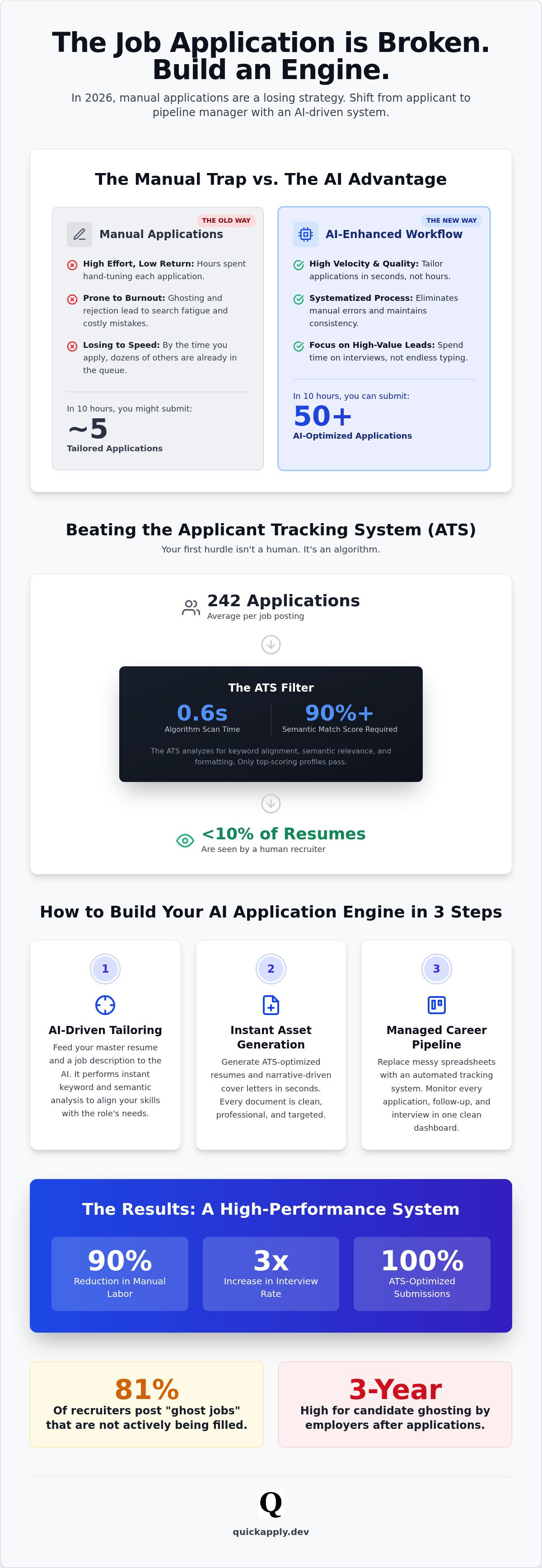
In 2026, 81% of recruiters admit to posting "ghost jobs" that aren't even active, while candidate ghosting by employers has hit a three-year high. You're likely spending hours hand-tuning every bullet point only to be met with silence from an automated screening system. It's a broken, manual approach to a high-velocity problem. You're fighting a losing battle against algorithms designed to filter you out before a human ever sees your name.
It's time to stop applying and start managing a high-performance pipeline. You can streamline job application process workflows using AI to cut manual labor by 90% and triple your interview rate. This isn't about spamming the market; it's about deploying a systems-engineering approach to your career. We'll show you how to use smart automation to achieve instant match scores, generate tailored assets in seconds, and maintain a managed track of every active lead. You'll move from being a frustrated applicant to a savvy professional who masters complex hiring systems with ease. Here is how to build your AI-driven application engine.
Key Takeaways
- Eliminate the manual trap by shifting from slow, hand-crafted applications to a high-velocity, automated system.
- Discover how to streamline job application process steps using AI-driven tailoring that aligns your skills with job descriptions in seconds.
- Beat the 2026 ATS filters by optimizing for Match Scores and removing formatting errors that cause instant rejections.
- Build a managed career pipeline using automated tracking tools that replace outdated, inefficient spreadsheets.
- Triple your interview rate by focusing on high-probability leads instead of fighting the losing battle of application inflation.
Why Manual Job Applications Are a Losing Strategy in 2026
In 2026, the average job posting receives 242 applications. This volume has created "Application Inflation," where being qualified isn't enough to guarantee a human even looks at your resume. If you don't streamline job application process workflows, your profile will likely sit at the bottom of a digital pile. Most companies now use an Applicant Tracking System (ATS) to handle the heavy lifting. Human eyes only see the candidates that the software ranks as top-tier matches first.
Spending two hours tailoring a single resume is the "Manual Trap." It's an inefficient use of your most valuable resource: time. While you're overthinking a single bullet point, dozens of automated applications have already filled the recruiter's queue and triggered notifications. A Streamlined Candidate is one who uses systemic automation to maintain a high-velocity presence in the market without sacrificing quality or burning out.
The High Cost of Tailoring by Hand
Manual work doesn't scale in a high-speed market. If you spend 10 hours a week on your search, a manual approach gets you roughly five tailored submissions. An AI-enhanced workflow gets you 50 or more in the same window. The difference isn't just volume; it's mental health. High-effort applications that result in "ghosting" lead to rapid burnout and search fatigue. When you're tired, you make mistakes. Manual errors in contact info or keyword alignment increase as your energy drops. These small slips are often the difference between an interview and a silent rejection from an automated filter.
The 2026 Recruiter Mindset: Speed and Scores
Recruiting is now a data game. The traditional 6-second resume scan has been replaced by an 0.6-second algorithm check. Hiring managers prioritize candidates based on Match Scores generated by AI. If you aren't in the top tier of those scores, you simply don't exist to the recruiter. You must position yourself as the logical choice for the software. By using automation to streamline job application process tasks, you ensure every submission hits the necessary semantic thresholds to trigger a human follow-up. In this landscape, speed is the ultimate competitive advantage.
Leveraging AI to Automate Resume and Cover Letter Tailoring
Deploying an AI-driven strategy transforms your search from a manual slog into a precision-engineered operation. To streamline job application process workflows, start with data ingestion. Feed the AI your master resume alongside the specific job description. This isn't just about copying and pasting; it's about providing the system with a comprehensive record of your technical wins and project history. The AI then performs instant keyword alignment. It identifies the "must-haves" in the job post and ensures they're reflected in your profile while stripping away irrelevant fluff that dilutes your impact.
Beyond Keywords: Semantic Matching for Tech Roles
Modern recruiting systems have evolved past simple text matching. Today, AI hiring tools utilize semantic matching to understand the relationship between different technical skills. An algorithm knows that "Python" proficiency is a foundational part of "Backend Architecture" or "Data Engineering." If you're still relying on old-school keyword stuffing, you're likely being flagged as a low-quality match. You need to understand How to Tailor Your Resume to a Job Description: The 2026 AI Strategy to ensure your experience maps correctly to the role's actual requirements. Semantic relevance is the new gold standard for getting past the initial digital gatekeeper.
Once your resume is optimized, the next step is generating narrative-driven cover letters. These shouldn't be generic templates. Use AI to craft letters that mirror the company's specific voice and culture. The final phase of this process is a rigorous quality control audit. Use the AI to check for technical accuracy and tone consistency across your documents. This step ensures you don't have contradictions between your tailored resume and your public professional profiles. It's a powerful way to optimize your application workflow while maintaining a high level of professional integrity.
Automating the Cover Letter Without Losing Your Voice
A high-impact cover letter follows a specific three-part formula: Context, Proof, and Call to Action. AI bridges the gap between your current expertise and "stretch" roles by highlighting transferable achievements that a manual scan might miss. For those looking to maximize their output, exploring The Best AI Cover Letter Builders for Tech Professionals in 2026 can provide the necessary edge. This approach allows you to streamline job application process tasks without sacrificing the unique perspective that makes you a top-tier candidate. You're not just sending more applications; you're sending better ones.
Beating the ATS: Winning the Systemic Game
Recruiters in 2026 are overwhelmed by sheer volume. To manage this influx, they rely on a Match Score to prioritize the top 5% of applicants. If your resume isn't formatted for high-velocity parsing, your score will tank, regardless of your actual talent. Complex layouts with multiple columns, images, or non-standard icons are the #1 cause of rejection. The algorithm simply can't map your skills to the database if it can't find them. You must treat your resume format as the technical infrastructure of your career search. An ATS-ready format is the passport that grants your experience entry into the interview stage.
The system doesn't care about your aesthetic choices. It cares about data accessibility. To streamline job application process outcomes, you need to eliminate any friction between your document and the scanner. This means moving away from over-designed templates and returning to clean, structured data that the software can digest in milliseconds.
Optimal Resume Formats for AI Scanners
Clarity beats creativity every time. Use standard headers like "Work Experience" and "Education" rather than creative alternatives that confuse the parser. Stick to simple, web-safe fonts. Chronological structures remain the gold standard because they allow the AI to calculate your years of experience in specific roles without errors. While modern systems have improved, the choice between PDF and Docx still matters. A .docx file is often more reliable for older systems, while a flattened PDF is usually acceptable for newer platforms. Avoid using graphic design tools that turn your text into an unreadable image. Review these Good Resume Examples for 2026 to ensure your layout isn't sabotaging your search.
The Ethics and Safety of AI Applications
Don't let the fear of "AI detectors" slow your momentum. Recruiters care about match quality and professional communication. Using technology to support your job search is now a standard practice among top-tier tech professionals. The goal is to streamline job application process steps, not to deceive the employer. Factual integrity is your only hard limit. AI is a powerful refiner for your bullet points and a great way to align your tone with the company culture. However, it should never be used to fabricate skills or roles. If the algorithm catches a factual discrepancy during background checks, you're finished. Dive into our ChatGPT Resume Myth-Busting to understand why strategic prompting beats generic AI generation every time.
Building a High-Velocity Application Pipeline
Success in 2026 requires more than just a great resume; it requires a robust technical stack to manage your opportunities. Stop using static spreadsheets that require manual updates every time you hit "send." To truly streamline job application process efficiency, you need a dynamic pipeline that treats every application as a lead in a sales funnel. This shift allows you to manage multiple versions of your professional identity, ensuring you present the right tech stack for the right role without crossing your wires. You're no longer just a job seeker; you're a pipeline manager.
Shift your mindset toward Application KPIs. In the current market, five highly tailored, AI-optimized applications beat 50 generic submissions every time. Quality is your leverage. When you streamline job application process workflows, your KPIs shift from raw volume to interview conversion rates. By focusing on high-probability Match Scores, you ensure your time is spent where it has the highest ROI. Once you've submitted, use AI to automate the "Follow-Up Loop." Draft personalized post-interview and check-in emails in seconds to maintain a constant presence in the recruiter's inbox without the manual overhead.
Centralizing Your Job Search Data
"Application amnesia" is a silent search killer. Forgetting which version of your resume you sent to which company makes you look unprepared during an initial screen. An integrated dashboard provides a single source of truth for status updates, interview dates, and recruiter contact info. This centralized approach is a core part of Mastering the Job Application Process. You need to know exactly where every lead stands at any given moment to negotiate effectively. You can automate your entire tracking workflow to ensure no opportunity falls through the cracks while you focus on higher-level strategy.
Interview Prep: The Final Stage of the Streamlined Process
Your pipeline ends at the interview, but the automation doesn't stop there. Use role-specific AI to simulate both technical and behavioral interviews. These simulations allow you to refine your pitch using the exact keywords and themes identified during your initial tailoring phase. Consistency across your resume, cover letter, and verbal pitch reinforces your status as a top-tier match. For those ready to close the deal, check out Final Round AI: Mastering the 2026 Interview for real-time coaching. This final layer of the process ensures you don't just get the interview; you win the offer.
QuickApply: The All-in-One Engine for Career Optimization
QuickApply isn't just a tool; it's a comprehensive operating system for your professional life. While fragmented bots and basic extensions struggle to keep up with 2026 hiring standards, QuickApply provides a unified platform to streamline job application process tasks from start to finish. It's built by tech pros who understand that a software engineer's resume needs more than just keywords. It needs semantic precision. By integrating Resume Tailoring and Cover Letter Generation into a single, high-velocity workflow, you eliminate the friction that usually kills search momentum.
Real-time Match Scores act as your strategic advisor. Instead of guessing which roles are worth your time, you see exactly how an ATS will rank you before you hit submit. This data-driven approach ensures you prioritize high-probability leads, effectively tripling your interview rate by focusing on quality over generic volume. You don't have to worry about manual data entry because the system's Application Tracker handles the logistics. Every status update and interview date is captured automatically, giving you a clear, managed view of your active career pipeline.
Automation extends beyond the initial application. QuickApply supports your long-term trajectory with a Salary Negotiation Guide and a Promotion Roadmap. These features ensure you don't just land the role; you maximize your total compensation and career velocity from day one. You're getting a partner that helps you manage your professional growth through every stage of the lifecycle.
Why Tech Professionals Choose QuickApply
Speed defines the 2026 market. When a new listing drops, the first 100 applicants often get the most attention from recruiters. QuickApply's speed-to-market allows you to generate a fully tailored, optimized application and submit it within 60 seconds of a listing going live. You're not just fast; you're precise. The platform offers several key advantages for the modern tech search:
- Speed-to-market: Deploy optimized applications in under a minute.
- Precision: AI that understands the difference between legacy stacks and modern architectures.
- Confidence: Knowing every submission is pre-validated for high Match Scores.
Start Streamlining Your Search Today
The transition from a passive job seeker to an active career manager happens the moment you automate the busywork. You can't afford to waste hours on manual tailoring when the competition is using high-tech solutions. Setting up your master profile takes under five minutes, and the impact on your interview rate is immediate. Stop fighting the system and start using it to your advantage. Streamline your career with QuickApply and secure your next role with systemic efficiency.
Master Your Career Pipeline Today
The job market in 2026 demands a systems-engineering mindset. You can't rely on manual tailoring when the competition is using high-velocity automation. By choosing to streamline job application process steps, you shift from being a passive applicant to an active pipeline manager. This strategy ensures your technical skills are never lost in a digital black box. You have moved past the manual trap and entered a phase of professional optimization where data drives every decision.
Real-time Match Scores and instant AI resume tailoring provide the disruptive advantage needed to win in a crowded field. An integrated application tracker replaces the chaos of spreadsheets with a managed, professional dashboard that tracks every lead through the funnel. You now possess the tools to dominate the hiring cycle, beat the ATS filters, and secure roles that align with your long-term roadmap. The gap between talent and opportunity has finally been bridged by smart technology.
Start streamlining your job search with QuickApply AI today. Your career trajectory is now entirely in your control. Success is no longer a matter of luck; it's a matter of deployment.
Frequently Asked Questions
How do I streamline my job application process in 2026?
Use AI-driven systems to automate the manual parts of your search. Focus on systemic automation for tailoring resumes and cover letters in seconds. Replace manual spreadsheets with an integrated tracker to manage your pipeline. This approach allows you to maintain high-velocity output without sacrificing quality. By deploying these tools, you streamline job application process workflows and ensure every application hits the technical thresholds required to pass through automated screening systems.
Will using AI to tailor my resume get me rejected by recruiters?
No, recruiters in 2026 prioritize match quality and professional results over the tools used to create them. High-tier companies use AI to screen candidates, so using AI to align your experience is a logical counter-move. The key is maintaining factual integrity. AI acts as a refiner for your bullet points and keyword alignment. As long as your skills are real, using technology to optimize your presentation is considered a standard professional practice.
What is the best way to track multiple job applications efficiently?
Use an integrated Application Tracker rather than manual spreadsheets. A dedicated dashboard provides a single source of truth for every lead in your pipeline. It automatically records status updates, interview dates, and different versions of your resume. This centralization prevents "application amnesia" and ensures you're prepared for every recruiter call. It's the most efficient way to manage a high-volume search while keeping your data organized and actionable.
How many jobs should I apply to per week for the best results?
Focus on quality conversions rather than raw volume. Aim for 5 to 10 highly tailored applications per week rather than 50 generic ones. When you streamline job application process tasks with AI, you can hit these targets in minutes. This strategy ensures you only pursue roles where you have a high Match Score. Targeted applications lead to higher interview rates because they are specifically engineered to pass through modern ATS filters.
Can AI help me write a cover letter that actually sounds human?
Yes, modern AI uses semantic matching to mirror specific company voices and professional tones. You can generate narrative-driven letters that bridge the gap between your experience and a new role. The system uses a formula of Context, Proof, and Call to Action to create a compelling story. This method avoids the generic "template" feel of old-school letters while highlighting transferable wins that a manual draft might overlook.
What is a good match score for a job application?
Aim for a Match Score of 85% or higher to ensure your resume reaches a human recruiter. Scores in this range signal to the ATS that you possess the core technical requirements and semantic relevance for the role. If your score is lower, use AI tailoring to better align your bullet points with the job description. Targeting high-score roles maximizes your ROI and prevents you from wasting time on long-shot applications.
Is it better to apply for more jobs or focus on quality?
Quality is the ultimate leverage in a crowded 2026 market. High-volume, generic applications are often filtered out instantly by automated systems. By focusing on quality, you ensure each submission is optimized for the specific role's technical stack. You can still maintain a high-velocity pipeline by using AI to handle the heavy lifting of tailoring. This hybrid approach gives you the benefits of volume without the typical drop in success rates.
How does an automated application tracker save time?
It eliminates the need for manual data entry and status monitoring. An automated system captures job details and contact info the moment you apply. It organizes your search into a visual funnel, showing you exactly which leads need follow-up. This saves hours of administrative work every week, allowing you to focus on interview prep and high-level networking. You get a managed career pipeline that runs with minimal active effort.


