

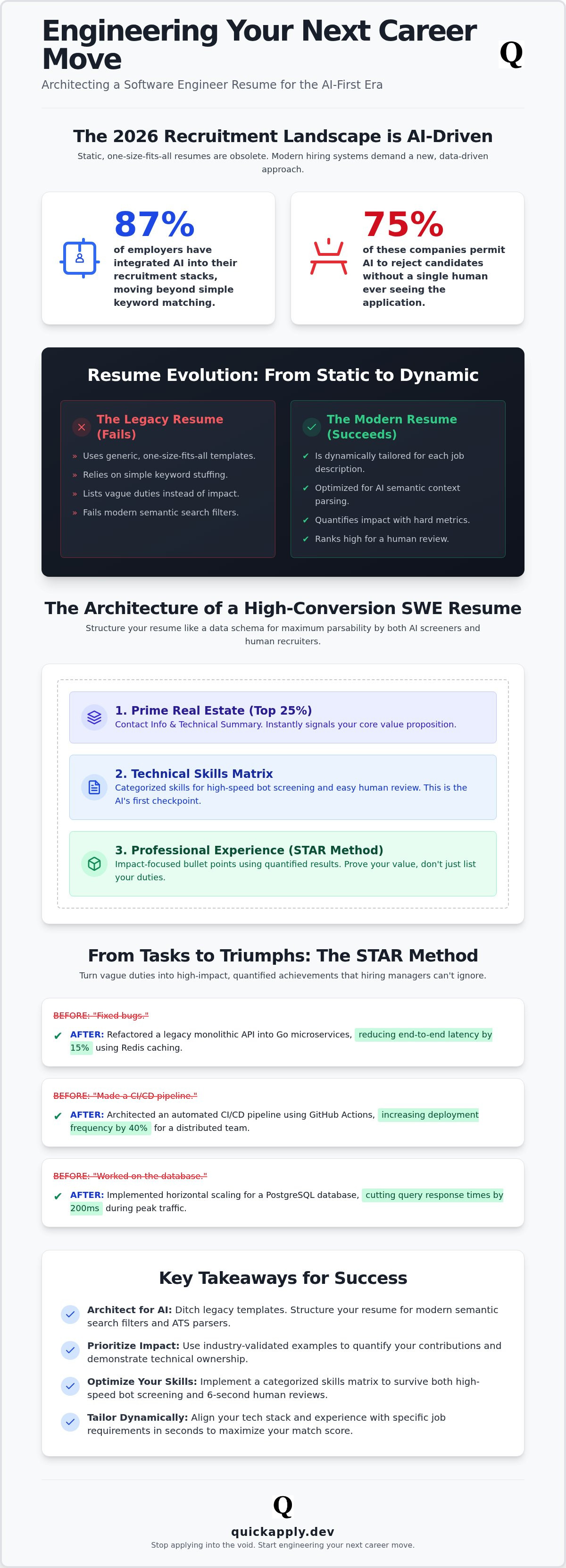
75% of companies now permit AI to reject software engineering candidates without a single human ever looking at the file. It's a brutal reality of the 2026 market where 87% of employers have integrated AI into their recruitment stacks. You've spent years mastering complex systems, yet your job search feels like debugging legacy code without a compiler. It's frustrating to watch your experience disappear into an ATS black hole while you waste hours manually tweaking every bullet point. You deserve a system that moves as fast as your code.
This guide provides the high-performance software engineer resume examples and tactical frameworks you need to flip the script. We'll help you master the art of technical resume writing with examples designed to beat modern ATS and secure FAANG interviews. You'll learn how to satisfy new AI transparency laws in states like Colorado and Illinois while quantifying your impact with surgical precision. We are breaking down dynamic tailoring and providing a repeatable system to scale your applications. It's time to stop applying into the void and start engineering your next career move.
Key Takeaways
- Stop using legacy static templates that fail 2026 semantic search filters. Learn how to architect your resume for the modern AI-first recruitment stack.
- Review industry-validated software engineer resume examples that demonstrate how to prioritize technical ownership and quantified impact at every career stage.
- Optimize your technical hierarchy with a dedicated skills matrix designed to survive both high-speed bot screening and 6-second human reviews.
- Master the process of dynamic tailoring to align your primary tech stack with specific job description requirements in seconds.
- Transition to an automated deployment strategy using AI-powered tools to manage high-volume applications without sacrificing personalization.
Why Static Resume Examples are Failing in the 2026 Job Market
The era of the "spray and pray" application strategy is officially dead. In 2026, 87% of companies use AI to filter talent, and 75% of those companies allow bots to reject candidates without a single human review. Relying on one-size-fits-all software engineer resume examples is a recipe for instant rejection. Modern tech sectors move too fast for generic templates. Manual tailoring is a massive productivity bottleneck for high-performing engineers who should be shipping code, not fighting with margins.
The 2026 ATS Landscape
Modern Applicant Tracking Systems have evolved beyond basic keyword matching. They now utilize semantic parsing, which is the process of understanding context and intent over simple keyword frequency. Instead of just scanning for "AWS," an AI parser categorizes your experience into sophisticated clusters like "Cloud Infrastructure" or "Scalable Backend Systems." This shift means you're no longer just trying to "pass" the bot. You're competing to rank in the top 5% of the recruiter's dashboard.
Recruiters now prioritize candidates based on a Match Score. This automated ranking determines who earns a 6-second human review and who gets archived. If your resume doesn't dynamically adapt to the nuances of the job description, your Match Score will tank. You can't rely on luck when the system is built on statistical probability. You need a document that speaks the language of the algorithm.
Optimization vs. Generalization
Generalist resumes are legacy code. While a standard resume format might provide a historical overview of your work, it often fails to signal the specific expertise required for high-stakes roles. Being a "jack of all trades" is a liability in a market that demands specialists. Specific software engineer resume examples that highlight niche domains, such as Distributed Systems or ML Ops, consistently outperform generalist submissions.
Your goal is total alignment with the target company's tech stack. If a job description emphasizes Kubernetes and Go, leading with Java and monolithic architecture creates a cognitive load for the recruiter. It signals a lack of fit. By optimizing for the specific stack, you demonstrate that you're ready to contribute on day one. Efficiency isn't just about how you work; it's about how you apply. Stop wasting time on generalities and start focusing on high-impact specialization.
The Technical Architecture of a High-Conversion SWE Resume
Think of your resume as a data schema. If the structure is broken, the system won't parse the information correctly. High-performing software engineer resume examples prioritize a clean, logical hierarchy that serves two masters: the AI screener and the human recruiter. Your contact information and technical summary must occupy the top 25% of the page. This is your prime real estate. Use standard headers like "Professional Experience" and "Technical Skills" to ensure ATS parsers map your data to the correct fields without errors.
The Skills Matrix is your most critical component for AI-first screening. Don't dump every tool you've ever touched into a comma-separated list. Categorize them by Languages, Frameworks, and Cloud/DevOps tools. This categorization helps modern parsers identify your core competencies and match them against the job's required tech stack. If you want to see how your current layout stacks up, you can use resume tailoring to analyze your document's technical alignment in seconds.
The STAR Method for Engineers
Quantifying impact is where most engineers fail. "Fixed bugs" is a task; it isn't an achievement. Use the STAR (Situation, Task, Action, Result) method to turn vague duties into high-impact metrics. Focus heavily on the "Action" component by using precise technical verbs like architected, refactored, or implemented. This demonstrates ownership of the solution. Consider these three examples of technical impact:
- Refactored a legacy monolithic API into Go microservices, reducing end-to-end latency by 15% using Redis caching.
- Architected an automated CI/CD pipeline using GitHub Actions, increasing deployment frequency by 40% for a distributed team.
- Implemented horizontal scaling for a PostgreSQL database, cutting query response times by 200ms during peak traffic periods.
Choose metrics that matter to the business. Focus on cost savings, system speed, or developer productivity. These numbers provide the objective proof hiring managers need to justify an interview.
Formatting for Machine and Human Eyes
Stick to a single-column layout. While two-column designs might look modern, they often cause parsing errors in older ATS systems and disrupt the natural 6-second scan of a human recruiter. Follow the "No-Graphics" rule strictly. Avoid charts, skill bars, or social icons. These elements are non-parseable noise that can break an AI's ability to read your content. Use bolding strategically to highlight technical keywords within your bullet points. This guides the human eye directly to the tech stack you utilized, making it easy for a recruiter to verify your qualifications at a glance.
Software Engineer Resume Examples by Career Stage
Your career stage dictates the data points that matter most to an AI screener. A junior engineer needs to prove they can ship code without constant hand-holding. A senior engineer must demonstrate they can design the systems that the junior engineers build. Effective software engineer resume examples pivot their focus based on years of experience and level of technical ownership. You can't use a new grad template to apply for a Staff role and expect to rank in the top 5% of the applicant pool.
Entry-Level and New Grad Examples
If you lack professional experience, your "Projects" section acts as your primary proof of work. Don't just list school assignments. Build a sophisticated "Projects" section that mirrors a professional work history. Highlight your GitHub contributions and LeetCode milestones to provide objective evidence of your problem-solving speed. You should also utilize the skills section of resume examples to fill gaps in your work history. Focus on specific implementations, such as "Built a full-stack task manager using Next.js and PostgreSQL, implementing JWT for secure user authentication."
Mid-Level and Specialist Nuances
Mid-level engineers must move beyond "completing tickets" to "owning features." Your bullets should highlight cross-team collaboration and your ability to define API contracts. If you specialize in a niche like DevOps or Machine Learning, your metrics need to reflect that domain. For a DevOps role, focus on infrastructure-as-code and deployment velocity. A Machine Learning specialist should highlight model latency and training efficiency. For example, "Reduced model inference time by 40% by refactoring the data pipeline in PyTorch" carries more weight than a generic list of libraries.
Senior and Lead Engineer Impact
At the senior level, the conversation shifts from writing code to designing systems. You aren't just a contributor; you're an architect. Your resume needs to showcase your decision-making frameworks and how you navigate technical trade-offs. Quantify your leadership through mentorship and system-wide improvements. Consider these Senior software engineer resume examples of high-impact bullets:
- Led the migration of a legacy monolithic billing system to a distributed microservices architecture, reducing system downtime by 99%.
- Mentored 5 junior developers through weekly code reviews and technical workshops, increasing team velocity by 25% within six months.
- Architected a multi-region database failover strategy that saved the company an estimated $50k per hour of potential downtime.
Senior roles require proof of business-level impact. Show how your technical decisions directly influenced the company's bottom line or operational efficiency. This high-level framing is what separates a senior architect from a mid-level coder in the eyes of a hiring manager.
Strategic Tailoring: Mapping Resumes to Job Descriptions
Your master resume is a repository. Each application is a feature branch tailored to a specific production environment. Static software engineer resume examples are insufficient when 75% of companies permit AI to archive candidates without human review. You must transform your document from a generic history into a targeted solution for the employer's specific pain points. Stop treating your application as a read-only file; it's a dynamic asset that requires frequent commits.
Follow this five-step protocol for high-conversion tailoring:
- Identify the Primary Tech Stack: Isolate the first three languages or frameworks mentioned in the job description. These carry the heaviest weight in 2026 semantic parsing algorithms.
- Align Experience Bullets: Rewrite your impact statements to use the exact technical verbs and qualifiers found in the "Required Qualifications" section.
- Adjust the Professional Summary: Mirror the company’s mission. If they value "scalability at speed," lead with your experience in high-throughput systems.
- Generate a Match Score: Use AI to verify your probability of passing the initial filter before you hit submit.
- Verify Technical Accuracy: Ensure the final output maintains your authentic voice and technical precision.
Leveraging AI for Precision Tailoring
Modern recruitment moves at machine speed. You can't afford to spend three hours manually editing a single PDF. You need to tailor your resume to a job description using automation that understands technical context. Keyword stuffing is a legacy tactic that fails 2026 semantic filters. Contextual alignment is the new standard. It's the difference between simply listing "Python" and describing how you used Python to optimize a specific data pipeline. Using QuickApply, you can generate 10 tailored versions of your resume in the time it takes to do one manually.
Beating the 2026 ATS Filter
The Match Score is your most critical pre-application metric. Recruiter dashboards prioritize candidates with scores above a specific threshold, often 85% or higher. If your document doesn't reflect the JD’s specific order of requirements, you're effectively invisible. Check the Best AI Resume Builders of 2026 to find tools that prioritize this ranking logic. Don't leave your career to chance. Use resume tailoring to ensure your software engineer resume examples are optimized for maximum visibility in the recruiter's queue. Efficiency isn't just about how you code; it's about how you navigate the systems that control your career growth.
Deploying Your Career: Moving from Static Templates to AI Automation
Static resumes are like manual deployments. They're slow, error-prone, and impossible to scale. In a 2026 market where 79% of companies use AI for screening, you need a high-frequency application pipeline. Stop treating your job search as a series of one-off tasks. Start treating it as a system. The software engineer resume examples you've built are just the beginning of a larger technical strategy.
A successful search requires more than just a document. You must integrate your resume with a broader automation strategy. This includes generating AI cover letters that complement your technical data and tracking every interaction to optimize your conversion funnel. Efficiency is the only way to compete when application volumes are at an all-time high.
Automating the Application Pipeline
High-volume searches are unmanageable without a dedicated system. Use an automated job application tracker to eliminate the manual labor of data entry. This allows you to implement the "Apply-Tailor-Track" workflow. First, identify the role. Second, use software engineer resume examples to tailor your document for that specific environment. Third, track the status to identify which technical narratives are converting into interviews.
Once the invites start arriving, use your tailored data for interview practice. The exact impact metrics you used on your resume become the foundation of your STAR responses. This ensures total consistency between what the bot parsed and what you tell the hiring manager. You aren't just memorizing answers; you're rehearsing the technical wins you've already validated.
Scaling Your Success with QuickApply
QuickApply acts as your career copilot. It doesn't just help you land the job; it helps you navigate the entire professional lifecycle. By maintaining recurring resume versions for different industry niches, you stay ready for any opportunity. Whether you're targeting FinTech or AI startups, your technical narrative remains optimized and ready for deployment.
Success doesn't stop at the offer letter. Use your application data to build a promotion roadmap. Track your growth, document your technical wins, and stay ahead of the curve. Don't let your career stagnate in a manual process. Start tailoring your software engineer resume with QuickApply today and turn your job search into a high-performance deployment system.
Optimize Your Career Deployment
The 2026 tech market doesn't reward manual labor; it rewards technical precision and speed. You've seen how legacy templates fail modern semantic filters and why your impact must be quantified through the STAR method. Mastering software engineer resume examples is the first step toward reclaiming your time and securing high-tier interviews. By aligning your technical narrative with specific job descriptions, you move from a generic applicant to a high-probability hire.
It's time to stop fighting the algorithm and start using it to your advantage. QuickApply provides the infrastructure you need to scale your search without sacrificing quality. Our platform automates the tedious parts of the job hunt by generating AI Match Scores, creating tailored cover letters, and managing your pipeline with a robust application tracker. This system ensures your expertise is never lost in the shuffle of high-volume recruitment.
Stop Building, Start Tailoring: Optimize Your SWE Resume in Seconds. Your next engineering role is just one optimized deployment away. Go build something great.
Frequently Asked Questions
How long should a software engineer resume be in 2026?
One page remains the gold standard for most engineers. If you have over 10 years of deep technical experience, two pages are acceptable. AI screeners don't care about page count, but human recruiters still follow the 6-second scan rule. Every line must justify its existence. If a bullet point doesn't contribute to your technical narrative or quantify impact, delete it to maintain density and focus.
Do I really need a different resume for every job application?
Yes, you need a tailored version for every role to maintain a high Match Score. Static software engineer resume examples are often archived by AI because they lack contextual alignment with specific job descriptions. You don't need to rewrite the entire document from scratch. Focus on adjusting your technical summary and the top three bullet points of your most recent role to ensure you rank in the top 5%.
What are the most important keywords for software engineers right now?
Semantic clusters are now more important than single keywords. Focus on core infrastructure terms like Kubernetes, Terraform, and Distributed Systems. If you're in application development, emphasize React, Next.js, or Go. Don't just list these tools; weave them into impact-driven bullets. Modern bots look for contextual relevance, so show how you used these technologies to solve specific architectural challenges or improve system performance metrics.
Should I include my GitHub and LinkedIn links on my resume?
Absolutely. These links provide the proof of work that a PDF cannot. Ensure your GitHub has recent activity and your LinkedIn profile matches the data on your resume. If an AI screener flags your profile, a human recruiter will use these links to verify your technical depth. Keep the URLs clean and clickable. Don't include them as long, messy strings of text that disrupt your document's clean hierarchy.
Is it okay to use AI to write my software engineer resume?
Use AI for editing and tailoring, not for generating your entire history from scratch. 49% of hiring managers dismiss resumes they believe are purely AI-generated. Use automation to optimize your software engineer resume examples for specific job descriptions. This ensures your Match Score is high while maintaining your authentic technical voice. AI is a tool for efficiency, but your actual professional experience must be grounded in reality.
How do I handle a gap in my employment history on a tech resume?
Be direct and focus on what you built during that time. Use a Projects or Consulting section to show you remained technically active. If you spent six months mastering Rust or contributing to open-source, list those as achievements. Gaps matter less in 2026 if your skills matrix is current. Bots prioritize your ability to solve current problems over a perfectly continuous timeline. Show your output rather than just your tenure.
Should I list my GPA if I am a recent computer science graduate?
Only list your GPA if it's 3.5 or higher. Once you land your first professional role, remove it entirely. For entry-level positions, your projects and internships carry significantly more weight than a test score. Recruiters at top tech firms care about your ability to ship production-ready code. If your GPA is lower, use that space to highlight technical certifications or LeetCode milestones. Focus on the skills that translate to value.
Does the order of my resume sections matter for FAANG companies?
Hierarchy is critical for 6-second human scans. Place your technical skills matrix at the top, followed immediately by your professional experience. Education should move to the bottom unless you're a new grad. FAANG recruiters want to see your most recent technical wins first. By leading with your impact metrics and tech stack, you make it easy for both the bot and the human to confirm your qualifications instantly.


