

Imagine meeting 100% of a job's technical requirements only to receive an automated rejection email three minutes after hitting submit. In the 2026 tech market, high-quality candidates are being ghosted not because of their skills, but because of how those skills are encoded. Modern gatekeepers like Workday and Greenhouse have evolved beyond simple keyword matching, leaving traditional resumes in the digital trash. Mastering ats resume optimization is the only way to bypass these automated filters and ensure your expertise actually reaches a human recruiter.
You shouldn't have to waste hours manually re-engineering your career history for every application. We understand the frustration of navigating a "black box" hiring process that feels rigged against talent. This guide promises to reveal the mechanics of 2026 NLP-based parsing and demonstrate why active AI tailoring beats passive resume checking every time. We will preview the frameworks for achieving high match scores and show you how to automate the optimization process. Stop guessing and start outsmarting the machine.
Key Takeaways
- Recognize that 97.4% of Fortune 500 companies rely on algorithmic gatekeepers, making machine legibility your first professional hurdle.
- Understand how modern NLP systems use entity recognition to categorize your technical stack and seniority levels automatically.
- Transition from static diagnostics to active ats resume optimization to align your candidacy with specific job descriptions in real time.
- Learn to structure technical side projects and certifications so they are indexed as valid professional experience by modern parsers.
- Adopt automated tailoring workflows to eliminate application fatigue and increase your high-quality interview callback rate.
ATS Resume Optimization: Why It’s Essential in 2026
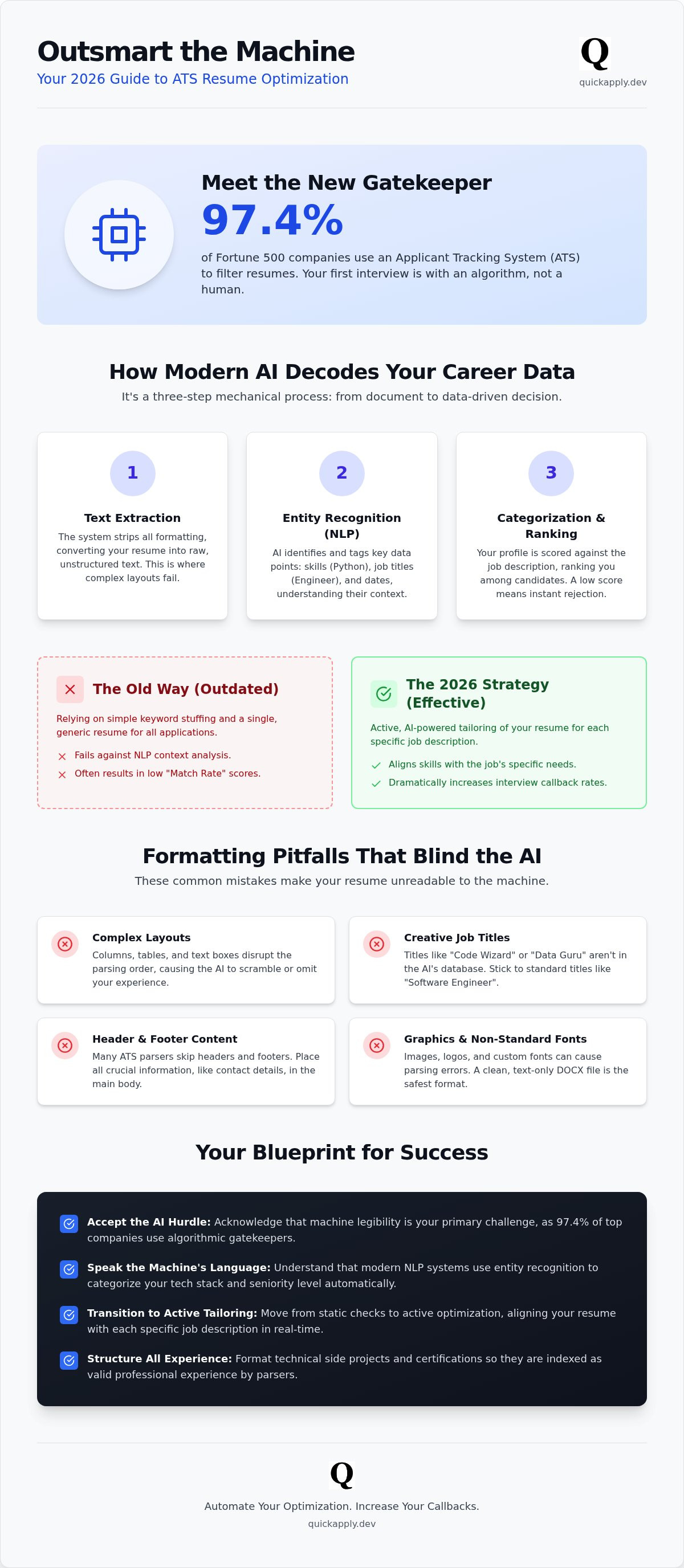
Hiring in 2026 is a high-stakes game of algorithmic survival. If your profile doesn't speak the machine's language, it effectively doesn't exist. What is an Applicant Tracking System (ATS)? At its core, it is the digital gatekeeper between your career data and a human recruiter. Research confirms that 97.4% of Fortune 500 companies now rely on these systems to manage the surge of digital applications. Platforms like Workday, Greenhouse, and Lever dictate the flow of talent, making ats resume optimization the mandatory prerequisite for any technical interview.
The standards for success have shifted. In previous hiring cycles, you could bypass filters by simple keyword stuffing. Modern 2026 systems have evolved. They now utilize advanced Natural Language Processing to assess the context and intent behind your bullet points. They don't just look for the word "Python"; they analyze how recently you used it and the complexity of the projects associated with it. Optimization is no longer an optional polish. It is the structural foundation required for your data to reach a human desk in a saturated market.
The Black Box Problem: Why Qualified Tech Resumes Fail
Qualified tech talent often disappears into the "black box" of automated recruiting. This occurs when complex layouts, multi-column designs, or non-standard fonts cause critical parsing errors. When the AI fails to read your document, it miscategorizes your cloud certifications or ignores years of specialized engineering experience. While humans might spend seven seconds scanning a resume, the ATS makes its determination in milliseconds. Tech professionals are uniquely vulnerable here because of non-standard job titles. A "Lead Infrastructure Architect" is easily indexed, while a "Cloud Wizard" is often discarded as irrelevant noise by the system.
Diagnostic vs. Solution: The Role of Optimization
Think of ats resume optimization as a high-fidelity diagnostic for your professional narrative. It identifies structural hierarchy flaws and keyword gaps before you hit the submit button. Effective optimization provides the machine with clean, structured data that it can easily categorize and rank. In the 2026 landscape, your "Match Rate" is the primary metric for career success. This score represents how closely your technical skills align with the specific requirements of a role. To win, you need more than a generic score. You need actionable data that allows you to adjust your resume for every specific job description you target.
How Modern AI-Driven ATS Decodes Your Career Data
The Applicant Tracking System doesn't read your resume; it decodes it. This process is a mechanical three-step sequence: text extraction, entity recognition, and categorization. First, the system strips your document down to raw text. Next, it identifies specific data points like names, dates, and skills. Finally, it assigns you a category based on the perceived match. Understanding this sequence is the foundation of effective ats resume optimization.
Natural Language Processing (NLP) is the computational technique used to extract meaning and context from unstructured resume text to facilitate automated ranking. This technology allows 2026 systems to understand that "scaling distributed systems" implies high-level engineering maturity. The AI follows a strict hierarchy of importance. It prioritizes your job title first to establish seniority. It then scans for technical skills and quantifiable results. If your title is vague or your dates are formatted inconsistently, the AI may flag your profile as high-risk or low-confidence.
Entity Recognition: How AI Sees Your Tech Stack
Entity recognition is where the AI maps your expertise to its internal database. It recognizes "Python" as a skill and "Senior Developer" as a seniority level. To succeed, you must use standard terminology. Avoid creative titles like "Software Evangelist." Stick to "Senior Software Engineer" to ensure the parser recognizes your rank. If you want to see how your stack ranks, you can check your match score in seconds to identify missing entities.
Formatting Pitfalls that Blind the AI Parser
Columns, tables, and complex graphics are the primary enemies of an ATS. They disrupt the reading order during the text extraction phase. If the parser can't determine which dates belong to which job, your experience effectively disappears. While many 2026 systems handle PDFs well, a clean DOCX file remains the safest choice for maximum parsing accuracy. Ensure your contact information is in the body of the document. Many systems still struggle to parse data hidden in headers or footers. Following standard Tips for an ATS-Optimized Resume ensures your data remains visible to the machine. Success in ats resume optimization depends on making your career data as legible to a machine as it is to a human.
Checking vs. Tailoring: Why a High Score Isn’t Enough
A high score on a generic checker is a vanity metric. This is the "Score Trap." You might achieve a 95% score on a general ats resume optimization tool, yet still receive an automated rejection letter. Why? Because a generic score measures your resume against a hypothetical average, not a specific job description. An 80% score tailored to a specific role always beats a 95% generic score. Recruiter-side AI in 2026 prioritizes relevance over volume. It looks for the exact alignment of your experience with the company's current tech debt and project goals.
Context is the missing variable in basic optimization. A system might recognize the word "Java" on your resume; however, it's looking for the "Spring Boot" or "Microservices" context mentioned in the job posting. If your resume lists skills in a vacuum, the AI sees a mismatch. This "Context Gap" is where most qualified candidates fail. Modern ATS logic doesn't just count keywords. It weights them based on proximity and semantic relevance. If the job description emphasizes "React performance optimization" and your resume only lists "React," you lose points. Manual tailoring to bridge this gap for 50 or more applications is the ultimate productivity killer. It leads to burnout and missed opportunities.
The Limitations of Static Resume Optimization
Static checks are purely diagnostic. They fix your past by cleaning up formatting and suggesting broad keywords. They ignore your future by failing to account for unique job requirements. Relying on static optimization often results in keyword stuffing. Human recruiters easily spot this and reject it instantly. Manual editing is a slow, error-prone process. It creates application fatigue that slows your momentum in a fast-paced market. Spending 30 minutes tweaking a single application is a poor use of engineering time. It’s a manual process in an automated world. ats resume optimization must be a continuous process, not a one-time event.
The 2026 Efficiency Strategy: Automated Tailoring
Success requires real-time adaptation. You need to pivot from a static document to a dynamic candidacy. Learning the art of tailoring your resume to a job description gives you a massive competitive edge. It ensures your profile aligns with specific technical frameworks every single time. This approach moves you from a passive applicant to an active contender. For those looking to scale their efforts without sacrificing quality, our 2026 Efficiency Guide provides the automated tactics needed to dominate the funnel. Stop checking. Start tailoring.
Tech-Specific Optimization: Keywords and Frameworks that Work
A technical skills section is the heartbeat of ats resume optimization. In 2026, you cannot simply dump keywords into a footer and expect results. You must categorize your expertise into three distinct buckets: Hard Skills, Tools, and Methodologies. Hard skills include your core languages like Rust, Go, or TypeScript. Tools cover your ecosystem, such as Docker, Kubernetes, or Terraform. Methodologies highlight your workflow, including CI/CD, TDD, or Microservices architecture. This structured taxonomy allows the parser to map your profile to specific engineering requirements with high confidence.
Side projects are often the deciding factor for mid-level and senior roles. To ensure an ATS recognizes these as valid experience, treat them as professional entities. Assign them a "Project Lead" or "Contributor" title, include a date range, and list the specific tech stack used. Use the Action-Result formula for every bullet point to prove your impact. Instead of writing "Worked on a database," write "Reduced query latency by 45% by implementing a Redis caching layer." This provides the quantifiable data points that AI-driven ranking systems prioritize. If you want to automate your skill mapping, use a tool that aligns your experience with these specific ranking factors instantly.
The Developer Stack: Ranking for Specific Frameworks
Grouping your stack effectively increases keyword density without triggering spam filters. Grouping "Languages" separately from "Frameworks" helps the AI understand the depth of your versatility. For infrastructure roles, specific mentions of cloud platforms like AWS, GCP, or Azure are mandatory. A Skill-Context pair is a semantic association that links a specific technical tool to its functional application within a professional environment. Using these pairs ensures the AI doesn't just see a list of words, but understands how you applied them to solve a problem.
Quantifying Engineering Impact for Recruiters
Once you bypass the gatekeeper, your resume must survive the human "Hiring Manager Check." Humans look for metrics that translate to business value. Focus on engineering-specific data points such as 99.9% uptime, deployment frequency, or team size managed. If you helped migrate a legacy system, state the budget saved or the reduction in technical debt. For visual inspiration on how to layout these sections, review these good resume examples for 2026. Balancing machine legibility with human-centric impact is the final step in a successful ats resume optimization strategy.
QuickApply: Move Beyond Checking to Automated Mastery
Most tech professionals are trapped in a cycle of "Checker Fatigue." They spend hours on manual ats resume optimization only to receive automated rejections. QuickApply breaks this cycle. It's a platform built specifically for engineers who value their time and demand technical precision. Our "Apply in Seconds" workflow transforms your candidacy from a static document into a dynamic asset. You tailor, track, and deploy in one seamless motion. Use our Application Tracker to manage your entire high-volume funnel without losing momentum. This is the end of manual labor in your job search.
How QuickApply Automates the ATS Optimization Loop
Manual checkers are too slow for the 2026 market. Generic ChatGPT resume prompts are too unreliable and often hallucinate technical details. QuickApply utilizes a proprietary AI tailoring engine that understands the nuances of modern engineering roles. It doesn't just suggest keywords; it reconfigures your professional narrative for maximum algorithmic impact. Our Match Score feature acts as your strategic filter. It tells you exactly where to prioritize your energy so you don't waste time on low-probability opportunities. You can also generate a complete application package instantly with our AI cover letter generator, ensuring consistent quality across every touchpoint.
Scaling Your Job Search Without Losing Quality
The recruitment math in 2026 is uncompromising. High-volume, highly tailored applications lead to more interview callbacks. Most candidates sacrifice quality for speed, but you don't have to. Tech professionals use QuickApply to maintain peak quality at scale. We eliminate the tedious manual "check and fix" loop that slows down your career progression. You get the precision of a manual edit with the speed of an automated system. This is the ultimate expression of ats resume optimization; it's an offensive strategy designed to win. It's time to move beyond the diagnostic phase and start dominating the funnel. Stop checking. Start tailoring with QuickApply.
Master the 2026 Job Funnel
The tech market in 2026 doesn't reward manual effort; it rewards systemic efficiency. You now understand that modern NLP parsers look for context and intent, making traditional keyword stuffing obsolete. Success requires moving beyond static diagnostics to a dynamic, offensive strategy that aligns your expertise with specific job requirements. Effective ats resume optimization is no longer a manual chore. It's a technical process you can automate to gain a massive competitive advantage. By utilizing smart technology, you bypass algorithmic gatekeepers and ensure your data reaches human recruiters with the highest possible match score.
Stop fighting modern machines with outdated, manual tools. Optimize your resume and land more tech interviews with QuickApply. Our platform delivers AI tailoring in seconds and includes an integrated job application tracker to manage your high-volume pipeline. We are trusted by tech professionals at top firms who value their time and demand results. Your next technical breakthrough is one optimized application away. Take control of your career trajectory and start winning the interviews you deserve.
Frequently Asked Questions
Is a free ATS resume checker actually accurate for tech jobs?
Free checkers are often inaccurate for tech jobs because they rely on basic keyword matching rather than modern NLP logic. Most basic tools lack the sophistication to understand technical context or career seniority. They provide a diagnostic score but fail to offer the dynamic tailoring required for 2026 systems. Relying on them for high-level ats resume optimization can lead to missed opportunities in competitive software engineering markets.
Can an ATS read PDF resumes in 2026, or should I use Word?
Most systems in 2026 can read PDF resumes; however, a DOCX file is still the safest choice for maximum parsing accuracy. If your document contains complex technical sections or specific formatting, a PDF might trigger text extraction errors. Word documents provide a cleaner data stream for the parser to categorize your experience. Always prioritize legibility for the machine to ensure your technical skills are correctly identified and indexed.
What is considered a "good" ATS score for a software engineering role?
A match score of 80% or higher is considered excellent for software engineering roles. Chasing a 100% score is often counterproductive and can make your resume appear robotic to human hiring managers. Focus on aligning your primary tech stack and quantifiable engineering impact with the job's specific requirements. Successful ats resume optimization is about demonstrating relevance and depth within your field rather than hitting every minor keyword in the posting.
How do I know if a job description is being filtered by an ATS?
Assume an ATS is active if you are applying to any large or mid-sized tech company. 97.4% of Fortune 500 firms use these systems to manage high-volume application funnels. You can identify them by checking the URL of the application portal for names like Workday, Greenhouse, or Lever. If the system asks you to verify parsed data after an upload, you are definitely interacting with an automated gatekeeper.
Does keyword stuffing still work with modern NLP-based systems?
Keyword stuffing is ineffective against modern NLP-based systems that prioritize semantic context and intent. Repeating terms without substance will likely trigger spam filters and hurt your ranking. Instead, integrate keywords naturally within your project descriptions and achievements. The algorithm evaluates the surrounding text to determine your actual proficiency level. Focus on providing meaningful technical narratives rather than a list of disconnected terms to win the filter.
How often should I update my resume for ATS optimization?
You must update your resume for every job application to remain competitive. A static resume is a diagnostic tool, while a tailored resume is an offensive strategy. Each job description has unique technical priorities that require specific emphasis in your profile. Using automation allows you to perform these updates in seconds, ensuring your candidacy always matches the latest algorithmic filters used by top-tier tech firms in the current market.
Can AI-generated resumes be detected by modern ATS platforms?
ATS platforms don't typically penalize AI-generated content, but they do filter out low-quality, generic patterns. The goal is to use AI for intelligent tailoring rather than simple text generation. High-quality AI tools help you align your real experience with technical requirements more efficiently. As long as your resume remains accurate and human-readable, the machine will prioritize your match score over the document's origin or creation method.
What are the most common formatting errors that break a technical ATS scan?
Common formatting errors include using tables, images, and multi-column layouts that confuse the parser's reading order. Placing your contact details in the header or footer is another frequent mistake, as many systems fail to extract data from these regions. Use standard fonts and clear section headings to ensure the AI categorizes your technical expertise correctly. Avoid using icons or progress bars to represent skill levels, as these are unreadable to machines.


