

32% of Gen Z professionals have already fallen victim to a job scam according to HR Chief Magazine's May 2026 report. Even for seasoned tech experts, the threat is evolving rapidly. You are likely exhausted by the influx of low-quality outreach and the persistent anxiety over identity theft. It is frustrating to realize a promising interview was just a sophisticated phishing attempt designed to harvest your data. Mastering the art of avoiding job scams on linkedin is no longer about gut feelings. It requires a systematic, tech-driven approach to protect your career and your information.
You deserve a job search that operates with the same efficiency as your code. This guide provides the tactical framework you need to verify recruiters instantly and secure your personal data. We will analyze the latest findings from the 2026 LinkedIn Job Search Safety Pulse and show you how to build a defense system that filters out the noise. You will learn to leverage new verification badges and on-platform communication protocols to ensure every outreach is legitimate. We are moving past manual checks toward a secure, automated application workflow that keeps you ahead of the scammers.
Key Takeaways
- Identify the signatures of AI-powered recruiter impersonation to protect high-salary tech data from sophisticated 2026 threats.
- Neutralize high-pressure tactics by spotting red flags like immediate off-platform communication requests to Telegram or WhatsApp.
- Establish a rigid verification protocol using the "Reverse Search" technique to validate every inbound message against official career portals.
- Centralize your search with an Application Tracker to optimize the process of avoiding job scams on linkedin and eliminate application chaos.
- Deploy a tech-driven defense system that automatically vets job descriptions to ensure you only engage with legitimate, high-value opportunities.
LinkedIn Job Scams in 2026: Why Tech Professionals are Primary Targets
The 2026 job market is an efficiency arms race. Scammers have upgraded their stack to match the speed of the industry they target. Gone are the days of obvious typos and clumsy phishing links. Today, AI-powered recruiter impersonation produces perfect, technical prose that mirrors high-level corporate communication. Mastering the tactics for avoiding job scams on linkedin is the only way to keep your career trajectory on track. Tech professionals are the primary targets because your data is a high-value asset. A single DevOps or AI Engineer resume contains enough specific metadata to fuel complex social engineering campaigns.
Scammers are moving beyond simple employment fraud; they are building sophisticated pipelines to harvest resumes at scale. They exploit the "Easy Apply" culture. You want speed. They want your contact info, work history, and internal project references. High-salary roles act as the ultimate gold mine. If a scammer can convince you to provide a deep-dive technical background, they've successfully breached your professional perimeter. They don't just want your identity; they want a map of your current employer's internal team structure.
The High Cost of a Fake Application
A fake application costs more than just wasted time. It is a massive data leak. Scammers use your detailed work history to train malicious AI models for targeted spear-phishing. They aren't just looking for your credit card. They want your professional identity to open doors elsewhere. Efficiency in avoiding job scams on linkedin is now a requirement for mental and digital survival. The psychological toll is equally heavy. "Ghost" interviews, where you prepare for hours only to realize the hiring manager was a generative video bot, destroy morale and burn out top talent.
- Social Engineering: Using your resume data to impersonate you to your own network.
- Data Harvesting: Selling your technical project details to corporate espionage rings.
- AI Training: Feeding your professional prose into LLMs to create more convincing fake recruiters.
The 2026 Scammer Profile
The modern scammer looks exactly like a FAANG mid-level manager. They use stolen professional headshots and spoofed LinkedIn Premium badges to project authority. They build entire fake company pages with thousands of bot followers to project a false sense of legitimacy. These pages often look verified at a glance. They target high-growth startups and established giants alike, knowing you expect a fast-paced outreach. They leverage deepfake technology for initial screening calls. You think you're talking to a recruiter on Zoom, but you're actually talking to a generative video model designed to extract sensitive information.
Because scammers often spoof legitimacy, real companies must work harder to maintain an ethical digital footprint. To see how professional organizations ensure their online presence is verified and Google-compliant, you can find out more about reputation management services.
The Anatomy of a LinkedIn Job Scam: Red Flags to Spot Instantly
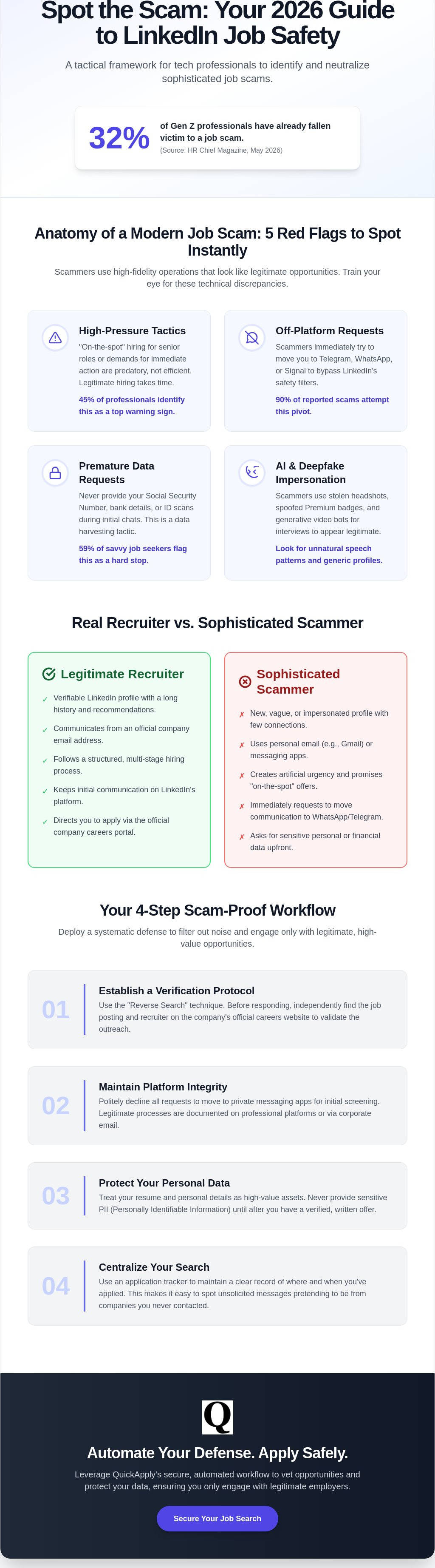
Job scams in 2026 are high-fidelity operations. They don't look like spam; they look like legitimate opportunities. Avoiding job scams on linkedin requires a zero-trust mindset and an eye for technical discrepancies. According to the June 2026 LinkedIn Job Search Safety Pulse, 45% of professionals now recognize high-pressure tactics as a primary warning sign. If a recruiter demands immediate action or offers "on-the-spot" hiring for a senior dev role, they aren't efficient. They are predatory. Legitimate hiring cycles for high-impact tech roles require due diligence, not artificial urgency.
The most common pivot happens early. 90% of reported scam messages attempt to move you off-platform to private messaging apps like Telegram, WhatsApp, or Signal. This move bypasses LinkedIn's automated safety filters. Follow FTC guidance on job scams to identify these patterns before you engage. If they ask for your Social Security Number, bank details, or ID scans during the initial chat, terminate the connection. 59% of savvy seekers already flag this as a hard stop. You can maintain control by using an automated application tracker to verify where and when you actually submitted your data.
The "Malicious Coding Test" Scam
Technical assessments are now a primary vector for malware. Scammers send links to fake GitHub repositories or password-protected zip files. These files often contain scripts designed to scrape your local environment variables or install backdoors. Never download unsigned software or disable firewalls for a "test." Only use browser-based IDEs for initial technical screens. If the recruiter insists on a local install for a simple algorithm test, it is a massive red flag. Legitimate firms prioritize the security of their candidates' machines as much as their own.
Domain Spoofing and Email Discrepancies
Always perform a one-second domain check. Scammers use "look-alike" domains to trick the eye, such as @quickappIy.dev instead of @quickapply.dev. These subtle character swaps are easy to miss when you are moving fast. Legitimate tech companies never use Gmail or Outlook for official recruitment correspondence. Verify the recruiter’s email address against the official company directory. If the compensation package significantly exceeds the 2026 market average for your role, it’s likely a lure for data harvesting. Real opportunities offer competitive pay, not statistical anomalies designed to bypass your logic.
Real Recruiter vs. Sophisticated Scammer: A Comparison Framework
Don't trust a high connection count. In 2026, bot networks generate thousands of fake endorsements and connections in seconds. You need a more robust filter for avoiding job scams on linkedin. Start with a mandatory verification protocol for every inbound message. Your first move is the "Reverse Search" technique. Locate the specific job ID mentioned by the recruiter on the company’s official career portal. If the role doesn't exist on their primary domain, the outreach is a high-fidelity fraud. Real recruiters expect you to do your due diligence. They won't be offended by your request for a formal job link from their corporate site.
Analyze the depth of the recruiter’s profile beyond the surface. Look for a consistent history of industry-specific activity and long-term endorsements from verifiable employees at their stated company. Scammers often use stolen identities, but they struggle to replicate years of authentic engagement. Deploy "Trap Questions" during the initial chat. Ask about the team's specific CI/CD pipeline or their thoughts on a technical white paper the company published last quarter. Real employees possess internal context. Scammers rely on generative scripts and will give vague, non-technical answers when pressed for specifics.
Communication Patterns That Signal Legitimacy
Legitimate tech hiring loops in 2026 follow a structured, predictable cadence. You should expect a recruiter screen, followed by a technical assessment and multiple panel interviews over several weeks. Scammers attempt to compress this timeline to keep you in a state of high-arousal urgency. They want to move from "hello" to "offer" before your logic catches up. Follow FTC advice on avoiding job scams to maintain your defensive posture when a timeline feels too good to be true.
Minimum Verification Standard: A legitimate 2026 recruiter must possess a company-verified badge and a profile history exceeding twelve months of consistent, industry-relevant activity.
Using LinkedIn Internal Tools for Protection
Leverage the "About this profile" feature to check account age and recent name changes. If a "Senior Talent Partner" at a major tech firm joined the platform three weeks ago, it's a critical red flag. LinkedIn now requires verification for recruiters adding new hiring-related experience. Look for these trust signals. If they are missing, proceed with extreme caution. Reporting these profiles effectively is vital for the ecosystem. You can learn more about mastering the job application process to build a workflow that prioritizes security. By flagging suspicious activity, you help LinkedIn’s automated defenses, which already stop 99.5% of fake accounts before they are even reported.
Systemic Defense: How to Build a Scam-Proof Application Workflow
Manual tracking is a liability in a high-volume search. If you are applying to 50 roles a week, your memory will fail. Scammers exploit this cognitive overload. They send fake follow-up emails for roles you never applied to, hoping you'll click a malicious link out of curiosity. Centralizing your search data is the only logical solution for avoiding job scams on linkedin. You need a technical "source of truth" that records every interaction, every domain, and every recruiter name in real time. If a follow-up isn't in your log, it is a threat.
Deploy a "Burner Email" strategy to protect your primary identity during the Top of Funnel (TOFU) stage. Use a dedicated, secondary professional email address for initial applications. This creates a buffer between your sensitive personal accounts and potential data harvesters. Once a recruiter passes your internal verification protocol, you can move them to your primary channel. Automated verification works by cross-referencing inbound messages with your tracked history. If an "HR Manager" reaches out about a DevOps role but your tracker shows no submission to that firm, delete the message instantly. Efficiency is your best armor.
The Power of the Source of Truth
The QuickApply Application Tracker prevents you from falling for fake follow-up traps. It creates a timestamped record of every legitimate submission. You can audit your search daily to spot anomalies or "ghost" listings that have changed descriptions post-application. Integrating your tracker with your calendar allows you to verify interview invites automatically. If an invite arrives from a domain that doesn't match your original record, the system flags it. This level of organization turns a chaotic search into a secure, streamlined pipeline. Stop managing your search with spreadsheets and start centralizing your application data for total security.
Resume Tailoring as a Security Layer
Scammers rely on broad, generic job descriptions to attract the widest possible pool of victims. When you tailor resume to job description ai, you force yourself to engage deeply with the technical requirements of a role. This process naturally exposes low-quality listings. If the AI cannot find enough substance to tailor your skills, the job is likely a data-harvesting template. You should only apply to roles that meet a high match score. This reduces your digital footprint and ensures you only interact with high-intent, legitimate employers. AI precision filters out low-fidelity job postings by identifying missing technical requirements and generic templates before you ever hit submit.
Leverage QuickApply to Secure Your Job Search and Maximize Efficiency
Chaos is a scammer's best friend. When your job search is disorganized, you become an easy target for sophisticated phishing. QuickApply eliminates this vulnerability by streamlining your entire search into a single, high-performance dashboard. This isn't just about speed; it's about tactical control. By centralizing your workflow, avoiding job scams on linkedin becomes a natural byproduct of your professional efficiency. You no longer have to guess if an outreach is legitimate because your system already has the logs to prove it.
The Match Score is your primary filter. It instantly identifies legitimate roles that align with your specific technical profile and career goals. If a job posting lacks the technical depth required for a high match score, it's a clear signal to move on. This allows you to ignore the low-fidelity templates scammers use to harvest data. You maintain professionalism at scale by using AI-driven Resume Tailoring and Cover Letter Generation. These tools ensure your interactions with real recruiters are high-impact and data-driven. Once you've verified a role, use our Interview Practice tools to prepare for the technical loop with confidence.
Optimization Over Volume
Applying to hundreds of random roles is a failing strategy in the 2026 market. The winning move is applying to fewer, better-vetted opportunities where you have a clear competitive advantage. QuickApply’s best ai resume builder 2025 features save you hours of manual work by automating the alignment between your unique skills and the job requirements. This precision reduces your digital footprint and limits your exposure to bad actors. You gain the security of knowing every application is tracked and every follow-up is expected. It's time to stop building resumes from scratch and start tailoring them for maximum impact.
Take Control of Your Career Path
You've seen the evolution of the 2026 scam landscape. You know that "gut feelings" aren't enough to protect your data or your career. Don't leave your professional security to chance in a market flooded with AI-powered fraud. Set up your QuickApply dashboard today to build a secure, automated pipeline that prioritizes quality over noise. Join the thousands of tech professionals who use our system to stay ahead of the curve and secure high-value roles without the manual grind. Take the final step toward a more efficient, protected future. Start your secure, AI-powered job search with QuickApply today.
Secure Your Professional Future Through Automation
The 2026 job market demands more than simple caution; it requires a systemic defense against evolving digital threats. You now have the tactical framework to spot AI-generated impersonation and dismantle high-pressure fraud attempts. By implementing a strict verification protocol and centralizing your search data, you move from a reactive posture to proactive control. Mastering the art of avoiding job scams on linkedin is the final barrier between you and your next legitimate career move. It's about protecting your data while optimizing your path to a high-value role.
Efficiency is your greatest asset in this digital arms race. Don't let disorganized workflows or manual tracking leave you vulnerable to data harvesting or fraudulent follow-up traps. Leverage AI-powered match scoring and integrated application tracking to ensure every interaction is high-intent and fully verified. Trusted by tech professionals globally, our platform provides the technical bridge you need to navigate a complex landscape with absolute certainty. Your expertise is too valuable to waste on fake opportunities. Take command of your search data and accelerate your career with confidence.
Stop guessing and start applying with confidence—Get QuickApply
Frequently Asked Questions
How can I tell if a LinkedIn recruiter is real or a bot in 2026?
Real recruiters in 2026 must possess a verified badge and a consistent activity history exceeding twelve months. Bots usually lack technical nuance in conversation and rely on repetitive, scripted prompts that avoid specific stack questions. Check the "About this profile" section to see the account creation date. If a senior talent partner at a major firm joined only weeks ago, terminate the interaction immediately.
What should I do if I accidentally gave my personal information to a job scammer?
Freeze your credit immediately through major bureaus and change passwords for all sensitive accounts. Contact your bank if you shared financial details or bank account numbers. Report the incident to LinkedIn to flag the fraudulent account and document every interaction for your records. Taking these fast, decisive actions is the only way to mitigate the risk of long-term identity theft or financial loss.
Do legitimate companies ever ask for money during the hiring process?
Legitimate employers never charge candidates for equipment, training, or application processing fees. Any request for a "refundable deposit" or upfront payment for a home office setup is a definitive sign of fraud. Real companies provide necessary hardware and software at their own expense after you sign a formal offer. If a recruiter asks you to buy equipment from a specific vendor, it is a scam.
Is it safe to use "Easy Apply" on LinkedIn for every job?
Easy Apply is convenient but often exploited by bad actors for high-volume data harvesting. Mass applying without vetting the company increases your exposure to identity thieves who use fake listings to collect resumes. Prioritize avoiding job scams on linkedin by cross-referencing every listing with the official company career portal or by using trusted regional sites like SavannahJobs.com. Use an application tracker to log your submissions and monitor for suspicious, untracked follow-ups.
How do scammers use fake coding tests to steal data?
Scammers deliver malware through password-protected zip files or malicious GitHub repositories disguised as technical assessments. These files contain scripts designed to scrape your local environment variables or install backdoors on your machine. Only use browser-based IDEs for initial technical screens to maintain local security. Never disable your firewall or install unsigned software packages to complete a simple algorithm challenge for a recruiter.
Can an AI resume builder help me avoid job scams?
AI tools help you identify low-fidelity job postings by highlighting a lack of specific technical requirements in the description. If the software cannot find enough substance to tailor your experience, the job is likely a generic scam template designed for data harvesting. This precision filtering keeps you focused on high-intent, legitimate roles. It reduces your digital footprint by preventing you from submitting data to fraudulent listings.
What are the most common job scam keywords to watch out for on LinkedIn?
Watch for high-pressure phrases like "immediate start," "no interview required," or "on-the-spot hiring." Scammers also use keywords like "reimbursement for equipment" or "premium training program" to lure victims into financial traps. Legitimate tech roles focus on specific stacks, CI/CD pipelines, and project requirements. If the language is overly generic and emphasizes speed over skill verification, it is a major red flag.
How do I report a fake job posting on LinkedIn effectively?
Use the "Report this post" or "Report this profile" feature directly on the platform to alert LinkedIn’s safety team. Select "fraud or scam" as the specific reason to ensure the report is prioritized by automated defenses. Providing clear feedback helps the platform stop 99.5% of detected fake accounts before they reach other members. This collective reporting is a vital part of avoiding job scams on linkedin for the entire tech community.


