

What if your worst interview performance was actually the catalyst for your highest-paying job offer yet? It's a common fear in 2026. You spent weeks prepping, only to freeze on a dynamic programming challenge or stumble through a complex system design walkthrough. You're likely feeling the sting of lost confidence and the dread of being blacklisted by a top-tier firm. It's frustrating to watch hours of application effort vanish in a single session. Knowing how to handle a bad technical interview isn't about dwelling on the failure; it's about pivoting with speed and precision.
You already know that tech hiring is becoming more intentional and AI-driven. While 78% of technology leaders plan to increase headcount this year, the margin for error remains slim. You can turn this setback into a data-driven strategy for your next high-paying role. This guide provides a systematic recovery protocol to salvage your current standing and optimize your future performance. We'll show you how to analyze technical gaps, automate your follow-up, and build a resilient interview pipeline. You'll move from emotional frustration to a state of continuous productivity, ensuring that every failed edge case brings you closer to an optimized offer.
Key Takeaways
- Execute an immediate performance audit to document specific edge cases and bottlenecks while your memory is fresh.
- Differentiate between core knowledge gaps and "signal interference" to pinpoint exactly where your engineering logic decoupled from the interview requirements.
- Master how to handle a bad technical interview by delivering a strategic follow-up that provides a corrected solution to showcase your true capacity.
- Deploy AI-powered interview practice systems to simulate high-pressure environments and automate your preparation for specific tech stacks.
- Scale your job search through automated application tracking to treat every interview as a data point rather than a high-stakes personal failure.
The First 2 Hours: Immediate Damage Control Protocol
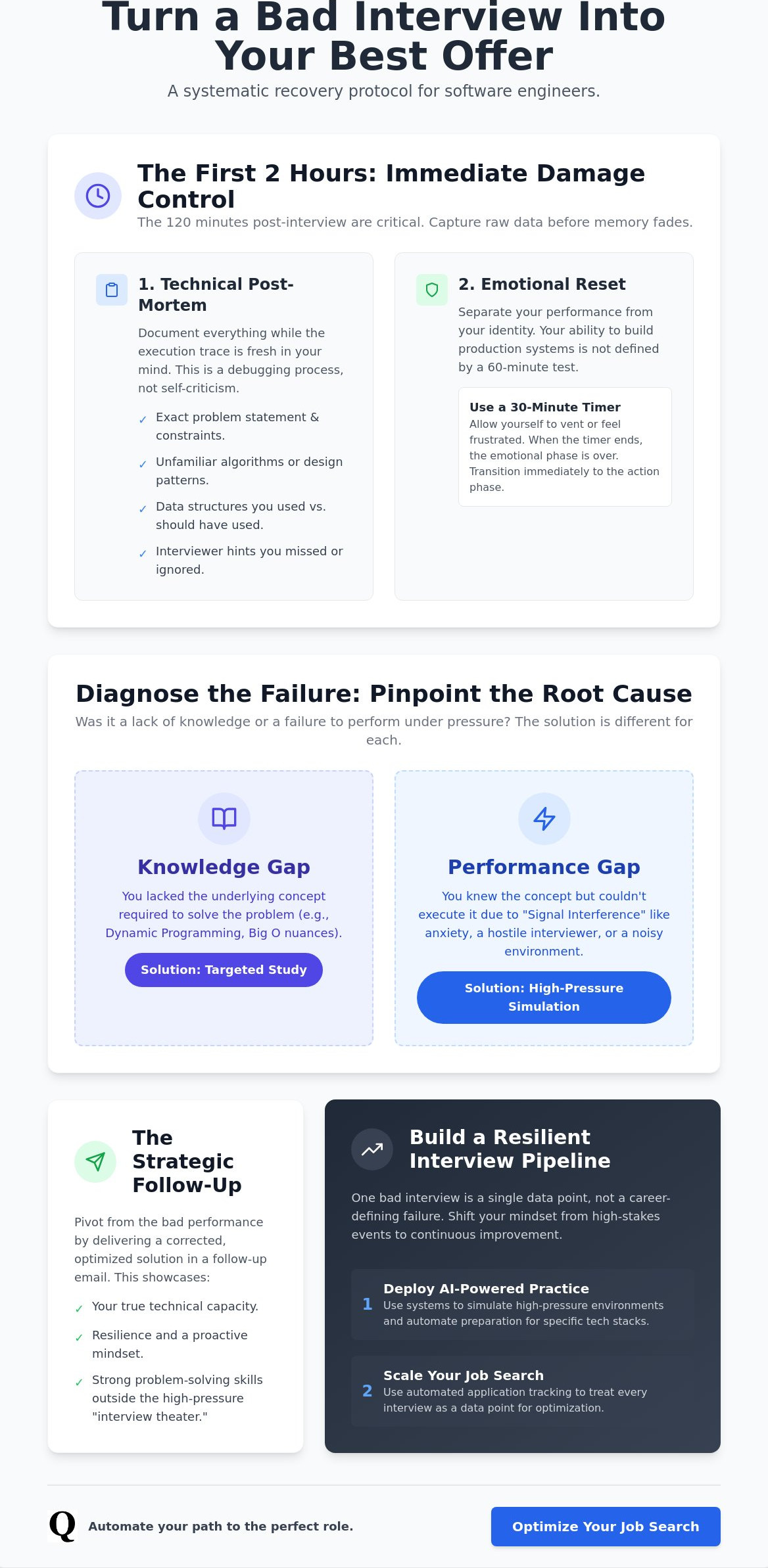
The first 120 minutes after a failed session are critical. Your brain is still holding the execution trace of your code and the specific logic paths you took. If you wait until tomorrow, you'll lose the granular edge cases that tripped you up. Most candidates waste this time in a shame spiral, but you need to treat this as a system post-mortem. You must capture the raw data before "rejection anxiety" overwrites your memory. Efficiency is your only priority now.
Learning how to handle a bad technical interview starts with immediate documentation. Open a blank document and list every prompt you received. Record the constraints. Note the exact moment you felt the logic decouple from the problem. Was it a knowledge gap in graph traversal, or did you simply fail to communicate your thought process clearly? Identifying the root cause now prevents the same bug from appearing in your next interview. With 78% of technology leaders planning to increase headcount in the second half of 2026 according to Robert Half, you cannot afford to repeat the same mistakes.
The Technical Post-Mortem
Write down the specific data structures you attempted to use. Did the interviewer offer a hint about using a sliding window or a hash map? If you ignored it, document why. This isn't about self-criticism; it's about debugging the process. Focus on these specific technical markers:
- The exact problem statement and any hidden constraints you discovered too late.
- The specific algorithm or design pattern that felt unfamiliar during the live-coding segment.
- Interviewer feedback loops. Did you catch their signals or miss them entirely?
Emotional Reset for Tech Pros
Coding for an audience is a distinct skill set. It has almost nothing to do with building scalable production systems. Stop conflating your identity as a developer with your performance in a 60-minute window. You are likely falling victim to understanding cognitive biases like the spotlight effect. This bias makes you overestimate how much the interviewer noticed your minor syntax errors while they were likely focused on your high-level architectural logic. Even in a market where 65% of hiring managers find it hard to find skilled talent, they value problem-solving over perfect syntax.
Set a strict 30-minute window to vent. Use it to complain about the prompt or the interviewer's lack of engagement. Once the timer hits zero, the emotional phase is over. Transition immediately to the action phase. You are now preparing your corrected solution. This proactive approach ensures you remain ahead of the curve, turning a perceived failure into a refined data point for your next high-paying role. You aren't just recovering; you're optimizing.
Diagnosing the Failure: Interview Theater vs. Engineering Reality
A technical interview isn't a day on the job. It's high-stakes performance art. Most firms use algorithmic puzzles as proxy metrics to filter candidates quickly. This creates a disconnect between your ability to deploy a microservice and your ability to invert a binary tree on a whiteboard. Understanding this gap is essential for anyone learning how to handle a bad technical interview. You didn't necessarily fail as an engineer; you failed as a performer in a specific, artificial environment. Scaling your search requires knowing how to handle a bad technical interview as a routine diagnostic event rather than a career catastrophe.
Identify if your struggle stemmed from "Signal Interference." This happens when external variables like extreme anxiety, a noisy environment, or a hostile interviewer disrupt your cognitive flow. Even if you follow established federal interview guidelines for preparation, these stressors can cause a system crash. If you were under-leveled or the role was a mismatch, the failure isn't yours. It's a data point. Use it to recalibrate your search toward roles that value your actual stack and seniority level. A bad fit is a bug in the application process, not a flaw in your code.
Knowledge Gaps vs. Performance Gaps
A knowledge gap means you lacked the underlying concept. You didn't know how to implement Dynamic Programming or the nuances of Big O notation for a specific sorting algorithm. A performance gap means you knew the concept but couldn't execute it while someone watched. Treat knowledge gaps with targeted study. Treat performance gaps with high-pressure simulation. Use Interview Practice tools to build the muscle memory needed to execute under load. This distinction dictates your next 48 hours of preparation. If you knew the answer but couldn't speak it, your logic isn't the problem; your execution environment is.
The "Match Score" Reality Check
Your resume might be writing checks your current skills can't cash. Or worse, it's underselling you for roles where you'd thrive. Analyze your "Match Score" by comparing your profile against the job description requirements. If the requirements were 90% outside your wheelhouse, the interview was doomed by math, not talent. Learn how to tailor your resume to a job description to ensure your next invitation is for a role you can actually win. You can use an Application Tracker to monitor which role types yield the best interview-to-offer ratios. This allows you to optimize your funnel for success without wasting time on misaligned opportunities.
The Strategic Follow-Up: How to Pivot After a Bad Performance
Most candidates accept defeat the moment the Zoom call ends. That's a systemic error. A failed session is just a bug in your execution, and every bug needs a patch. Sending a generic "thank you for your time" note is a wasted cycle. Instead, you must deploy a strategic follow-up that reframes the failure as a demonstration of your persistence and technical maturity. This is a core component of how to handle a bad technical interview effectively. You're shifting the narrative from "I failed this test" to "I am an engineer who solves problems, even after a crash."
Your follow-up must be punchy and direct. Limit the communication to 3-4 sentences. Recruiters and hiring managers are optimized for speed; they don't want a long-winded apology. They want to see that you've processed the challenge and reached a resolution. Following Harvard career advice, professional persistence is often the differentiator in high-stakes roles. By providing a corrected solution, you prove that your technical judgment remains intact even when the live-coding environment fails you.
The "Post-Interview Solution" Email
Don't just say you could have done better. Show it. Send a brief note acknowledging the specific bottleneck you encountered. "I reflected on the recursive approach we discussed and realized a bottom-up dynamic programming solution would optimize the space complexity to O(1)." Attach a link to a GitHub Gist containing the clean, commented code. This isn't about begging for a second chance. It's about demonstrating the growth mindset that 2026 engineering leads prioritize. You're showing them that when you hit a blocker in production, you don't stop until you find the fix.
Managing the Recruiter Relationship
Recruiters are the gatekeepers of your future pipeline. Even if this specific role is a "no," the relationship is a long-term asset. With 78% of technology leaders planning to increase permanent headcount in the second half of 2026, today's rejection could be next month's lead for a better-fitting role. Ask for specific feedback if the rejection email arrives. Frame it as a request for data to fuel your continuous technical growth. Use your Application Tracker to log these interactions. Tech circles are small; a candidate who handles a "bad" interview with professional poise often stays at the top of the stack for the next opening. You're building a reputation for reliability, not just coding speed.
- Acknowledge the challenge without sounding desperate.
- Provide the optimized "patch" for the problem you missed.
- Highlight a project experience or soft skill that didn't get airtime.
- Keep the door open for future iterations of the hiring cycle.
Building Resilience Through Algorithmic Preparation
Resilience in 2026 isn't about "trying harder" or brute-forcing more LeetCode problems. It's about systemic automation and high-fidelity simulation. Manual grinding is a low-efficiency path that fails to account for the psychological load of a live session. To master how to handle a bad technical interview, you must shift from passive study to active performance optimization. If 65% of technology hiring managers report that finding skilled talent is more challenging than last year, the bar for execution has moved. You need to bridge the gap between your local IDE and the high-pressure environment of a live-coding platform.
Building this resilience requires a "Failure Log." This is a living document where you track recurring technical blind spots and execution bottlenecks identified in your post-mortems. Instead of solving random problems, use your log to identify which patterns, like sliding windows or dynamic programming, consistently cause your logic to decouple. This data-driven approach ensures your preparation is targeted and efficient. You are no longer guessing what to study; you are debugging your own performance profile to eliminate systemic weaknesses before your next high-stakes call.
AI-Driven Interview Simulation
AI tools are the new standard for interview readiness. These systems provide instant feedback on your verbal explanations, which is often the primary point of failure for senior engineers. You might know the solution, but if you can't articulate the trade-offs while writing the code, you lose the signal. Use final round ai to master real-time performance. These copilots help you build the muscle memory required to maintain logic flow while engaging with an interviewer. This reduces cognitive load, allowing you to focus on solving the problem rather than managing your anxiety.
Systematizing the Study Plan
Don't boil the ocean. Tech interviews in 2026 focus heavily on pattern recognition over memorization. Focus your energy on three key patterns: sliding windows, two pointers, and recursion. These patterns cover a significant percentage of modern algorithmic challenges. Use your Application Tracker to see which tech stacks or company types yield the most difficult sessions. This allows you to prioritize your study time based on actual market feedback. Schedule "mock failure" sessions where you tackle problems intentionally designed to be above your current level. Practicing the transition from "stuck" to "solving" is the most effective way to learn how to handle a bad technical interview in real time.
Ready to turn your next interview into a guaranteed win? Deploy our Interview Practice tools to simulate high-pressure environments and master the verbal logic that hiring managers demand.
Scaling Your Search: Why One Bad Interview Doesn’t Matter
One failed session is a single data point in a much larger set. If your pipeline is empty, a rejection feels catastrophic. If your pipeline is full, it's just a bug report you'll use to patch your next performance. Learning how to handle a bad technical interview involves shifting from a scarcity mindset to a high-volume strategy. When you have three more interviews scheduled for the same week, the pressure on any single session drops significantly. You don't need luck; you need a better funnel. Automation allows you to treat the job search as an optimization problem rather than an emotional hurdle.
The tech landscape in 2026 moves too fast for manual entry. With 78% of technology leaders planning to increase permanent headcount this year, the opportunities are there, but the competition is automated. You must match that speed. By utilizing Resume Tailoring and Cover Letter Generation, you can apply to 10 high-match roles in the time it used to take to customize a single application. This volume ensures that a single "bad" interview never stalls your career momentum. You stay productive without active effort, keeping your pipeline consistently primed with new leads.
Automating the Top of the Funnel
Efficiency starts with your application strategy. Don't waste time on roles where you lack the core technical stack. Use a "Match Score" strategy to prioritize applications where you have at least an 80% technical fit. This ensures you only spend energy on interviews you are statistically likely to win. You can learn the specifics of this high-speed approach by mastering the job application process through systemic automation. This guide helps you move past the tedious manual hunting phase and into a state of continuous opportunity generation.
The High-Efficiency Job Search
A diversified interview schedule is the best cure for performance anxiety. When you diversify your pipeline, you stop obsessing over a single firm's "blacklisting" and start focusing on the next offer. Use an Application Tracker to monitor every stage of your funnel. This data tells you exactly where your process is breaking down, whether it's the initial screen or the final technical round. You aren't just looking for a job; you're building a resilient career system that functions regardless of a single bad day. Stop let a single rejection define your value as an engineer. It's time to scale your output and secure the offer you deserve. Optimize your job search with QuickApply and turn your next application into a high-paying reality.
Shift from Recovery to Optimization
A failed session isn't a dead end; it's a diagnostic report. By executing a technical post-mortem and delivering a strategic follow-up, you've already outperformed the majority of your peers. You've turned a logic crash into a demonstration of senior-level resilience. Mastering how to handle a bad technical interview is simply the first step in optimizing your professional trajectory. The 2026 market rewards those who treat the job search as a scalable system rather than a series of high-stakes gambles.
Now is the time to automate your advantage. Use AI-powered resume tailoring in seconds to ensure every application is a high-match hit. Deploy interview practice tools for tech pros to build the verbal muscle memory that live-coding demands. Track your progress with real-time application tracking to maintain a diversified pipeline that eliminates performance anxiety. You have the talent; you just need the right infrastructure to scale it.
Stop worrying about one failure and start scaling your search with QuickApply. Your next high-paying role is a function of volume and precision. Keep iterating, keep optimizing, and watch your offer rate climb.
Frequently Asked Questions
Should I apologize for a bad technical interview in my thank-you note?
Never apologize for your performance. Apologies signal low professional confidence and highlight the failure. Instead, frame your thank-you note as a technical pivot. Acknowledge the complexity of the challenge and provide a corrected, optimized solution. This demonstrates a growth mindset and proves you can debug your own logic under pressure.
Will bombing one interview blacklist me from a company forever?
No company blacklists candidates for a single failed technical loop. Most top-tier firms view interviews as snapshots of your current state, not permanent labels. In fact, many successful hires at major tech companies failed their first attempt. They simply waited for the cooling-off period to end and reapplied with a more refined strategy.
How long should I wait to reapply to a company after a failed technical interview?
The standard cooling-off period is usually 6 to 12 months. This duration allows you to show measurable growth in your technical stack. Use your application tracker to monitor these windows across your target firms. Reapplying too soon suggests you haven't patched the logic bugs that caused the initial failure.
What if I knew the answer but my mind went blank during the live coding session?
This is a performance gap caused by signal interference, not a lack of knowledge. You must learn how to handle a bad technical interview by building resilience through high-fidelity simulations. Practice in environments that mimic the pressure of a live call. Muscle memory is the only way to ensure your logic executes when stress levels spike.
Can I ask for a second chance or a different interviewer?
Requesting a redo rarely works and often looks desperate. It's a low-efficiency move. Your time is better spent sending an optimized code snippet to prove your competence and then moving to the next lead in your pipeline. If there was a legitimate technical issue, mention it objectively to the recruiter without asking for favors.
Is it worth finishing the coding challenge if I know I already failed the time limit?
Yes, you should always finish the challenge. Completing the task demonstrates persistence and completion logic. Even if you miss the window, a finished solution provides a signal that you can reach the goal state. It shows the interviewer that you don't quit when you hit a blocker, which is a critical trait for senior engineers.
How do I explain a failed technical interview to my recruiter?
Keep your explanation data-focused and objective. State that the specific technical prompt didn't align with your primary stack or that you've already identified the execution bottlenecks you encountered. Maintaining professional poise is how to handle a bad technical interview while keeping your leverage. Show the recruiter that you're already iterating on the feedback to optimize your next performance.
How much of a technical interview is based on the final code vs. the thought process?
In 2026, your thought process is the primary signal. AI can generate perfect syntax, but it cannot explain architectural trade-offs or business impact. Interviewers look for your ability to articulate logic, handle edge cases, and accept feedback. A minor syntax error won't disqualify you if your high-level architectural judgment is sound and clearly communicated.


