

Over 53% of job seekers in 2026 report being ghosted by employers after a final interview. This is a three-year high that turns professional ambition into a frustrating waiting game. It's exhausting to deliver a high-performance interview only to be met with a digital void. You've done the work, but the silence makes you feel like your career momentum has stalled. Knowing what to do when you don't hear back after final interview is no longer about polite patience. It's about tactical execution.
You deserve a strategy that respects your time and your talent. We're moving past the anxiety of "checking in" and replacing it with a tech-driven plan to reclaim your momentum. This guide delivers a precise timeline for professional outreach and a system to manage multiple active pipelines simultaneously. You'll learn how to use automated templates and application trackers to ensure your search never stops for a single unresponsive recruiter. It's time to stop waiting and start optimizing your path to the next offer.
Key Takeaways
- Establish a realistic 2026 response window to eliminate anxiety and recognize that silence often signals internal stakeholder delays.
- Deploy a structured "Rule of Three" cadence to master exactly what to do when you don't hear back after final interview without appearing desperate.
- Upgrade your outreach with high-impact, value-add subject lines and project insights that keep you top-of-mind for hiring teams.
- Build an "Apply and Forget" defensive strategy by leveraging automated resume tailoring to keep your pipeline moving while you wait.
- Identify the precise moment to pivot your resources toward new opportunities and stop burning time on unresponsive leads.
The Post-Interview Silence: Understanding the 2026 Hiring Timeline
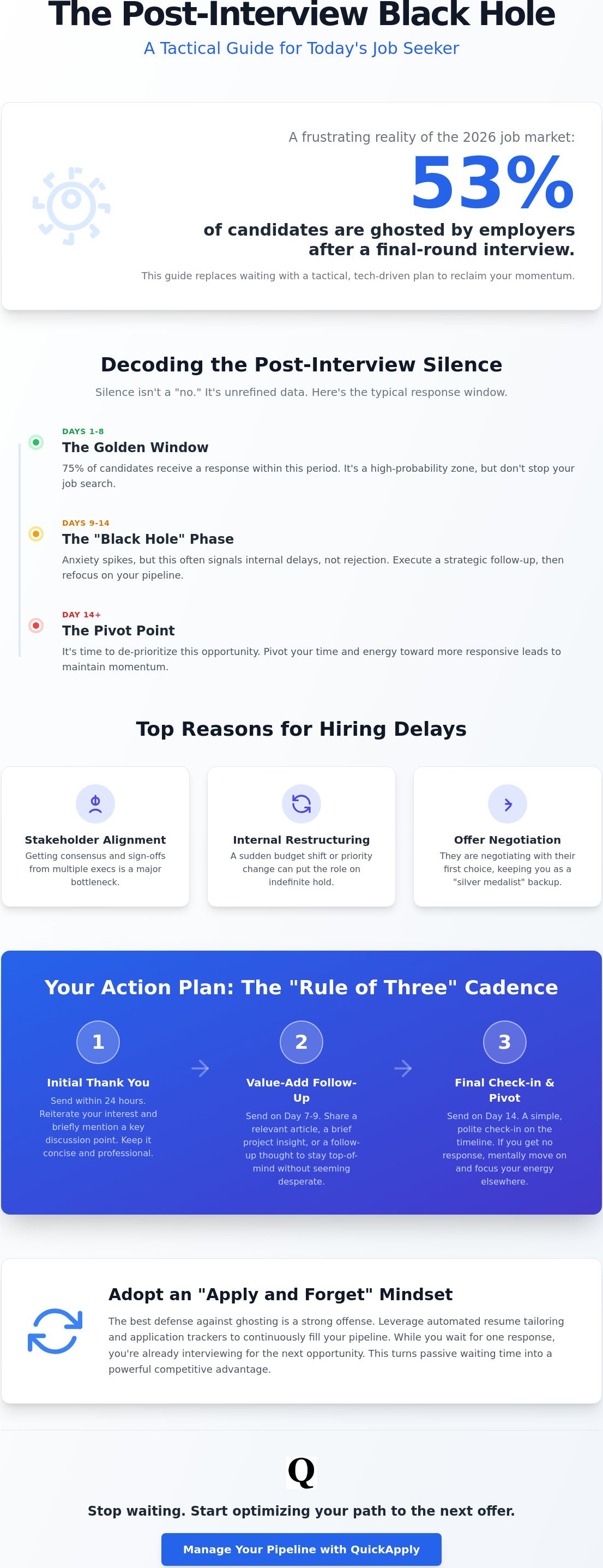
The post-interview void isn't a dead end. It's a system status. In the 2026 market, the gap between your final handshake and a signed offer letter has shifted. Statistics show that 75% of candidates receive a response within eight days. However, the full window typically spans 3 to 14 days. If you've hit day nine without a ping, your anxiety is likely spiking. This "black hole" phase is the most taxing part of the hiring process. But remember this: silence isn't a "no" until the system confirms it. It is simply unrefined data. Knowing what to do when you don't hear back after final interview starts with decoding this silence rather than fearing it. Treat every day of radio silence as a signal to optimize your next move. Use this time to refine your strategy rather than refreshing your inbox.
Why the Final Round Takes Longer
Final rounds involve more than just a culture fit check. They require stakeholder alignment across multiple departments. You are often waiting on executive sign-offs that stall in overflowing inboxes. Reference verification and background checks add another layer of latency to the pipeline. Sometimes, a sudden shift in team priority or a budget re-evaluation puts the entire role on ice. These are internal system errors that have nothing to do with your performance. Stakeholders may also be debating between two top-tier candidates, causing a consensus bottleneck that delays the final notification.
The 'Ghosting' Phenomenon in Tech
Automation is a double-edged sword. While it speeds up initial screenings, automated HR systems often fail to close the loop with final-round candidates. Only 24% of companies have a formal policy to notify everyone they interview. This leads to the "silver medalist" trap. Companies keep high-quality backups on ice while they negotiate with their first choice. To survive this, you need a proactive system. Use an Application Tracker to log every interaction and set hard deadlines for follow-ups. Don't let a single silent thread stall your entire career momentum. When you understand what to do when you don't hear back after final interview, you stop being a passive observer and start acting like a strategist who manages multiple active leads.
Why Companies Go Silent After the Final Round
Hiring is a high-stakes algorithm. Silence is rarely a personal slight. It's usually a system failure or a strategic delay. Companies often find themselves paralyzed by stakeholder indecision. They hunt for the "perfect" candidate while the "available" ones wait in a digital queue. This creates a bottleneck where you are left wondering what to do when you don't hear back after final interview. The reality is that 53% of candidates get ghosted after a job interview because the internal process has stalled. If you aren't the immediate top choice, you're often kept as a "silver medalist" while the first-choice candidate negotiates their offer. This keeps the company's pipeline secure while leaving yours in limbo.
Internal restructuring and sudden headcount freezes also disrupt the flow. A role that was a priority on Monday can be deprioritized by Friday due to budget shifts. In these cases, recruiters are often instructed to halt communication until a new directive is issued. They don't have a definitive "no" yet, so they provide nothing. This communicative vacuum is where your momentum dies if you let it. Instead of waiting for a manual update that might never come, use an application tracker to maintain visibility across all your active leads. Don't let one silent stakeholder freeze your entire career progression.
The Multi-Stakeholder Decision Loop
Modern hiring requires consensus. Coordinating debriefs for four or more interviewers is a logistical nightmare. Conflicting feedback between technical leads and culture-fit managers creates a deadlock. In a remote-first world, these decision loops take even longer as asynchronous communication replaces immediate boardroom huddles. One vacation or one sick day in the stakeholder chain can add a full week to the timeline. This latency is a feature of the corporate structure, not a bug in your performance.
HR Tech and Systemic Delays
Applicant Tracking Systems (ATS) like Workday or Greenhouse are built for compliance, not candidate experience. Workflows often stall if a specific manager forgets to click an "approve" button. Automated notification triggers are frequently disabled to prevent premature rejections, leading to total silence. Your "Match Score" still matters after the interview phase. If the system flags a late-entry candidate with a higher automated score, the recruiter might pivot their focus instantly. High-volume hiring environments prioritize efficiency over empathy every time.
Follow-up Strategy: When to Ping vs. When to Pivot
Passive waiting is a strategy for failure. In a high-speed market, your silence is interpreted as a lack of interest or a lack of other options. You must deploy a structured outreach cadence that maintains your professional authority without crossing into desperation. This is the "Rule of Three." It's a sequence designed to elicit a response while protecting your time. Knowing what to do when you don't hear back after final interview requires a shift from emotional attachment to tactical execution. You aren't just checking in. You're managing a lead in your professional pipeline. If the lead goes cold after three structured attempts, you have your data. It's time to reallocate your resources.
Leverage is your most powerful tool during the post-interview phase. If you're in final stages with other firms, mention it. A simple note stating that you're approaching a decision deadline with another organization can often break a stakeholder deadlock. It forces the hiring team to move you from the "silver medalist" pile to the "priority" pile. This isn't about bluffing. It's about communicating your market value. When companies realize they might lose a top-tier asset to a competitor, their internal bottlenecks suddenly clear. Use your Application Tracker to visualize these overlapping timelines and ensure you never miss a follow-up window.
The Day-Three Check-In
The immediate "Thank You" note is a baseline requirement, but the Day-Three check-in is where you differentiate. Don't just ask for a status update. Reiterate your value proposition based on specific feedback you received during the final round. If the team mentioned a specific technical hurdle, briefly explain how your expertise solves it. Keep it short, punchy, and professional. You are reminding them why you are the optimal solution to their problem, not just asking for a favor.
The Day-Ten Pivot
Day ten is the hard stop. If you haven't received a meaningful update by this point, the probability of an immediate offer drops significantly. Stop checking your email every five minutes. Shift your focus from this single role to a diversified pipeline. Use an Application Tracker to stay organized and keep other leads moving forward. A diversified search is your best defense against the anxiety of a silent recruiter. When you have five other active pipelines, one silent final round is just a minor data point, not a career crisis.
Writing the High-Impact Follow-Up Email
Precision is your only currency. Flowery prose is a waste of bandwidth. When you are deciding what to do when you don't hear back after final interview, your outreach must serve a singular purpose: reinforcing your status as the optimal solution. Recruiters in 2026 are flooded with generic, AI-generated "checking in" notes. To cut through the noise, your email needs to be a high-signal update that provides immediate value. Stop asking for favors. Start providing data. If you haven't received a response, it's often because the hiring manager is stuck in a decision loop. Your job is to provide the nudge that breaks the cycle.
Your subject line is the first gate. It needs to be functional and searchable. Use a format like "[Role Title] - [Your Name] - [Specific Insight/Update]". This allows the recruiter to categorize your message instantly within their ATS. Inside the body, maintain a tone of professional parity. You aren't a supplicant; you're a peer discussing a business arrangement. Ask for a timeline directly. It shows you value your own schedule as much as theirs. This level of directness signals confidence and high self-worth, which are traits of "ahead of the curve" talent. To ensure your next outreach is just as sharp, use Resume Tailoring to keep your profile aligned with the evolving needs of the market.
Template: The Technical Value-Add
Connecting the follow-up to a specific technical problem discussed during the interview is a power move. It demonstrates continuous interest without sounding needy. Write a follow-up that references a specific pain point mentioned by the CTO. For example: "I was thinking about our discussion regarding the latency issues in your legacy API. I recently saw a similar architecture solved by [Specific Technique], and I'm eager to apply that logic to your stack." This keeps you in the "problem solver" category rather than the "job seeker" category.
Template: The Leverage Play
Professionally mentioning other offers or final rounds creates immediate urgency. It signals that your talent is a finite resource. A simple, confident statement works best: "I'm currently approaching the decision phase with another firm, but this role remains my priority due to [Specific Reason]. I'd appreciate an updated timeline so I can manage my commitments effectively." This maintains your brand persona as a high-demand professional. It forces the hiring manager to act before they lose a top-tier asset to a competitor.
Automating Your Pipeline While You Wait
Waiting is a low-yield activity. In the 2026 market, the most effective answer to what to do when you don't hear back after final interview is to make the outcome irrelevant. You do this by scaling your output. The "Apply and Forget" mindset isn't about being careless. It's about systemic detachment. While a hiring manager navigates their internal bottlenecks, you should be generating new leads. Don't waste cognitive energy refreshing an empty inbox. Instead, turn that silence into a productivity sprint. By the time they finally send an update, you should already have three other final rounds scheduled. This is how you reclaim your career momentum and maintain a position of power.
Automation is your best defense against the anxiety of the "black hole." Modern tools allow you to submit high-quality, targeted applications at a volume that was previously impossible. If one lead goes cold, your system should already be warming up ten more. This high-volume, low-effort approach ensures that your career trajectory is never dependent on a single stakeholder's decision. You are the architect of your own pipeline. Use technology to bypass the manual friction of the traditional job search. Focus on the variables you can control, like your application rate and your match score.
Keep Your Momentum with QuickApply
Speed is a decisive competitive advantage. You can tailor your resume to a job description in seconds, ensuring you pass every ATS filter with a high Match Score. Stop manually editing bullet points for hours. Use Resume Tailoring to align your profile with the specific technical needs of your next target. This reduces your "cost per application" and keeps your pipeline full without active effort. While your competitors are stuck in a cycle of post-interview anxiety, you are flooding the market with optimized applications. This is how you win in a digital-first landscape.
Preparing for the Next 'Yes'
The silence is an opportunity to sharpen your edge. Use Interview Practice tools to refine your delivery while you wait for a response. Don't wait for an offer to start your salary negotiation strategy. Map it out now. You should also be building your promotion roadmap before you even sign the contract. Treat your career like a software product that requires continuous deployment. When you stay ahead of the curve, a single "silent" interview is just a minor bug in a much larger, more successful system.
Scale Your Strategy and Reclaim Your Momentum
Post-interview silence is a variable you can't control, but your reaction to it determines your career trajectory. You've learned that stakeholder indecision and administrative bottlenecks are the primary drivers of delay in 2026. By deploying the "Rule of Three" and high-impact follow-up templates, you've mastered the tactical response. However, the most critical lesson in what to do when you don't hear back after final interview is to never let a single lead freeze your pipeline. Professional growth requires consistent output regardless of external latency.
Successful professionals treat their job search like a high-performance system. They use automation to stay ahead of the curve. While you wait for a response, keep your edge sharp by practicing with AI-driven tools and tracking every new lead with precision. Don't let a recruiter's silence dictate your value. Scale your efforts, diversify your options, and ensure that your next offer is just one of many. Your momentum is your greatest asset.
Stop waiting and start applying with QuickApply’s AI tools. Leverage AI-powered resume tailoring in seconds and manage your search with an automated application tracker designed for 2026. Use our interview practice tools to keep your edge sharp until the right offer lands. You've got the strategy. Now, execute.
Frequently Asked Questions
How long should I wait after a final interview to follow up?
Wait five to seven business days before initiating your first follow-up. While 75% of responses arrive within eight days, internal stakeholder alignment often requires a full week to finalize. If the recruiter provided a specific date, wait exactly one business day past that deadline before sending a brief, professional nudge to check the status.
Is it a bad sign if I haven't heard back after 5 days?
No, a five-day silence is standard in the 2026 hiring landscape. Most final-round decisions involve coordinating calendars for multiple executives and verifying references. Silence doesn't indicate a rejection; it simply reflects the latency of modern corporate workflows. Stay focused on your broader pipeline while the internal team completes their necessary debriefing sessions.
Should I call the recruiter if they aren't answering my emails?
Avoid calling the recruiter directly. Stick to email or LinkedIn messages to respect their workflow and maintain a digital paper trail. Recruiters manage high volumes of candidates and prefer asynchronous communication that they can process at speed. A phone call is often seen as disruptive and can project a sense of desperation rather than professional confidence.
What should I do if the recruiter told me they'd have an answer by Tuesday, but it's now Friday?
Send a concise follow-up on Friday morning to request an updated timeline. Acknowledge that internal priorities can shift and reiterate your interest in the position. Knowing what to do when you don't hear back after final interview involves being proactive without being pushy. Internal delays are common, so treat the missed deadline as a logistical update rather than a personal slight.
Can I still be rejected after a successful final interview?
Yes, rejections can occur even after a perfect interview performance. Headcount freezes, budget re-allocations, or the sudden emergence of an internal candidate can disrupt the process. This is why you must maintain your momentum. Treat every interview as a single data point in a larger strategy and keep your application volume high until a contract is signed.
How do I handle the anxiety of waiting for a job offer?
Channel your anxiety into new applications. The stress of waiting usually stems from a lack of alternative options. By automating your next batch of applications, you reclaim a sense of control over your career path. Constant activity is the best defense against the emotional toll of the post-interview silence; for instance, you can find out more about local opportunities in Paphos to expand your search. Focus on the variables you can control today.
Should I keep applying for other jobs while waiting for a final decision?
Yes, you should keep applying until you have a signed offer letter. 61% of candidates accept the first offer they receive to secure their momentum. Continuous application ensures you have leverage during salary negotiations and protects you if the current lead goes cold. Never stop your search based on the verbal promise of an upcoming decision.
What are the signs that I didn't get the job after the final round?
Extended silence beyond 14 days and a lack of response to two structured follow-ups are strong indicators of a pivot. If you see the job posting refreshed on LinkedIn or the company website, it's a sign they are still searching. When you are deciding what to do when you don't hear back after final interview, recognize these signs as a prompt to reallocate your energy.


