

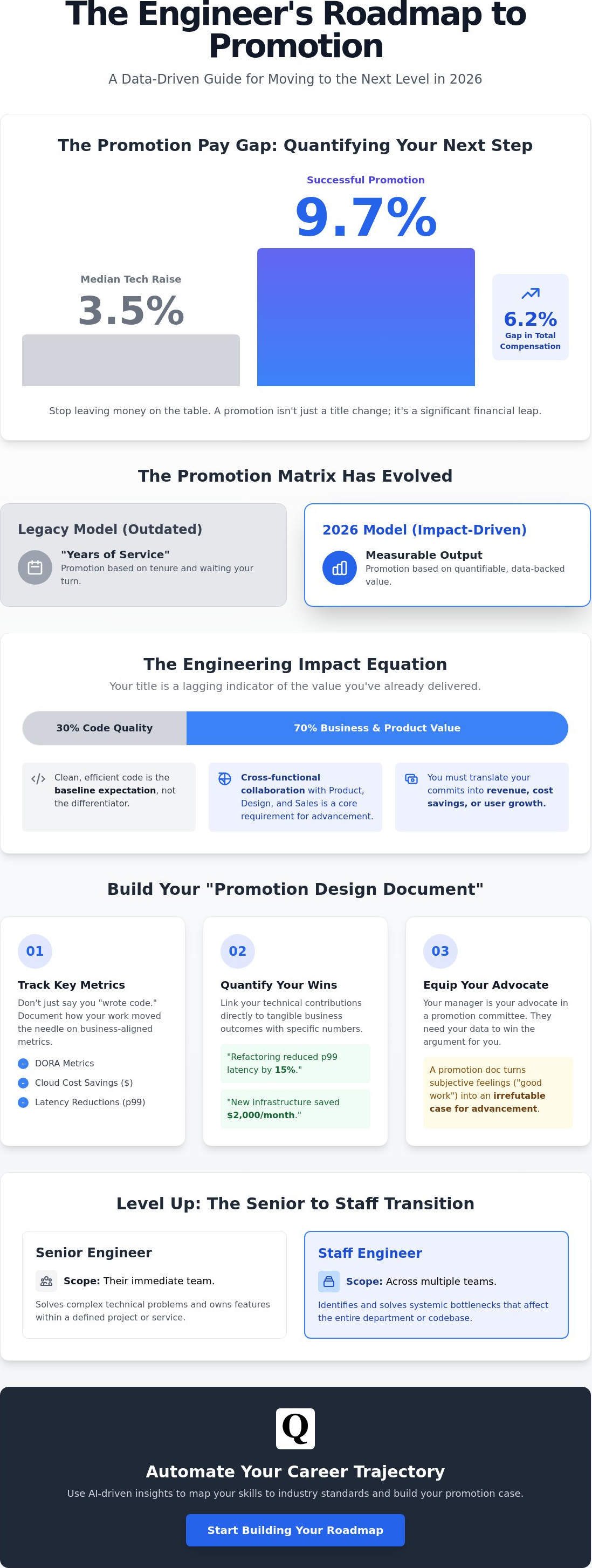
In 2026, the gap between a standard cost-of-living adjustment and a promotion is a massive 6.2% in total compensation. While the median tech raise sits at just 3.5%, engineers who successfully level up are securing 9.7% increases. You've likely spent months refactoring messy codebases and unblocking teammates, only to receive vague feedback like "keep up the good work." It feels like your most impactful contributions are invisible to the people holding the budget. Knowing how to ask for a promotion as a software engineer shouldn't feel like a high-stakes gamble or a social hurdle. It's a system to be solved.
We agree that your career growth should be as predictable as a well-tested CI/CD pipeline. This guide promises to help you master the engineering promotion cycle by treating your professional trajectory like a technical system optimized with data. You'll learn to move past the anxiety of the "ask" by using hard metrics and AI-driven insights to prove your value. We're providing a clear list of metrics to track, repeatable scripts for your 1-on-1 meetings, and a structured roadmap to accelerate your journey to the next level.
Key Takeaways
- Shift your focus from seniority to measurable output by decoding the 2026 impact-based promotion matrix.
- Build a data-backed "Promotion Design Document" using DORA metrics and cost-saving logs to prove your technical value.
- Master how to ask for a promotion as a software engineer with punchy scripts designed for high-impact 1-on-1 conversations.
- Debug a "not yet" response by creating a time-bound improvement plan that separates economic hurdles from performance gaps.
- Automate your trajectory with a Promotion Roadmap that maps your technical skills to current industry standards using AI.
Decoding the Engineering Promotion Matrix in 2026
Stop treating your promotion like a surprise gift. In the 2026 tech market, a title change is a lagging indicator. It's the official recognition that you've already been operating at the next level for months. The legacy model of "years of service" is dead. High-growth firms now prioritize measurable impact over tenure. If you want to know how to ask for a promotion as a software engineer, you must first master the logic of the matrix. You aren't asking for a reward for past work; you're confirming your current rank in the system.
Your company's career ladder isn't just an HR document; it's a technical specification for your career. You need to audit your current output against these requirements with surgical precision. Most engineers wait for the formal performance appraisal process to start the conversation. That's a tactical error. By the time the review cycle hits, the budget is already locked and the decisions are often finalized. You need to be the person who makes the decision easy for the stakeholders involved.
Understand that your manager is rarely the sole decision-maker. Modern engineering organizations use Promotion Committees to neutralize individual bias. Your manager acts as your advocate, but the committee demands proof. They look for patterns of behavior that align with the next level's expectations. They need a "deal room" of evidence to approve your case. If you don't provide the data, your advocate can't win the argument for you. You must equip them with the logs, metrics, and testimonials that prove your current level of operation is already exceeding your current title.
The Difference Between Senior and Staff Impact
The transition from Senior to Staff is a shift in scope, not just technical skill. Senior engineers solve complex technical problems within their immediate team. They own features and mentor juniors. However, Staff engineers scale solutions across multiple teams or entire departments. They identify systemic bottlenecks that affect fifty engineers, not five. You must identify where you currently sit on this impact spectrum. Are you fixing a localized bug, or are you building the framework that prevents that class of bug from ever appearing across the entire codebase again?
Why 'Good Code' is Only 30% of the Equation
Quantifying Impact: Building Your Promotion Design Document
Your manager doesn't remember what you did in February. Memory is a volatile storage system, and relying on it during a review cycle is a critical failure. To master how to ask for a promotion as a software engineer, you must build a Promotion Design Document. This is a living log of every win, optimization, and architectural decision you've made. It functions exactly like a technical specification for your career. It turns subjective feelings into objective, irrefutable data points that a promotion committee can't ignore.
Start by tracking metrics that align with business goals. Don't just say you "wrote code." Document how your work moved the needle on DORA metrics. If you increased deployment frequency or slashed the change failure rate, that's a high-signal achievement. Use AI tools to scan your GitHub contributions and Jira tickets weekly. This helps you synthesize raw activity into a quarterly impact summary without wasting hours on manual entry. If you're struggling to articulate these wins, looking at good resume examples can help you frame internal accomplishments with the same precision you'd use for a job search.
Hard Metrics: The Proof in the PRs
Quantify your technical contributions with precision. Did your refactoring reduce p99 latency by 15%? Did your infrastructure changes save the company $2,000 a month in cloud costs? These are the numbers that justify a higher salary and a new title. Link your technical debt reduction directly to developer velocity. Show that by cleaning up a legacy module, you enabled the team to ship features 20% faster. Data wins arguments. When you present a spreadsheet of performance gains, you remove the emotional friction from the promotion request. Start building your Promotion Roadmap now to ensure your data is ready when the next review cycle hits.
Soft Metrics: The Force Multiplier Effect
Executing the Growth Conversation: Scripts and Talk Tracks
Timing is a technical constraint. If you wait for the official annual review to discuss your advancement, you've already missed the deployment window. Decisions regarding headcount and budget are typically finalized months before the HR cycle officially begins. To master how to ask for a promotion as a software engineer, you must initiate the conversation during a standard 1-on-1 at least one full quarter in advance. This isn't a surprise pitch; it's a synchronization of expectations.
You might face a "Manager Gap" if your lead is new to the team or lacks a deep technical background. They don't have a cached history of your contributions. In these scenarios, you must act as the primary data source. Schedule a specific "Gap Analysis" meeting. The objective is to identify the exact delta between your current performance and the next level's requirements. Don't ask for a promotion yet; ask for the roadmap to get there. This forces your manager to define the success criteria in writing, which you can then execute against with surgical precision.
The 1-on-1 Script for Level Alignment
Start the conversation with a direct, high-signal opening. Try this: "I’ve been tracking my impact against the Staff Engineer matrix, and I’d like to align on the path to reaching that level by the next cycle." This frames the promotion as a collaborative goal rather than a demand. Once you've stated your intent, pivot to the delta: "Based on the current matrix, what do you see as the primary gap I need to close to be considered a lock for this transition?"
Securing this alignment early is critical. It ensures that when the time comes for the formal ask, there are no technical blockers. This proactive approach simplifies the process found in our salary negotiation guide when you eventually move to the compensation phase. You're building a foundation of documented agreement that makes the final approval a mere formality.
The 'Evidence-Based' Ask
When you're ready for the formal request, present your Impact Log as a "Technical Case for Promotion." Treat this document like a critical design review. Focus entirely on business outcomes. Managers and committees don't care about your years of experience; they care about the $200,000 in infrastructure costs you saved or the 15% increase in deployment frequency you engineered. You aren't selling yourself; you're presenting a portfolio of verified results.
Expect the "we don't have the budget" objection. It's a common system error. Debug it early by asking: "If the budget were available today, would you support my promotion based on this impact data?" If the answer is yes, you've secured a performance endorsement, and the problem is now purely financial. If the answer is no, you've identified a hidden performance gap that you need to address immediately. Either way, you gain the data needed to move forward.
Debugging a 'Not Yet': Navigating Feedback and Timelines
A "not yet" is not a system crash. It's a failed test case that requires debugging. When the promotion is denied, you must immediately categorize the failure. Is it an "Economic No" or a "Performance No"? An economic rejection means the company's budget is the bottleneck, not your output. A performance rejection means you haven't hit the next level's technical or leadership bar. Knowing how to ask for a promotion as a software engineer requires the resilience to parse this feedback without taking it personally. Treat the rejection as a data point, not a final judgment.
If the feedback feels inconsistent, seek a second opinion through a skip-level meeting. Your manager's boss can provide a high-level view of departmental priorities and budget constraints. This meeting isn't about complaining. It's about verifying the roadmap. If the path to the next level remains opaque after these conversations, you've identified a "Never" state. Stagnation is a high-cost bug that requires a pivot. Don't let your career sit in a dead-end loop while your market value depreciates. Recognizing when the internal system is broken is just as important as optimizing your own performance.
Standardizing the Feedback Loop
Demand specific, actionable, and measurable criteria for the next cycle. Vague feedback like "show more ownership" is a project risk. Force your manager to define the delta. Ask: "What three specific outcomes will prove my readiness in 90 days?" Once you have these milestones, schedule a recurring 30-day check-in to review your progress. Document every agreement in writing. This creates a version-controlled history of your growth. It prevents leadership from moving the goalposts when the next review cycle arrives. You need a Promotion Improvement Plan that functions like a sprint backlog, with clear, time-bound milestones.
The External Market Check
Your internal title might be lagging behind your actual market value. In early 2026, IT professionals who stayed in their roles actually outperformed job switchers by 0.6% in wage growth, but this only applies if you're being paid fairly. Use an AI resume tailor to see how your current skills rank against 2026 job descriptions. If your skill set matches Staff roles elsewhere but you're stuck as a Senior internally, you're leaving money on the table. A "No" at your current firm is often a "Yes" with a significant raise elsewhere. Use our Salary Negotiation Guide to benchmark your worth before your next 1-on-1 and ensure your compensation matches your output.
Automating Your Career Path with a Promotion Roadmap
Stop manually updating spreadsheets and chasing vague feedback. Your career deserves a tech stack as sophisticated as your production environment. The QuickApply Promotion Roadmap automates the tedious parts of professional growth. It transforms your raw daily output into a structured narrative that aligns with 2026 engineering standards. Mastering how to ask for a promotion as a software engineer becomes a matter of data deployment rather than social anxiety. You've already done the hard work; now you need the system to present it.
By using AI to map your technical skills, you can identify hidden "Skill Clusters" that your manager might miss. Our system analyzes your impact logs to pinpoint exactly where you exceed your current level's matrix. This isn't just about tracking commits. It's about translating those commits into the language of the Promotion Committee. When you can show that your work on distributed systems aligns with the industry standard for Staff Engineers, the conversation shifts from "can I have a raise" to "here is my documented value."
AI-Powered Skill Mapping
Upload your impact logs to the platform to instantly visualize your trajectory. The system identifies gaps in your technical profile and suggests high-leverage projects you should volunteer for to close those deltas. You can even leverage the logic from our AI cover letter generator to draft internal promotion memos. These memos use the same high-impact phrasing that converts in the external job market. It ensures your internal case is bulletproof and formatted for immediate approval by non-technical stakeholders.
The 'Always-Ready' Strategy
Promotion-readiness is a permanent state, not a seasonal event. Even if you plan to stay with your current team, your resume must be current to provide leverage. Use our Application Tracker to monitor both internal openings and external market shifts. This ensures you always know your exact market worth. If an internal promotion stalls due to an "Economic No" as discussed in previous sections, you'll have the data and the documentation ready to pivot instantly. In the 2026 landscape, the most successful engineers are those who treat their career as a product under continuous improvement.
Don't leave your trajectory to chance or a manager's memory. You need a centralized system that logs your wins, maps your skills, and prepares your scripts. Start building your automated Promotion Roadmap with QuickApply today and take control of your engineering career.
Deploy Your Career Upgrade
The 2026 engineering market doesn't reward passive tenure. It rewards the intentional deployment of high-impact solutions. You've learned that a promotion isn't a gift; it's a validation of the system you've already built. By shifting your focus from "good code" to business value and leveraging data-backed talk tracks, you remove the friction from the growth process. Mastering how to ask for a promotion as a software engineer is about replacing gut feelings with hard logs and verifiable metrics. You are the architect of your own career path; it's time to treat it with the same rigor you apply to your codebase.
Don't let your accomplishments get lost in a fragmented Jira backlog or a forgotten Slack thread. You need a centralized command center to track your professional trajectory. QuickApply provides the technical edge you need with AI-powered impact synthesis and real-time market value tracking. It automates your "Brag Document" generation so you're always ready for the next review cycle or market shift. Stop waiting for permission to advance and start providing the proof. Stop guessing and start growing—build your AI Promotion Roadmap with QuickApply. Your next level is just a system optimization away. Go execute the plan.
Frequently Asked Questions
How often should I talk to my manager about promotion?
You should discuss your growth trajectory once a month during your 1-on-1s. Don't wait for the annual review cycle to bring it up. Frequent check-ins allow you to treat your career like a continuous integration pipeline, identifying and fixing performance "bugs" in real time before the final promotion meeting.
What if my company doesn't have a formal career ladder?
Create your own technical specification for the role you want. Use industry-standard matrices from major tech firms to define the responsibilities of the next level. Present this draft to your manager to get a written agreement on what "success" looks like at your specific organization.
Can I ask for a promotion if I've only been at the company for 6 months?
Yes, if your data proves you're already operating at the next level. If you were mis-leveled during hiring, present your Impact Log to show you're delivering Senior-level value at a Mid-level title. However, be prepared to focus on a roadmap for the 12-month mark if internal policy prevents immediate jumps.
How do I quantify 'soft skills' like leadership and communication?
Treat soft skills as technical force multipliers. Don't use vague terms like "good communicator." Instead, document that you "authored three RFCs adopted by four cross-functional teams" or "mentored two junior engineers who increased their sprint velocity by 15%." Numbers turn subjective traits into objective assets.
What should I do if my manager agrees I'm ready, but HR blocks the promotion?
This is an "Economic No" that requires a different strategy. Ask your manager for a written performance endorsement and a specific date for the next budget review. If the block is indefinite, it's a signal that your internal growth is capped regardless of your technical output.
How do I ask for a promotion while working remotely?
Maximize your digital visibility. Since you lack physical presence, your Promotion Design Document is your primary interface with leadership. Ensure your wins are logged in public Slack channels and Jira tickets. When you're learning how to ask for a promotion as a software engineer in a remote world, your documentation is your most powerful advocate.
Is it better to ask for a title change or a salary increase first?
Prioritize the title change. A new title is a permanent upgrade to your market value and usually triggers an automatic move into a higher salary band. When you know how to ask for a promotion as a software engineer, you understand that the title change makes the salary increase a logical requirement rather than a special request.
What are the 'red flags' that a promotion will never happen at my current company?
Watch for "moving goalposts" where you hit agreed-upon metrics but the requirements suddenly change. Other flags include a manager who refuses to provide a written gap analysis or a company that hasn't promoted anyone in your department for over 18 months. If the system is broken, stop trying to optimize it and look for a new environment.


