

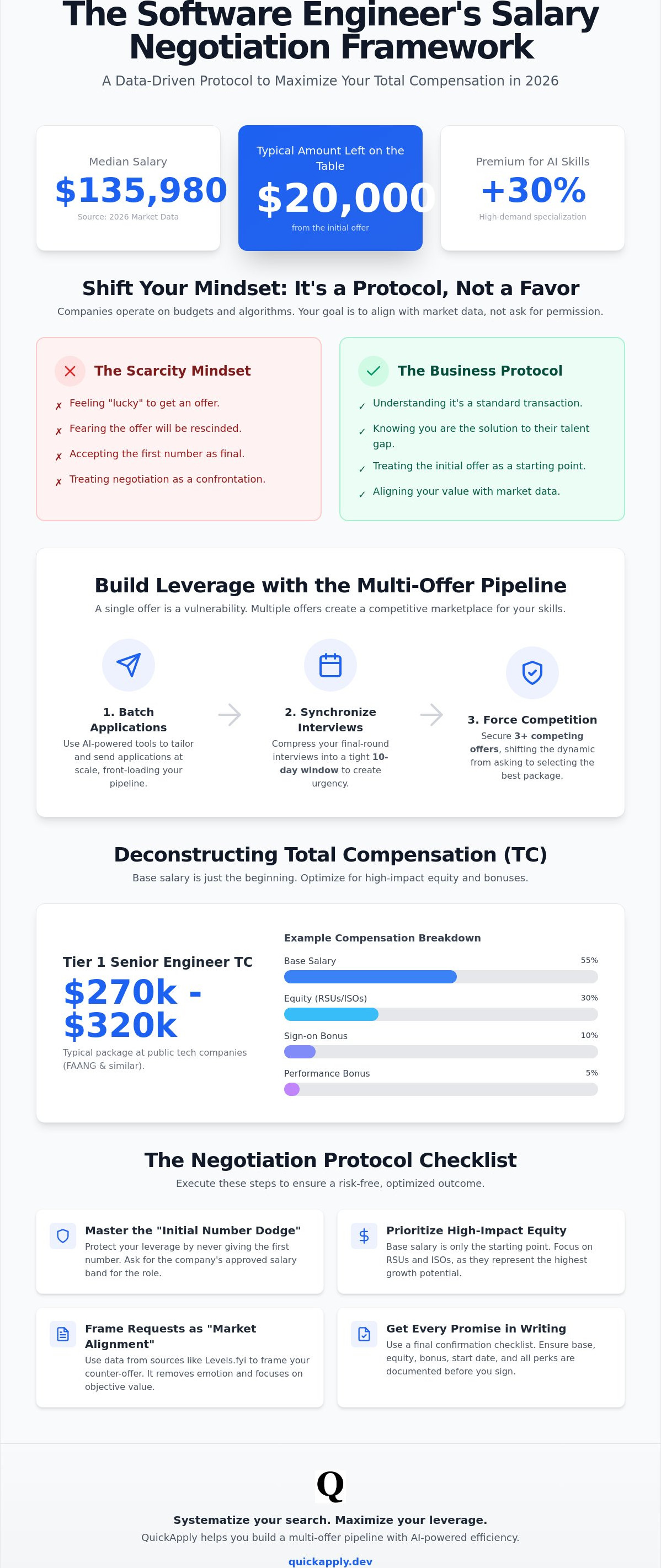
Leaving $20,000 on the table isn't a rounding error; it's a failure of logic. In a market where the median software engineer salary has hit $135,980, most candidates still treat their final offer as a take-it-or-leave-it ultimatum. You've spent years mastering complex systems, yet you're likely letting the fear of a rescinded offer dictate your financial future. Learning how to negotiate salary for software engineer roles is not about being lucky to have a job in 2026. It's about executing a data-driven framework that treats total compensation like any other optimization problem.
It's understandable if you feel hesitant. Between volatile market shifts and the confusion of RSUs versus ISOs, the process feels designed to keep you in the dark. You deserve clarity and a package that reflects your actual market value. This article provides the exact protocol you need to increase your total compensation without the risk of losing the offer. We will dive into the latest salary benchmarks, explain the 30% premium for AI skills, and show you how to leverage a framework that secures the base, equity, and sign-on bonus you've earned.
Key Takeaways
- Shift your perspective from asking for favors to executing a standard business protocol. Stop letting a scarcity mindset devalue your specialized technical skills.
- Deploy a multi-offer pipeline by batching interviews into a tight ten-day window. This creates the systemic leverage required to force recruiters to compete for your talent.
- Learn how to negotiate salary for software engineer roles using specific 2026 phrasing. Master the "Initial Number Dodge" to protect your leverage during early conversations.
- Optimize your total compensation by prioritizing high-impact equity like RSUs and ISOs. Base salary is only the starting point for a modern tech package.
- Defuse exploding offer deadlines with a clinical final confirmation checklist. Secure every promise in writing to ensure your transition is risk-free and fully optimized.
The Software Engineer Negotiation Framework: Beyond the Scarcity Mindset
Stop viewing a job offer as a gift. It's a business transaction. Negotiation is a standard protocol in the tech industry, not a personal favor. When you prioritize understanding salary negotiation, you stop asking for permission and start aligning with market data. Companies don't operate on feelings; they operate on algorithms and budgets. Your goal is to optimize the output of the final contract. Learning how to negotiate salary for software engineer roles is about data, not desperation.
The "Scarcity Mindset" is a critical bug in your professional operating system. Many engineers feel "lucky" to get an offer in a volatile market. This mindset leads to under-valuing specialized skill sets, especially in high-demand areas like AI and infrastructure. If you've cleared the technical bar, you've already proven you're part of the top percentile. Don't let a fear of rejection override the reality of your value. You are the solution to their talent gap, not a line item they're doing a favor for.
Companies use rigid salary bands to manage their burn rate. These are determined by compensation algorithms that factor in location, role impact, and market demand. Your initial offer is rarely the maximum. It's usually the lower quartile of what they're actually authorized to pay. In the 2026 tech landscape, Fair Market Value is the intersection of your specific technical impact, the current regional cost-of-labor adjustments, and the competitive premium for your specialized tech stack.
Understanding how companies approach these decisions is key; for instance, many organizations rely on strategic insights from IMO Talent to navigate the complexities of building high-performing remote teams in emerging global markets.
Understanding Salary Bands and Market Tiers
Tier 1 companies like FAANG operate on a different scale than Tier 2 or 3 firms. A senior engineer at a public tech company might see a total compensation package between $270,000 and $320,000. Use tools like Levels.fyi and check latest salary transparency laws to find the real floor. Don't settle for the "mid-point" of a salary band. In high-growth tech, the mid-point should be your absolute minimum starting point for any serious discussion.
The Psychology of Leverage in Tech
Recruiters expect a counter-offer. They internalize a negotiation buffer before the first call happens. If you don't push back, you're leaving the company's allocated budget on the table. The cost of re-starting a hiring cycle is astronomical. Between recruiter fees, engineering hours lost to interviewing, and the delay in shipping code, the company is often more afraid of losing a qualified candidate than you are of losing the offer. Reframing your request as market alignment removes emotional friction. It positions you as a savvy professional who understands the systems you work within.
Building Leverage: The Multi-Offer Pipeline Strategy
A single offer is a vulnerability. It leaves you with zero leverage and a binary choice: accept or decline. To truly master how to negotiate salary for software engineer roles, you must build a pipeline. Aim for at least three competing offers. This shifts the power dynamic from a request for a job to a selection of the best partner. When multiple firms compete for your talent, the conversation moves from a social favor to a logistical adjustment of market value. You don't need to ask for more; you simply report what the market is currently bidding.
Efficiency is your primary weapon. Use the "Batching Strategy" to synchronize your interview cycles. Front-load your applications so final rounds and offer letters land within the same 10-day window. This creates a high-pressure environment for recruiters. They know you're active. They know you have options. Managing this volume manually is a recipe for failure. Using automated job application trackers ensures no lead leaks through the cracks while you focus on technical execution. Systematize your search to maximize your leverage.
Accelerating the Funnel with AI Efficiency
Manual resume tailoring is a bottleneck. It limits your volume and, by extension, your negotiation power. High-volume tailoring leads to higher interview-to-offer ratios. You can't build a pipeline if you're stuck editing bullet points for hours. Deploying AI resume tailoring allows you to bypass ATS filters and reach the negotiation table faster. Scale your output to maximize your input. If you want to optimize your search, you can automate your application pipeline to focus exclusively on high-value negotiation phases.
The Power of the "Competing Offer" Signal
Signal your leverage early. Mention you're in "final rounds" with other firms during the initial recruiter screen. It isn't arrogant; it's a status update. If Company A offers $140,000 but Company B is at $165,000, use a "Match Score" to bridge the gap. Tell Company A you prefer their tech stack, but the compensation gap is a logical blocker. This forces them to justify their lower number against a verified market competitor. If one offer arrives early, stall. Ask for a week to review the full total compensation package. Use that time to push other firms to clear their final hurdles and enter the bidding war.
The Software Engineer Negotiation Script: Exact Phrasing for 2026
Execution requires the right syntax. You wouldn't push unoptimized code to production; don't push a vague counter-offer to a recruiter. The 2026 market demands precision. Following a structured script ensures you maintain leverage while navigating the "AI-driven recruiter" era. Mastering how to negotiate salary for software engineer roles starts with controlling the narrative from the very first ping.
Step 1: The "Initial Number" Dodge
Never reveal your hand early. If a recruiter asks for your expectations during the first screen, stall. Say: "I'm currently focused on finding the right technical fit and impact. I’m confident we can reach a fair agreement based on the market once we confirm a match." This keeps the "compensation algorithm" from anchoring you to a lower band. The person who says the first number usually loses the negotiation.
Step 2: The "Enthusiastic Pivot"
When the offer arrives, acknowledge it without accepting it. Use the pivot: "I'm thrilled about the opportunity to work on the distributed systems team. I’ve reviewed the initial numbers, and while they're a solid starting point, there’s some work to do to bring the total compensation in line with current market data for this specialized skill set." This signals that a counter is coming without creating hostility.
Step 3: The "Data-Backed Counter"
Deploy your research. Reference the $135,980 national median or the $186,770 California average if you are in a high-cost hub. If you have AI/ML expertise, remind them of the 20-30% salary premium documented for those roles. Say: "Based on recent data from the U.S. Bureau of Labor Statistics and current benchmarks for AI-focused infrastructure roles, I was expecting a base salary closer to $X."
Step 4: The "Final Ask"
When they claim they've hit the ceiling, move to the closer. Say: "I understand the constraints on base salary. If we can bridge the remaining gap with a $25,000 sign-on bonus or an additional equity grant, I’m prepared to sign the offer today." This creates an immediate path to a "Yes."
Handling the Recruiter Phone Screen
Don't let recruiters trap you with "What are your salary expectations?" Flip the script. Ask: "What is the budgeted total compensation range for this role?" Knowing their ceiling before you share your floor is a massive tactical advantage. If they push back, explain that you want to ensure your expectations align with their internal bands before moving forward.
Counter-Offering via Email vs. Phone
Use email for precision. It allows you to document your data points without being interrupted. For a 10% base increase, keep it lean: "Thank you for the offer. I'm excited about the role but noticed the base salary is 10% below the market average for this seniority level. Can we adjust the base to $X to align with current benchmarks?" If they cite budget limits, pivot immediately to a sign-on bonus or increased RSUs. This keeps the momentum moving toward a resolution.
Deconstructing Total Compensation: Equity, Bonuses, and Perks
Base salary is for monthly bills. Equity is for wealth. In high-tier tech roles, your base salary often accounts for only 60-70% of your actual value. If you focus exclusively on the monthly deposit, you're failing to optimize your financial engine. Many senior engineers now diversify their total compensation into digital assets using services like Pallapay to manage their long-term wealth. Total Compensation (TC) is the only metric that matters in 2026. Mastering how to negotiate salary for software engineer roles requires you to treat equity and bonuses as primary variables, not afterthoughts.
Restricted Stock Units (RSUs) are the standard at public firms. They function like cash with a delivery delay. Startups typically offer Stock Options (ISOs or NSOs), which provide the right to buy shares at a fixed price. Most packages follow a four-year vesting schedule with a one-year "cliff." You get zero equity if you exit before month 12. This creates a liquidity gap in your first year. Use a sign-on bonus to bridge this gap. Research shows signing bonuses of $10,000 to $30,000 are standard for new graduates to offset lower first-year vesting. For senior roles, this number can scale significantly higher.
Equity Math for Engineers
Public company equity is liquid; you can sell it as it vests. Startup equity is speculative. Calculate the "Expected Value" by applying a risk multiplier to the company's internal valuation. Don't ignore "Refreshers." These additional grants ensure your TC doesn't drop off a cliff once your initial four-year grant fully vests. Exercise ISOs strategically to avoid the Alternative Minimum Tax (AMT) trap during high-growth years.
Non-Monetary Negotiation Levers
Cash isn't the only variable you can tune. Remote work remains a major lever, though it often comes with an 8-15% salary penalty depending on your location. If the base salary is non-negotiable, pivot to hardware allowances, conference stipends, or educational budgets. Be wary of "Unlimited PTO" policies. Fixed PTO is a trackable liability on the company's balance sheet that you can actually use; unlimited policies often result in fewer days taken. You can optimize every single one of these variables by using our Salary Negotiation Guide to build a custom counter-offer.
Closing the Deal and Finalizing Your New Role
The final stage is about execution, not emotion. You've successfully navigated the protocol. Now you must secure the win. Recruiters often use "Exploding Offers" with short deadlines to force a quick signature. Don't panic. This is an artificial pressure tactic designed to limit your leverage. Ask for an extension with a clear reason, such as needing time to review the full legal documentation of the equity grant. Most firms will grant 48 to 72 additional hours if you remain professional and engaged.
Never resign until you have a signed offer letter in hand. Verbal promises are non-binding and offer zero protection. Your "Final Confirmation" checklist must include the base salary, the specific equity vesting schedule, sign-on bonus terms, and your start date. Once the ink is dry, decline your other offers with precision. A short, respectful note keeps your network intact for future cycles. You aren't just closing a deal; you're finalizing the baseline for your future earnings. Learning how to negotiate salary for software engineer roles ensures you enter your new position with the respect and compensation you deserve.
The Counter-Offer Trap from Your Current Employer
Expect a counter-offer when you give notice. Your current company wants to avoid the cost of backfilling your role. However, statistics show that 80% of engineers who accept a counter-offer leave within 6 months anyway. More money rarely solves the underlying issues like stagnant tech stacks or poor management. Tell your boss you're leaving with a direct statement: "I've accepted an offer that aligns with my long-term technical goals." Avoid long explanations. Move on to your next challenge without looking back. Your growth depends on finding new systems to master, not staying in an environment you've already outgrown.
Operationalizing Your Career Growth
Your new compensation package is your new market floor. Use this baseline to build your next promotion roadmap immediately. Mastering how to negotiate salary for software engineer roles is a continuous process, not a one-time event. Keep your resume updated and your application pipeline warm even after you start. Continuous optimization is the only way to stay ahead of market shifts and ensure you're never starting from zero again. Treat your career like a product that requires constant iteration and upgrades.
Leverage is built through volume and data. If you're ready to build your leverage pipeline, start tailoring your applications with QuickApply today and secure the offer you actually deserve.
Optimize Your Career Trajectory
Negotiation is the final stage of a technical optimization problem. You've learned that total compensation isn't a gift; it's a market-driven output based on your specific impact. By shifting your mindset from scarcity to business protocol and deconstructing the math behind RSUs and sign-on bonuses, you've secured a competitive advantage. Mastering how to negotiate salary for software engineer roles allows you to move past the fear of rescinded offers and into a position of authority.
Systematizing this process is what separates top earners from the rest of the market. You need a high-volume pipeline to generate the competing offers that force recruiters to move their numbers. QuickApply handles the heavy lifting of your search by providing AI-powered resume tailoring in seconds and an integrated application tracker for precise pipeline management. It's the same tool used by tech professionals at FAANG and high-growth startups to stay ahead of the curve. Stop leaving money on the table through manual inefficiency.
Automate your application pipeline and build negotiation leverage with QuickApply today. You have the technical skills. Now secure the package that matches your actual market value.
Frequently Asked Questions
Can a company rescind an offer if I try to negotiate?
Rescinding an offer is a rare occurrence in the tech sector, typically reserved for cases of extreme unprofessionalism or sudden budget freezes. Most companies view a respectful counter-offer as a standard business practice. They have already invested significant time and resources into vetting your technical abilities. They are far more likely to engage in a logical discussion than to restart the entire hiring cycle from scratch.
How much more should I ask for in a software engineer salary negotiation?
Aim for a total compensation increase that aligns with the upper quartiles of your specific market tier. If the initial base salary is firm, pivot your focus toward performance bonuses or equity grants. Small adjustments in your first-year package can lead to substantial gains over a four-year vesting cycle. Always justify your request with the specific technical impact you will have on the team’s current roadmap.
What if I don’t have a competing offer?
Use the company's internal need as your primary leverage when competing offers aren't available. Your status as the top candidate means the firm has already rejected dozens of other applicants. Present recent data points from industry reports to show where the current offer falls short. Focus on your specialized skills, particularly in high-impact areas like AI or distributed systems, to validate a higher price point.
Should I negotiate my salary if I am an entry-level software engineer?
Entry-level candidates should always advocate for their market value. While base salaries for new grads are often standardized, sign-on bonuses and relocation assistance are frequently negotiable. Learning how to negotiate salary for software engineer roles at the start of your career sets a higher baseline for all future compensation reviews. A successful negotiation now ensures you aren't playing catch-up for the next five years.
How do I negotiate for a remote software engineering position?
Negotiate remote status by highlighting your ability to deliver high-quality code without the overhead of an office. If the company attempts to apply a remote pay penalty, counter with data on the national median for your role. Emphasize that your value is tied to the complexity of the problems you solve, not the zip code where your laptop is located. Focus on the output, not the location.
Is it better to negotiate salary over email or phone?
Conduct the core of your negotiation via email to ensure precision and a clear paper trail. This format allows you to layout your data-backed arguments without the pressure of a live conversation. Use phone calls only for final clarifications or to build rapport with the hiring manager once the major terms are agreed upon. Always follow up every call with a written summary of what was discussed.
What happens if the recruiter asks for my current salary?
Redirect the recruiter to the market range for the role instead of revealing your current pay. Disclosing your current salary can lead to a low-ball offer that ignores your growth and current market demand. Simply state that you are looking for compensation that reflects the responsibilities of this specific position. Check local transparency laws, as many regions now prohibit employers from asking for your salary history.
How do I negotiate equity if I don’t understand the company’s valuation?
Request the most recent 409A valuation and the total shares outstanding to calculate the real value of an equity grant. Never accept a stock offer based on a vague dollar amount without understanding your percentage of ownership. Knowing how to negotiate salary for software engineer positions means deconstructing every component of the package. If the company refuses to share valuation data, treat the equity as a high-risk variable and push for a higher base.


