

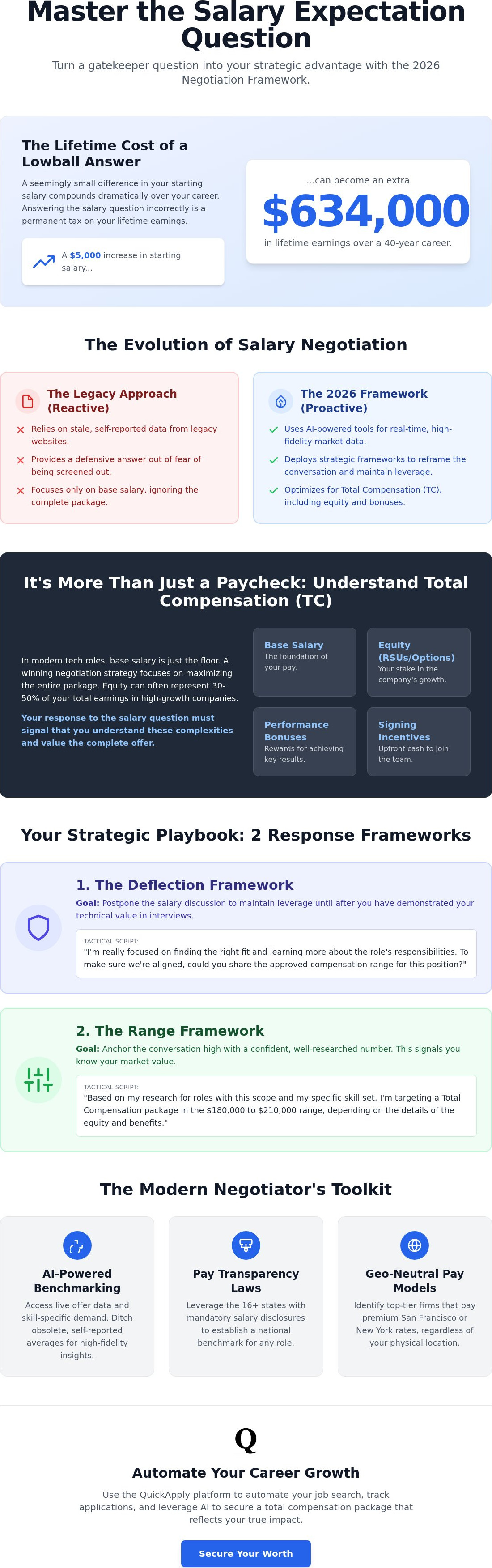
Did you know that a $5,000 increase in your starting salary can compound into an extra $634,000 over a 40 year career? Most tech professionals leave this capital on the table because they fear being screened out during the initial sync. You've likely felt that spike of anxiety when a recruiter asks for your "number" before the technical interview even begins. It's a high-stakes data point where the wrong input results in a sub-optimal output. Mastering what to say when asked for salary expectations is the difference between a standard paycheck and a maximized career trajectory.
Stop guessing your market value. We've built the 2026 Negotiation Framework to turn this gatekeeper question into a strategic leverage point. You'll master the conversation using real-time data from the 16 states with active pay transparency laws and AI-powered research tools. This guide provides the scripts you need to navigate salary bands, optimize total compensation, and secure your worth. We'll break down how to bypass the screening trap, use modern market stats to your advantage, and pivot toward a total package that reflects your specialized skill set.
Key Takeaways
- Reframe the salary question as a strategic filter. Move from defensive answering to data-driven optimization.
- Utilize AI-powered tools for real-time compensation benchmarking. Access high-fidelity data that accounts for geo-neutral pay and specialized skill sets.
- Deploy the Deflection or Range frameworks to maintain control. Protect your leverage until you have successfully demonstrated your technical value.
- Master what to say when asked for salary expectations using tactical scripts designed specifically for the 2026 tech landscape.
- Use the Salary Negotiation Guide to automate your strategy and secure a total compensation package that reflects your true impact.
Understanding the "Salary Expectations" Question in 2026
Recruiters aren't looking for a casual conversation when they ask about your pay requirements. They're running a script. This question is a strategic filter designed to optimize the hiring funnel by removing candidates who don't align with the internal budget. The "gatekeeper" myth persists because many professionals treat this as a social interaction rather than a data validation step. You can bypass this hurdle by treating the inquiry as a technical requirement. A foundational Understanding Salary structures is essential before you enter the negotiation phase. In 2026, the landscape has shifted significantly. With 16 states now enforcing pay transparency laws, the recruiter's playbook has changed. They already have a range. They're testing your market literacy to see if you've done the benchmarking.
Modern tech roles require you to look beyond the monthly check. In high-growth environments, base salary is just the floor of your compensation package. Total compensation (TC) is the real metric. This includes equity, performance bonuses, signing incentives, and remote work flexibility. When you're determining what to say when asked for salary expectations, you must account for these variables. A high base salary with zero equity might be a sub-optimal outcome compared to a balanced package in a scaling firm. Your response should signal that you understand these complexities.
Why Recruiters Ask Early
Recruiters prioritize efficiency. They need budget alignment before moving a candidate into expensive technical rounds. It's a screening protocol used to assess market awareness and professional seniority. If you can't articulate your value, you're perceived as a high-risk hire. They want to identify candidates who haven't tracked current market shifts. Seniority is signaled by your comfort with high-fidelity data. Recruiters use this early sync to ensure they aren't wasting resources on a candidate whose expectations far exceed the ceiling of the role's salary band.
The Cost of a Wrong Answer
A low anchor point acts as a permanent tax on your career. Research shows that a $5,000 increase in starting salary for a 25 year old can result in an additional $634,000 in lifetime earnings. If you lowball yourself, you're leaving massive capital on the table. Conversely, giving an inflated number without data results in immediate disqualification for being "overqualified." Knowing what to say when asked for salary expectations signals technical authority. Precise, data-backed answers suggest you're a savvy professional who understands the current landscape. This level of preparation turns a potential rejection point into a demonstration of your value.
Data-Driven Research: Finding Your Market Value
Manual research is obsolete. In 2026, relying on self-reported averages from legacy sites like Glassdoor is a strategic error. These platforms often provide stale data that lags behind real-time market shifts. Modern tech professionals use AI-driven benchmarking tools to process live offer data and skill-specific demand. This high-fidelity approach ensures your numbers reflect the current technical landscape. Precision is your primary weapon when deciding what to say when asked for salary expectations during a high-stakes interview.
Remote work has bifurcated into two distinct compensation models: geo-neutral and regional adjustment. Top-tier firms often pay San Francisco or New York rates regardless of your physical location. You must identify these "geo-neutral" players early. Use specialized pay transparency job boards to find hidden salary bands that aren't advertised on mainstream aggregators. These boards often reveal the actual budget allocated for the headcount, giving you a clear ceiling for your negotiation. Don't forget the equity equation. In the current market, Restricted Stock Units (RSUs) and stock options can represent 30% to 50% of your total compensation. Calculate the vesting schedule and current valuation to understand the true worth of the offer.
Leveraging Pay Transparency Laws
Use the legal landscape to your advantage. With 16 states now mandating salary range disclosures, you have access to a massive national benchmark. Even if you aren't in a transparency-mandated state, look for similar roles in California or New York to find the upper bound for the position. During the initial recruiter sync, be direct. Ask for the internal range immediately. If the range is missing from the job description, it's often a sign of a legacy hiring process or a tight budget. You can use Harvard's Salary Negotiation Checklist to ensure your research covers every variable before you commit to a specific range.
Calculating Your "Walk-Away" Number
Your "floor" isn't a guess; it's a calculation. Determine your minimum acceptable total compensation based on your specialized tech skills and the current replacement cost for your role. Factor in the value of 401k matching, health premiums, and professional development stipends. Market Value is the intersection of company budget and replacement cost. If you need help synthesizing this data into a coherent pitch, our Salary Negotiation Guide provides the exact frameworks needed to defend your number with confidence. Knowing what to say when asked for salary expectations becomes simple when your number is backed by hard data rather than intuition.
3 Strategic Response Frameworks for Tech Pros
Strategic negotiation is a system, not an intuition. You must choose your framework based on the current state of the interview pipeline. In the early stages, your objective is to maintain leverage by withholding data. As you move toward the final offer, your goal shifts to anchoring the conversation around a high, data-backed number. Knowing what to say when asked for salary expectations requires a tactical pivot depending on who you are talking to and how much value you have already demonstrated. If you haven't established your technical impact yet, giving a number is a premature optimization that can cap your earnings.
The Deflection Framework
Use the Deflection Framework during initial HR screens. At this stage, the recruiter is simply looking for a reason to move you to the next round or filter you out. You haven't met the hiring manager or seen the full scope of the technical stack. Focus on the "fit" rather than the finance. Tell the recruiter: "I'm currently focused on finding the right technical fit. Once I have a better understanding of the role's responsibilities and the total package, I'm sure we can find a number that works for both of us." This keeps you in the process without setting a low anchor. It signals that you are a professional who values the scope of work over a quick paycheck. Don't be evasive; be firm. If they push, reiterate that you need more data on the team structure and equity components before providing a range.
The Data-Backed Range
Once you reach the technical rounds, switch to the Range Strategy. This framework uses a "Top-Heavy" range to set a high anchor point. Your "happy" number should be the bottom of your range, not the middle. If you want $150,000, your range should be $155,000 to $170,000. Use precise numbers to signal deep market research. Instead of saying "$140k," say "$142,500." This suggests you've benchmarked your specific skill set against current market demand. Recruiters often only hear the bottom number, so ensuring that your floor is higher than your actual target protects your upside. This approach demonstrates technical authority and forces the company to meet you at your calculated value.
If a recruiter insists on a hard number before you're ready, deploy the Reverse Strategy. Flip the data request by asking: "What is the budgeted range for this position?" This forces them to reveal their internal salary bands first. If you need a structured approach to these high-pressure moments, our Salary Negotiation Guide provides exact scripts for every possible pushback. Mastering what to say when asked for salary expectations is about controlling the flow of information. By using these frameworks, you ensure that every interaction moves you closer to a maximized offer rather than a budget-friendly compromise.
Tactical Scripts for Every Interview Stage
Negotiation is a real-time execution problem. You need precise scripts for each phase of the hiring pipeline to maintain control of the narrative. Using a one-size-fits-all response is a recipe for leaving money on the table. Each interaction requires a specific level of transparency and leverage. If you haven't mapped out what to say when asked for salary expectations at every touchpoint, you're reacting rather than leading. Professionalism in 2026 is defined by data-driven confidence and the ability to pivot under pressure.
Scripting the Initial Screen
The recruiter screen is a high-speed filter. Your goal is to pass the gatekeeper without capping your upside. When the salary question arises, flip the script immediately. Ask: "What has the company budgeted for this specific role?" This forces the recruiter to reveal the internal band before you commit to a number. If they ask about your current earnings, remain firm. In 16 states, asking for salary history is now prohibited. Respond with: "I'm looking for a total compensation package that reflects my current market value and specialized technical skills." This is the time to ensure your background matches the top end of that budget. Focus on tailoring your resume to align with the high-impact requirements of the role, justifying the premium you're targeting.
The Final Offer Pivot
Once you reach the closing phase, the power balance shifts. You're the preferred candidate. Now is the time to move beyond the base salary and discuss "Total Rewards." If the base is fixed, pivot to equity, sign-on bonuses, or performance-based incentives. Use the "Alternative Offer" script to create urgency: "I'm very excited about this team, but I'm also evaluating another offer that is more competitive regarding total equity. Can we bridge that gap?" Even if you don't have a signed letter, you have market data that acts as a virtual competitor. For those who feel the pressure of live negotiation, tools like Final Round AI can act as a real-time copilot to ensure you don't miss a beat. If you want a comprehensive library of scripts for every scenario, our Salary Negotiation Guide is the ultimate resource for tech professionals.
Handling a lowball offer requires a logical, non-sentimental approach. Don't take it personally; treat it as a bug in the system. State clearly: "Based on my technical assessment and the market data for this seniority level, I was expecting a range closer to $X. How can we get there?" This forces the recruiter to find creative ways to increase the total value. Whether it's more PTO or a guaranteed performance review in six months, every variable is a lever. Mastering what to say when asked for salary expectations means knowing exactly when to pull those levers to optimize your final contract.
This approach mirrors how organizations handle high-stakes business deals. For example, many companies utilize RightCostIQ for professional RFP management and negotiation assistance to optimize their procurement outcomes. By applying the same level of data-driven rigor to your personal compensation, you ensure that your career trajectory is managed with corporate-level precision.
Automating Your Career Growth with QuickApply
Manual negotiation is a legacy bottleneck. It relies on human memory and emotional regulation in high-stress environments. In 2026, top-tier tech professionals don't guess. They use systems. Knowing what to say when asked for salary expectations shouldn't rely on a handwritten note or a vague memory of a blog post. It requires a repeatable, automated framework that adapts to real-time feedback. Stop treating your career like a manual override and start treating it like the high-performance system it is.
The QuickApply Salary Negotiation Guide eliminates the guesswork. It provides high-fidelity scripts tailored to your specific technical niche and seniority level. By integrating these scripts with our Interview Practice tool, you can rehearse your delivery until it's flawless. The AI analyzes your responses to eliminate verbal tics and low-power language. This ensures you project the technical authority needed to command top-tier compensation. You'll enter every conversation with the confidence of a candidate who knows their exact market value.
Negotiation isn't a one-time event. It's a continuous optimization process. By integrating your Promotion Roadmap into your long-term strategy, you ensure that your starting salary is just the first milestone in a high-growth career. You aren't just landing a job. You're building a scalable professional trajectory that compounds over time. Mastering what to say when asked for salary expectations is simply the first step in a larger plan for sustained financial and professional growth.
The QuickApply Advantage
Our platform offers data-driven insights that go far beyond generic salary boards. We process thousands of data points to ensure your range is optimized for the current market. You can track your negotiation progress across multiple applications within our Application Tracker. This bird's-eye view allows you to identify patterns and refine your approach for maximum ROI. Rehearsing with AI helps you maintain a steady, confident tone, even when recruiters push for a hard number before you're ready.
Next Steps for Job Seekers
Precision execution starts with a solid foundation. You should begin by mastering the job application process to ensure you're entering the funnel with maximum leverage. Once your funnel is full, sign up for a subscription to unlock the full Salary Negotiation Guide. This is your toolkit for a successful 2026 career transition. Don't leave your earnings to chance. Use AI precision to secure the offer you deserve and execute your career move with total confidence.
Secure Your Market Value with Precision
Salary negotiation is no longer a guessing game; it's a data optimization challenge. You've learned how to leverage 2026 pay transparency laws and deploy stage-specific frameworks to protect your upside. By shifting the focus from a single number to total compensation, you ensure that equity, bonuses, and remote flexibility are prioritized. Mastering what to say when asked for salary expectations is the final step in converting technical expertise into a maximized career offer.
Don't leave your financial future to chance or outdated scripts. Optimize your approach with AI-powered market benchmarking and real-time interview simulation to eliminate every verbal tic. You can even build custom promotion roadmaps for tech professionals to ensure growth doesn't stall after the first year. Negotiate like a pro with the QuickApply Salary Negotiation Guide and take control of your professional trajectory. The modern market rewards those who arrive prepared. Your next high-impact role is waiting for a candidate who knows exactly how to defend their worth.
Frequently Asked Questions
Is it okay to say I am flexible with my salary expectations?
Yes, but use flexibility as a strategic pivot rather than a default stance. Claiming you're flexible without providing a range can signal a lack of market awareness. Instead, state that you're flexible based on the total compensation package, including equity and bonuses. This keeps the door open while signaling that you understand the complexity of modern tech rewards.
What if the recruiter asks for my current salary history?
Decline the request and pivot to your target range immediately. In 2026, 16 states and D.C. legally prohibit employers from asking about your salary history. Tell the recruiter you're focused on the current market value for this specific role's impact. This keeps the conversation focused on your future contributions rather than your past earnings, protecting your negotiation leverage from the start.
How do I handle a job application that requires a numeric salary field?
Input a "0" or "1" if the form allows, or use the bottom of your researched range. Automated systems use these fields as binary filters. If the system forces a realistic number, provide your calculated floor. You'll have the opportunity to refine this during the technical rounds. Don't let a rigid form cap your earnings before you've spoken to a human.
Should I give a single number or a salary range?
Always provide a range to maintain flexibility while setting a high anchor. Your target "happy" number should be the bottom of the range you provide. Use precise figures, such as $162,500, to demonstrate that your expectations are based on rigorous data benchmarking. This signals technical authority and makes it harder for recruiters to push back with generic budget constraints.
What happens if my salary expectations are higher than their budget?
Evaluate if the gap can be bridged with equity or signing bonuses. If the base salary is fixed, ask about performance-based incentives or a guaranteed review in six months. Companies often have more flexibility in different budget buckets. If the total package doesn't meet your walk-away number, be prepared to exit. Your time is better spent on applications that align with your value.
How do I negotiate salary for a remote tech job in 2026?
Benchmark against national high-tier rates rather than your local market. Top tech firms in 2026 often utilize geo-neutral pay structures. When determining what to say when asked for salary expectations for remote roles, cite data from transparency-mandated states like California or New York. This ensures you aren't penalized for your zip code while delivering high-value technical output to a global team.
Can I change my salary expectations later in the interview process?
Yes, you can adjust your number if the role's scope changes during the process. If the technical requirements are more complex than the initial job description suggested, your value case has increased. Explain that after learning more about the specific challenges and expectations, your requirements have shifted to align with the market rate for that level of responsibility and impact.


