
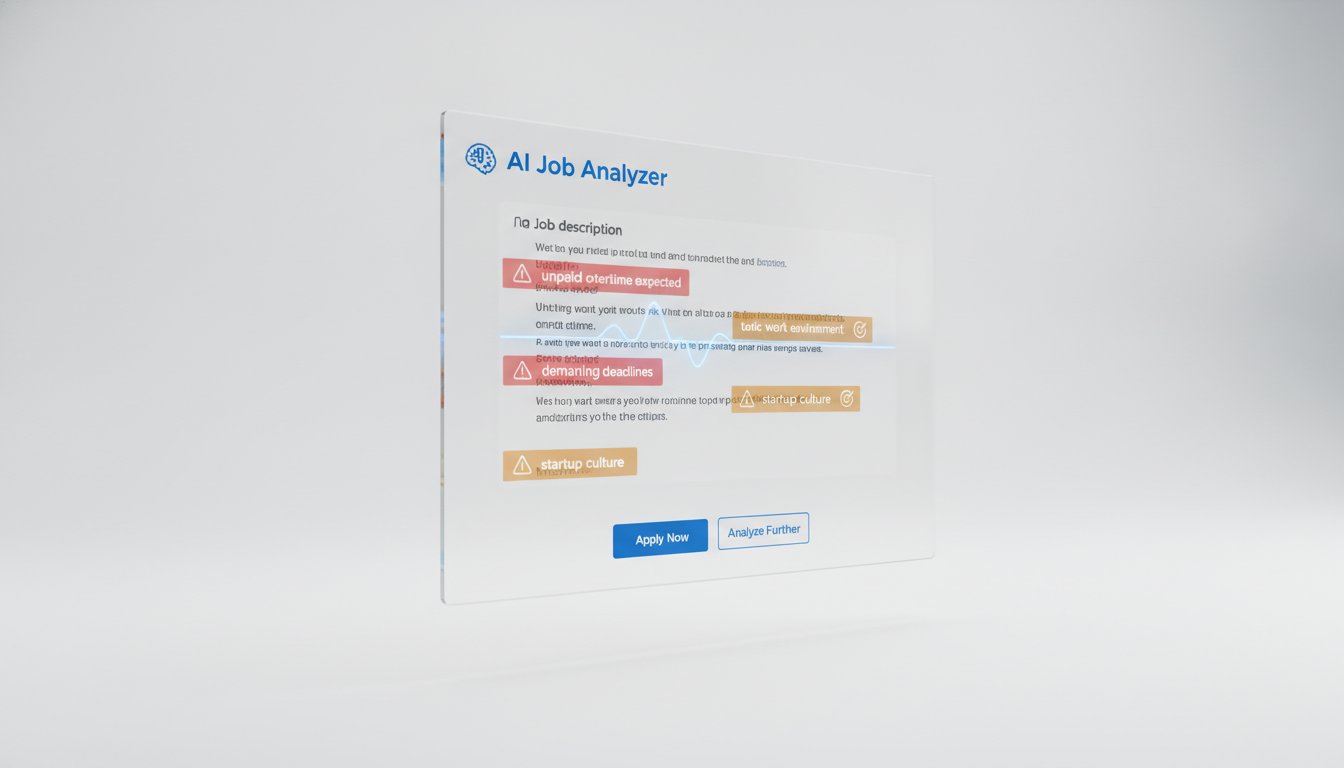
With 87% of companies now using AI-powered recruiting software, your job search is no longer a human interaction; it is a data optimization challenge. Knowing how to spot red flags in a job description is the only way to stop wasting hours tailoring resumes for roles that might not even exist. You likely feel the frustration of feeding your data into a "high-growth" listing only to realize later that it is a high-burnout trap. It is a waste of your cognitive load to apply for positions that are fundamentally broken or perpetually open.
Protect your productivity by identifying systemic failures before you ever hit the apply button. This 2026 efficiency audit will teach you to decode job postings like a professional analyst and distinguish between true opportunity and toxic environments. We are breaking down the specific linguistic markers of "ghost jobs" and the reality of modern hiring cycles to ensure you only invest energy where the ROI is guaranteed. Stop being a passive participant in a flawed system and start auditing your opportunities for maximum output.
Key Takeaways
- Identify linguistic and structural signals that reveal hidden mismatches between company expectations and operational reality.
- Audit technical requirements to detect "unicorn" roles that demand excessive expertise for entry-level compensation packages.
- Decode toxic culture buzzwords like "work hard, play hard" to protect your time from systemic burnout and boundary violations.
- Learn how to spot red flags in a job description by analyzing the absence of salary ranges and the true intent behind "urgent" hiring tags.
- Leverage AI precision to automate the screening process and instantly compare job data against your existing resume profiles.
What Are Red Flags in a Job Description?
A job description is more than a list of duties; it is a data set that reveals a company's operational health. Red flags are linguistic or structural signals that indicate a fundamental mismatch between what a company claims to be and how it actually functions. These markers serve as early-warning systems for burnout, poor management, or financial instability. In the modern recruitment process, these signals often get buried under layers of corporate speak. Learning how to spot red flags in a job description allows you to filter out noise and focus on roles that offer a high return on your effort.
By 2026, the rise of AI-generated job postings has created a new challenge: the template trap. Many companies now use automated tools to churn out listings, which can hide systemic issues behind a polished, generic exterior. You must look for inconsistencies in the requirements or a lack of specific, role-related detail. If a post feels like it was written by a machine that doesn't understand the work, the management likely doesn't understand it either. Spotting these patterns early protects your career momentum and prevents you from entering a cycle of constant firefighting.
The Cost of Ignoring Warning Signs
Every application you submit carries an opportunity cost. Spending three hours tailoring a resume for a role that turns out to be toxic is a waste of your cognitive load. Toxic roles frequently lead to shorter tenures, creating fragmented resume gaps that can hinder future negotiations. Beyond the resume, the physical and mental toll of a dysfunctional workplace is a massive liability. High-burnout environments stall your technical skill development. When you are stuck in survival mode, you aren't mastering new frameworks or optimizing systems; you are just trying to get through the day. This stagnation can put you years behind your peers in a competitive market.
Red Flags vs. Yellow Flags
Distinguish between hard stop red flags and yellow flags that simply require clarification. A yellow flag is a point of interest, like a vague reporting structure or a broad job title. These are topics to probe during an initial screening call. Red flags are systemic failures, such as "unlimited" expectations paired with a lack of clear KPIs. You should categorize these signals based on your personal "must-haves." Before you commit to the application, use an ATS resume checker to see if the job requirements actually match your profile. If the requirements are a chaotic mess of unrelated technologies, it is a red flag that the company doesn't know what they actually need.
Technical Red Flags for Software Engineers and Tech Pros
General workplace warnings are easy to ignore. Technical red flags are systemic risks. Knowing how to spot red flags in a job description requires you to audit the stack requirements before you sync your data. In 2026, these listings are often generated by AI that simply aggregates every buzzword in the company's Jira backlog. This leads to several common technical traps:
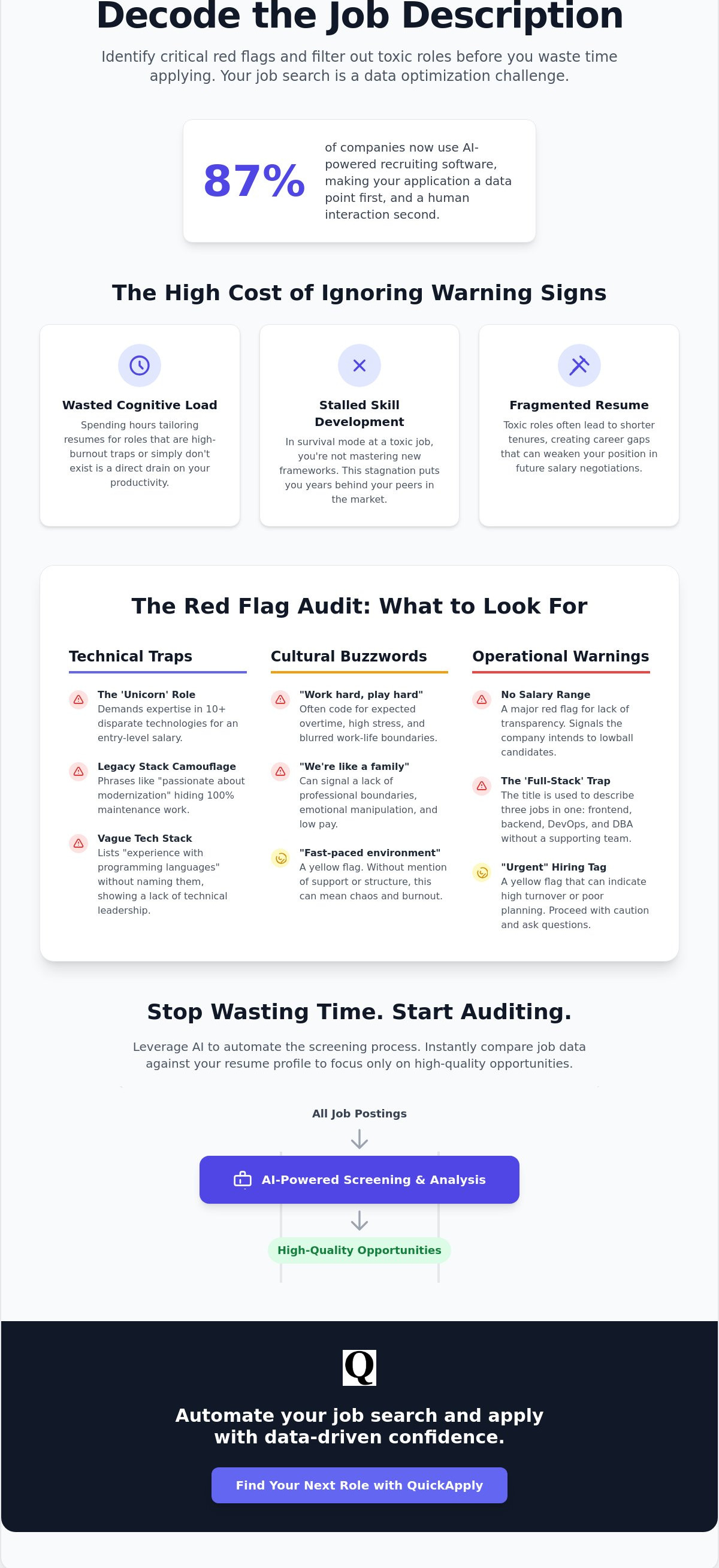
- The 'Unicorn' Requirement: Listings that demand expertise in 10+ disparate technologies, such as React, Rust, and Kubernetes, for an entry-level salary. They want an entire engineering department for the price of one junior developer.
- Legacy Stack Camouflage: Phrases like "passionate about modernization" often hide 100% maintenance work on a legacy monolith. Without a named stack, you are walking into technical debt.
- Vague Tech Stack: Mentioning "experience with programming languages" without naming them indicates a lack of technical leadership. If they don't know what they use, they won't know how to evaluate your output.
- Zero Mention of Testing or DevOps: This signals a "move fast and break things" culture where you are the manual tester and the release manager. You'll spend the majority of your time on manual deployments rather than writing high-impact code.
Learning how to spot red flags in a job description is your first line of defense against these technical traps. This lack of infrastructure is a direct tax on your professional growth and long-term marketability. It is a waste of your cognitive load to fix systems that were designed to fail.
Decoding the 'Full-Stack' Trap
Full-Stack is the most abused term in the industry. It often means you are the entire IT department. If a role requires frontend, backend, database management, and cloud architecture without a supporting team, it's three jobs in one. This lack of a technical roadmap ensures you'll never achieve deep focus or mastery. You'll spend your time context-switching between CSS bugs and server outages instead of building scalable systems. It is an inefficient way to manage talent and a fast track to burnout.
The 'Rockstar' and 'Ninja' Vocabulary
Terms like "Rockstar" or "Ninja" are relics of low-maturity management. They rely on hero culture. In these environments, work-life balance is a myth. The "Rockstar" is expected to pull all-nighters to save a project from poor planning. Tech-bro jargon is a definitive signal of low management maturity and a lack of scalable processes. Use a professional application tracker to filter these high-risk roles out of your pipeline immediately. Professional environments value sustainable output over temporary heroics.
Culture Buzzwords That Signal a Toxic Workplace
Technical debt is visible; cultural debt is often camouflaged. While auditing code is straightforward, knowing how to spot red flags in a job description requires a deeper analysis of corporate linguistics. In 2026, companies use specific buzzwords to sanitize dysfunctional environments. These phrases are not just clichés; they are operational warnings that indicate a lack of professional boundaries or systemic disorganization. If you value your time, you must learn to decode these high-risk signals before you enter the interview funnel.
- 'We are a family': This is a definitive boundary violation. Families do not terminate members for missing performance targets. In a professional context, this phrase usually signals an expectation of extreme loyalty and unpaid overtime. It suggests that asking for a raise or setting a hard stop at 5:00 PM will be viewed as a betrayal.
- 'Work hard, play hard': This is the hallmark of a high-burnout environment. It typically translates to 60+ hour work weeks where the "play" is mandatory social interaction that further erodes your personal time. It is a sign of a low-maturity culture that prioritizes optics over sustainable output.
- 'Self-starter who thrives in ambiguity': This is a confession of documented failure. It means the company has no onboarding process, no clear KPIs, and no internal documentation. You will spend your first quarter guessing what your job actually is while being held accountable for results you cannot define.
- 'Wear many hats': Expect massive scope creep without a corresponding salary adjustment. This phrase indicates that you will be performing roles entirely outside your expertise, such as a developer handling customer support or a designer managing server migrations. It is a sign of understaffing and poor resource allocation.
The 'Fast-Paced Environment' Reality Check
High-growth startups have velocity. Disorganized companies have chaos. You must distinguish between the two. A truly fast-paced environment is characterized by efficient decision-making and automated workflows. A toxic one is defined by frantic activity and constant context-switching. Ask about the sprint planning process and how priorities are set. If the answer is "everything is a priority," walk away. Use this application for job guide to manage your pipeline while you filter out these frantic, low-ROI roles.
Flexibility and Remote Work Ambiguity
By 2026, remote work transparency is a standard requirement for top talent. "Remote-ish" roles that mention "occasional office visits" without a specific cadence are a major red flag. This ambiguity often masks an unannounced Return to Office (RTO) mandate. Similarly, "flexible hours" is often code for being "on-call 24/7." If the job description does not explicitly state geographical requirements or core working hours, the management likely lacks the systems to support asynchronous work. Do not sacrifice your autonomy for a role that refuses to define its physical or temporal boundaries. Knowing how to spot red flags in a job description regarding location will save you from a bait-and-switch commute later.
Operational and Financial Red Flags to Watch For
Operational inefficiency is a direct tax on your career. While cultural issues are draining, operational and financial red flags indicate a company that cannot manage its most basic functions. Just as efficient organizations use LicenseIQ to discover and recover wasted spend on software licenses, you must look for similar signals of waste in their hiring practices. Knowing how to spot red flags in a job description requires looking past the perks to analyze the underlying business logic. By 2026, over 18 U.S. states and Washington, D.C. have enacted pay transparency laws. If a company is hiring for a remote role that can be performed in California or New York but refuses to list a range, they are actively bypassing legal and ethical standards. This lack of transparency is a definitive signal of below-market compensation.
- The 'Urgent Hire' Tag: This often signals a failure in resource planning. It can indicate high turnover or a recent mass exodus that left a critical gap. You aren't being hired to grow; you are being hired to put out a fire.
- Excessive Interview Steps: A 7-step process for a mid-level role is a red flag for indecisive leadership. If they cannot evaluate talent in 3 or 4 stages, they will struggle to make decisions on product and strategy.
- Inconsistent Job Titles: When the H1 title says "Senior Developer" but the responsibilities describe "Junior Support," there is zero internal alignment. You will likely be underpaid for the actual value you provide.
Salary Ranges and 'Competitive' Pay
"Competitive pay" is a hollow phrase. It is not a data point. In a modern market, transparency is the only currency that matters. Companies that lean on "equity-heavy" compensation in early-stage startups with no confirmed funding are asking you to subsidize their risk with your labor. You must benchmark these roles against actual market data. Use a salary negotiation guide to determine if the offered range aligns with 2026 standards for your specific stack and experience level. Do not accept ambiguity as an answer.
The Ghost Job Phenomenon
As of February 2026, the U.S. labor market saw 6.9 million open jobs, yet the hires rate fell to 3.1 percent. This gap is driven by "ghost jobs"—postings that remain active for 90+ days without any intent to hire. These companies are talent pooling; they are collecting your data for a rainy day while you waste time tailoring resumes. Check the "posted date" on every listing. If it has been live for months, it is likely a data-harvesting exercise. Use an application tracker to monitor these listings and see if your profile actually aligns with their requirements or if the role is a systemic dead end. High-precision screening is the only way to maintain your search efficiency.
How to Screen Roles with AI Precision
Data-driven screening allows you to compare requirements against good resume examples to identify unrealistic expectations. If the delta between a standard high-performing profile and the job's "unicorn" list is too wide, the role is a systemic failure. Use match scores to prioritize listings that align with your actual career roadmap. This isn't just about finding a job; it's about optimizing your professional trajectory by avoiding low-ROI opportunities.
Leveraging AI for Rapid Role Auditing
A tailor resume to job description ai tool is your most powerful audit asset. These systems do more than match keywords; they highlight hidden requirements buried in corporate jargon. You can quickly distinguish between "filler" requirements designed to discourage applicants and "hard" technical requirements that define the actual work. AI identifies linguistic patterns of toxic management by analyzing the ratio of "responsibilities" to "resources," flagging roles where the expected output exceeds the provided infrastructure.
Turning Red Flags into Interview Leverage
Red flags aren't always a signal to walk away. They are data points for negotiation. Use detected flags to build power questions for your first recruiter screen. If the description mentions a "fast-paced environment," don't ask if it's stressful. Ask about the specific sprint cycles and deployment frequency. Use the "wear many hats" flag as leverage to negotiate a higher base pay or a clear promotion roadmap. By knowing how to spot red flags in a job description before the interview, you enter the room with the leverage of a technical expert who understands the company's operational gaps. Turn their disorganization into your financial gain.
Optimize Your Professional Pipeline
Your career is a series of data points. Don't let toxic roles dilute your value. By mastering how to spot red flags in a job description, you've moved beyond manual guesswork into systemic auditing. You now know that "unicorn" requirements and vague salary ranges are signals of operational failure. You've learned to decode tech-bro jargon and identify the "ghost jobs" that waste your cognitive load. Now, it's time to automate the process.
Stop wasting energy on high-burnout environments. Use smart technology to secure a competitive advantage in a crowded market. Stop wasting time on bad roles; use QuickApply to find your perfect match. Our system provides an AI-powered Match Score for every role and delivers automated resume tailoring in seconds. Manage your high-efficiency searches with an integrated application tracker designed for the modern web. You have the technical expertise to recognize a broken system. You now have the tools to bypass it. Build the career you deserve by prioritizing efficiency over effort.
Frequently Asked Questions
Is a 'fast-paced' environment always a red flag?
No, but it requires a technical audit of the company's workflows. High-growth startups are naturally fast-paced because they are scaling systems rapidly. However, if "fast-paced" is paired with a lack of clear KPIs or documentation, it signals disorganized chaos. You must ask about deployment frequency and sprint planning to determine if the speed is driven by efficiency or frantic firefighting.
What should I do if I find a red flag in a dream job description?
Treat the red flag as a high-priority data point for your first interview. If the role aligns with your career roadmap, use the screening call to probe the specific concern. Ask direct questions about resource allocation or management style to see if the flag is a systemic failure or a poorly written template. Never ignore the signal; use it to verify the reality behind the buzzwords.
How can I tell if a job description is fake or a scam in 2026?
Verify the source domain and the recruiter's credentials immediately. Scams in 2026 often use AI-generated templates and "too good to be true" salary ranges to harvest your personal data. Look for inconsistent contact information or requests for payment for "equipment." If a job has been active for 90+ days without a hire, it may be a "ghost job" used for talent pooling rather than an active vacancy.
Why do companies use vague job descriptions?
Vague descriptions usually indicate a lack of internal alignment between hiring managers and HR. They use broad language to cast a wide net or to hide the reality of expected scope creep. If a company cannot define the technical requirements or daily responsibilities, they likely lack the infrastructure to support your role. This ambiguity is an inefficiency that often leads to mismatched expectations and early turnover.
Is 'we are a family' always a sign of a toxic workplace?
Yes, in a professional context, it is a definitive signal of low management maturity. Professional environments should be built on mutual respect and clear contracts, not emotional loyalty. When a company claims to be a "family," they are often signaling an expectation of unpaid overtime and a lack of professional boundaries. It suggests that setting hard limits on your time will be treated as a personal betrayal.
How many interview rounds is considered a red flag?
Anything exceeding four rounds for a mid-level technical role is a red flag for indecisive leadership. A streamlined hiring process reflects an efficient company that knows how to evaluate talent. If a company requires seven or eight stages, they are offloading their risk onto your schedule. This indecision will likely manifest in the day-to-day work, leading to stalled projects and slow product cycles.
Can AI help me spot hidden red flags in job postings?
Absolutely. AI tools can analyze the sentiment and keyword density of a listing to find hidden risks. By scanning for patterns of "hero culture" or unrealistic requirement clusters, algorithms can help you understand how to spot red flags in a job description without reading every line. This automation saves you hours of manual auditing and ensures your energy is focused only on high-ROI applications.
Should I apply to a job that doesn't list a salary range?
Only apply if you are willing to terminate the process immediately if the numbers don't align. In 2026, with widespread pay transparency laws, a missing range is a signal of below-market compensation. It shows a lack of transparency that will likely persist throughout your tenure. If you decide to proceed, make salary the first topic of discussion in the initial screening to avoid wasting your cognitive load.


