

Did you know that the platforms you trust most were ranked as the most privacy-invasive in 2026? According to a recent Incogni report, industry giants like LinkedIn and ZipRecruiter are leading the pack in data harvesting. These privacy concerns with online resume tools aren't just theoretical; they're baked into the terms of service you likely skimmed. Since November 2025, LinkedIn has used member data for AI training by default. You aren't just the applicant anymore. You're the training set.
It's frustrating to realize that "free" tools often treat your identity as the product. You want the optimization of AI without the risk of identity theft or data leaks. We agree that your professional history belongs to you, not a third-party algorithm. This guide promises to help you master the balance between efficiency and security by auditing how modern career tools handle your data. We'll provide a clear framework for tool security and specific data-scrubbing techniques that keep you ahead of the curve and in control of your professional identity.
Key Takeaways
- Identify the core risks of data harvesting, identity theft, and AI training exploitation to secure your professional footprint.
- Address privacy concerns with online resume tools by distinguishing between persistent storage and zero-retention APIs.
- Deploy a Security Scorecard to audit your career tech stack and verify data deletion transparency.
- Master data-scrubbing techniques and use burner contact info to protect your identity during high-volume application phases.
- Don't let your data become training fuel. Leverage privacy-first architecture to automate your search securely.
The Evolution of Privacy Concerns with Online Resume Tools
Privacy in 2026 isn't just about who sees your profile. It's about how many databases own your history. The old model of public versus private visibility is dead. Today, privacy concerns with online resume tools center on three distinct pillars of risk: data harvesting, identity theft, and AI training exploitation. You aren't just uploading a document; you're feeding a machine. If that machine isn't secure, your career becomes public property.
Tech professionals are high-value targets for data brokers. Your specific tech stack, project history, and salary trajectory are lucrative assets. Brokers use this data to build massive salary benchmarks and talent maps. They sell these insights to your competitors. You must distinguish between public job boards and private productivity tools. Job boards are built for exposure. Productivity tools should be built for execution. If a tool treats your data as a resource to be extracted, it's a liability, not an asset.
What counts as PII on a modern resume?
Personally Identifiable Information (PII) has evolved beyond your home address. On a modern resume, PII includes your personal phone number, specific GitHub links, and internal project metrics. These data points form a unique fingerprint. Malicious actors use these details for sophisticated social engineering attacks. By aggregating these fragments, data aggregators build "shadow profiles" without your consent. A foundational step in understanding information privacy is realizing that your career history is a roadmap for hackers. They don't need a password if they have your entire life story in a PDF.
The "Free Tool" trap in the job search
Free resume builders have a hidden cost. They don't charge you money because your data is the primary currency. Your career transition is a lucrative lead. These tools monetize your search by selling your contact info to third-party recruiters, insurance companies, or predatory "educational" services. It's a volume game. They need your data to keep their business model alive.
A paid subscription usually signals a more robust privacy agreement. It creates a service where you are the customer, not the product. When you use an AI resume tailor, you expect optimization. You shouldn't have to trade your security for that efficiency. Tools built for professionals prioritize data isolation. They ensure your hard-earned experience doesn't end up powering a global training set for a competitor's LLM. Choose tools that respect your boundaries while accelerating your growth.
AI Data Training: Is Your Career History Powering Someone Else’s Model?
Uploading your resume to a modern AI tool is more than a simple file transfer. It's an entry into a training loop. Large Language Models (LLMs) thrive on high-quality human data. Your career history is exactly that. If a tool doesn't explicitly guarantee data isolation, your professional achievements are likely being used to refine a global model. This reality fuels modern privacy concerns with online resume tools. New regulations, like the Connecticut Data Privacy Act amendment effective July 1, 2026, now force companies to disclose if your data trains their models. You shouldn't be the unpaid researcher for a tech giant's next update.
The technical divide lies between zero-retention APIs and persistent data storage. Zero-retention means the AI processes your input, generates the output, and immediately flushes the memory. Persistent storage is the opposite. It archives your data to "improve performance," which is often code for training. This increases the risks of AI data exposure. If a system is vulnerable to prompt injection attacks, your private data could theoretically leak into another user's session. It's a systemic risk that demands a proprietary, secure approach.
For those who value speed without exposure, choosing a tool that uses privacy-first resume tailoring is the only logical path forward. You need a system that works for you, not one that works on you.
Data Isolation vs. Global Training
Data silos are the solution. Instead of feeding your resume into a general AI brain, modern platforms use Retrieval-Augmented Generation (RAG). RAG allows the AI to reference your specific history in a secure, isolated environment without ever incorporating it into the base model. Always look for "Opt-out of training" clauses in the Terms of Service. If you can't find one, assume your data is being harvested for the benefit of others.
The role of SOC2 and GDPR in 2026
Compliance certifications aren't just paperwork; they're your defense. In 2026, the GDPR "Right to be Forgotten" must apply to every version of your resume, including those processed by AI. If a tool can't purge your data from its training weights, it's non-compliant. SOC2 compliance is a non-negotiable requirement for any tech platform handling sensitive professional identity data in 2026. These standards ensure your career moves remain your business and nobody else's, a principle that Humae also prioritizes within its AI-powered HR platform for secure workforce management.
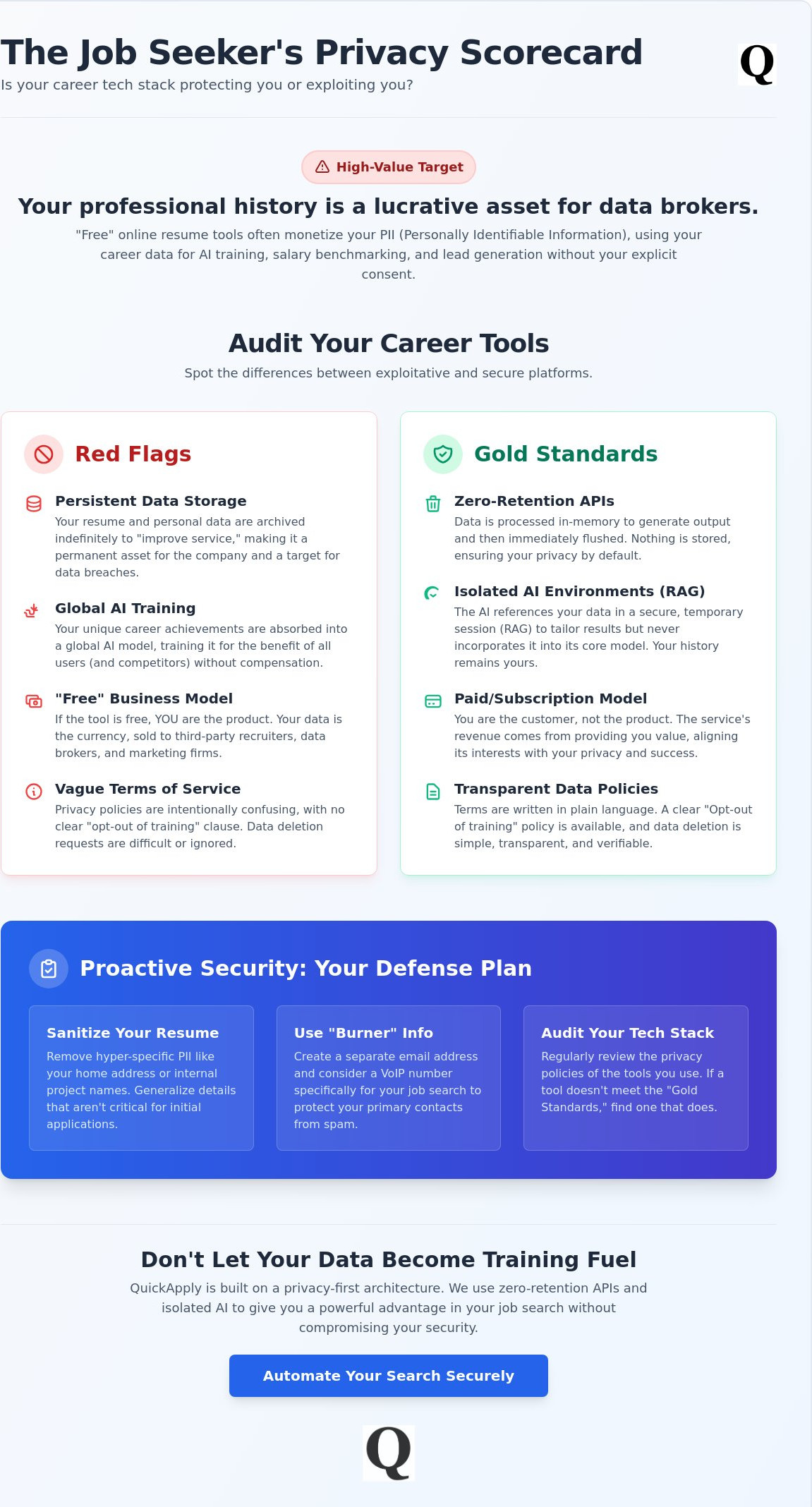
Red Flags vs. Gold Standards: Auditing Your Career Tech Stack
Audit your tools before you trust them with your history. Addressing privacy concerns with online resume tools requires more than a casual glance at a landing page. It demands a technical audit of your career stack. Don't wait for a data breach notification to realize your security was insufficient. Use a Security Scorecard to evaluate every platform you use for resume tailoring or application tracking. If a tool fails these basic benchmarks, it's a liability to your professional future.
Your audit must prioritize data deletion transparency. California's "Delete Act," effective August 1, 2026, has set a new benchmark for how companies must handle your request to vanish. A gold-standard tool provides a "hard delete" option that purges your data from all backups and training sets within a specified window. Anything less is just a "soft delete" that keeps your identity in their system for future monetization. End-to-end encryption for document storage is another non-negotiable. Your resume should be encrypted at rest and in transit, ensuring that even if the server is compromised, your PII remains unreadable.
Red Flags: When to close the tab
- Opaque Pricing: If a tool is "free" without a clear enterprise or subscription model, you are the product. These platforms often survive through data-selling partnerships that are buried in 50 pages of legalese.
- Lack of MFA: If a platform doesn't offer multi-factor authentication (MFA) in 2026, it doesn't value your security. Your career account contains enough PII to facilitate full identity theft. Protect it.
- Invasive Extensions: Be wary of browser extensions that request permission to "read and change all your data on all websites." These are often data harvesters disguised as productivity aids.
Gold Standards: Features that protect you
Look for granular privacy controls for every resume version you create. You should be able to set individual expiration dates for shared links. A "Recruiter Access" toggle is essential. It should allow you to grant temporary, read-only access to specific files rather than opening your entire library to a database. High-quality platforms provide human-readable data usage summaries. These snapshots tell you exactly what is shared, with whom, and for how long. Finally, prioritize tools that offer encrypted vaults for sensitive career documents. This isolation ensures your primary data remains separate from the AI processing environment until the exact moment you need to tailor a document. Efficiency shouldn't come at the cost of your digital sovereignty.
Proactive Security: How to Sanitize Your Resume for AI Processing
Efficiency shouldn't leave a trail of breadcrumbs for hackers. Most tech professionals overshare. They treat their resume like a public ledger. This habit creates massive privacy concerns with online resume tools that archive every draft you've ever made. You need to sanitize your data before the AI even touches it. This isn't about hiding your talent. It's about data minimization. You provide the signal; you strip the noise. You remain anonymous until the interview stage where trust is actually earned.
The goal is beating the ATS without handing over your home address. Algorithms don't need to know your street number to rank you for a Senior DevOps role. They need keywords, metrics, and context. By scrubbing PII, you reduce your surface area for identity theft while maintaining high-performance results. Use "burner" contact info for high-volume phases. A dedicated VOIP number and a secondary email address keep your primary digital life isolated from recruiter databases that might eventually be sold or leaked.
The "Sanitized Resume" Checklist
- Location Neutrality: Replace your physical address with "City, State" or simply "Remote / Global." Most modern roles don't require your zip code until the tax forms are signed.
- Contact Isolation: Use professional aliases or LinkedIn-only contact methods. This prevents your personal phone number from ending up in a data broker's 2026 "Tech Talent" list.
- Proprietary Scrubbing: Remove internal project codes or highly specific proprietary company names. Use descriptive terms instead. This protects your current employer and prevents social engineering attacks based on your internal knowledge.
Managing AI-generated versions
Your digital footprint grows with every application. If you generate twenty tailored resumes, you've created twenty new data points. Delete old versions from cloud builders once your hiring cycle ends. Don't let your history sit on a server indefinitely. Use a job application tracker to monitor exactly where your data has been sent. This allows you to request data deletion systematically once a role is filled. One-time use resumes are the gold standard for exploratory applications. They provide the necessary "hook" for the recruiter without leaving a permanent record in their system.
Take control of your data today by using QuickApply's secure resume tailoring to optimize your search without the privacy tax.
QuickApply: Built for Optimization, Engineered for Privacy
Stop compromising your security for the sake of a better job. You need high-speed automation without the constant surveillance of data brokers. QuickApply was built to solve the systemic privacy concerns with online resume tools by moving away from the data-harvesting status quo. We don't view your career history as free training material for a generic LLM. We view it as your competitive advantage. Our architecture ensures your data stays in your hands while our algorithms do the heavy lifting. You get the optimization. We skip the harvesting.
Our AI resume tailor uses a strict data isolation protocol. It processes your input in a secure, ephemeral environment and flushes the session immediately after generation. We don't contribute your unique professional insights to global training sets. This approach respects your intellectual property and maintains your professional fingerprint. Our business model is transparent. We sell high-performance software, not user profiles. You are the customer, not the product. This distinction is the core of our technical philosophy.
Our commitment to data integrity
We implement a "Zero-training" policy for our users. This means your Resume Tailoring and Cover Letter Generation never feed the base model of any third-party provider. We use advanced encryption to secure your sensitive documents, including your Promotion Roadmap and salary data. Your long-term career strategy remains private. QuickApply delivers professional efficiency without the privacy tax. It's high-volume output with low-effort input. We protect your data as if it were our own code because in the 2026 economy, information is the only currency that matters.
Start optimizing safely today
Don't let your job search become a permanent data leak. Use our platform to gain a technical edge in the 2026 market. Our Match Score provides a private way to evaluate roles before you ever hit apply. It gives you the data you need to prioritize high-probability opportunities without exposing your intent to the entire web. Take control of your application history. Build your future on a platform that respects your past and secures your present. Start optimizing your career with total confidence and zero exposure. Your next big move shouldn't cost you your privacy.
Secure Your Professional Sovereignty
The 2026 job market demands a high-tech approach that doesn't leak your PII to the highest bidder. You've learned how to audit your tech stack using a Security Scorecard and why data sanitization is your first line of defense. Mastering the balance between AI-driven efficiency and data security is now a baseline requirement for any savvy tech professional. Navigating privacy concerns with online resume tools shouldn't stall your career momentum. You just need a partner that respects your boundaries.
QuickApply offers SOC2-aligned data practices and a zero-training architecture for your career data. We don't use your history to train global models. It's why we're already trusted by thousands of software engineers who refuse to trade privacy for optimization. Stop leaving your professional identity to chance and start using a system built for your security. Your hard-earned experience deserves a platform that values your digital sovereignty.
Stop compromising your privacy and start tailoring with QuickApply. Optimize with confidence and keep your data where it belongs. Your next big career move starts with a secure foundation.
Frequently Asked Questions
Are online resume builders safe for sensitive tech roles?
Yes, but safety depends on the platform’s specific data isolation policies. For sensitive tech roles, you must choose tools that utilize SOC2-aligned security and don't store your proprietary project details in a shared training set. Avoid generic builders that lack granular privacy controls. Use a tool that allows you to sanitize PII while maintaining ATS compatibility to ensure your professional identity remains secure throughout the search.
Do AI resume tools sell my data to third-party recruiters?
Many "free" tools monetize your profile by selling it to recruitment partners or data aggregators. This practice is a primary driver of privacy concerns with online resume tools in the 2026 market. Always audit the Terms of Service for "data sharing" or "affiliate marketing" clauses. Paid, subscription-based platforms typically offer better protection because their revenue comes from users, not the sale of lead generation data to third-party agencies.
How can I tell if an AI tool is using my resume to train its model?
Check the platform's data usage policy for mentions of "model improvement" or "LLM training." Under 2026 regulations like the Connecticut Data Privacy Act amendment, companies must disclose if personal data is used to train large language models. Look for a "Zero-training" guarantee or an explicit opt-out toggle. If the tool doesn't mention data isolation or RAG, assume your history is powering their global model.
Should I remove my phone number from my resume when using online tools?
Removing your primary phone number is a smart proactive security measure. Replace it with a VOIP burner number or a LinkedIn profile link until you reach the interview stage. This prevents your personal contact info from ending up in a leaked database or a recruiter's cold-call list. You can still pass ATS filters by providing your city and state while keeping your most sensitive PII isolated from the initial screening process.
What is the difference between a resume builder and a resume tailor regarding privacy?
A resume builder often archives your entire career history to create a static document, while a resume tailor focuses on ephemeral optimization. Privacy-first tailors use session-based processing to match your experience to a job description without permanent storage. This distinction is critical for managing your digital footprint. Builders frequently act as data repositories, whereas modern tailors prioritize data minimization by processing only what is necessary to generate a specific output.
Can using an AI resume tool lead to more spam emails or calls?
It can if the tool sells your contact information to business partners or has weak data-sharing boundaries. Free platforms often use your data for lead generation, resulting in a surge of unsolicited recruiter outreach or insurance offers. To prevent this, use a dedicated job-search email and a VOIP number. Choosing a platform that sells software rather than data is the most effective way to keep your inbox clean during a transition.
How long do online resume tools store my data after I delete my account?
Storage duration varies, but 2026 laws like California's "Delete Act" mandate that companies must purge user data within a specific timeframe upon request. You should verify if the tool performs a "hard delete" or simply deactivates your profile while keeping data in backups. Gold-standard tools offer immediate deletion of all processed versions and source files. Always check the privacy policy for specific retention periods to ensure your history isn't stored indefinitely.
Is it safer to use a paid resume tool over a free one?
Generally, yes, because paid tools align their revenue with your success rather than your data's value. When you pay for a subscription, you are the customer, and the platform has a financial incentive to protect your privacy. Free tools often view your career history as the primary product to be harvested and sold. Investing in a professional tool ensures you get high-end security features like MFA and SOC2 compliance that free alternatives ignore.


