

In 2026, hiring a human resume writer is like buying a paper map for a city that changes its streets every hour. You spend hundreds of dollars on a static PDF only to watch it fail against the 99% of Fortune 500 companies now using AI to filter applicants. The debate over ai resume builder vs human writer isn't just about cost anymore; it's about survival in a market where manual effort can't keep up with algorithmic speed.
You're likely exhausted from sending out dozens of applications and hearing nothing back. It's frustrating to realize that your expensive, hand-crafted resume is being rejected by a machine in milliseconds. This guide will show you why dynamic AI tailoring is the only way to gain a competitive edge and secure more interviews without the slow turnaround of traditional services. We'll break down the efficiency gap, compare the latest costs, and explain how to master the high-risk AI regulations that now define the modern hiring landscape. It's time to stop fighting the system and start using it to your advantage.
Key Takeaways
- Understand the critical shift from "static" general resumes to "dynamic" AI-tailored assets that adapt to every job description instantly.
- Analyze the ai resume builder vs human writer showdown to determine which path maximizes your interview conversion rates in a high-volume market.
- Master the "24-hour rule" by using automation to bypass the slow turnaround times and high costs associated with manual writing services.
- Identify the "Premium Tax" of human writers and decide if high-level career coaching justifies the price increase over scalable AI tools.
- Discover how an integrated career operating system automates your entire workflow, from cover letter generation to tracking your application pipeline.
The 2026 Job Search Paradigm: Static vs. Dynamic Resumes
The 2026 job market doesn't reward hard work; it rewards architectural precision. If you're still using a "Master Resume," you're effectively invisible to modern hiring systems. A static resume, whether crafted by a veteran consultant or a basic template, is a generalist document designed to appeal to everyone. In reality, it appeals to no one. Contrast this with a dynamic resume: a precision-tailored asset generated specifically for a single job description in seconds.
Tech professionals now face a landscape where 99% of Fortune 500 companies rely on Applicant Tracking Systems (ATS) to perform high-speed triage. These systems aren't looking for "potential." They're looking for exact keyword matches and specific skill densities. When evaluating an ai resume builder vs human writer, the winner is determined by who can produce 50+ unique, optimized versions of your career story in the time it takes to drink a coffee. Speed and volume are no longer optional.
The Death of the Master Resume
For FAANG and high-growth startups, the "Match Score" is the only metric that matters. A human writer might spend ten hours perfecting one version of your history. However, that document will fail a different job's ATS scan because it lacks the specific technical nuances that the second company's algorithm prioritizes. Modern systems don't just read your resume; they score it against the job description in real-time. If your document isn't a 95% match for the specific stack mentioned in the posting, you're discarded before a human ever looks at your LinkedIn profile.
- Mathematical Impossibility: Manually tailoring 100 applications is a full-time job you don't have time for.
- Algorithmic Gatekeeping: If your Match Score is below 85%, a human recruiter will never see your name.
- Scale over Polish: High-volume application strategies require a dynamic approach that a single "perfect" PDF cannot provide.
The Human Writer Bottleneck
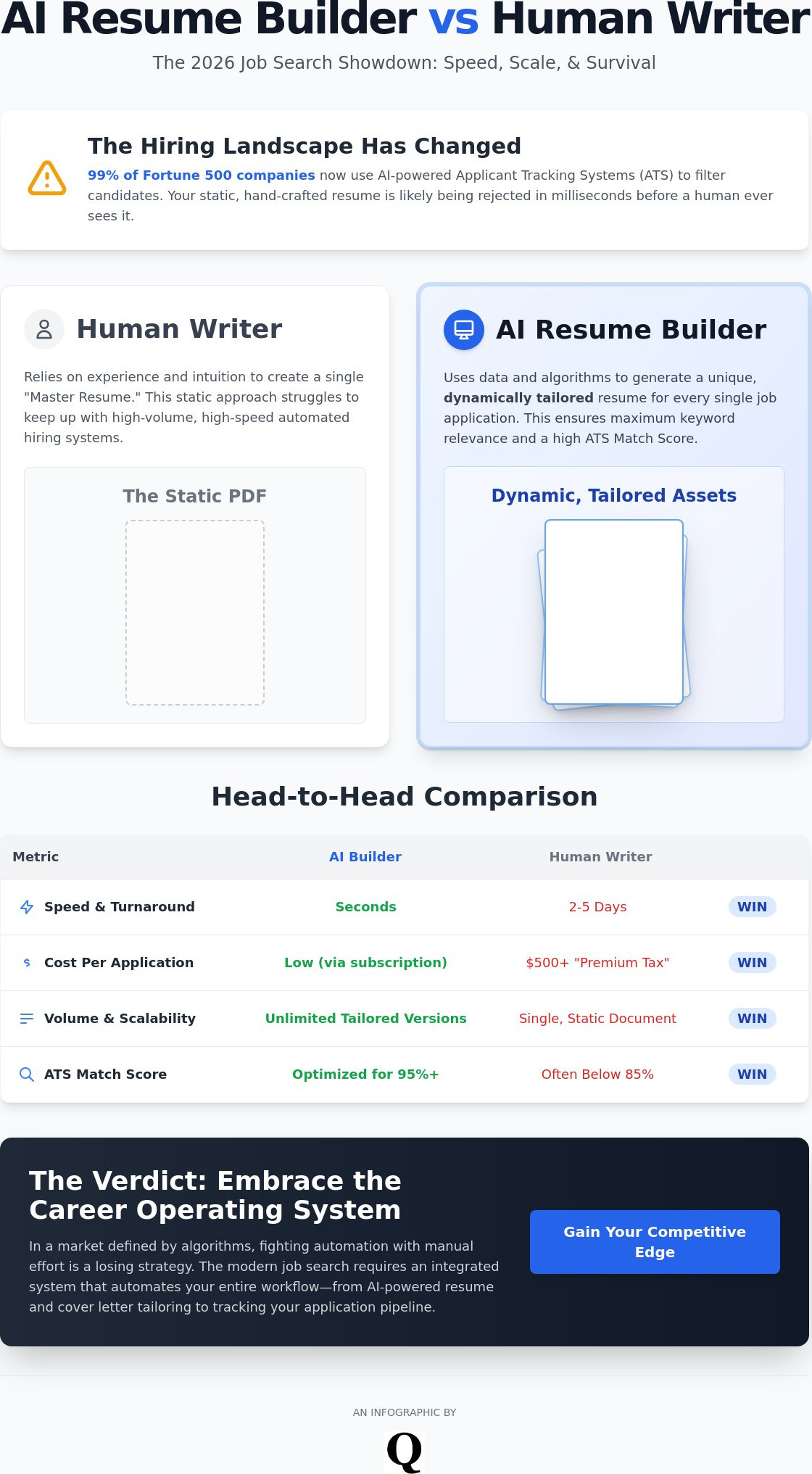
Speed is the new currency in 2026. Most top-tier tech roles receive hundreds of applications within the first 24 hours. Waiting three days for a human writer to return a draft means you've already lost the window of opportunity. The financial side is equally disruptive. A professional human writer might charge $500 for a single document. If you need to tailor that document for 20 different roles, the cost-per-application becomes astronomical.
Humans offer a "Premium Tax" without providing the real-time feedback loops that AI tools deliver. When comparing an ai resume builder vs human writer, the human model lacks the scalability required to compete against automated systems. You need a system that evolves as fast as the job boards. Relying on a manual process in an automated world is a strategy for obsolescence.
AI Resume Builders: Precision, Speed, and Scale
Precision is the only metric that matters when your application hits a database. Modern AI resume builders don't just "write" content; they map your career data to specific job requirements with mathematical accuracy. While a traditional approach relies on subjective intuition, the ai resume builder vs human writer debate is increasingly settled by the ability to process technical data at scale. Speed is your primary leverage. By the time a human consultant reviews your initial inquiry, an AI tool has already generated ten optimized versions of your profile.
Achieving the Perfect Match Score
The secret to a high interview conversion rate lies in the Match Score. AI tools perform a gap analysis on your profile, identifying missing skills or frameworks mentioned in the job description. This advanced resume tailoring process ensures your experience is framed in the exact language the hiring company uses. Semantic search calculates relevancy by analyzing the contextual relationship between your professional history and job requirements rather than just matching isolated strings of text. This ensures your background in "distributed systems" is correctly mapped to a role asking for "backend scalability."
Eliminating Human Error in Technical Resumes
Technical resumes are prone to "word salad" when candidates try to manually guess which keywords will trigger an ATS. AI solves this by standardizing tech acronyms and frameworks, ensuring they are recognized by any system. It maintains "clean" formatting, avoiding the graphical elements that often break machine parsing. While some experts debate the pros and cons of using AI for creative storytelling, the technical reality is that machines prefer structured data.
- Instant Mapping: Experience is translated into the recruiter's dialect in seconds.
- Standardized Recognition: Acronyms like AWS, CI/CD, and K8s are formatted for maximum visibility.
- Clean Parsing: Documents are stripped of invisible formatting errors that stop human-written resumes.
Stop wasting time on manual edits that don't move the needle. You can start optimizing your workflow immediately with automated resume tailoring to see how precision beats manual labor every time. Efficiency is the bridge between your talent and your next high-growth role.
Human Resume Writers: Strategy vs. Execution
Human writers are the traditional choice for a reason. They excel at high-level career coaching and complex narrative building. If you are looking for someone to help you navigate a mid-life identity crisis or a radical career pivot, a human is a solid ally. However, when it comes to the actual execution of a high-volume job search in 2026, the human model is fundamentally broken. The "Premium Tax" is real. You are often paying $500 or more for a single, static document. That is 20 times the cost of a monthly AI subscription that offers unlimited iterations and real-time updates.
The ai resume builder vs human writer debate often hits a wall when candidates claim AI sounds like a robot. That was true in 2023. In 2026, LLMs have mastered the professional tech tone by training on millions of successful recruiter interactions. Many human writers are still using outdated templates from 2022 that fail modern ATS parsing. They rely on "old-school" strategies like flowery objective statements or heavy graphics that actually hurt your chances. Relying on a manual process for a technical role is a strategic misalignment. You need a tool that moves as fast as the market.
The Narrative Fallacy
Recruiters often talk about "storytelling." It sounds good in theory. In practice, storytelling matters zero percent if you don't pass the initial ATS filter. Automated systems don't care about your "journey." They care about skill density and technical relevance. Overly creative resumes designed by human writers often confuse these systems with non-standard layouts. AI focuses on clarity and data structure. It ensures your profile is readable for both the machine and the human recruiter who finally sees it. In 2026, a clean data structure beats a creative story every time.
When to Hire a Human (and When to Automate)
There are specific scenarios where a human writer makes sense. If you are a C-suite executive or making a radical industry pivot, you need high-level strategic input. For standard tech role applications, automation is the superior path. The most efficient professionals use a hybrid approach. They hire a human to define their "Master" narrative and then use AI for the "Tailoring" phase. This allows for rapid execution while maintaining a strategic core. You can use an Application Tracker to manage this process, ensuring your human-refined strategy is applied to every automated submission. Efficiency is about using the right tool for the right task.
The Comparison Framework: Which Wins for Your Career?
Choosing between an ai resume builder vs human writer is a resource allocation problem. In a market where 99% of Fortune 500 companies use automated filters, your strategy must prioritize market velocity. A human writer provides a single, high-cost document. An AI platform provides a high-frequency execution engine. If your goal is a high-paying tech role, the bottleneck isn't the quality of your prose. It's the speed and precision of your tailoring.
Speed to market is non-negotiable in 2026. Most high-growth roles receive hundreds of applications within the first 24 hours. If you're waiting three days for a human writer to return a draft, the window has already closed. Automation allows you to submit a high-fidelity, tailored application in under five minutes. This volume-based approach dramatically shifts your interview ratios. Candidates using dynamic tailoring see significantly higher conversion rates because they consistently land in the top 5% of ATS match scores.
ROI Calculation for Tech Professionals
The math is clear. Investing in the best ai resume builder 2025 costs a fraction of a typical tech salary increase. When you factor in the Time to Hire metric, the value of automation explodes. Shortening your job search by just two weeks can save you thousands in lost wages. The opportunity cost of manual resume writing is too high for any professional who values their time. You aren't just saving money on a consultant; you're buying back your career momentum.
Recruiter Perception in 2026
Recruiters have moved past the "is this AI?" debate because they use these same tools to source and vet candidates. They value clarity and technical alignment over hand-crafted formatting. In 2026, a resume that hits every technical requirement is seen as a sign of professional competence. You can use good resume examples to audit your AI output and ensure it aligns with industry standards. The focus has shifted entirely toward value-added content: your achievements, your stack, and your measurable results.
Stop settling for a slow, manual search. You can start scaling your applications today with QuickApply's automation tools to secure your next role faster.
QuickApply: The Career Operating System for the AI Age
QuickApply isn't just a tool; it's a career operating system. While the ai resume builder vs human writer debate often focuses on the quality of a single PDF, the real bottleneck for tech professionals is the entire application lifecycle. You don't just need a document. You need a pipeline. QuickApply provides a 100% automated tailoring workflow that handles everything from the initial job scan to the final offer. It's designed for those who refuse to let manual processes slow their momentum. Efficiency is the core value here.
Traditional human services stop once the document is delivered. In the ai resume builder vs human writer showdown, QuickApply wins by managing your full career stack. The platform moves you beyond simple generation by integrating an Application Tracker that organizes your search into a high-speed dashboard. You aren't just sending resumes into the void. You're executing a calculated, data-driven strategy. By centralizing your workflow, you eliminate the mental overhead of tracking different versions, follow-up dates, and recruiter responses.
Automating the Entire Funnel
Efficiency starts with prioritization. QuickApply uses the Match Score to help you identify which roles deserve your immediate attention. Instead of manually guessing which jobs fit your stack, you get instant data on your compatibility. This allows you to scale your reach without sacrificing quality. You can generate high-converting documents using the ai cover letter generator to ensure your entire package is consistent. By utilizing cover letter examples tailored to specific technical requirements, you maintain a professional edge across every touchpoint. The system handles the execution so you can focus on the interviews.
Long-Term Career Growth Tools
The journey doesn't end when you sign the contract. QuickApply is built for continuous productivity. Most candidates leave money on the table because they lack market data. Our Salary Negotiation Guide provides the leverage you need to maximize your total compensation. It's a pragmatic solution to a complex problem. Once you're in the door, use the Promotion Roadmap to plan your next vertical move. This isn't about passive waiting. It's about active career engineering. Whether you're using Interview Practice to sharpen your communication or tracking internal wins, the system keeps you ahead of the curve. For those looking to apply this same level of strategic optimization to their own digital ventures, you can check out eComQB for expert eCommerce growth consulting.
Stop building resumes and start tailoring your career with QuickApply.
Own Your Career Architecture
The 2026 job market has no room for manual bottlenecks. Relying on a static document is a strategy for invisibility. In the showdown of ai resume builder vs human writer, the winner is the professional who leverages speed and precision to dominate the ATS match score. Human writers provide a one-time product. AI provides a continuous execution engine that evolves with every job description you target. It's the difference between a single draft and a scalable application strategy.
Stop treating your career like a series of manual tasks. You need a system that handles the heavy lifting from the first application to the final offer. By automating your workflow, you reclaim your time and focus on the interviews that actually matter. It's about systemic efficiency and long-term optimization. You've seen the shift; now it's time to adapt.
Master your job search with QuickApply’s AI Tailoring Tool to access Match Score optimization, an Integrated Application Tracker, and our Salary Negotiation and Promotion Roadmaps. Your next high-growth role is waiting for an optimized version of your story. Take control of your momentum and secure your competitive edge today.
Frequently Asked Questions
Do AI resume builders really pass ATS filters?
AI resume builders are specifically engineered to pass Applicant Tracking Systems by using machine-readable layouts and standardized data structures. These tools eliminate the formatting errors and incompatible fonts that often cause human-written resumes to be rejected by scanners. By mapping your experience directly to the technical requirements of a job description, AI ensures your profile achieves the high match score necessary to reach a human recruiter.
Is it better to pay a human resume writer for tech jobs?
Paying a human writer is often a bottleneck in the high-speed tech market where roles are filled in days, not weeks. While a human can offer career storytelling, they cannot provide the rapid, multi-version tailoring required to apply for dozens of roles with precision. In the ai resume builder vs human writer debate, automation is the superior choice for professionals who need to scale their application volume without sacrificing technical accuracy.
Will recruiters reject my resume if they think it was written by AI?
Recruiters prioritize your technical stack and measurable achievements over the specific tool used to format your document. In 2026, hiring teams use AI for sourcing and screening, so they value the clarity and structured data that AI-optimized resumes provide. As long as the content accurately reflects your professional background and passes technical vetting, using automation is viewed as a sign of modern professional efficiency.
How much does a human resume writing service cost in 2026?
Human resume writing services typically require a significant one-time investment that varies based on your career level. Entry-level packages often cost several hundred dollars, while executive-level services can reach much higher figures for a single document. These premium fees represent a high cost-per-application compared to the scalable, subscription-based models offered by AI platforms that allow for unlimited tailoring.
Can an AI resume builder handle career transitions for software engineers?
AI builders excel at career transitions by using semantic search to identify transferable skills and frameworks across different tech stacks. If you are moving from frontend development to a full-stack role, the tool recontextualizes your existing experience to highlight the most relevant backend competencies. This data-driven approach ensures your transition is logical to both automated filters and hiring managers who focus on skill density.
What is the best AI resume builder for tech professionals?
The best AI resume builder for tech professionals is one that integrates dynamic tailoring with a full application management system. You need a platform that offers real-time match scores and handles the entire funnel, including cover letter generation and interview preparation. Efficiency is found in tools that move beyond simple document creation to provide a comprehensive career operating system for a competitive market.
How often should I tailor my resume with an AI tool?
You should tailor your resume for every single job description to ensure your profile aligns with specific company requirements. Since AI allows you to generate a precision-tailored version in seconds, submitting a generic resume is an unnecessary risk that lowers your conversion rate. Constant tailoring is the only way to maintain a competitive edge in a market where 99% of Fortune 500 companies use automated screening.
Does using an AI resume builder count as lying on an application?
Using an AI tool is a legitimate method of professional optimization, not a form of deception. You are responsible for the accuracy of the data, but the AI helps frame your verified achievements in the language that recruiters and systems prioritize. Choosing the ai resume builder vs human writer path is simply a decision to use the most efficient technology available to communicate your actual value to the market.


