
87% of companies now use AI-powered recruitment tools to filter talent, yet most tech professionals are still building resumes for humans who will never see them. You've mastered complex architectures and scaled systems, but your application is likely dying in a digital black hole because you don't know what not to put on a resume 2026. It's exhausting to follow outdated advice from traditional career coaches while your inbox stays empty. You need a document that functions like a high-performance API, not a bloated legacy database.
We're here to optimize your professional output. This guide helps you strip away the signal interference and survive high-speed AI screening filters without being flagged as spam or over-optimized. You'll learn how to remove the "fluff" that triggers rejection and focus on the precise data points that drive match scores. We'll examine the obsolete sections, overused buzzwords, and formatting errors that are currently sabotaging your career growth, giving you a lean, high-impact resume that converts instantly.
Key Takeaways
- Identify and eliminate "data noise" to ensure your profile passes high-speed AI screening filters with a maximum match score.
- Learn exactly what not to put on a resume 2026, including obsolete career objectives and physical addresses that waste valuable space.
- Eliminate invisible red flags like non-standard typography and keyword stuffing that modern parsers now penalize as "AI-washing."
- Replace passive task descriptions with high-density, quantifiable results while applying the 10-year rule to purge early career fluff.
- Optimize your workflow by using automated tailoring to remove irrelevant data points and align your resume with specific job requirements instantly.
Why Your 2026 Resume Needs a 'Data Purge' to Pass AI Screening
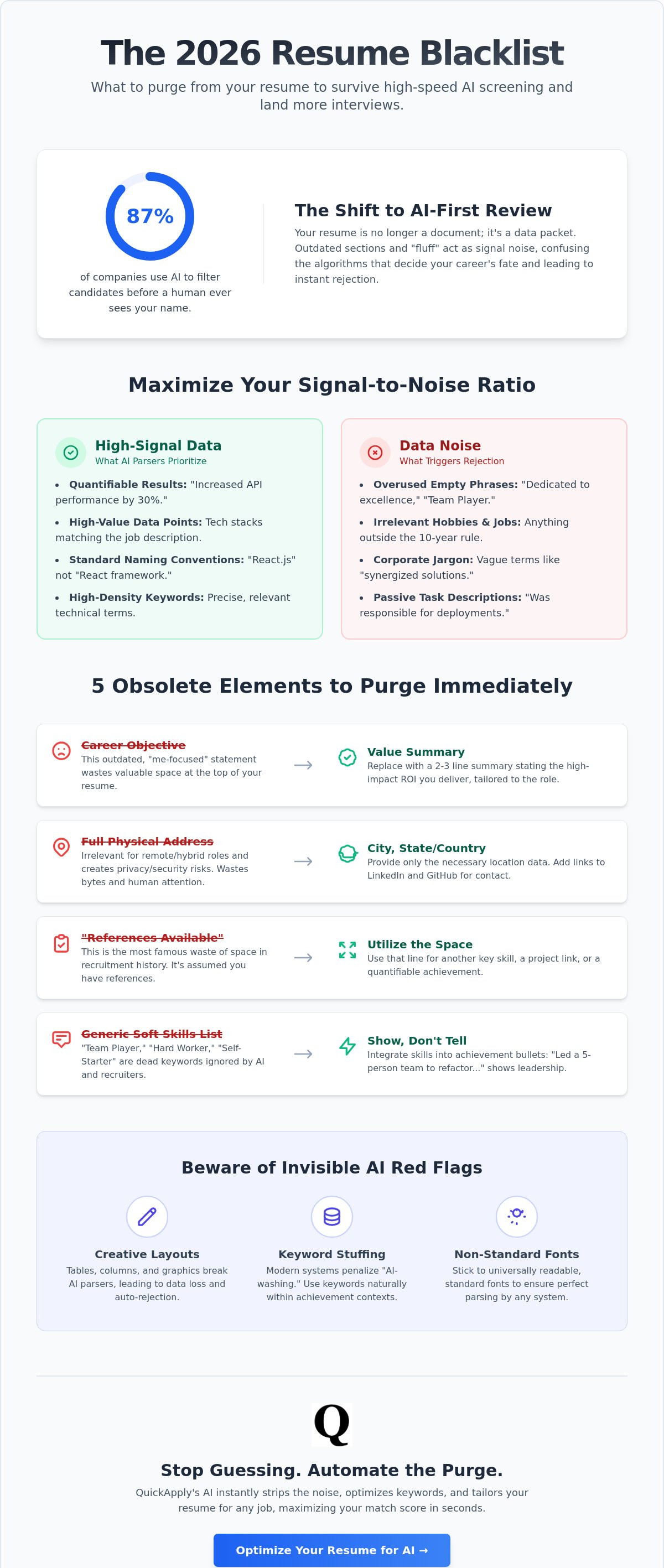
Your resume is no longer a document. It's a data packet. In the high-velocity job market of 2026, every word that doesn't actively contribute to your match score is "Data Noise." This noise acts as signal interference, confusing the algorithms that decide whether you're worth a human's time. The 2026 "Zero-Fluff" standard isn't a suggestion; it's a survival requirement. AI parsers prioritize high-density, relevant data points over the traditional "well-rounded" narrative. In fact, being well-rounded is now a liability. If you're applying for a Senior DevOps role, your background in retail management or your "passionate" leadership style is just static. You need to understand what not to put on a resume 2026 to keep your Signal-to-Noise Ratio high. If the algorithm can't find the signal, it discards the entire packet instantly.
Recruiters are currently drowning in applications. Research shows that 73% of recruiters report fatigue from seeing the same overused, empty phrases on resumes. They don't want to read about your "dedication to excellence." They want to see the specific metrics that prove you can do the job. When you purge the fluff, you allow the core technical data to stand out. High-speed filters are designed to find specific "features" in your professional history. If those features are buried under paragraphs of corporate jargon, your match score will suffer. Efficiency is the only metric that matters in the initial screening phase.
The Shift from Human-First to AI-First Review
Current data shows that 87% of companies use AI-driven tools for recruitment. These systems rank you before a human recruiter even sees your name. If your layout is too "creative," you've already lost. Tables, graphics, and non-standard columns often break the parser. This leads to auto-rejection because the system can't map your data to its internal schema. Following modern resume standards in 2026 means prioritizing machine readability over visual flair. Irrelevant data costs you more than just space. It dilutes your core tech stack relevance. Every time an AI sees a non-essential skill, your match score for the primary requirement effectively drops. You're wasting the algorithm's "attention span."
Defining Your Resume as a Structured Dataset
Think of your professional history as a collection of "features" and "attributes" for an algorithm to process. Consistency is your best friend here. In 2026, an AI might struggle to realize that "React" and "React.js" refer to the same capability if the system isn't properly tuned for variations. Use standard naming conventions to ensure your "features" are indexed correctly. Our Resume Tailoring tools help you identify these high-value data points instantly. By treating your experience as a structured dataset, you ensure the parser extracts the exact information it needs to give you a high match score. Stop writing stories and start providing clean, actionable data that the machine can verify.
7 Obsolete Resume Elements Killing Your 2026 Interview Chances
Efficiency is the only metric that matters in a high-volume job market. If your resume contains legacy formatting, you're actively lowering your match score and signaling that you haven't kept pace with industry shifts. Knowing what not to put on a resume 2026 is just as critical as knowing which technical skills to highlight. Start by deleting these obsolete resume elements to clear the path for your high-value technical data.
- The Career Objective: This "me-focused" section is a relic. Replace it with a Value Summary that explicitly states the ROI you bring to the table.
- Full Physical Addresses: Street names are irrelevant in a global, remote-first economy. They also raise unnecessary privacy and security concerns.
- References Available Upon Request: This is the most famous waste of vertical space in recruitment history. Recruiters know you have references; don't waste bytes stating the obvious.
- Irrelevant Hobbies: Unless your hobby involves a GitHub contribution or a tech-adjacent project, it's just signal noise that dilutes your professional brand.
- Generic Soft Skills: Adjectives like "Team Player" or "Self-Starter" are dead keywords. They lack evidence and are often ignored by modern AI parsers.
To ensure your document is lean and optimized, you can utilize our automated Resume Tailoring tool to identify and strip away these high-friction elements instantly.
Removing the 'Personal' from Professional
Modern HR technology often utilizes biased-correction filters to ensure fair hiring practices. Including photos or excessive personal details can trigger these filters, sometimes leading to your application being hidden or flagged for manual review. Your email handle also matters. Handles like "tech_guru_99" feel dated and unprofessional in an automated world. Stick to a clean, name-based format. Similarly, prune your social media links. While a link to your Facebook profile is noise, a link to a specialized tech platform or portfolio is a high-value data point.
Tech-Specific Deletions: Outdated Stacks
Your tech stack needs to be a reflection of current industry standards. Including legacy skills like jQuery for modern frontend roles can actually signal that you haven't upskilled in years. It's also time to stop listing "Proficient in Microsoft Office." In 2026, basic digital literacy is assumed; listing it only consumes valuable real estate that could be used for specialized frameworks. Always prune your stack to match the specific requirements of the job description. If a tool isn't relevant to the role, it's just more interference for the AI to sift through.
Beyond Formatting: The Invisible Red Flags of 2026
Visual aesthetics mean nothing if your data integrity is compromised. While previous sections focused on visible bloat, the real danger in 2026 lies in the technical "invisible" layer. Modern AI parsers are now sophisticated enough to detect manipulation attempts that once bypassed simpler systems. Understanding what not to put on a resume 2026 includes mastering this invisible technical layer to ensure your data remains clean, credible, and parseable. If you try to game the system, the system will simply flag you as spam.
Keyword stuffing is the most common invisible red flag. Repetitive phrasing or stuffing lists of tools without context triggers "AI-washing" detection. Algorithms now analyze the semantic relationship between your skills and your achievements. If you list "Python" fifteen times but only describe one project using it, your match score will drop. Consistency matters. Non-standard fonts also create significant friction. Fancy typography often results in parsing errors within the recruitment database, turning your experience into unreadable strings of characters. Stick to standard, web-safe sans-serif fonts to ensure 100% data extraction.
AI-Detected Keyword Manipulation
The myth of "white text" keywords is dead. In 2026, parsers extract all text regardless of color or visibility. If you hide keywords in the margins, the system sees them as a lack of integrity. You must learn how to use an AI resume tailor for tech jobs to optimize your content without cheating. There's a sharp distinction between tailoring and manipulating. Tailoring highlights existing relevant data; manipulation invents it or hides it. One gets you an interview; the other gets you blacklisted.
The 'Broken Link' Professionalism Test
Broken portfolio links are an instant "no" for tech recruiters. They signal a lack of attention to detail and technical incompetence. Verify every hyperlink on your document, including LinkedIn, GitHub, and personal sites. Security is also a factor. Non-secure (HTTP) sites are often blocked by corporate firewalls, meaning a recruiter might never see your work. Always use HTTPS. Shorten long, messy URLs using standard naming conventions to keep your data presentation clean. A messy URL is just more noise that distracts from your core signal.
Finally, avoid the "over-optimization" trap. While you must pass the AI filter, a human eventually reads the top-ranked results. If your resume reads like it was written by a first-generation chatbot, you won't survive the human review. Balance high-density data points with natural language that proves you're a functional member of a technical team. Efficiency doesn't mean becoming a machine; it means making it easier for the machine to find the professional you already are.
Strategic Omissions: What Tech Recruiters Actually Want to See
Omission is a high-level strategy. It's not just about what you include. It's about what you choose to hide to amplify your signal. When deciding what not to put on a resume 2026, start by killing the "Responsible for" bullet points. Recruiters don't care about your duties; they care about your outcomes. Swap task lists for achievements. Instead of "Responsible for AWS infrastructure," use "Reduced cloud latency by 40% through infrastructure refactoring." This shift transforms your resume from a manual into a performance report. Benchmarking your signal density against good resume examples helps ensure you aren't leaking valuable attention on low-impact details.
Apply the 10-year rule without sentimentality. Your high school achievements or that internship from 2014 are irrelevant data points. They clog the parser and distract the human reviewer. If it didn't happen in the last decade, it's likely noise. Omission allows you to curate a specialized tech path. If you're a Senior Backend Engineer, your three months as a junior web designer a decade ago doesn't add value. It creates a "jack of all trades" perception that modern algorithms and specialized recruiters actively avoid. Every line you remove makes the remaining lines more powerful.
The Power of Negative Space
The one-page resume remains the gold standard for efficiency. You have approximately six seconds to capture a human's attention before they move on. This is the "F-Pattern" of reading; eyes scan the top third and the left margin. If your most impactful data isn't in that prime real estate, it effectively doesn't exist. Cut the word count. Increase the impact density. Every character must justify its existence in the database. White space isn't empty; it's a guide for the reader's eye.
Tailoring vs. Generalizing
A one-size-fits-all resume is a guaranteed path to rejection. In 2026, generalized profiles are treated as low-match junk. Removing 20% of your history to focus on a specific role actually increases your match score. It creates a tighter alignment between your "features" and the job's requirements. You can leverage AI resume precision to automate this omission process. Don't waste time manually pruning. Let the software identify which data points are dragging down your ranking.
Ready to purge the noise? Use our Resume Tailoring engine to strip away the fluff and highlight your core value instantly.
Automate the Filter: How QuickApply Strips the Noise
Manual resume building is a legacy bottleneck. In 2026, the job market moves at the speed of light; if you're still hand-crafting every bullet point, you've already lost the race. QuickApply replaces the outdated guesswork of what not to put on a resume 2026 with a high-precision diagnostic engine. We don't just help you write. We help you delete. Our Match Score identifies the specific signal interference that's currently suppressing your ranking in the ATS. By analyzing your document against the 87% of companies now using AI-driven recruitment tools, we ensure your profile reaches the top of the stack without the "fluff" that triggers a rejection.
The Instant Tailoring feature functions as an automated data purge. It cross-references your master professional profile against specific job descriptions to prune irrelevant skills and experiences instantly. If a role doesn't require a specific legacy framework, QuickApply strips it out. This ensures your signal-to-noise ratio remains at peak levels for every single application. You aren't just sending a document; you're deploying an optimized data packet designed for maximum algorithmic compatibility. It's about presenting a lean, high-density version of your career that speaks the language of modern parsers.
Managing these high-impact resumes is handled through our centralized Application Tracker. You no longer need to maintain dozens of local file versions or confusing naming conventions on your desktop. Every tailored iteration is stored, tracked, and ready for deployment in a single dashboard. This shift from "building" to "tailoring" is the new standard for tech professionals who value their time. It's a technical solution for a technical problem, allowing you to focus on the interview rather than the formatting.
From 'Building' to 'Optimizing'
QuickApply acts as your personal ATS pre-check. It simulates the screening process before you ever hit submit. This eliminates the risk of auto-rejection due to the "invisible red flags" or formatting errors discussed earlier in this guide. The speed advantage is undeniable. You can now apply to 10 tailored roles in the time it previously took to manually edit a single document. QuickApply serves as the ultimate bridge between elite tech talent and the algorithmic opportunity of the 2026 job market.
Join the Optimization Revolution
Stop guessing what recruiters want. Start using data-driven insights to secure your next role. Claim your competitive advantage in the 2026 tech market by removing the friction from your search. The transition from a bloated biography to a high-performance dataset is just a click away. Don't let your skills get lost in the noise of a legacy resume.
Optimize your resume with QuickApply today.
Master the 2026 Algorithmic Job Market
Your professional narrative is now a high-stakes data packet. To survive the high-speed screening of 2026, you must prioritize signal density over sentimental legacy formatting. We've identified the critical "data noise" that triggers auto-rejections; from obsolete career objectives to the technical red flags of broken links and non-standard fonts. Mastering what not to put on a resume 2026 is the definitive way to ensure your core technical achievements resonate with both AI parsers and human recruiters. Omission isn't a loss; it's a strategic optimization of your professional brand.
Stop fighting the algorithms and start leveraging them. Our platform provides an AI-powered Match Score to help you identify exactly where your document is leaking value. You can generate unlimited resume versions tailored for specific roles and manage every lead through our Integrated Application Tracker. Efficiency is your competitive advantage in a crowded market. Take control of your career trajectory by stripping away the noise today.
Start Tailoring Your Resume for Free with QuickApply
The system is complex, but your solution doesn't have to be. You have the skills; now give them the platform they deserve.
Frequently Asked Questions
Is a two-page resume okay in 2026?
Yes, but only if your data density justifies the extra real estate. Senior tech professionals with over 10 years of specialized experience often require two pages to document high-impact results. If you're mid-level or junior, stick to a single page. AI parsers don't penalize length, but human recruiters still prioritize the top 30% of the first page. Don't add fluff just to fill the second sheet.
Should I include my GPA on my tech resume?
No, unless you graduated within the last 12 months. Tech recruiters and AI filters prioritize your current tech stack and project outcomes over academic metrics. Listing a GPA after your first professional role signals a lack of recent, relevant achievements. Delete it to make room for quantifiable results like deployment speeds or system uptime improvements. Your skills matter more than your grades.
Are resume objectives completely dead?
Yes, resume objectives are obsolete. They focus on your needs rather than the company's problems. Replace this section with a "Value Summary" that highlights your highest-impact data points and technical expertise immediately. This shift is a core component of what not to put on a resume 2026. You want to prove your ROI from the first sentence, not state your career goals.
Can ATS see 'hidden' keywords in the resume header or footer?
No, many modern ATS systems fail to parse headers and footers accurately. Placing critical contact information or keywords in these sections is a high-risk move that can lead to a zero-match score. The parser might skip this data entirely, leaving your profile incomplete in the database. Keep all essential technical data in the main body of the document to ensure 100% visibility.
Should I include my full home address for remote jobs?
No, listing your full street address is an unnecessary security risk. For remote-first roles, providing your "City, State" or "City, Country" is sufficient for recruiters to verify your time zone. Including your exact house number is a common example of what not to put on a resume 2026. It wastes space and offers no professional value in a digital-first hiring environment.
Do I need to include every tech tool I've ever used?
No, only include tools that are relevant to the specific job description. Listing every legacy language you touched a decade ago creates signal noise that dilutes your modern expertise. Curate your tech stack for each application to maximize your match score. If a tool doesn't contribute to the specific role's requirements, it acts as interference for the algorithm and should be removed.
How do I handle employment gaps without looking 'risky' to AI?
Address gaps with a brief, honest label such as "Career Break" or "Full-Time Upskilling." AI filters are programmed to flag long periods of inactivity. By providing a label, you give the parser a data point to categorize. Focus the surrounding sections on recent project outcomes and certifications to prove your skills are current. Transparency is more efficient than trying to hide dates.
Is it better to use a PDF or Word document for ATS compatibility?
PDF is the 2026 standard for preserving your document's data structure. Modern ATS systems parse PDFs with high accuracy, ensuring your formatting doesn't break during the upload. Word documents can shift or display inconsistently across different software versions. Use a clean, standard PDF to guarantee that what you see on your screen is exactly what the recruiter sees on theirs.


