

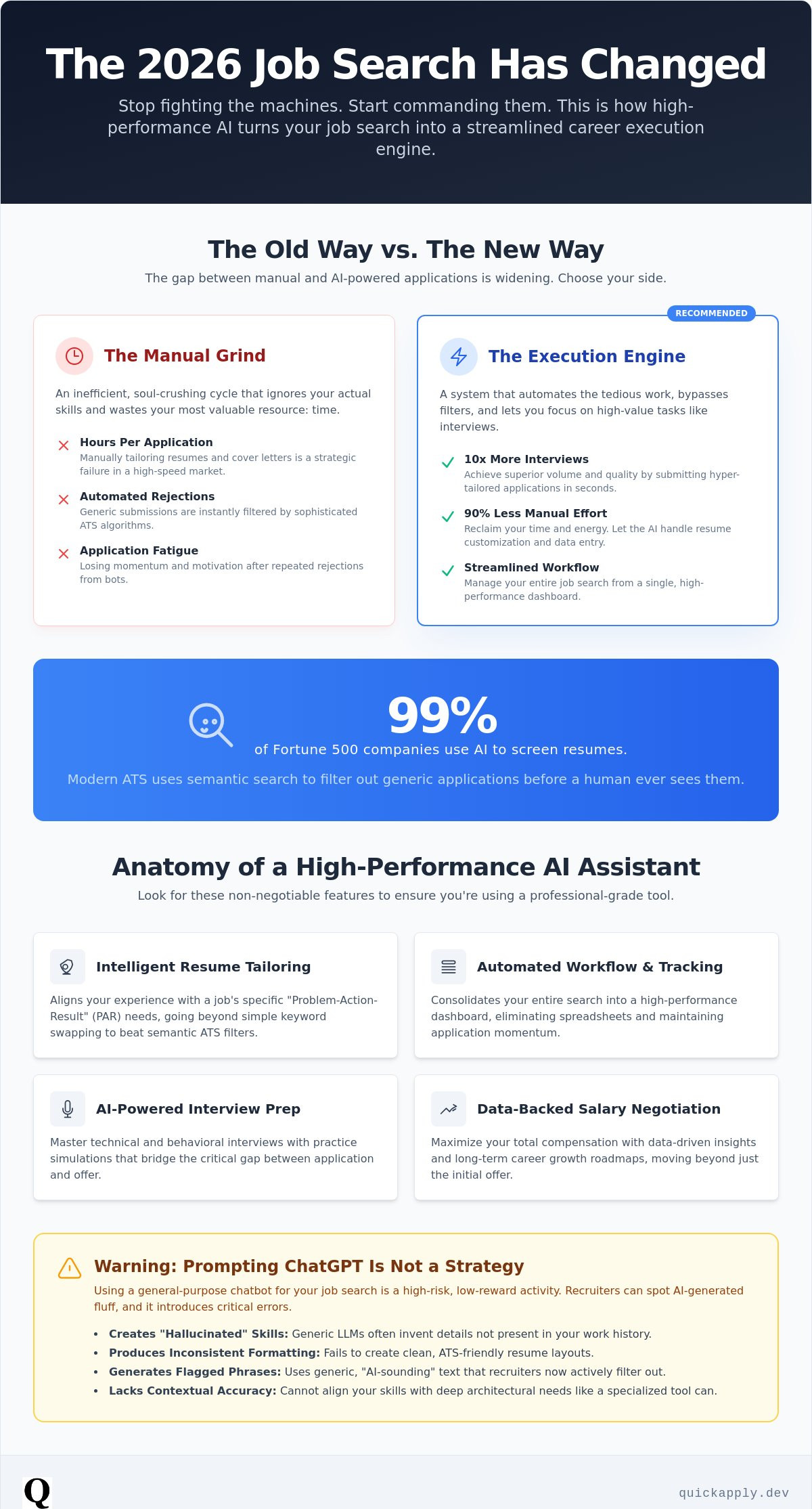
99% of Fortune 500 companies now use AI to screen resumes before a human recruiter even glances at them. In this hyper-competitive landscape, finding the best ai job application assistant 2026 isn't just a luxury; it's a mandatory upgrade for your career stack. You already know the frustration of spending hours manually tailoring a resume only to receive an automated rejection minutes later. It's an inefficient, soul-crushing cycle that ignores your actual technical skills and wastes your most valuable resource: time.
It's time to stop fighting the machines and start commanding them. This guide reveals how to leverage high-performance AI assistants to automate your entire job search, bypass rigid ATS filters, and secure top-tier tech roles. You'll discover how to achieve 10x more interviews with 90% less manual effort. We'll explore the specific tools that provide a centralized dashboard for every application and the data-backed insights you need for confident salary negotiations. From instant resume tailoring to interactive interview practice, you're about to turn a tedious manual process into a streamlined execution engine that works while you sleep.
Key Takeaways
- Navigate an AI-first job market where sophisticated tailoring is the only way to bypass modern recruiter filters.
- Identify the essential features of the best ai job application assistant 2026 to prioritize high-speed resume customization over low-quality bulk submissions.
- Consolidate your workflow into a high-performance "Job Search Stack" that automates tracking and maintains application momentum.
- Master role-specific technical and behavioral interviews through AI-powered practice simulations that bridge the gap between application and offer.
- Maximize your total compensation using data-backed salary negotiation guides and long-term promotion roadmaps.
The 2026 Job Market: Why Manual Applications are Obsolete
In 2026, the job market operates like a high-frequency trading floor for talent. Speed is your primary competitive advantage. If a high-tier tech role opens at 9:00 AM, the top 5% of candidates have their tailored applications submitted by 9:05 AM. Waiting for a human to manually edit a resume is a strategic failure. Recruiters now deploy sophisticated algorithms to filter out low-effort, generic submissions. They aren't just looking for keywords; they're screening for AI-generated fluff that lacks depth. This creates a paradox. You need AI to compete, but you need the best ai job application assistant 2026 to ensure your output remains high-fidelity and contextually accurate.
Most tech pros fall into the "Application Fatigue" trap. You spend hours on one perfect application, get rejected by a bot, and lose the momentum needed to reach top-tier firms. This manual approach is obsolete. The industry has shifted toward the "Career Execution Engine." This isn't just a resume builder. It's a system that manages your professional presence across the entire digital landscape. It turns the job search from a series of exhausting chores into a streamlined, automated workflow.
The Evolution of ATS Algorithms in 2026
Modern recruitment relies on an Applicant Tracking System (ATS) that uses semantic search. Keyword stuffing is a relic of the past. Today's filters understand the relationship between your specific tech stack and the company's project needs. Your assistant must align your professional narrative with these deep architectural requirements in seconds. Semantic ATS Matching is the core of 2026 recruitment technology, prioritizing the context of your achievements over simple word counts.
Why Prompting ChatGPT is Not a Strategy
Copy-pasting prompts into ChatGPT is not a strategy. It's a time drain that produces inconsistent results and lackluster formatting. Generic LLMs often "hallucinate" skills or project details when they lack grounding in your actual work history. This creates a massive risk during technical rounds. You need a dedicated tool, not a general-purpose chatbot. For a deeper dive into why this manual approach fails, check out this ChatGPT Resume Myth-Busting analysis. Relying on raw prompts is like trying to compile code with a word processor; it's the wrong tool for a high-stakes environment. Efficiency requires a specialized system that understands the nuances of the tech industry.
Core Features of the Best AI Job Application Assistants
High-performance assistants in 2026 are precision instruments, not just automation scripts. The best ai job application assistant 2026 must offer more than simple bulk submissions. Bulk auto-applying is a losing game. It triggers recruiter detection systems and floods your inbox with low-value rejections. Instead, look for tools that prioritize deep personalization. You need a system that mimics human nuance while maintaining machine speed. This requires "clean" AI generation that avoids the generic phrasing recruiters now flag as low-effort bot output.
Privacy is the other non-negotiable pillar. Your professional history is sensitive data. Leading platforms ensure your resume and project details aren't used to train public models. This secure, professional-grade environment protects your intellectual property while you scale your search. Efficiency doesn't mean sacrificing security; it means choosing a tool that respects both. If you're ready to upgrade your search, you can start optimizing your applications with a system built for privacy.
Intelligent Resume Tailoring vs. Generic Builders
Generic builders just swap keywords. Intelligent tailoring aligns your specific experience with the job’s "Problem-Action-Result" (PAR) requirements. This ensures your resume speaks the language of the hiring manager, not just the initial filter. QuickApply tailors resumes for tech roles in seconds, providing a level of detail that manual editing cannot match. It’s about building on good resume examples and refining them into hyper-specific documents. This method eliminates the "AI-sounding" fluff that recruiters have learned to ignore, keeping your candidacy credible and professional.
The Role of Real-Time Match Scores
Your time is a finite resource. Stop wasting it on roles where you have a 10% chance of success. High-performance assistants provide a real-time Match Score. This data-driven percentage quantifies your fit for a specific role based on technical stack, seniority, and project history. It effectively filters out "ghost jobs" and low-probability reaches. Focus your energy on roles with an 85% score or higher to maximize your ROI. This data-backed approach ensures you spend your effort where it yields the highest interview volume. It turns the "spray and pray" method into a surgical strike on the roles that actually matter for your career growth.
Streamlining the Workflow: Tracking and Automation
Spreadsheets are where job searches go to die. Managing 50 plus applications across LinkedIn, Indeed, and various company portals manually is a recipe for burnout. The best ai job application assistant 2026 eliminates this friction by integrating your entire Job Search Stack into a single command center. Using siloed tools for resume tailoring and separate spreadsheets for tracking creates data fragmentation. You lose the context of which resume version you sent where. An integrated ecosystem ensures your application tracker communicates with your tailoring engine, maintaining perfect alignment across every touchpoint.
Momentum is the engine of a successful search. Automated tracking does more than just list jobs; it captures full job descriptions before they are deleted and sets intelligent follow-up triggers. This level of organization is essential for mastering the job application process in a high-speed market. QuickApply replaces the chaos of manual entry with a centralized system that tracks your progress from the first click to the final offer.
Centralized Application Management
The mental load of a job search is often more taxing than the technical interviews themselves. In 2026, organization isn't just about being neat; it's about data retention. Use this checklist to stay ahead of the curve:
- Capture real-time status updates for every submission.
- Archive job descriptions for future interview preparation.
- Monitor your match score history to identify high-performance resumes.
- Enable automated follow-up reminders to stay on the recruiter's radar.
Automated Cover Letter Generation for Tech Roles
One-size-fits-all cover letters are a rejection guarantee. In 2026, recruiters expect your letter to address role-specific pain points and mention your relevant tech stack immediately. Finding the best ai job application assistant 2026 means choosing a tool that scales your professional voice without making you sound like a bot. AI cover letter generators now hit these nuances by focusing on project outcomes. For software engineers, this means highlighting how your specific contributions, like a database optimization that reduced latency by 20%, solve the hiring manager's current problems. It’s about merging technical precision with a persuasive narrative at scale.
Mastering the Human Element: AI-Powered Interview Prep
Efficiency in the interview phase means practicing with a purpose. Don't waste time on generic question lists. You need a feedback loop that identifies your specific weaknesses before a recruiter does. If you're ready to convert your interviews into signed contracts, you should start practicing with role-specific AI simulations today. This proactive approach turns a high-stress event into a predictable execution of your professional skills.
Behavioral and Technical Simulation
Master the "STAR" method by generating responses based on the exact experience you highlighted in your tailored resume. Practicing for system design or complex coding rounds with an AI coach allows you to refine your logic in a low-stakes environment. These tools analyze your verbal delivery for clarity and impact. During these practice sessions, the AI identifies filler words and weak phrasing that can undermine your professional authority. For real-time support during the actual call, Final Round AI acts as a real-time copilot, providing data points and cues when you need them most.
Post-Interview Follow-up Automation
The 24-hour rule still dictates follow-up success in 2026. Use your assistant to generate personalized thank-you notes that reference specific technical discussions from your interview. This reinforces your engagement and keeps your candidacy top-of-mind for the hiring manager. Referencing a unique project outcome or a specific question from the call shows a level of attention that generic templates can't match. Mastering the follow-up email format ensures you maintain momentum after the screen goes dark. It's the final step in an automated workflow that transforms a conversation into a concrete offer.
Beyond the Hire: Salary Negotiation and Career Growth
The job search isn't over when you receive an offer letter. It's over when you sign a contract that maximizes your market value. Most tech professionals leave significant money on the table because they view negotiation as a social confrontation rather than a data problem. The best ai job application assistant 2026 solves this by providing a comprehensive Salary Negotiation Guide. This tool transforms the discomfort of asking for more into a logical, evidence-based discussion. By leveraging high-performance automation, you ensure that the assistant doesn't just find you a job; it pays for itself through optimized compensation packages.
QuickApply represents the logical conclusion of a modern career strategy. It transitions from application tracking to long-term career execution. Instead of using siloed tools that forget your history once you're hired, you need a system that builds on your initial success. This integrated approach ensures your momentum doesn't stall after the first paycheck. It turns a one-time search into a continuous cycle of professional optimization; as you transition into new roles, you can explore Pay-per-assignment e-learning platform options to see how AI is streamlining the way teams create and consume internal training.
Securing the Best Offer with AI Insights
Negotiation is won with data, not intuition. High-performance assistants analyze real-time market data to provide a realistic target salary range for your specific tech stack and location. This eliminates the guesswork and gives you the leverage needed to push back on lowball offers. The Scripting feature provides you with exact phrases to use during the negotiation call, ensuring you remain professional and firm. Utilizing a professional assistant can result in a total compensation increase of $10,000 to $30,000. This ROI makes the tool an essential part of your financial toolkit.
The Promotion Roadmap: Winning Your Next Role Today
Successful tech pros start applying for their next promotion the day they begin a new role. The Promotion Roadmap feature allows you to track achievements from day one, building a bulletproof promotion case for your annual review. You won't have to scramble to remember your impact six months down the line. QuickApply helps you document every database optimization, successful deployment, and team leadership moment as they happen. This proactive mindset ensures you're always ready for the next level of your career. Stop reactive job searching and start strategic career building. Optimize your career today with QuickApply and take control of your professional trajectory.
Command Your Career Evolution
The job market in 2026 doesn't reward manual effort; it rewards systemic efficiency. Relying on outdated application methods is a strategic liability that costs you time and total compensation. You've seen how semantic ATS filters and high-speed recruitment cycles have changed the rules of the game. Success now requires an integrated approach that combines rapid resume tailoring, automated tracking, and data-driven interview preparation. Finding the best ai job application assistant 2026 is the only way to maintain a competitive edge in a landscape dominated by algorithms.
QuickApply delivers the high-performance tools needed to dominate this new environment. With resume tailoring that takes seconds and a 95% ATS pass rate for tech roles, you can stop fighting the filters and start winning the offers. Our integrated 2026 Salary Negotiation Guide ensures you never leave money on the table again. Stop being a passenger in your career search. Execute with precision. Start Tailoring for Free with QuickApply. You have the technical talent; now use the technology that ensures the world sees it.
Frequently Asked Questions
What is the best AI job application assistant for tech professionals in 2026?
QuickApply is the best ai job application assistant 2026 because it integrates the entire career lifecycle into one execution engine. It replaces fragmented, siloed tools with a centralized system for resume tailoring, application tracking, and salary negotiation. Designed specifically for the technical nuances of the software industry, it ensures your stack and project impact are communicated with high precision to modern recruiters.
Can recruiters tell if I used AI to tailor my resume?
Recruiters only detect AI use if you rely on low-quality generators that produce generic, repetitive phrasing. High-performance assistants use sophisticated tailoring to align your specific experience with the company's technical needs. This results in a document that mirrors human nuance while maintaining machine speed. Focus on tools that provide clean generation to avoid the red flags associated with basic chatbot prompts.
Is auto-applying to hundreds of jobs a good strategy in 2026?
Bulk auto-applying is a failed strategy that triggers recruiter detection systems and results in automated rejections. In 2026, quality beats volume every time. High-tier companies use algorithms to filter out low-effort submissions instantly. You achieve better results by using an assistant to surgically tailor a smaller number of high-probability applications where your Match Score is 85% or higher.
How does an AI match score actually work?
An AI match score uses semantic analysis to compare your resume against a job description's technical requirements and project goals. It doesn't just count keywords. The system analyzes the relationship between your skills and the role's architectural needs to produce a fit percentage. This data allows you to prioritize applications with the highest ROI, saving you hours of manual effort on low-probability roles.
Do AI job assistants help with salary negotiation?
The best ai job application assistant 2026 includes integrated negotiation guides that use real-time market data to script your requests. These tools provide exact phrases to use during the call, removing the emotional discomfort of asking for more. By leveraging data-backed insights, users often secure an additional $10,000 to $30,000 in total compensation, making the assistant a tool that pays for itself.
Is it worth paying for a premium AI job assistant subscription?
Yes, because the ROI on a premium subscription is immediate through time saved and higher offer values. A professional-grade assistant automates hundreds of hours of manual tailoring while providing exclusive features like interview practice and promotion roadmaps. Viewing this as a career investment rather than an expense ensures you have the technical edge needed to secure top-tier compensation packages in a competitive market.
How do I bypass ATS filters using AI in 2026?
Bypass modern ATS filters by using semantic matching to align your resume's context with the recruiter's specific project needs. Keyword stuffing is obsolete. Today's filters look for deep architectural alignment and proven project outcomes. Your assistant must refine your experience into a narrative that proves you can solve the company's current technical problems, ensuring your candidacy moves directly to a human recruiter for review.
Can an AI assistant help me practice for a technical coding interview?
Yes, advanced AI assistants provide role-specific simulations for technical coding and system design rounds. These tools analyze your logic and verbal delivery in real-time to identify weak phrasing or technical gaps. By practicing in a low-stakes environment, you refine your STAR method responses and build the confidence needed to execute perfectly during the actual call with the hiring team.


