

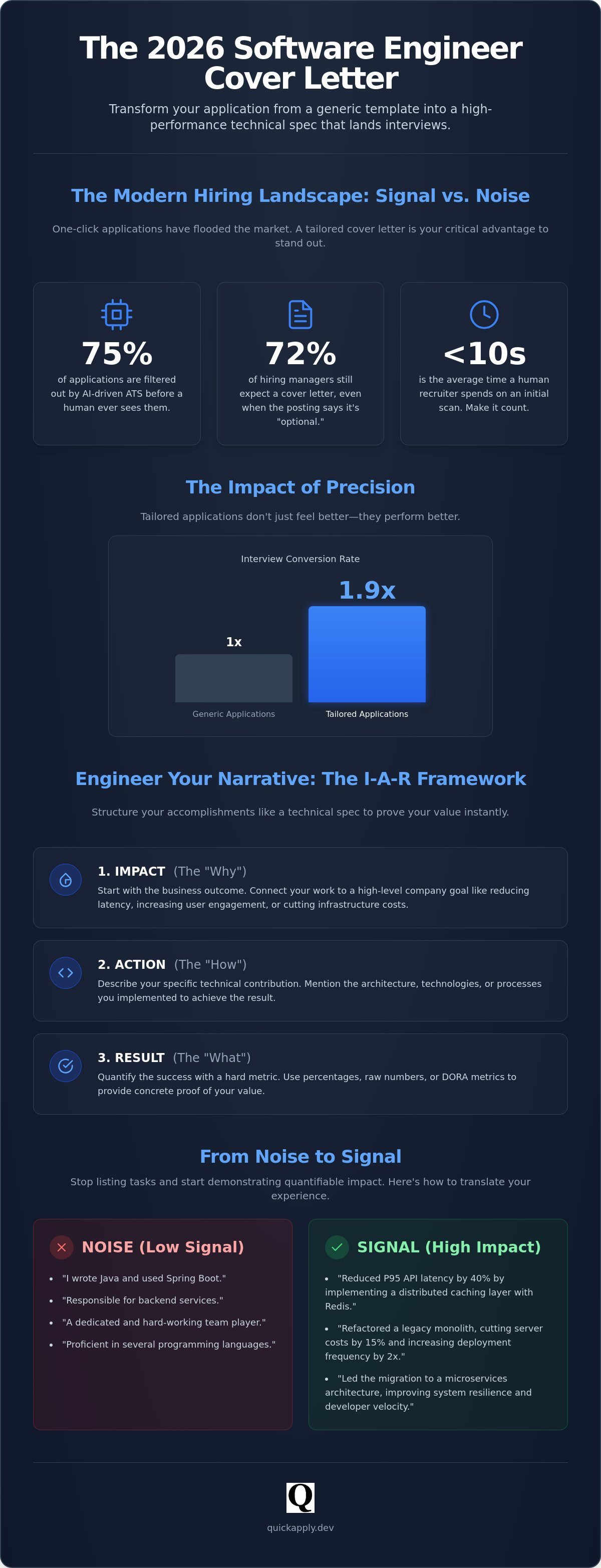
Did you know that 72% of hiring managers still expect a cover letter even when the job posting claims it's optional? In 2026, skipping this step isn't just a missed opportunity; it's a signal that you're low-effort. You already know that drafting a manual cover letter for software engineer roles is a massive bottleneck. It's a tedious process that often leads to low response rates from AI-driven ATS systems that check 75% of all applications today.
You want a way to quantify your technical impact without wasting hours on every submission. We're going to fix that. This guide promises to teach you the art of technical storytelling and how to use smart AI tools to build high-impact letters that land interviews. You'll move from generic templates to a repeatable system that delivers a 1.9x increase in interview rates. We're diving into the exact framework for turning your career history into a high-performance technical specification that recruiters can't ignore.
Key Takeaways
- Stop treating your application as a formality and start using a cover letter for software engineer roles as a high-performance technical specification.
- Deploy the "Impact-Action-Result" framework to quantify your technical value and solve specific company bottlenecks before the first interview.
- Align your narrative with your career archetype to highlight either high-growth potential or complex system architecture.
- Leverage AI to automate the extraction of hidden keywords and map your resume to unique job requirements instantly.
- Repurpose your tailored impact metrics to dominate recruiter screens and streamline your final-round interview preparation.
The 2026 Tech Landscape: Are Cover Letters Obsolete?
In 2026, the job market is noisier than ever. The surge of one-click applications has created a signal to noise crisis for hiring teams. A cover letter for software engineer candidates is no longer just a polite introduction; it's a technical narrative. It bridges the gap between your static resume and a dynamic job description. While your resume lists what you've done, the cover letter explains how you'll solve the specific system problems the company faces today. Understanding What is a Cover Letter? in this modern context means viewing it as a bridge for technical alignment and culture-add.
The "Easy-Apply" era has backfired. Recruiters are drowning in thousands of generic submissions. They've stopped looking for the "best" candidate and started looking for reasons to hit "delete." Your cover letter is your chance to stand out as a high-signal applicant. It provides the context that raw keyword parsing often misses. It shows you've done the research, understood the product roadmap, and identified exactly where your skills fit into their architecture.
The ATS vs. Human Recruiter Filter
Hiring systems have evolved beyond simple keyword matching. By 2026, AI-driven ATS platforms are projected to filter out 75% of applicants before a human recruiter even views the file. These modern tools prioritize semantic relevance, analyzing how your experience maps to the actual intent of the role. If the machine doesn't see a clear narrative connection, you're gone. Even if you pass the machine, human recruiters spend less than 10 seconds on an initial scan. They aren't looking for fluff; they're looking for immediate proof that you understand their stack and their specific technical challenges.
Why Generic Templates are Career Debt
Generic templates are the technical debt of your job search. They might save you five minutes now, but they'll cost you weeks in ghosted applications. Recruiters can instantly spot unedited AI prompts or boilerplate language. It signals a lack of genuine interest and a low-effort mindset. In a market where 80% of hiring managers dislike fake-sounding AI content, precision is your only competitive advantage. Efficiency isn't about sending 100 generic applications. It's about sending 10 high-precision ones that actually convert. A tailored cover letter for software engineer roles proves you're a builder who values quality over raw volume.
Engineering the Narrative: Anatomy of a Scalable Cover Letter
The Evidence section is where you deploy the Impact-Action-Result framework. It's the most critical part of your narrative. You need to prove that your code doesn't just work; it delivers measurable business value. Modern hiring managers look for engineers who understand the bottom line. They want to see that you can translate complex technical tasks into organizational wins. Your goal is to make the reader believe that hiring you is the most efficient path to reaching their next deployment target.
Solving for Technical Debt and Scalability
Most engineers ignore the company's engineering blog. That's a massive mistake. Use those posts to find their current pain points. Are they struggling with a messy monolith migration? Are they hitting scaling limits on their database? Position yourself as the fix. Mention your familiarity with their specific SDLC and deployment patterns. When Crafting Your Cover Letter, remember that senior roles require showing you can handle technical debt, not just write new features. Demonstrate that you understand how to maintain velocity while refactoring legacy systems.
Quantifying Impact Beyond the Code
Stop listing languages and start listing results. "I wrote Java" is noise. "I reduced backend latency by 40% by implementing a distributed caching layer" is signal. Use DORA metrics like deployment frequency or time to restore service to prove your efficiency. Tailored applications have a 1.9x higher interview conversion rate compared to generic submissions. If you want to scale this process without burning out, you can use Cover Letter Generation to map these metrics to new roles in seconds.
The Close should be a bold invitation. "I'm eager to discuss how my experience with high-concurrency systems can help your team achieve its Q4 scaling goals." This shifts the power dynamic from seeker to partner. Align your tech stack experience directly with their architecture. If they use AWS and Terraform, don't just say you know "cloud." Detail your experience with Infrastructure as Code. End with a confident, results-oriented call to action that invites a technical discussion rather than just hoping for an interview.
Archetype Alignment: Senior Architects vs. Junior Devs
A one-size-fits-all approach is a recipe for rejection. Your cover letter for software engineer roles must reflect your specific career stage. Hiring managers look for vastly different signals depending on the seniority of the position. For an entry-level role, the focus is on your ability to learn and your baseline technical competence. For senior or staff positions, the narrative shifts toward system-level thinking and organizational impact. You aren't just applying for a job; you're aligning your professional archetype with their specific business needs.
Career switchers and bootcamp grads face a unique challenge. You must pivot your narrative to show how your previous professional experience translates into technical logic. Don't hide your past. Use it to prove you have the "soft skills" that many pure-tech candidates lack. Highlighting your ability to manage stakeholders or lead projects in other industries can be a significant differentiator in a crowded market. It's about showing that you possess the maturity to handle production environments even if your Git history is relatively fresh.
Entry-Level: Highlighting Projects and Git History
If you're a junior, your potential is your primary product. Since you lack a decade of professional experience, your personal projects must serve as your proof of work. Discuss specific open-source contributions as a proxy for professional collaboration. Link to a clean, well-documented GitHub repository to provide immediate social proof. Show that you can ship production-ready code that follows industry best practices. Recruiters want to see that you've moved beyond basic tutorials and can build functional, scalable systems from scratch.
Senior/Staff: Highlighting Architecture and Mentorship
At the senior level, writing code is the easy part. Hiring managers for staff roles prioritize your ability to think cross-functionally. Your cover letter for software engineer leadership roles should focus on architecture, distributed systems, and cloud infrastructure. Detail your experience with complex migrations or security implementations. Equally important is your track record of mentoring junior developers. Highlighting how you've improved team culture or increased sprint velocity through better code review processes proves you're a force multiplier, not just an individual contributor.
Precision matters more than volume. Whether you're proving your potential or your expertise, every sentence must serve a purpose. Avoid fluff and focus on technical alignment. By tailoring your narrative to your specific archetype, you demonstrate a level of self-awareness that generic candidates miss. This strategic alignment is what moves your application from the "maybe" pile to the interview shortlist.
Systematizing the Tailoring Process with AI
Manual tailoring is a legacy process. In 2026, spending an hour on a single cover letter for software engineer roles is an inefficient use of your technical talent. You need to treat your application pipeline like a CI/CD pipeline. Systematize the output. For engineers curious about how enterprise data is similarly unified into actionable formats, you can find out more about knowledge graph technology. By using smart technology to handle the heavy lifting, you can scale your impact without sacrificing the precision that recruiters demand. Authenticity isn't about the time spent typing; it's about the accuracy of the technical alignment you present.
To build a high-performance application system, follow these five steps:
- Step 1: Extract. Scrape the job description for "hidden" keywords. Look beyond the tech stack for latent needs like "latency reduction" or "technical debt refactoring."
- Step 2: Map. Align your existing Impact-Action-Result metrics to those specific requirements. If they need scalability, lead with your distributed systems experience.
- Step 3: Generate. Produce a technical draft that mirrors the company's engineering tone. A startup wants "scrappy," while a FAANG-scale giant wants "systemic."
- Step 4: Audit. Perform a manual sanity check. Ensure the AI hasn't hallucinated technical specs or misrepresented your level of expertise with a specific framework.
- Step 5: Track. Save the version against the Job ID. You'll need this exact narrative when you move to the initial recruiter screen.
Avoiding the 'AI-Bot' Trap
Hiring managers can spot low-effort, unedited AI drafts instantly. Use technology to generate the structure, but provide the "soul" yourself. This means injecting specific anecdotes that only a human could know. You can also tailor resume to job description ai to ensure your entire application package is semantically linked. Always double-check technical claims; a single hallucinated library name will kill your credibility.
High-Volume Optimization Strategies
Precision beats raw volume every time. Applying to 10 tailored roles yields better results than 100 generic submissions. Use an job application tracker to monitor your pipeline and identify which narratives are converting. Tailored applications lead to a 1.9x increase in interview rates, making this the most efficient path to your next role. Stop wasting time on manual drafts and start using a system designed for the modern web.
Ready to optimize your outreach? Start using Cover Letter Generation to build high-impact applications in seconds.
Beyond the Draft: Automating Your Tech Career Growth
Your cover letter for software engineer roles isn't a one-and-done file. It's the technical documentation for your career. The narrative you built to land the interview becomes the script for your initial recruiter screen. Since 94% of hiring managers say cover letters influence their interview decisions, you must maintain consistency between your written claims and your verbal delivery. Treat this content as the baseline for your entire hiring lifecycle. It's the foundation for your professional brand, ensuring that every interaction reinforces your value proposition.
The data you've gathered doesn't lose utility once the offer letter arrives. Those same quantified achievements are your primary leverage during salary negotiation. When you can prove you've already solved a company's specific scaling issues in your narrative, you aren't just asking for a salary; you're presenting a business case. This systematic approach ensures your career trajectory remains on an upward curve without the manual grind. You're building a repeatable framework for professional advancement that scales with your experience.
From Application to Interview Real-Time Prep
Don't start from scratch when the calendar invite hits your inbox. Use your tailored impact metrics to fuel your interview practice. AI tools can now predict likely interview questions based on the specific technical narrative you submitted in your cover letter for software engineer applications. By mapping your achievements early, you build a "career vault" that streamlines not only this job search but also future promotion roadmaps. You'll always have a repository of high-impact results ready for performance reviews or your next big career pivot.
The QuickApply Advantage
QuickApply functions as your career operating system, not just a drafting tool. While our ai cover letter generator handles the heavy lifting of tailoring, the platform's real power lies in optimization. Use the match score to identify high-probability roles and stop wasting bandwidth on low-probability leads. This data-driven approach allows you to focus your energy where it yields the highest return.
- Match Score: Prioritize roles where your technical stack and experience align perfectly.
- Application Tracker: Maintain a clean pipeline and never miss a follow-up.
- Systemic Efficiency: Replace hours of manual writing with seconds of AI-powered precision.
Scaling your impact requires a system that works as hard as you do. Join the thousands of engineers who have stopped manual drafting and started winning. Optimize your search, dominate your interviews, and secure the compensation you deserve. It's time to stop searching and start landing.
Scale Your Technical Narrative for 2026
The tech market in 2026 demands more than just a list of skills. It requires a high-performance narrative that maps your achievements directly to company pain points. You've learned how to bridge the gap between static resumes and dynamic job descriptions by using the Impact-Action-Result framework. Whether you're a junior dev proving potential or a senior architect solving for scale, your application must function like a technical specification.
Efficiency is the only way to stay ahead of the curve. Mastering the cover letter for software engineer roles doesn't have to be a manual bottleneck. Stop wasting hours on drafts that might never be read. Use a system built by engineers for engineers to streamline your path to the interview. You're now equipped to turn every application into a high-signal asset that recruiters can't ignore.
Optimize your career with QuickApply's AI Cover Letter Generator to tailor your application in seconds. With 95% Match Score accuracy, you'll identify high-value opportunities instantly and spend your time where it actually matters. Your next role is waiting. Take control of your career trajectory today.
Frequently Asked Questions
How long should a software engineer cover letter be in 2026?
Aim for a length between 350 and 400 words. Recruiters and hiring managers have limited bandwidth, so your writing must be dense and high-impact. Get straight to the point by addressing technical challenges and your specific solutions. Avoid long-winded paragraphs that don't contribute to your technical narrative or demonstrate your ability to solve system-level problems.
Should I include my GitHub or portfolio link in my cover letter?
Always include these links as they serve as immediate social proof of your ability to ship production-ready code. For a cover letter for software engineer roles, a clean GitHub repository is often more persuasive than the letter itself. Ensure your README files are well-documented and your most relevant projects are pinned to the top for maximum visibility.
Is it okay to use an AI cover letter builder for tech jobs?
Use AI as a high-speed drafting tool, not a total replacement for your voice. While 32% of job seekers use AI to help write drafts, 80% of hiring managers can spot and dislike "fake-sounding" content. Use technology to handle the structure and keyword mapping, then manually audit the output to ensure your genuine technical expertise and personality remain intact.
Do FAANG and Tier-1 tech companies actually read cover letters?
Tech giants require cover letters about 48% of the time, and they use them strategically. For highly competitive roles, a well-crafted letter acts as a tie-breaker between candidates with similar resumes. About 49% of hiring managers say a strong letter can persuade them to interview a candidate who might otherwise seem unqualified based on their resume alone.
How do I address a cover letter if I don't know the hiring manager's name?
Address it to "Engineering Hiring Manager" or the specific team, such as "Backend Infrastructure Team." Never use "To Whom It May Concern," as it signals a lack of research and interest. If you can't find a specific name on LinkedIn or the company site, focus your energy on the technical content rather than worrying about a generic salutation.
What is the most effective format for a technical cover letter?
Use a 3 to 5 paragraph structure that prioritizes technical alignment. Start with a hook about a company milestone, follow with two paragraphs of quantified achievements using the Impact-Action-Result framework, and end with a confident call to action. This format mirrors the logic of a technical specification, making it easy for recruiters to parse your value quickly.
Should I mention my salary expectations in the cover letter?
Don't mention salary in your initial application. The goal of the cover letter for software engineer is to secure an interview, not to start a negotiation. Wait until you've demonstrated your value through the technical screening process. You should save those discussions for the later stages of the pipeline where you have more leverage to maximize your offer.
How many technical keywords should I include for ATS optimization?
Prioritize semantic relevance over raw keyword count. Modern ATS tools in 2026 analyze how your skills map to job requirements rather than just counting occurrences. Include your core tech stack and 3 to 5 high-impact keywords found in the job description. This ensures your narrative matches the machine's intent without making the text unreadable for the human recruiter who follows.


