
In 2026, the average callback rate for software engineers has bottomed out at a staggering 1 to 2 percent. You've likely felt the weight of this statistic while firing off hundreds of applications into the digital void. It isn't just you. Even senior developers are seeing their response rates plummet as automated systems prioritize hyper-specific AI skill sets. Sending 100 applications to receive zero human responses is the new, brutal reality of the technical job market.
We know that feeling ghosted by a faceless algorithm is infuriating. You can do the work, but the gatekeeper is a machine that doesn't care about your potential. This guide changes the math. You'll discover the hard data behind current engineering benchmarks and learn the exact algorithmic strategy required to 5x your interview invites. We'll identify the specific friction points in your application funnel and show you how to automate the optimization process to reclaim your time and your career momentum.
Key Takeaways
- Benchmark your performance against the current 2026 average callback rate for software engineers to see if your funnel is healthy or broken.
- Understand how LLM-based ATS filtering has replaced simple keyword matching and why generic resumes are discarded in under two seconds.
- Master semantic alignment to map your technical experience directly to a job description's specific problem statements.
- Leverage AI-powered match scoring to predict your probability of a response before you ever hit the submit button.
- Shift to a high-velocity tailoring strategy that automates the application process while maintaining the quality required to bypass automated gatekeepers.
What is the Average Callback Rate for Software Engineers in 2026?
Your callback rate is the primary KPI of your job search. It represents the ratio of human interview invites to the total number of applications you've submitted. In the current market, this number is a cold reflection of how well your profile survives automated gatekeepers. If you're sending out resumes and hearing nothing, you're likely a victim of the 2026 "Application Inflation" effect.
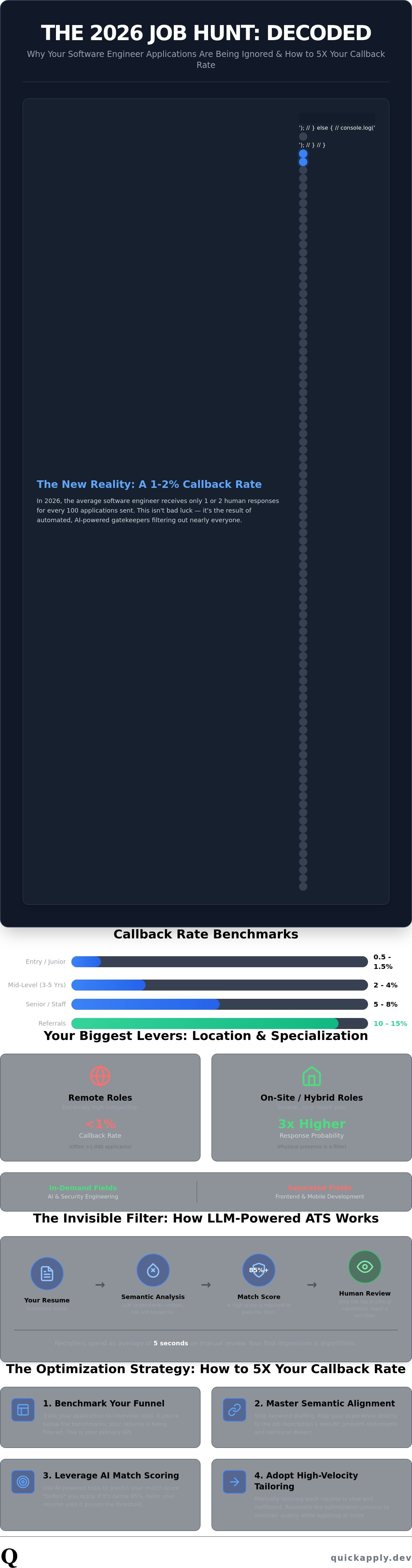
The average callback rate for software engineers currently sits between 2% and 3% for cold applications. This means for every 100 jobs you apply to, you can expect two or three human responses. Referrals remain the heavy hitters, boasting a 10% to 15% success rate. While a 1% rate is statistically common today, it's strategically unacceptable for top-tier talent. It signals a fundamental mismatch between your resume and the recruitment process algorithms used by modern firms.
Volume has increased because applying is easier than ever. This flood of data has forced recruiters to rely on even stricter LLM-based filtering. The result is a massive drop in response rates for generic profiles. You aren't just competing with other engineers. You're competing with the speed of the systems they use. Monitoring the average callback rate for software engineers is the only way to diagnose if your resume is technically invisible or just unlucky.
Callback Benchmarks by Experience Level
Your seniority significantly dictates your baseline expectations. Entry-level and junior developers face the most hostile environment, with callback rates hovering between 0.5% and 1.5%. Mid-level engineers with three to five years of experience typically see a 2% to 4% return. Senior and Staff-level roles remain the most resilient. These specialized positions enjoy callback rates of 5% to 8% because the candidate pool is naturally smaller and more verified. They possess the specific technical debt-solving experience that machines are programmed to find. For those in high-growth niches, you can check out Mark Loucas Ltd to access specialized executive search solutions in the fintech sector.
Remote vs. On-site: The Competition Gap
Location strategy is the biggest lever you can pull. Remote roles are currently the most competitive, often attracting over 1,000 applicants per listing. This extreme volume drives callback rates below 1% for most candidates. Conversely, hybrid or on-site roles offer a 3x higher probability of a response. The local talent pool is smaller, and the friction of physical presence acts as a natural filter. For those considering relocation to high-demand markets, CanadaPathway provides a self-service platform to manage the immigration process. Sector choice also matters. AI and Security engineering are seeing talent shortages, while Frontend and Mobile roles are heavily saturated, further depressing their specific callback metrics.
The Technical Breakdown: Why Callback Rates are Plummeting
The 2026 job market isn't just crowded. It's automated. If you're struggling with a low average callback rate for software engineers, you're likely fighting an invisible war against LLM-based filtering. Legacy Applicant Tracking Systems (ATS) looked for simple keywords like "Java" or "Kubernetes." Modern systems are far more sophisticated. They use semantic analysis to understand the context of your achievements. If your resume doesn't mirror the specific problem-solving language of the job description, the algorithm flags you as a low-probability match before a human ever sees your name.
Despite a strong job outlook for software developers, the sheer volume of applications has created the "Dead Sea Effect." Generic resumes are the salt. They clog the system. Recruiters, overwhelmed by thousands of entries per role, have reduced their manual review time to roughly five seconds. If the AI doesn't rank you in the top tier, you're effectively non-existent. This algorithmic bias favors candidates who align perfectly with the JD's unique dialect. It often filters out "perfect" engineers who simply failed to tailor their technical narrative.
The Role of AI in Modern Recruitment
Companies now deploy AI to rank candidates based on a "Match Score." This isn't a simple percentage of shared words. It's a calculation of contextual relevance. The AI understands that "optimizing latency" is related to "high-performance computing." Recruiters set high cut-off thresholds. If your score is below 85%, you stay in the digital pile. To break through, you need to tailor your resume to meet these specific thresholds instantly. Automated screening ensures that only the top 10 candidates ever reach a human desk.
Common Resume Technical Debt
Your resume might be suffering from technical debt. Non-parsable formats are the most common culprit. Fancy PDF designs with multi-column layouts often break when processed by LLM filters, making your best experience invisible. Then there are skill-gap hallucinations. This happens when you have the skills but describe them in a way the AI doesn't recognize as relevant to the specific role. An ATS is a gatekeeper that prioritizes semantic relevance over raw experience. If you aren't speaking the right technical dialect, the system assumes you don't know the language.
Benchmarking Your Funnel: Is Your Rate Normal or Broken?
Stop treating your job search like a lottery. It's a sales funnel. If you don't know your numbers, you can't optimize your output. The three critical stages are Apply, Screen, and Interview. Each stage has distinct candidate dropout rates that reveal exactly where your process is leaking. If you're hitting a 0% callback rate, your resume is likely technically invisible. The ATS isn't even parsing your data. This is a syntax error in your career code.
When you're ghosted after an Online Assessment (OA), the diagnosis changes. Your technical skills are visible, but your profile lacks "fit" or semantic alignment with the team's specific needs. You're passing the machine's logic test but failing the recruiter's relevance test. To fix this, you must calculate your personal ROI. Track your applications per hour against your interviews per week. If your average callback rate for software engineers is below the 2% benchmark, you're wasting cycles on a broken strategy.
The 100-App Stress Test
Statistical significance requires a sample size. You need at least 100 applications before you can accurately judge your performance. Ten silent rejections might be bad luck; 100 silent rejections is a system failure. Distinguish between automated rejections and silent ghosting. An instant rejection means you failed a hard filter. Ghosting means you're in a "maybe" pile that never gets reached. Use an automated job application tracker to find patterns in these rejections. Look for specific sectors or tech stacks that consistently ignore you.
Referral vs. Cold Apply Metrics
While referrals are the gold standard, they shouldn't be your only channel. If your average callback rate for software engineers is low, you need to diversify. Referrals offer a 5x multiplier on your success. They bypass the initial filter and put you directly in front of a human. However, referrals don't scale. In a high-competition market, cold applying becomes a volume strategy. It's often more efficient to automate 50 high-quality, tailored cold applications than to spend a week chasing one referral. The key is balancing quality and quantity. You need enough volume to beat the 1% odds, but enough tailoring to ensure you aren't just adding to the noise.
Optimization Strategy: How to 5x Your Callback Rate
Generic applications are a waste of compute. In a market where the average callback rate for software engineers is hitting record lows, your strategy must evolve from manual labor to systemic automation. Your master resume is a static asset in a dynamic market. It's a liability. To break the 2% ceiling, you must stop "building" a resume and start "tailoring" a profile for every single submission. This shift ensures your profile passes the semantic threshold required by modern LLM filters.
Semantic alignment is the engine of this strategy. You aren't just matching keywords; you're mapping your engineering experience to the specific problem statements defined in the job description. Apply the 80/20 rule to your job search. Focus your energy on the top 20% of roles where your match score exceeds 80%. This high-probability targeting prevents you from diluting your efforts on roles where the algorithm has already decided your fate. Use technical tools to bridge the gap between your raw experience and the recruiter's specific requirements.
The Algorithmic Tailoring Framework
Success requires a repeatable process. First, extract the core technical requirements and latent needs from the JD. Second, re-weight your bullet points to emphasize the specific tech stacks the company values most. If the role emphasizes RAG architecture and LLM integration, these should be your primary headers. Finally, tailor your resume to the job description with AI precision to ensure every line serves a purpose. This method transforms your resume from a general history into a specific solution.
Beating the "First 48" Rule
Timing is a critical variable in the recruitment equation. Applying within the first 48 hours of a posting increases your callback probability by 300%. After this window, the volume of applicants often triggers a "hard cap" on human review. You need a rapid-response workflow. Set up automated alerts for your target sectors and utilize tools that allow for instant, high-quality submissions. The best AI resume builders enable you to submit a perfectly tailored application in seconds. Speed and precision are no longer mutually exclusive. To start scaling your interview invites today, automate your resume tailoring now.
QuickApply: Automate Your Way to More Interviews
Scaling your job search manually is a losing game. When the average callback rate for software engineers is stuck at a dismal 2%, you need a technical edge to bypass the noise. QuickApply provides that high-speed solution. Our AI Tailoring engine creates role-specific resumes in seconds. It doesn't just swap keywords. It re-aligns your entire professional narrative to meet the semantic demands of modern LLM-based filters. You get the precision of a manual edit with the speed of a script.
The Match Score Advantage is your predictive KPI. Before you hit submit, you'll know your exact probability of a callback based on JD alignment. This data allows you to prioritize high-value roles and stop wasting cycles on applications that will never see human eyes. Once your applications are live, our centralized Application Tracker manages 100+ entries without effort. You'll never miss a follow-up or lose track of which resume version landed the interview. It's about moving from a chaotic search to a strictly managed career funnel.
Scaling Your Search Without Burning Out
Burnout is the direct result of inefficient effort. QuickApply users maintain a 10% or higher callback rate because they use specialized systems built for the 2026 technical landscape. Many developers mistakenly believe ChatGPT resumes are a myth that actually helps their chances. In reality, generic prompts produce generic output that LLMs easily detect and discard. You need a tool that understands the specific nuances of engineering JDs and tech-stack hierarchies. Shift your focus from "applying" to "managing" your funnel and let the technology handle the repetitive tailoring tasks.
Next Steps: From Callback to Offer
The goal isn't just a callback. It's the signed offer. Once the invites start rolling in, use our Interview Practice tools to sharpen your technical and behavioral delivery. Our system doesn't just help you get the job; it helps you engineer your entire career. Use the Promotion Roadmap to visualize your long-term trajectory and the Salary Negotiation Guide to ensure you're paid your true market value. Don't settle for the average callback rate for software engineers when you can dominate the market through automation. Start optimizing your job search today with QuickApply and turn your applications into interviews instantly.
Take Control of Your Career Funnel
The 2026 technical market doesn't reward manual effort; it rewards systemic efficiency. If your current average callback rate for software engineers is hovering at the 1% mark, your strategy needs an immediate technical upgrade. You've seen how LLM-based filtering has rewritten the rules of the recruitment game. To win, you must stop fighting the machine and start leveraging its logic. Success now depends on your ability to align your technical narrative with a job description's semantic needs in real-time.
Stop guessing and start getting called back with QuickApply. Our platform delivers AI-powered match scoring to predict your success and instant JD-to-resume alignment to ensure you bypass automated gatekeepers. Combined with automated application tracking, you can monitor your funnel's health without wasting time on manual data entry. You have the talent. Now, use the tools that ensure the market sees it. Your next high-impact role is just a match score away.
Frequently Asked Questions
Is a 1% callback rate normal for software engineers in 2026?
A 1% response rate is statistically normal for cold applications in the current market. Many developers with years of experience report receiving only three callbacks for every 300 submissions. While common, this is a sign of a generic application strategy. High-performers use automated tailoring to push their average callback rate for software engineers toward 10% or higher by bypassing initial LLM filters.
How many applications should a software engineer send per day?
Aim for 5 to 10 high-match applications per day. Quality now scales through automation, so there is no reason to send generic resumes. Prioritize roles where your technical match score exceeds 80%. Mass-applying with a single master resume is a waste of cycles. Focus your energy on submitting tailored profiles within the first 48 hours of a job posting for maximum impact.
Does the ATS actually reject resumes automatically based on keywords?
Modern ATS systems have evolved beyond simple keyword matching to use LLM-based semantic analysis. They don't just look for "Python"; they evaluate the context of your achievements. If your resume fails to meet a specific relevance threshold, the system flags it for rejection before a recruiter ever sees it. Your profile must speak the exact technical dialect of the job description to survive the initial scan.
How much does a referral improve my callback rate?
Referrals typically improve your callback probability by 5x to 10x compared to cold applications. While cold response rates often sit at 2%, referrals enjoy a 10% to 15% success rate. They act as a bypass for automated filters and place you directly in front of a human. However, referrals are difficult to scale. Use them as a high-value supplement to a high-velocity, tailored application strategy.
Should I tailor my resume for every single job application?
Yes, tailoring is mandatory to maintain a competitive average callback rate for software engineers. A master resume is too generic for 2026 recruitment algorithms. You don't need to do this manually. Use AI-driven tools to align your experience with the job description in seconds. This ensures you meet the semantic requirements of every specific role without sacrificing your time or burning out.
Why am I getting rejected immediately after applying even though I meet all requirements?
Immediate rejections usually stem from "knock-out" questions or low algorithmic match scores. If you answer "No" to a required skill or years-of-experience prompt, the system triggers an instant rejection. Another cause is a resume format that the ATS cannot parse. If the machine can't read your data, it assumes you don't meet the requirements and moves your application to the rejection pile automatically.
Do cover letters still matter for software engineering callbacks?
Cover letters rarely influence the initial automated filter, but they improve your conversion rate once a human recruiter reviews your profile. They provide the narrative context that a resume lacks. If you can generate a tailored cover letter in seconds, it's a low-effort way to add a layer of professional polish. Focus on how your specific skills solve the company's documented technical problems.
How do I know if my resume is ATS-compliant?
Test your resume against a match scoring tool to see how an LLM interprets your experience. Avoid multi-column layouts, images, or non-standard fonts that break automated parsers. A clean, single-column structure is the most reliable way to ensure your data is readable. If a machine cannot extract your skills accurately, your application will stay at the bottom of the digital pile regardless of your talent.


