

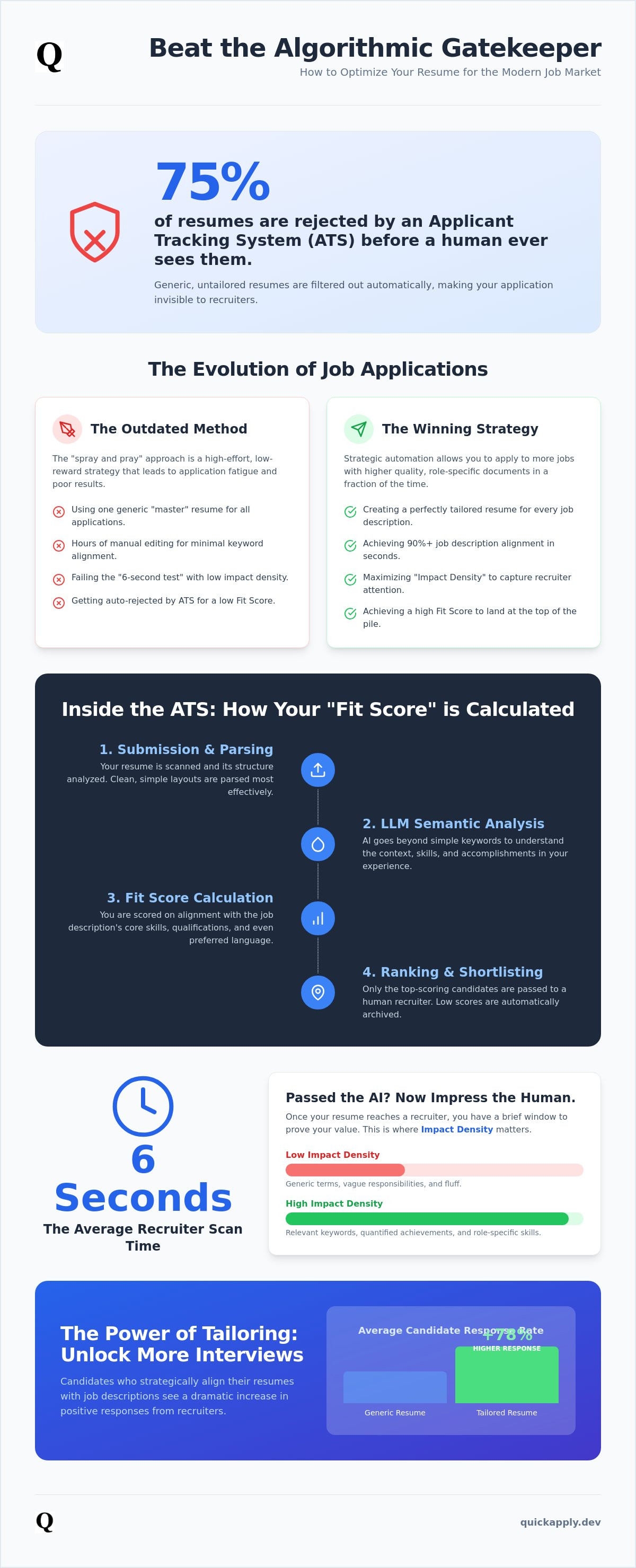
An estimated 75% of resumes are rejected by an Applicant Tracking System before a human ever sees them. If you're still wondering how important is tailoring your resume, the answer is definitive: it's the only way to survive the 2026 algorithmic gatekeepers. You've likely experienced the soul-crushing fatigue of manual editing, only to be met with total silence from recruiters. It's a common frustration to feel like you're shouting into a void, uncertain which keywords actually matter to the high-tech filters standing between you and your next career move.
Generic resumes are now obsolete, and manual tailoring is a productivity trap that kills your momentum. We'll show you how to achieve 100% alignment with job descriptions using high-speed optimization that takes seconds, not hours. Candidates who tailor their documents see a 78% higher response rate, and we'll reveal how to hit those numbers consistently. Discover how AI recruiters rank candidates and learn the system to increase your interview conversion rates. This is your roadmap to mastering the efficiency layer of the modern job search and ensuring you're always ahead of the curve.
Key Takeaways
- Stop guessing why you're being ghosted; learn how modern LLM-based ATS calculates your Fit Score before a human recruiter even opens your file.
- Discover exactly how important is tailoring your resume in a landscape where generic documents trigger immediate rejection by algorithmic gatekeepers.
- Master a strategic framework to deconstruct job descriptions, identifying core skills versus preferred qualifications to mirror the employer's primary needs.
- Bridge the efficiency gap by automating your application pipeline, moving from five manual edits to fifty high-alignment submissions with zero burnout.
- Utilize Match Score technology to verify your alignment with job requirements instantly, ensuring every application you send is optimized for maximum impact.
The 2026 Job Market: Why Generic Resumes Fail the 6-Second Test
Resume tailoring is the strategic alignment of your skills and experience to the specific requirements of a single job description. It's no longer an optional "extra" for overachievers. In the hyper-saturated tech markets of 2026, the "spray and pray" method is a guaranteed path to immediate rejection. When you send a generic document, you're essentially gambling with your career. High-volume roles receive hundreds of applications within hours, and recruiters have zero patience for candidates who haven't bothered to customize their pitch.
The psychological impact on a recruiter is immediate and negative. A generic resume sends a clear signal: "This candidate didn't do the work." It suggests a lack of interest and a low level of professional diligence. If you're wondering how important is tailoring your resume, consider that a 90% match is now the baseline for landing an interview. Anything less is a statistical anomaly. Most resumes are discarded by the Applicant Tracking System before a human ever sees them, making high-precision alignment your only ticket to the next round.
The Death of the 'Master Resume'
Relying on one "perfect" version of your resume is a major strategic error. The era of chronological storytelling is over. Hiring managers don't want a history lesson; they want a solution to their specific problems. You must shift your mindset from "what I've done" to "how I solve your current challenges." Static PDFs are being outpaced by dynamic, role-specific profiles that can be updated in seconds. If your resume doesn't pivot to meet the exact needs of the role, it's already obsolete. Understanding how important is tailoring your resume means recognizing that your document must be as agile as the software you build.
Recruiter Psychology in the AI Era
Even if you beat the initial filters, you still have to pass the "6-second test." This is the brief window where a human recruiter scans your document for relevance. They look for a clear visual hierarchy and immediate proof of value. To win this stage, you need to optimize for impact density. Impact density is the ratio of relevant keywords to total word count. By stripping away fluff and focusing on high-impact phrasing, you keep the recruiter's attention focused on your qualifications. If your impact density is low, you'll be skipped in favor of someone who prioritized clarity and relevance. In 2026, efficiency is the only currency that matters in the job search.
The Algorithmic Gatekeeper: How Modern ATS Evaluates Your Fit
In 2026, the gatekeeper isn't a person. It's an algorithm. An estimated 75% of resumes are rejected by an Applicant Tracking System (ATS) before a human recruiter ever opens the file. This happens because modern systems have moved beyond simple keyword matching. They now utilize Large Language Model (LLM) parsing to evaluate your professional history with human-like comprehension. If you're still using a generic template, you're essentially invisible to the recruiters you're trying to reach.
The system calculates a "Candidate Fit Score" the moment you hit submit. This score determines whether you end up at the top of the pile or buried in the digital archives. Don't make the mistake of "keyword stuffing." Older systems were easily fooled by repeating words in the footer, but modern AI identifies these tactics as spam. Instead, you need contextual relevance. This means your experience must be tailored to the specific position by demonstrating how your skills solve the employer's unique problems. High-speed alignment is the only way to ensure your profile reaches a human eye.
Semantic Matching vs. Keyword Search
2026-era ATS understands semantic meaning. It knows that a "Python expert" and a "Backend Engineer with 5 years of Django" are functionally related. However, using the exact terminology found in the job description still provides a necessary boost to your Fit Score. The system is looking for the path of least resistance to find a perfect match. You must also avoid the "ATS Trap" of complex columns, tables, and intricate graphics. These elements often break the parser. When the AI can't read your layout, it assigns a zero score and moves on to the next candidate. Stick to clean, high-score structures that prioritize data readability.
The Hidden Ranking System
Recruiters use these Match Scores to sort hundreds of applicants in seconds. If you're missing even one "Mandatory Skill," your ranking plummets regardless of your other achievements. This is exactly how important is tailoring your resume in a digital-first market. You can't afford to leave your ranking to chance. Review these good resume examples for 2026 to see how successful candidates structure their data for algorithmic approval. Knowing your score before you hit submit is a massive competitive advantage. You can verify your match score instantly to ensure you meet the 90% threshold required for a human review. Stop guessing and start optimizing your path to the interview.
Tailoring Fatigue vs. Strategic Automation: The Efficiency Gap
Tailoring fatigue is the silent killer of job search momentum. It's the mental burnout that occurs after spending two hours meticulously editing a single document, only to receive an automated rejection notice. This manual approach is a productivity trap. In the high-volume tech markets of 2026, the ROI on five manual applications can't compete with 50 AI-tailored submissions. When you analyze how important is tailoring your resume, you have to look at the math. Manual editing is slow, inconsistent, and prone to human error. You often miss subtle keyword nuances that a Large Language Model catches instantly. To win, you must bridge the efficiency gap between manual effort and strategic automation.
The competitive advantage in 2026 belongs to the fast. Most corporate job postings receive approximately 250 resumes. If you aren't in the first wave of applicants, your Fit Score might not even matter. Recruiters often stop looking once they have a viable shortlist. Strategic automation allows you to maintain 100% alignment without sacrificing your entire afternoon to a single job description. It transforms the job search from a grueling manual process into a streamlined pipeline of high-probability opportunities.
The Cost of Manual Optimization
Manual optimization is a losing bet. If a single application takes you 90 minutes to tailor, you're capped at roughly five quality submissions per day. Meanwhile, your competition is using systemic automation to apply to 50 roles with the same level of precision. This creates a massive "Time-to-Apply" discrepancy. Speed is a critical variable. Statistics show that applying within the first hour of a posting significantly increases your visibility. If you're stuck fixating on a single bullet point, you're missing the first-mover advantage. Stop treating your resume like a piece of art and start treating it like a functional data set designed for rapid deployment.
Leveraging AI for High-Volume Success
Modern tools have evolved beyond simple templates. The best AI resume builders are now powerful optimizers that focus on alignment rather than just layout. The workflow has shifted from "writing" to "verifying." You don't need to draft new sentences from scratch; you just need to validate that the AI has accurately mapped your real experience to the job's core requirements. This preserves your authenticity while maximizing your score. By shifting your mindset to this efficiency layer, you maintain continuous productivity without the active effort that leads to burnout. You aren't cheating the system; you're mastering it to ensure your talent actually reaches the right desk.
The 5-Point Framework for High-Impact Resume Alignment
Understanding how important is tailoring your resume is only the first step. You need a repeatable, high-speed system to execute that alignment without burning out. The 2026 job market demands a framework that converts complex job descriptions into precise data points. Start by deconstructing the Job Description (JD) to identify 'Core' versus 'Preferred' skills. Core skills are the non-negotiables that trigger the initial ATS pass. Preferred skills are the tie-breakers that convince a human recruiter to pick up the phone. If you miss the core requirements, your application dies in the parser.
Mirroring the Professional Summary
The top third of your resume is prime real estate. This is where the "6-second test" is won or lost. You must align your professional summary to mirror the JD's primary problem statement immediately. A tailored summary can increase scan time by 40%. Craft a narrative that speaks directly to the company's current pain points rather than listing generic goals. If the JD emphasizes "scaling distributed systems," your summary should lead with your experience in high-growth infrastructure. This immediate relevance signals to both AI and humans that you're the specific solution they've been searching for.
Dynamic Bullet Point Optimization
Static bullet points are a strategic error. You must re-order and re-phrase your achievements to emphasize role-specific results. Use the 'Action + Context + Result' formula to give your accomplishments weight. Swap industry-specific jargon to match the target company's internal dialect. This semantic alignment ensures the LLM-based ATS recognizes the depth of your expertise. Check out the 2026 efficiency guide for specific AI prompts that automate this re-phrasing process. By optimizing your bullets, you increase your impact density and keep the reader's attention focused on your value.
The final steps involve optimizing your Skills section for semantic parsing and validating your work. Group your technical abilities into categories that reflect the JD's layout. This makes it easier for the ATS to map your profile to the role's requirements. Finally, validate your version against a Match Score tool. Never hit submit on a guess. If you're serious about your career, you'll recognize how important is tailoring your resume to reach that 90% threshold. Start tailoring your resume with QuickApply to ensure every application is optimized for the 2026 algorithmic reality.
Executing at Scale: How QuickApply Automates the Competitive Edge
Manual tailoring is a relic of the past. In a market where 83% of companies use AI to review resumes in 2026, you cannot compete using 20th-century methods. QuickApply serves as the essential efficiency layer for tech professionals who value their time. It eliminates tailoring fatigue by replacing hours of manual editing with seconds of automated optimization. You no longer have to wonder how important is tailoring your resume because the platform provides an immediate, data-driven answer through its Match Score feature. This score reflects exactly how an ATS perceives your alignment with a specific role, allowing you to stop guessing and start knowing your fit before you hit submit.
Managing a high-volume application pipeline requires more than just a good resume. It requires a system. QuickApply includes an integrated Application Tracker designed to manage complex recruitment cycles without the administrative mess. This tool ensures you never lose track of a lead or miss a follow-up opportunity. The platform also solves the "Cover Letter Problem" by generating role-specific letters in seconds. These documents are designed to match your tailored resume perfectly, creating a cohesive professional brand that stands out during the initial 6 to 8-second recruiter scan. This is systemic automation at its finest.
From Application to Interview Practice
Landing the interview is only half the battle. QuickApply bridges the gap between being a "candidate on paper" and being the "final choice." Once your tailoring strategy starts generating callbacks, you need to master the live interaction. The platform provides access to interview practice tools that help you refine your pitch in real-time. In a disruptive market, a unified career management system is your best defense against stagnation. It moves you rapidly from the identification of a problem to the execution of a solution, maintaining your competitive advantage through every stage of the hiring funnel.
Beyond mastering the digital and verbal aspects of the interview, your physical presentation plays a significant role in making a lasting impression. To ensure you look as sharp as your tailored resume, you can discover Shane Ave for bespoke suits and custom formal attire designed for a perfect, individualized fit.
Securing the Offer: Beyond the Application
Your career journey doesn't end when you click "Apply." QuickApply supports your long-term growth with salary negotiation guides and promotion roadmaps. These resources ensure that once you get your foot in the door, you're positioned for maximum earning potential and upward mobility. The job search is a technical challenge that requires a technical solution. Stop wasting effort on manual processes that don't scale. Optimize your resume with AI precision today and take control of your professional trajectory. The 2026 algorithmic reality rewards those who adapt, so use the tools built for the modern web to secure your next role.
Master the Algorithmic Market
The 2026 job market doesn't reward manual effort; it rewards algorithmic alignment. By now, it's clear how important is tailoring your resume to survive the initial LLM screening process. You've seen how semantic parsing and Fit Scores dictate who gets the interview and who stays buried in the digital archives. Manual editing is a legacy process that leads to burnout and missed opportunities. You need a system that moves as fast as the technology you develop. QuickApply provides that essential efficiency layer for the modern professional.
Stop fighting the system and start mastering it. With AI-powered Match Scores and an automated Application Tracker built specifically for tech professionals, you can scale your search without sacrificing quality. It's time to shift from building resumes to optimizing your career trajectory. You have the talent. Now, use the right tools to make it visible to the gatekeepers. Start tailoring your resume in seconds with QuickApply and secure your competitive edge in the current landscape. Your next big role is waiting for an optimized version of you.
Frequently Asked Questions
Is it better to have one perfect resume or many tailored ones?
You need multiple tailored versions to survive the modern market. A single "perfect" resume is a strategic error because it fails to meet the specific Fit Score requirements of diverse roles. Understanding how important is tailoring your resume begins with realizing that each job description has unique mandatory skills. By tailoring, you ensure your profile aligns with the exact problem the employer is trying to solve.
How much should I change my resume for each job?
Focus on achieving a 90% match score for every application. You don't need to rewrite your entire history. Concentrate on the professional summary and the skills section to mirror the job description's primary requirements. Re-order your bullet points to put the most relevant achievements at the top. This increases your impact density and passes the 6-second human scan after beating the ATS gatekeepers.
Can ATS tell if I used AI to tailor my resume?
Modern ATS platforms focus on contextual relevance rather than detecting AI generation. Recruiters actually expect candidates to use technology to optimize their search in 2026. As long as your tailored content accurately reflects your real experience and isn't just "keyword stuffing," you're safe. The goal is data alignment. Use automation to ensure your terminology matches the employer's internal dialect precisely.
Do recruiters really care about tailored resumes in 2026?
Recruiters rely on tailored resumes to manage high-volume pipelines. They use Match Scores to sort through hundreds of applicants in seconds. If your resume isn't tailored, your score won't meet the threshold for a human review. In 2026, recruiters view a generic resume as a sign of low interest. Tailoring demonstrates that you've done the work to understand their specific business needs.
This demand for high-quality, specialized talent is why many business owners are now working with dedicated agencies to find the right fit; to learn more about this process, check out Amplify Yourself, LLC.
What happens if I don't tailor my resume?
You will likely be ghosted by the algorithmic gatekeepers. Without specific alignment, your resume will fall into the 75% that are rejected by an ATS before a human ever sees them. You'll waste time applying for roles where you're technically qualified but digitally invisible. Understanding how important is tailoring your resume is critical to avoiding this productivity trap and staying visible in a crowded market.
Is tailoring my resume the same as lying about my experience?
Tailoring is about strategic emphasis, not fabrication. You're simply highlighting the parts of your experience that are most relevant to the specific role. It's the difference between saying you "managed a team" and "led a 10-person DevOps squad." Both are true, but the latter uses the terminology the employer is looking for. Never invent skills; just prioritize the ones that match the JD's requirements.
How can I tailor my resume quickly without spending hours on it?
Stop using manual methods and switch to systemic automation. Tools designed for tech professionals can analyze a job description and optimize your document in seconds. This allows you to apply to 50 roles with the same precision that used to take days of manual editing. You'll bridge the efficiency gap by moving from "writing" to "verifying" AI-generated content that already meets the 90% Match Score threshold.
Does a tailored resume help with referrals?
A tailored resume is essential even for referred candidates. Most referrals still have to pass through the same ATS as everyone else. If your document doesn't match the job description, the hiring manager might struggle to justify your candidacy to their team. A high Fit Score makes it easier for your referrer to champion your application. It proves you're a serious contender who understands the role.


