

Your data science resume is likely being discarded before a human ever sees it if your keyword overlap is less than 70%. It's the "Black Hole" effect in action. You've mastered complex neural networks and high-dimensional data, yet you're stuck manually adjusting margins or debating LaTeX vs. Word compatibility. It's an inefficient use of your time. You're likely frustrated by the lack of response despite having the technical stack recruiters claim to want.
This guide promises to help you master the algorithmic triggers and parsing standards required to bypass digital gatekeepers. By treating your ats resume for data scientist as a technical optimization problem, you'll land more interviews without the manual grind. We'll preview the 2026 standards for 100% parsable structures, tiered skill groups, and the specific productionalization metrics that trigger a "yes" from the system. It's time to stop guessing and start engineering a resume that performs as well as your best models.
Key Takeaways
- Identify the specific algorithmic triggers that cause data science resumes to fail the initial screening phase.
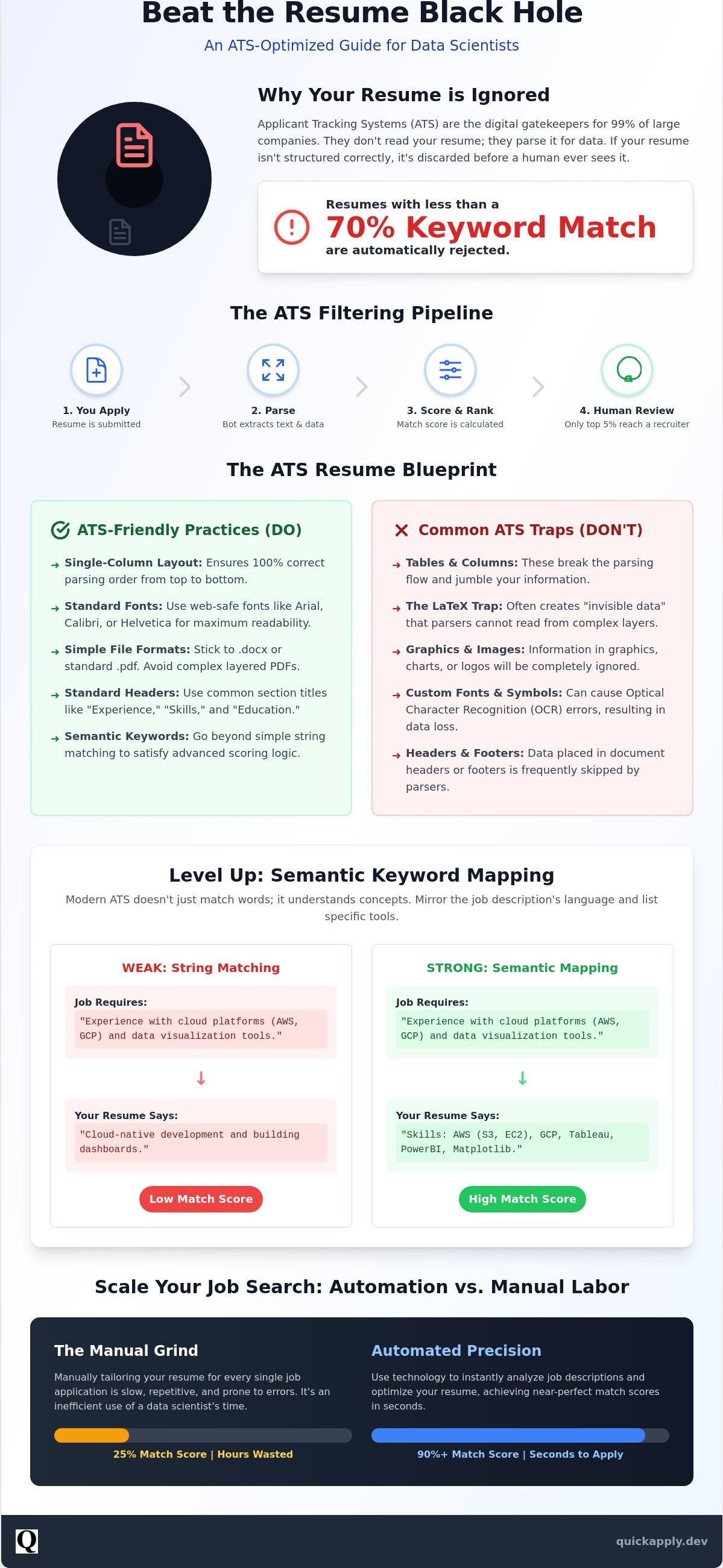
- Architect an ats resume for data scientist using a single-column layout to ensure 100% parsing accuracy across all platforms.
- Replace simple string matching with semantic keyword mapping to satisfy the advanced scoring logic used in 2026.
- Eliminate technical debt in your document by sticking to standard headers and avoiding complex formatting like tables or columns.
- Switch to automated tailoring to reach 90%+ match scores instantly and outpace the manual competition.
The Data Science Resume Black Hole: Why Algorithmic Filtering Happens
Most data scientists believe their technical work speaks for itself. It doesn't. Not when an algorithm is your first audience. If you're applying to a Fortune 500 company, you're dealing with what is an applicant tracking system. These platforms serve as the primary gatekeepers for 99% of large-scale enterprises. They don't read your resume; they parse it. If your ats resume for data scientist doesn't hit the right statistical triggers, it ends up in the "Black Hole." This isn't just a metaphor. It's a database state where your application is technically received but never surfaced to a human recruiter.
The 2026 hiring landscape is a battle of volume versus precision. Tech recruiting has pivoted toward hyper-specific matches. Companies no longer want generalists. They want candidates whose resumes act as a data-driven mirror to the job description. This creates a divide between format compliance and content relevance. Format compliance ensures the bot can extract your text. Content relevance ensures the bot likes what it finds, and utilizing resources like traineticsacademy.com.sg can help you acquire the specific skills that algorithms are programmed to prioritize. You need both to survive the initial sweep and reach a human reviewer.
The Myth of the Human Recruiter
Stop picturing a recruiter reading every submission. They don't have the time. They log into a dashboard and see a ranked list of the top 5% of candidates. Everyone else stays buried in the archive. Systems use automated "knockout questions" to discard applicants who don't meet binary criteria before a person even opens the file. Even the most polished good resume examples will fail if they aren't optimized for these specific bot triggers. You aren't writing for a person yet. You're writing for a parser that values structured data over creative prose.
How ATS Rankings Work
Your visibility depends on your Match Score. This is a numerical value representing how closely your resume aligns with the job description. The algorithm analyzes keyword frequency and strategic placement. If "PyTorch" or "A/B testing" are listed as primary requirements and you only mention them once in a footer, your score drops. More importantly, un-parsable data is treated as non-existent. If your skills are trapped inside a complex graphic or a non-standard table, the ATS records a null value. To the system, you simply don't have those skills. Optimization isn't optional. It's the only way to ensure your data reaches the human stage of the pipeline.
The Technical Architecture of ATS: Parsing, OCR, and Scoring Logic
Think of your resume as a data structure. If the parser cannot read the schema, your content becomes invisible. To build a successful ats resume for data scientist, you must eliminate technical debt. This means stripping away tables, columns, and text boxes. These elements break the natural reading order of the software. While a human recruiter reads left-to-right, a bot processes the underlying code from top-to-bottom. If your machine learning skills are in a right-hand column, they might be appended to the end of your education section, confusing the scoring logic.
The file format hierarchy is clear. Use .docx or a standard .pdf. While .pdf is the preferred choice for preserving layout, some legacy systems still rely on basic Optical Character Recognition (OCR). This software often fails to extract text from complex layers or non-standard fonts, leading to data loss during the ingestion phase. Stick to standard formats to ensure your data is indexed correctly the first time.
The LaTeX Trap for Data Scientists
LaTeX is the gold standard for academic documentation, but it is often a liability in recruitment. Many enterprise systems struggle with LaTeX's complex layering, creating the "Invisible Data" problem. Your contact information, GitHub link, or specific certifications might exist on the visual page but remain unread by the parser. You can test this easily. Copy all text from your PDF and paste it into a plain text editor like Notepad. If the output is garbled or missing sections, the ATS will fail to index your profile. For guidance on professional standards, data science career resources suggest prioritizing machine readability over aesthetic complexity.
Safe Fonts and Layout Structures
Stick to web-safe, sans-serif fonts. Arial, Calibri, and Helvetica are read with 100% accuracy by modern parsers. Avoid serif fonts or custom typefaces that might trigger OCR errors. A single-column layout is the only way to guarantee the correct reading order. Creative, multi-column designs are for marketing roles, not technical ones. Your goal is to make the data extraction process as frictionless as possible. If you're struggling to balance design with data integrity, you can use resume tailoring tools to ensure your structure meets 2026 standards without losing your professional edge.
Semantic Keyword Mapping: Moving Beyond Simple Search
Simple string matching is a relic of the past. In 2026, Applicant Tracking Systems use sophisticated Natural Language Processing (NLP) to understand the semantic relationship between your skills and the job requirements. Building an effective ats resume for data scientist roles requires more than just a list of tools. You must map your expertise to the specific intent of the hiring algorithm. The bot isn't just looking for words. It's looking for evidence of competency.
Semantic Search and NLP in 2026
Modern systems understand synonyms and technical hierarchies. If you mention "PyTorch," the algorithm automatically associates your profile with "Deep Learning" and "Neural Networks." However, you shouldn't leave this to chance. Use both acronyms and full terms to cover all bases. Write "Natural Language Processing (NLP)" at least once to ensure the parser captures both variants. It's vital to tailor resume to job description requirements using high-impact technical verbs like "architected," "optimized," or "deployed." These verbs signal seniority and technical ownership to the scoring engine.
The Skills Section vs. Experience Context
Standalone skill lists are for humans to skim. Algorithms assign higher weights to keywords found within your "Experience" section because it proves you've applied the tool in a professional environment. Structure your bullets using the "Action + Tool + Result" framework. For example: "Optimized XGBoost models to reduce inference latency by 15%." This format provides the context the NLP engine needs to validate your skill level. Quantifying your impact is non-negotiable. Performance-based filters in an ats resume for data scientist prioritize candidates who provide hard metrics. Numbers are universal data points that the bot can easily categorize, rank, and surface to the recruiter.
Step-by-Step Guide to Building an ATS-Friendly Resume
Optimization is a waste of resources if your baseline file is corrupt. Stop using Canva, Photoshop, or complex design tools for technical applications. These platforms prioritize visual layers over data integrity. To build a high-performing ats resume for data scientist roles, start with a clean, single-column document in Microsoft Word or Google Docs. This ensures the parser follows a linear path without skipping critical data points. Complex layouts might look good to a human, but they are a liability when your first hurdle is an algorithm.
Structure your document using standard H1-H4 headings. Label sections clearly as "Experience," "Education," and "Skills." Avoid creative titles like "My Journey" or "Technical Prowess" because the bot won't know how to categorize them. Place your contact information block at the top of the body text, including your LinkedIn profile and GitHub repository. Don't hide this data in the header or footer. Many legacy systems ignore those areas entirely, leaving you with a nameless application. Once your structure is set, map your technical skills to the specific job description. Use an ats resume checker to verify your match score before hitting submit.
The Reverse-Chronological Gold Standard
The chronological format is the easiest for ATS to parse accurately. It provides a clear timeline of your professional growth. List your most recent role first and work backward. If you have employment gaps or are transitioning from a different tech field, use a brief summary to bridge the narrative. Always format dates using the Month/Year standard, such as 05/2022 to 08/2026. This consistency prevents the algorithm from miscalculating your years of experience, which is a common cause for automatic rejection in high-volume hiring cycles.
Testing Your Resume for Parsing Errors
Don't trust what you see on the screen. Run the "Select All + Copy" test. Paste the content into a plain text editor like Notepad. If the text appears garbled or symbols are missing, the bot can't read it. This usually identifies "Garbage Code" caused by fancy bullets or non-standard icons. Never use white text to hide keywords. Modern systems detect this "Hidden Text" and will penalize your profile for deceptive practices. If you want to ensure your document is flawless, use professional resume tailoring tools to automate the technical audit and secure your spot in the interview pool.
Scaling Your Data Science Job Search: Automation vs. Manual Labor
Manual tailoring is a legacy workflow. It's a bottleneck that kills your career momentum. In a market where 99% of Fortune 500 companies use automated filters, your ats resume for data scientist needs to be perfect every time. Spending hours on a single application is a statistical error. You're trading your most valuable asset, time, for a low probability of success. The 2026 job market demands a higher throughput without compromising on technical precision. If you're manually adjusting bullet points for every LinkedIn post, you've already lost the race to more efficient candidates.
Automation is the only logical path forward. By leveraging a best ai resume builder 2025, you can achieve 90%+ match scores in seconds. This isn't just about speed; it's about technical accuracy. AI-driven systems identify the exact semantic requirements of a job post and realign your experience to meet them perfectly. Once you've optimized the document, use an application tracker to monitor your conversion rates. Data-driven career management is about iterating based on hard results, not intuition. You should treat your job search like a production pipeline. Monitor the metrics, identify the drop-off points, and optimize for the highest yield.
Leveraging QuickApply for Technical Optimization
QuickApply’s engine analyzes job descriptions to extract critical keywords that human eyes often miss. It identifies the hierarchy of tools like PyTorch, SQL, and AWS within the context of the role's specific needs. The "Match Score" feature provides a definitive metric of your compliance. You'll know exactly how the algorithm will rank you before you even hit the submit button. This removes the anxiety of the "Black Hole" and replaces it with technical certainty. It's about moving from a reactive search to a proactive, engineered strategy that respects your time.
The Future of Career Management
The future of work belongs to those who view their career as a dynamic, AI-tailored profile rather than a static PDF. High-volume, high-quality applications are the only way to win in a crowded tech market. You need a system that handles the tedious manual labor so you can focus on technical interviews and salary negotiations. Don't let a poorly parsed document stand between you and your next role. Start optimizing your search with QuickApply today and turn the "Black Hole" into a predictable, high-performance pipeline of opportunities.
Engineer Your Interview Pipeline
The 2026 job market doesn't reward effort; it rewards precision. You've seen how legacy formats and manual tailoring create technical debt that stalls your career. To win, you must treat your ats resume for data scientist as a production-level data structure. This means prioritizing clean parsing, semantic keyword alignment, and a single-column architecture that machines can index with 100% accuracy. Stop guessing which versions of your resume perform best. It's time to leverage systems that do the heavy lifting for you.
QuickApply was built specifically for tech professionals who value their time. Our platform provides AI-powered match scoring and automated application tracking to ensure you pass every digital gatekeeper. Don't let a parsing error stand between you and a top-tier machine learning role. Stop getting ghosted; tailor your data science resume with QuickApply AI now. You have the skills. Now, make sure the bots know it too.
Frequently Asked Questions
What is the best file format for ATS compliance in 2026?
The most reliable file format remains .docx for maximum compatibility across all hiring platforms. While most modern systems handle standard PDFs, legacy software used by some enterprise firms can still struggle with complex PDF layers. Using a Word document ensures that your metadata and text structure stay intact during the ingestion phase. It's the safest way to guarantee that every bullet point is indexed correctly without the risk of character corruption.
Can ATS read data science resumes with two columns?
Two-column layouts are a major parsing risk and should be avoided for technical roles. Most Applicant Tracking Systems read text from left to right across the entire page. When you use columns, the bot often merges the text from both sides into a single, nonsensical string. This destroys the logical flow of your experience and skills sections. Stick to a single-column architecture to maintain a clean data schema for the parser.
How many keywords should I include to pass the ATS for data science?
Aim for a range of 30 to 45 specific technical skills to optimize your ats resume for data scientist roles. These should be grouped into 5 to 7 logical categories like "Machine Learning" or "Data Engineering" for better readability. Including fewer than 25 skills can make your profile appear weak, while exceeding 50 can trigger spam filters. Focus on integrating these keywords naturally into your bullet points rather than just listing them in a footer.
Do images or headshots break the ATS parsing process?
Images, headshots, and complex graphics will break the parsing process and should be removed. Bots cannot see the information contained within an image file. If you put your contact info or a skills chart in a graphic, the ATS will record a null value for those fields. Furthermore, these elements often generate "garbage code" that obscures the readable text around them. Keep your document text-based to ensure full transparency for the algorithm.
Is it better to use a PDF or a Word document for job applications?
Use a .docx file if you want to ensure the highest probability of parsing success in 2026. While PDFs are visually superior for human reviewers, some enterprise systems fail to extract data from them accurately. If the application portal doesn't explicitly require a PDF, the Word format is your most efficient choice. It eliminates the risk of OCR errors that frequently occur with complex PDF encoding or non-standard fonts.
How do I know if my resume is ATS compliant before applying?
Perform the "Select All + Copy" test to verify your compliance instantly. Copy the entire content of your resume and paste it into a plain text editor like Notepad. If the text appears in a logical order without garbled symbols or merged sections, you're on the right track. For a more precise audit, use a match scoring tool to compare your document against the job description's specific requirements before you hit the submit button.
Does using white text to hide keywords actually work?
White text is a "black hat" tactic that will get your application rejected by modern systems. Current algorithms are designed to detect text that is invisible to the human eye by analyzing the underlying code. When a system identifies hidden keywords, it flags the profile as deceptive and often disqualifies the candidate automatically. Focus on building content relevance through legitimate experience descriptions rather than trying to game the system with outdated tricks.
Should I use a functional or chronological resume format for ATS?
The reverse-chronological format is the gold standard for ATS compatibility and career progression. Functional formats, which focus on skills rather than a timeline, often confuse the bot's ability to calculate your total years of experience. A chronological layout provides the structured data the system needs to map your professional growth. It ensures that your most recent, relevant roles are surfaced first, giving you a distinct competitive advantage in the ranking logic.


