

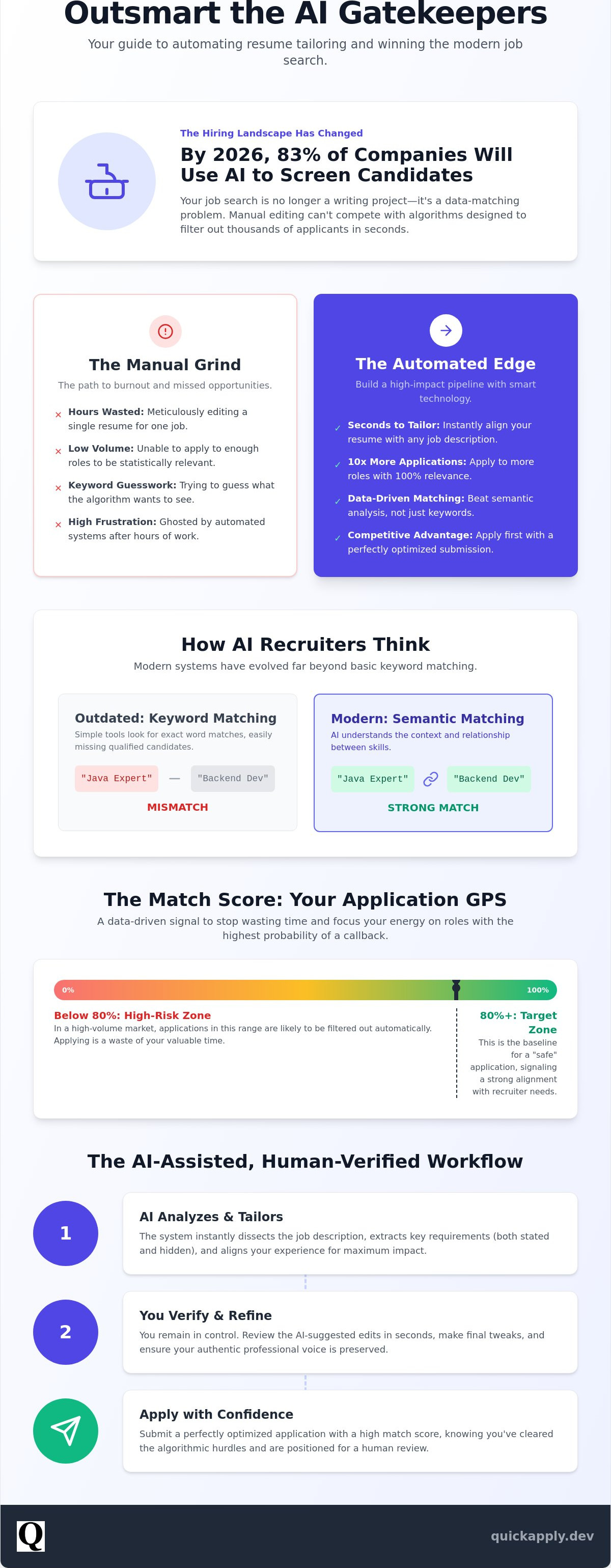
With 83% of companies leveraging AI to screen candidates in 2026, your job search is no longer a writing project. It's a data-matching optimization problem. You've likely spent entire evenings meticulously editing a single application, only to get ghosted by an automated system seconds later. It's frustrating to feel like your career depends on guessing which keywords a machine wants to see. You know you're the right fit, but the gatekeeper is an algorithm that doesn't care about your manual effort.
By integrating resume tailoring automation tools into your daily workflow, you can stop the grind and start winning. This guide teaches you how to tailor every resume in seconds, ensuring a high match score while keeping your professional voice intact. We'll show you how to apply to 10x more roles with total relevance and centralize your entire search process. You'll master high-speed job hunting using smart technology that turns a tedious chore into a high-impact pipeline. It's time to outpace the competition and claim the advantage you deserve.
Key Takeaways
- Stop wasting hours on manual edits and start using resume tailoring automation tools to align your experience with job descriptions in seconds.
- Discover how semantic matching identifies hidden recruiter requirements that traditional keyword stuffing completely misses.
- Implement an "AI-Assisted, Human-Verified" workflow to bypass the robotic stigma and maintain a high-impact, authentic professional voice.
- Transition from chaotic one-off applications to a managed career pipeline by centralizing your search with a dedicated application tracker.
- Learn the tactics to apply to 10x more positions with 100% relevance, ensuring every submission hits a high match score.
Why Manual Resume Tailoring is Obsolescent in 2026
Manual resume editing is no longer a viable strategy for high-level job hunting. In 2026, resume tailoring automation tools have redefined the application process. These AI-driven systems function as optimization engines, instantly aligning your professional history with specific job descriptions. If you're still spending hours tweaking bullet points for a single role, you're operating at a massive disadvantage. You're caught in the "Volume vs. Quality" paradox, where you must choose between applying to enough roles to be statistically relevant or spending enough time on one application to be qualified. Automation eliminates this choice.
Speed is the new currency in the tech job market. Modern hiring cycles move at a pace that manual labor cannot match. Early applicants often secure a significant competitive edge, frequently seeing response rates that are triple those of latecomers. While you're manually adjusting your summary, the window of opportunity is already closing. Automation removes the primary bottleneck in your career growth, allowing you to submit a perfectly optimized application the moment a role goes live.
The Mathematical Reality of Modern Job Boards
The math behind modern job boards is brutal. Tech roles in 2026 regularly attract thousands of applicants within the first 48 hours. To survive this volume, you need relevance-at-scale. Applying to more jobs only works if your relevance remains at 100%. If your match score drops, your volume becomes noise. Resume tailoring automation tools allow you to maintain peak relevance across dozens of applications simultaneously. This systemic approach ensures you're always in the top percentile of the candidate pool without sacrificing your personal time.
How Recruiters Use AI to Filter You Out
Recruiters don't start by looking for reasons to hire you; they look for reasons to filter you out. Understanding how applicant tracking systems work is the first step toward beating them. By 2026, these systems have evolved far beyond simple keyword matching. They now utilize semantic alignment to judge the context and depth of your experience.
A manual resume often fails the initial 6-second scan because it lacks the structural precision these algorithms demand. Traditional keyword stuffing is easily detected and dismissed. Instead, automation ensures your experience is mapped contextually to the recruiter’s needs. This clears the algorithmic hurdles and places your resume directly in front of human eyes with a high match score already attached. It's about speaking the language of the system to get to the person behind it.
Essential Features of High-Performance Resume Tailoring Automation Tools
High-performance resume tailoring automation tools are precision instruments, not simple text editors. They dissect job descriptions to extract "hidden" requirements recruiters prioritize but rarely state explicitly. This isn't just about finding words. It's about identifying the core problems a company needs you to solve. By automating this extraction, you bypass the cognitive load of manual analysis and move straight to the submission phase. You're not just applying; you're engineering a match.
The most effective systems focus on four critical pillars:
- Deep Keyword Extraction: Pinpoints specific technical and soft skills that drive recruiter interest.
- Semantic Matching: Understands the relationship between different technologies and methodologies.
- Match Score Generation: Provides a quantitative green light for every application.
- Instant Formatting: Guarantees the output remains machine-readable and visually professional.
The Power of the Match Score
In competitive tech sectors, you don't have time to apply for every role. You need a data-driven prioritization strategy. A match score gives you a clear signal. If your score is below 80%, you're likely wasting your time in a high-volume market. This threshold is the baseline for a "safe" application in 2026. QuickApply leverages these scores to identify top-fitting opportunities, allowing you to focus your energy where the statistical probability of a callback is highest. This signal-to-noise filter is essential for high-speed hunting.
Deep Semantic Analysis vs. Basic Keyword Matching
Basic tools rely on exact string matches. They're dangerous and outdated. If a job description asks for "Backend Development" and your resume says "Java Expert," an outdated tool might mark you as a mismatch. Modern AI understands these are semantically linked. It knows your experience with microservices and cloud architecture is exactly what the recruiter wants; even if the phrasing differs. This deep analysis allows you to maintain the integrity of your real information while shifting the emphasis to meet the specific context of the role. You're not inventing skills; you're highlighting the ones that matter most for that specific desk.
Avoid tools that encourage "keyword stuffing." Modern ATS algorithms easily detect forced phrases and may flag your profile as spam. High-performance tools prioritize semantic alignment. They ensure your resume feels natural to a human reader while satisfying the technical requirements of the machine. This balance is the key to surviving the 2026 hiring gauntlet. It's the difference between looking like a bot and looking like the perfect candidate.
Overcoming the 'AI-Generated' Stigma in Tech Recruiting
Recruiters don't hate AI; they hate low-quality, generic output. The fear that you'll "sound like a robot" is a relic of 2023. By 2026, resume tailoring automation tools have become standard equipment for high-performers. If your resume perfectly mirrors the job's technical requirements, a recruiter sees a solution, not a script. They're looking for a match, not a writing sample. Your goal is to use technology to bridge the gap between your skills and their needs without losing your unique professional identity. Relevance is the only metric that matters in a high-volume market.
The most successful candidates use an "AI-Assisted, Human-Verified" workflow. This partnership ensures the machine handles the complex mapping of your experience while you provide the final layer of nuance. It follows a specific, high-speed sequence:
- Data Ingestion: The AI analyzes your locked, verified professional history.
- Contextual Mapping: The system aligns your skills with the job's semantic requirements.
- Human Polish: You spend sixty seconds reviewing the tone and verifying the accuracy.
This dual-layer approach bypasses the "uncanny valley" of fully automated applications that feel hollow. You ensure the human trusts you while the AI ensures the machine reads you correctly.
Truth-Anchoring: Keeping the AI Honest
Hallucinations are the primary enemy of your credibility. If an AI claims you managed a team of fifty when you only managed five, your application is dead on arrival. You must ensure your best AI resume builder 2025 is strictly anchored to your verified history. High-performance tools allow you to lock your core data so the AI can only adjust the emphasis, never the facts. You are the ultimate source of truth. The system's job is to translate that truth into the specific dialect of the job posting. A final thirty-second sanity check is your insurance policy against algorithmic errors.
Tone Control and Professional Voice
Tailoring isn't just about technical skills. It's about cultural alignment. A Software Engineer persona requires direct, data-heavy bullet points that highlight technical stack and output. A Manager persona needs a narrative of leadership, conflict resolution, and strategic growth. Effective resume tailoring automation tools allow you to toggle these personas to match the company's specific vibe. You can increase the "punchiness" of your bullets for a fast-paced startup or adopt a more measured tone for a legacy enterprise. In the 2026 tech landscape, professional tone is defined as the intersection of high-density data and clear, active verbs that demonstrate immediate value. Controlling this tone proves you have the professional maturity to understand the environment you're entering.
Integrating Tailoring Tools into Your Career Growth Pipeline
Winning a high-level tech role requires more than a single polished document. It requires a managed pipeline. You must shift your mindset from one-off applications to a systemic, data-driven job search. Resume tailoring automation tools provide the foundation for this shift. By generating a high volume of relevant resumes, you create a feedback loop that informs your entire strategy. This isn't just about getting one interview. It's about controlling your career trajectory through continuous optimization.
A cohesive application package is non-negotiable. Your tailored resume must align perfectly with your cover letter to reinforce your value proposition. Use the semantic data extracted by your tailoring tool to inform your cover letter examples. This ensures a consistent narrative across all touchpoints. When the recruiter sees the same high-impact keywords and contextual alignment in both documents, your candidacy becomes undeniable. You aren't just a name on a screen; you're a solution to their specific technical challenges.
The Application Tracker: Your Search Command Centre
High-speed hunting means managing 50 or more tailored applications simultaneously. Without a system, you'll lose momentum and miss critical follow-ups. You need a centralized command centre to monitor your progress. An automated job application tracker allows you to visualize your funnel and identify which versions of your resume are generating the highest response rates. This data is tactical intelligence. It tells you exactly what the market wants so you can double down on winning patterns. Stop guessing and start measuring. Activate your QuickApply tracker to centralize your search and maximize your efficiency.
Beyond the Hire: Promotion and Salary Negotiation
The intelligence you gather during your search is a goldmine for long-term growth. The specific skills identified by resume tailoring automation tools represent the most in-demand requirements in your sector. Use this data to build a Promotion Roadmap. If every high-paying role asks for a specific certification or methodology, you know exactly where to invest your professional development time. This knowledge also serves as leverage during salary negotiations. You aren't just asking for more money. You're demonstrating your value based on verified market demands. The search process isn't a temporary chore; it's the first step in a multi-year strategy for professional dominance. As your income grows through these strategies, you can automate your financial management with Easy Wealth AI, an AI-powered family CFO platform.
QuickApply: Scaling Your Tech Job Search with AI Precision
QuickApply represents the logical conclusion of the high-speed job hunt. It's the definitive engine for tech professionals who refuse to waste time on low-impact manual labor. While other resume tailoring automation tools offer basic templates, QuickApply delivers an integrated ecosystem designed for the modern web. The promise is simple: tailor every application in seconds, not hours. This speed allows you to dominate the early-applicant window, giving you a statistical edge that manual candidates simply can't match.
Efficiency is the core of the platform. You don't just get a document; you get a data-driven strategy. By using the Match Score advantage, you instantly identify which roles are worth your energy and which are statistical dead ends. This all-in-one approach combines tailoring, tracking, and interview preparation into a single, high-velocity workflow. It's about working smarter, moving faster, and securing the role you want without the burnout of the traditional search.
Built for Tech Professionals and Students
QuickApply understands the specific nuances of tech stacks and engineering roles. It knows that a Senior DevOps position requires a different semantic emphasis than a Junior Frontend role, even if the underlying skills overlap. For active job seekers and students, the ability to generate unlimited resume versions is a game-changer. You can pivot between different niches or adjust your level of seniority for various applications without starting from scratch. Learning how to tailor your resume to a job description using QuickApply’s tech-first logic ensures that your technical expertise is always presented in the most relevant context possible.
Your Career Growth Partner
The journey doesn't end when you hit "submit." QuickApply supports your transition from applicant to interviewee with integrated Interview Practice tools. Once you've cleared the algorithmic hurdles, you need to perform in the room. Our system uses the same tailoring data to help you anticipate technical questions and refine your delivery. This holistic support extends into your first day and beyond. With our Salary Negotiation Guide and Promotion Roadmap, you're equipped to maximize your lifetime earnings and plot a clear path to leadership.
Stop fighting the system and start using it to your advantage. You have the talent; now you need the tools to make it visible to the right people. Efficiency isn't just about saving time; it's about creating opportunity. Start optimizing your job search with QuickApply today and experience the power of resume tailoring automation tools built for the future of work.
Secure Your Competitive Advantage in the 2026 Market
The era of spending hours on a single application is over. You've seen how resume tailoring automation tools transform a tedious manual process into a high-speed optimization engine. By leveraging semantic matching and real-time data, you move past the algorithmic gatekeepers and into the interview room. It's about maintaining 100% relevance at 10x the scale. You don't need to work harder; you need to work faster with the right technology.
QuickApply provides the specific tech-first logic needed to dominate this landscape. With our Match Score technology, you'll never guess your fit for a role again. Use our integrated Application Tracker to manage your high-velocity pipeline and stay organized as you scale your search. We built this platform specifically for tech professionals and students who value their time and expect results. Your career growth shouldn't be limited by how fast you can type.
Apply to more jobs in less time with QuickApply’s AI Tailoring. Your next career breakthrough is a data-matching problem. Solve it today and claim your spot at the top of the candidate pool. You have the skills; now give them the visibility they deserve.
Frequently Asked Questions
Is it okay to use AI to tailor my resume?
Yes, utilizing AI is now the standard requirement for staying competitive in the 2026 job market. With 83% of companies using AI for resume reviews, you need comparable technology to ensure your profile isn't filtered out by the same algorithms. It's not about cheating. It's about optimizing your professional data for the systems that actually manage hiring decisions.
How do resume tailoring automation tools beat the ATS?
These tools utilize semantic matching to align your professional history with the specific context of a job description. Unlike outdated methods of keyword stuffing, modern automation understands the relationship between different skills and technologies. This ensures your resume passes the initial algorithmic scan and reaches a human recruiter with a high relevance score already attached.
Do recruiters penalize candidates for using AI tools?
No, recruiters prioritize relevance and accuracy over the specific tools used to format a document. 92% of recruiters manually review applications after the initial filter, looking for the best solution to their technical problems. As long as your resume is truth-anchored and professional, the method you used to achieve that alignment is irrelevant to the hiring team.
How much time can I actually save with resume automation?
You can reduce the time spent on a single application from several hours to just a few seconds. Automation allows you to apply to 10x more roles while maintaining 100% relevance for every submission. This efficiency turns a slow, manual process into a high-speed pipeline, allowing you to focus your energy on interview performance rather than document editing.
Can I use these tools for software engineering and other technical roles?
Yes, resume tailoring automation tools are specifically engineered to handle complex tech stacks and engineering hierarchies. They understand how different frameworks and languages are semantically linked, ensuring your technical expertise is mapped correctly to the job's requirements. This precision is essential for roles where specific stack experience is the primary filter for candidates.
What is a good match score for a job application?
Target a match score of 80% or higher for the best chance of a callback. This threshold serves as a data-driven signal that your profile aligns with the core requirements of the role. If your score is lower, the tool tells you instantly, allowing you to prioritize roles where your statistical probability of success is highest.
Do I still need to write a cover letter if I use a resume tailor?
Yes, but you should use automated Cover Letter Generation to maintain consistency across your application package. A tailored cover letter reinforces the narrative established in your resume and provides further proof of your fit. Using integrated tools ensures your entire package speaks the same optimized language, which significantly increases your credibility with the hiring manager.
Can these tools help with salary negotiation later on?
Absolutely. The market intelligence gathered during the tailoring process identifies which of your skills are currently in highest demand. You can use this data to justify your value during the final stages of the hiring process. Leveraging a Salary Negotiation Guide alongside your search data gives you a massive advantage when it's time to sign the offer letter.


