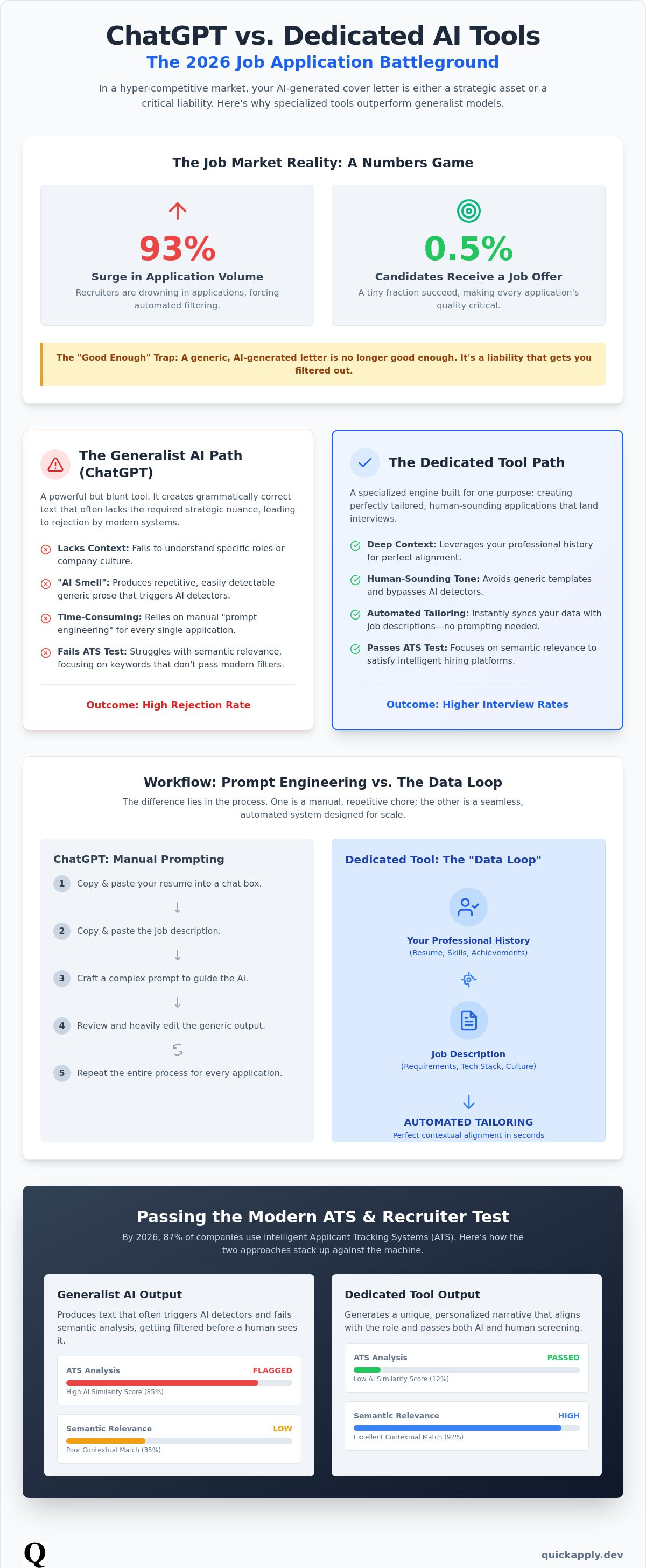
Recruiters are currently drowning in a 93% surge in application volume, yet only 0.5% of candidates actually land a job offer. In this hyper-competitive market, your standard AI-generated letter is no longer a tool; it's a liability. You've likely spent hours refining prompts for GPT-5.5 only to receive a generic, robotic response that feels like a tired template. When evaluating using chatgpt for cover letter vs dedicated tool solutions, the gap between a generalist and a specialist is now a chasm.
It's frustrating to master prompt engineering just to watch your application get buried by an intelligent talent ecosystem. We understand the fatigue of fighting a system that feels rigged against manual effort. This guide will show you why general-purpose AI falls short in the 2026 job market and how dedicated tools provide the competitive edge you need for higher interview rates. You'll discover the technical shift from basic prose generation to strategic application engines that prioritize human-sounding, targeted results. It is time to stop prompting and start winning.
Key Takeaways
- Understand the performance gap when using chatgpt for cover letter vs dedicated tool ecosystems designed for the 2026 recruitment landscape.
- Learn why modern ATS platforms prioritize semantic relevance over the generic prose typically produced by generalist AI models.
- Leverage the "Data Loop" to automatically synchronize your professional history with specific job descriptions for perfect contextual alignment.
- Shift from time-consuming prompt engineering to automated tailoring that scales your output without sacrificing quality or human tone.
- Utilize real-time Match Scores to move beyond simple document generation and achieve total application automation.
The Reality of Using ChatGPT for Cover Letters in 2026
ChatGPT is a hammer. It hits every nail, but it won't build a high-performance career engine. By 2026, the distinction between using chatgpt for cover letter vs dedicated tool platforms has become the difference between a rejection and an interview. ChatGPT is a general-purpose Large Language Model (LLM). It predicts the next token in a sequence based on broad patterns. It doesn't understand the tactical nuances of a Lead Engineer role or the specific cultural DNA of a scaling fintech firm. Clean prose is no longer a competitive advantage. It's the bare minimum.
Many job seekers fall into the "Good Enough" trap. They see a grammatically perfect letter and assume it's ready for submission. It isn't. Recruiters now have a refined nose for the "AI smell." They recognize the flowery adjectives and repetitive structures that GPT-5.5 produces by default. If your application sounds like a thousand others, you've already lost the attention of the hiring manager. High-stakes roles require precision, not just generic fluency.
The Generalist Problem
Generalist AI lacks career-specific context. When you ask a general LLM to write a cover letter, it often hallucinates achievements or relies on vague buzzwords to fill gaps. It doesn't have a deep memory of your professional history or a real-time understanding of market trends. Maintaining a consistent, authoritative voice across 50 applications is nearly impossible when you're starting from a blank chat box every single time. The result is a fragmented personal brand that feels hollow to a seasoned recruiter.
Prompt Engineering vs. Instant Tailoring
Prompt engineering is a hidden tax on your productivity. Crafting the "perfect" prompt takes minutes, sometimes hours. You copy your resume. You paste the job description. You instruct the AI to "sound professional but innovative." This manual process fails to scale. In 2026, job seekers are competing in a market where 87% of companies use an Applicant Tracking System (ATS) to filter candidates before a human ever looks at a document. Using chatgpt for cover letter vs dedicated tool workflows means you're manually fighting a system that's already automated.
Why Generalist AI Fails the ATS and Recruiter Test
By 2026, Applicant Tracking Systems (ATS) have evolved into intelligent talent ecosystems. They no longer scan for simple keywords. They analyze semantic relevance and predictive performance. When comparing using chatgpt for cover letter vs dedicated tool options, the primary failure of generalist AI is its inability to grasp these shifting technical requirements. ChatGPT relies on broad patterns. It produces clean prose that lacks the deep contextual mapping modern recruiters demand.
Keyword stuffing is a legacy tactic. Today's hiring platforms use sophisticated algorithms to evaluate how your skills integrate with a specific tech stack. These systems are increasingly aligned with the framework for inclusive AI hiring, emphasizing fair but rigorous technical vetting. ChatGPT often gets this wrong by prioritizing volume over value. It fills the page with buzzwords but fails to demonstrate the actual application of those skills in a high-pressure environment.
The AI-Detector Arms Race
Recruiters are fighting fire with fire. They use AI-driven screening tools to filter out the massive influx of automated noise. If your cover letter follows the standard GPT-5.5 structure, it will trigger a high similarity score. This flags you as just another candidate using a generic template. Sounding human isn't about using fancy vocabulary anymore. It's about providing specific data points and unique career narratives that a general LLM simply cannot invent. Without hyper-personalization, your application is invisible.
Contextual Misalignment
Generalist AI struggles with the nuance of specialized roles. It often fails to distinguish between the tactical responsibilities of a Senior Developer and the strategic oversight of a Lead Architect. This gap creates a disconnect between your cover letter claims and your resume evidence. ChatGPT resume strategies often fail the ATS check because they lack the granular technical alignment necessary to pass modern screening filters. To stay competitive, you must move beyond basic prompting. Leverage a specialized application engine to ensure your documents are technically precise and recruiter-ready.
Dedicated AI Tools: The Strategic Advantage of Context
Writing is a bottleneck. In a high-speed job market, treating every application as a creative writing project is a tactical error. When evaluating using chatgpt for cover letter vs dedicated tool options, the primary differentiator is the "Data Loop." A generalist AI treats your resume and the job description as isolated text blocks. A dedicated tool treats them as interconnected data points. This synchronization ensures that every claim in your cover letter is backed by verified evidence from your professional history.
Match Scoring changes the game. Instead of guessing if you're a good fit, dedicated systems analyze your profile against the job requirements before you even start. This predictive insight allows you to prioritize high-probability roles and ignore those where you'll be filtered out instantly. Job seekers are currently navigating a more automated recruitment process than ever before. Success requires a tool that understands the mechanics of that automation rather than one that just generates paragraphs.
Context-Aware Generation
Specialized tools use your actual career history as a "source of truth." This eliminates the hallucinations common in GPT-5.5, where the AI might invent a certification or a project to fill a narrative gap. By restricting the AI to your verified data, you ensure every document is authentic. You can also tailor resume to job description requirements simultaneously, creating a cohesive application package that passes both the ATS and the human recruiter test. Context is the difference between a generic letter and a targeted strike.
The Efficiency Framework
Efficiency is the ultimate competitive advantage. A typical ChatGPT workflow takes 15 minutes of copying, pasting, and prompt refining. A dedicated tool completes the same task in 30 seconds. For tech professionals, the value lies in optimization, not content creation. You aren't just writing; you're managing a pipeline. Utilizing a high-performance cover letter builder allows you to maintain a consistent professional brand across hundreds of applications without the manual overhead. Integrated tracking then ensures you never lose sight of where your data is working for you. Stop wasting time in a chat window and start using a system designed for high-volume success.
Evaluating Your Workflow: Speed vs. Quality
In 2026, the "Application Gap" is a statistical reality. With recruiter volume surging by 93%, you aren't just competing with other humans. You're competing with algorithms. Landing a single interview often requires dozens of high-quality, tailored submissions. This is where the debate of using chatgpt for cover letter vs dedicated tool workflows becomes critical. Manual editing of ChatGPT output is the hidden bottleneck. If you spend 20 minutes "fixing" a robotic draft, you've already lost the efficiency battle. Your time is too valuable for manual prompt engineering.
The current hiring rate sits at a staggering 0.5%. This means for every 200 applications, only one person gets the job. If your workflow isn't built for high-volume, high-precision output, you are statistically likely to fail. Scalability is the goal. Can your current setup handle 5 or 10 high-quality applications per day? Most manual workflows break under this pressure. The ROI of professional career tools isn't just about the software. It's about the value of your time and the speed of your next hire. Shortening your job search by even one week pays for years of tool subscriptions. Every day spent in a chat window is a day you aren't interviewing.
This trend toward hyper-efficiency isn't limited to job hunting; forward-thinking businesses are also utilizing Memphis Web Solutions to automate their customer desks and lead management, allowing human teams to focus on high-value strategy rather than repetitive tasks.
Quantifying Your Job Search
Treat your job search like a funnel. Track your conversion rate from application to interview. If you're "spraying and praying" with generic AI, your response rate will likely hover near zero. Data allows you to identify exactly where your application is failing. Low Match Scores usually indicate a lack of semantic relevance. This is a problem generalist AI cannot solve without significant manual intervention. Dedicated tools allow you to bypass the "Similarity Score" problem by injecting unique data points from your professional history into every letter. ChatGPT cannot do this without you manually feeding it new data for every single role.
The Tech Professional Advantage
Software engineers understand the power of a deployment pipeline. You don't manually script every server update; you automate it. Your job search should function the same way. Automate the tedious writing tasks so you can focus on high-value interview preparation and networking. Utilizing an ai cover letter generator turns a manual chore into a streamlined process. Efficiency is the ultimate competitive advantage in a crowded market. Optimize your career pipeline today and stop letting manual bottlenecks stall your professional growth.
QuickApply: Beyond Generation to Total Application Automation
Stop struggling with prompts. You are a high-value professional, not a prompt engineer. While the previous sections established the technical limitations of generalist AI, QuickApply offers the systemic solution. It is a high-performance engine designed specifically for the 2026 tech market. When you evaluate using chatgpt for cover letter vs dedicated tool platforms, the difference is the output. Generalists create drafts. QuickApply creates outcomes.
Efficiency is the only metric that matters in a crowded job market. QuickApply provides instant Resume Tailoring and Cover Letter Generation based on real-time Match Scores. You no longer have to guess if your profile aligns with a job description. The system analyzes the semantic requirements of the role and adjusts your documents to meet them instantly. This isn't just about writing; it's about strategic positioning. Our integrated Application Tracker then moves your search from messy spreadsheets to a centralized command center. You gain total visibility into your pipeline without the manual overhead.
The QuickApply Workflow
Upload your data once and apply everywhere. QuickApply manages your professional history as a single source of truth. The "2-second tailor" feature allows the AI to recalibrate your narrative for every unique job description in the time it takes to refresh a browser. You can also browse our library of cover letter examples to see exactly what winning, high-conversion letters look like in 2026. This workflow eliminates the friction of starting from zero for every new role.
Empowerment Through Optimization
Stop being a writer and start being a candidate. Your goal is the interview, not the document. By automating the tedious aspects of the application process, QuickApply users typically apply to 4x more roles with 2x higher response rates compared to manual ChatGPT workflows. We provide the tools to sustain this productivity throughout your entire career journey. From Interview Practice to Salary Negotiation Guides and Promotion Roadmaps, we ensure your growth doesn't stall after the hire. You deserve a tool that values your time as much as you do. Start optimizing your career with QuickApply today and outpace the competition through superior automation.
Master the 2026 Talent Ecosystem
The job market has shifted from a writing contest to a data alignment race. Success in 2026 requires more than just grammatically correct prose; it requires strategic technical precision. Generalist AI models lack the context-aware depth needed to navigate modern, intelligent screening systems. By prioritizing semantic relevance over generic output, you ensure your professional narrative resonates with both algorithms and human recruiters. When comparing using chatgpt for cover letter vs dedicated tool solutions, the choice is between a manual bottleneck and a high-speed deployment pipeline.
Stop fighting the interface with inefficient prompts. Leverage AI-powered Match Scores, Instant Resume and Cover Letter Tailoring, and an Integrated Application Tracker to dominate your job search. You've spent years mastering your technical craft; don't let a manual application process stall your career growth. It is time to replace low-effort input with high-volume, high-precision results.
Stop prompting and start applying with QuickApply. Take control of your professional trajectory and secure the competitive advantage you deserve. Your next big role is waiting for a candidate who knows how to use the right tools.
Frequently Asked Questions
Is using ChatGPT for cover letters considered cheating by recruiters?
No, using AI is not cheating, but sending generic output is a tactical failure. Recruiters care about results and fit. If your letter sounds like a bot, you will be filtered out. In 2026, nearly half of job seekers use AI in some form. The real competitive advantage comes from using a tool that ensures your specific data actually matches the job description.
Can ATS systems detect if a cover letter was written by AI?
Modern ATS platforms use similarity scores and semantic analysis to identify repetitive patterns. They don't just detect AI; they filter out low-value content that lacks specific data points. When you're using chatgpt for cover letter vs dedicated tool systems, generalist AI often triggers these flags by using common templates. Dedicated tools avoid this by injecting your unique career history into the narrative.
How is a dedicated AI tool different from a custom ChatGPT prompt?
Dedicated tools use a systemic Data Loop to synchronize your resume, the job description, and your professional history. A custom prompt requires you to manually feed ChatGPT new information for every single application. This manual process is a productivity bottleneck. Dedicated tools automate this alignment, ensuring your cover letter is a targeted strike rather than a generic guess based on a static prompt.
Will a dedicated tool help me get past the initial HR screening faster?
Yes, because it optimizes for semantic relevance rather than just keyword density. Dedicated tools align your skills with the specific tech stack mentioned in the job description. This precision ensures you pass the algorithmic filters that catch the majority of applicants. By using chatgpt for cover letter vs dedicated tool workflows, you choose between a manual struggle and automated success.
Should I still edit the cover letter if I use a dedicated AI tool?
Yes, you should always perform a final review to ensure the tone matches your personal brand. While dedicated tools handle the heavy lifting of data alignment, human oversight is still crucial for authenticity. The EU AI Act even classifies hiring AI as high-risk, requiring human review. Use the tool to build the engine, then do a quick check to ensure it is ready for deployment.
What is a Match Score and why does it matter for my application?
A Match Score is a quantitative evaluation of how well your profile aligns with a specific job description. It allows you to identify high-probability roles before you waste time applying. In a market where only 0.5% of applicants receive a job offer, focusing on roles where your Match Score is highest is the only way to optimize your interview conversion rate.
Can I use QuickApply for roles outside of the tech industry?
Absolutely, though the platform is optimized for the high-precision requirements of tech careers. Any industry that uses an ATS or values data-driven applications will reward the optimization QuickApply provides. The core mechanics of tailoring your narrative to a job description remain the same across all professional landscapes. Efficiency is not industry-specific; it is a career requirement.
Is it worth paying for a dedicated tool if I only apply to a few jobs a week?
Yes, because the cost of a slow hire far exceeds the price of a subscription. Even a few applications a week require perfect tailoring to succeed in 2026. If those few applications fail because they lack technical precision, you are losing time and potential salary. High-performance tools ensure that every application you send has the maximum possible impact on recruiters.


