

Your job search isn't a logistics problem; it's a conversion problem. You've likely spent weeks organizing your pipeline in a tracker, only to realize that a perfectly organized list of rejections is still a list of rejections. Teal works well for basic organization, but spreadsheets don't get you past a FAANG recruiter's ATS. If you're hunting for a teal alternative that actually moves the needle, you've realized that manual tailoring is the bottleneck killing your productivity. Paying a high weekly subscription cost just to watch your applications vanish into a black hole isn't a strategy. It's an efficiency leak.
Hiring managers now report that 62% of generic AI resumes are flagged and rejected immediately. You need more than a digital filing cabinet; you need a system that optimizes your output for speed and precision. This article reveals why elite tech talent is moving beyond basic trackers to high-octane AI career platforms. We'll show you how to secure a higher interview-to-application ratio using automated tailoring and integrated negotiation tools. It's time to stop managing your job search and start winning it.
Key Takeaways
- Stop managing rejections and start automating success. Shift from administrative tracking to high-precision document tailoring that captures recruiter attention instantly.
- Beat the high ATS rejection rates for generic content. Leverage deep JD analysis to map your tech stack and seniority directly to specific hiring requirements.
- Discover why QuickApply is the superior teal alternative for tech professionals. Compare the efficiency of an automated copilot against the friction of manual tracking systems.
- Optimize your entire career lifecycle beyond the initial submit button. Access integrated tools for interview practice and salary negotiation to maximize your total compensation.
- Increase your application volume without sacrificing quality. Centralize your data into a single hub to generate FAANG-level tailored assets in seconds.
Why Tech Professionals are Seeking a Teal Alternative in 2026
Stop treating your job search like a data entry project. In 2026, the "spray and pray" method has a near-zero success rate for high-stakes engineering and product roles. If you're using a tool that simply tracks where you've been rejected, you're looking in the rearview mirror. You need a teal alternative that drives you forward through strategic automation rather than administrative overhead. Efficiency is the only metric that matters when you're competing against thousands of other applicants for a single FAANG-level seat.
The current market demands precision. Career success is no longer about how many jobs you can track in a week; it's about how many interviews you can convert from a handful of high-intent applications. Tech pros are moving toward a "Career Copilot" model. This isn't just a digital filing cabinet. It's a system that actively optimizes your output while you focus on upskilling or preparing for technical rounds. The shift from manual tracking to full-stack automation is the defining trend of the 2026 job market.
The Manual Tracking Trap
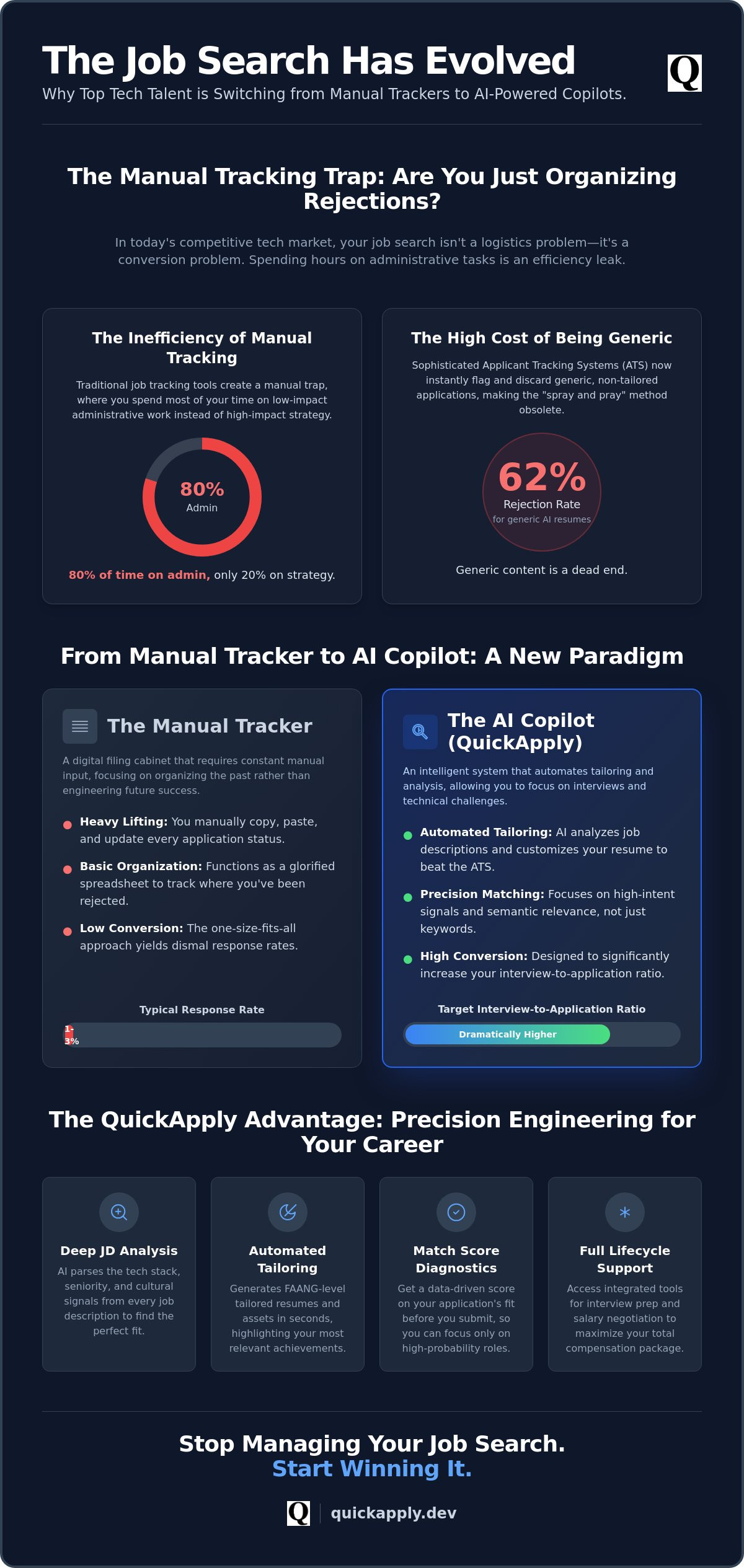
Teal is essentially a glorified spreadsheet with a browser extension. It asks you to do the heavy lifting. You copy, you paste, you manually update statuses, and you type out your own tailoring. This creates a manual tracking trap where you spend 80% of your time on administration and only 20% on actual strategy. Tech professionals are burning out because they're managing a pipeline of generic applications that never stand a chance. QuickApply flips this script. Instead of requiring you to type every detail manually, it automates the data extraction and tailoring process. You don't need a prettier way to organize your rejections; you need a way to stop getting them.
The 2026 Tech Hiring Landscape
The market has evolved. Recruiters now use sophisticated applicant tracking system (ATS) software that detects generic, AI-generated fluff instantly. They aren't looking for a list of keywords anymore. They're looking for high-intent signals that prove you've analyzed their specific tech stack and culture. Every job description is a unique puzzle of requirements, seniority levels, and specific pain points. If your resume is static, it's dead on arrival. Precision AI is the new standard. This means moving beyond basic trackers to a teal alternative that builds a custom narrative for every single role. Software engineers need a tool built for their ecosystem, prioritizing technical accuracy and speed over basic organizational features.
A tracker tells you that you have a deadline. A Career Copilot meets the deadline for you. It analyzes the role, scores your match, and generates the tailored assets in seconds. It's the difference between a project manager who just asks for updates and a lead engineer who actually ships the code. If you value your time, you can't afford to stay stuck in a manual workflow.
Beyond Basic Tracking: The 2026 Logic of Precision AI Tailoring
Static profiles are a relic. In 2026, sending the same resume to five different startups is a waste of bandwidth. Every job description is a distinct narrative that requires a precise response. If you're looking for a teal alternative, you're likely tired of the generic "one-size-fits-all" approach that yields a dismal 1-3% response rate. You need a system that parses tech stacks, company culture, and seniority levels before you even draft a bullet point. Precision is the difference between an automated rejection and a technical screen.
The AI in the recruitment process has evolved beyond simple keyword matching. Modern systems look for semantic relevance. They analyze how your past projects solve their current problems. QuickApply’s Match Score technology gives you a diagnostic look at your application before you hit submit. It isn't just about "having the skills"; it's about proving you've already done the work they need. This data-driven triage allows you to focus your energy on roles where you have a statistical advantage.
Semantic Tailoring vs. Keyword Stuffing
Keyword stuffing is a 2010 strategy. In 2026, hiring managers and advanced filters look for project impact. Semantic tailoring is the 2026 tech standard where AI understands the context of your achievements rather than just scanning for buzzwords. QuickApply transforms generic bullet points into quantified, high-impact achievements. It maps your experience with Go or Kubernetes directly to the specific infrastructure challenges mentioned in the job description. You can optimize your resume in seconds to ensure your narrative aligns with their technical requirements. This level of granular detail is what sets a true teal alternative apart from basic job trackers.
Automated Cover Letters That Get Read
Most AI-generated cover letters look like bot spam. They're dry, repetitive, and obviously fake. This is a major reason why 62% of hiring managers now reject applications with generic AI text. High-quality AI cover letter generation focuses on building a bridge between your history and the company's future. Whether you're a Software Engineer, PM, or Data Scientist, your cover letter must structure a narrative that proves cultural and technical fit. It shouldn't just repeat your resume; it should explain why your specific background makes you the best solution for their problem. This level of precision is why users are moving to this platform to secure callbacks within 7 days. Stop managing rejections and start engineering your next career move.
QuickApply vs. Teal: Comparing the Full-Stack Career Copilot
Choosing between platforms often comes down to one question: do you want to manage your job search or finish it? Teal excels at organization. It provides a structured view of your pipeline. However, it functions as a passive repository. It requires you to manually input data and draft your own content. For tech pros who value their time, a teal alternative must do more than just watch the clock. It must actively participate in the application lifecycle. QuickApply is designed as a full-stack copilot that handles the heavy lifting from the first click to the final signature.
The gap between these tools becomes obvious once you hit "submit." Most trackers stop at the application stage. They leave you to navigate the high-stakes interview process alone. This is where users find the most value in the best AI resume builder for engineers and PMs. It doesn't just build a document; it builds a strategy. By automating the tailoring process, you eliminate the friction of manual entry. You trade a high weekly subscription fee for a system that delivers measurable ROI through higher conversion rates and faster offer cycles.
Integrated Tracking vs. Manual Input
Manual data entry is a productivity killer. Teal requires constant updates to keep your board accurate. QuickApply integrates a sophisticated job application tracker that streamlines your workflow. It centralizes your career data and automates status updates. You no longer need to jump between tabs or manually type out job details. The system handles administrative burdens. This allows you to focus on high-impact activities like networking and technical upskilling. It's a cleaner, faster path to your next role.
Interview Prep: The Final Barrier
Getting the interview is only half the battle. Many Teal users find themselves stalling at the live stage. They have an organized tracker but no preparation for the technical screen. QuickApply bridges this "Post-Submit" gap with integrated interview practice. The AI simulates technical and behavioral interviews tailored to the specific job description you applied for. You get real-time feedback on your technical accuracy and delivery. This preparation ensures you don't just land the interview; you close the offer. While basic trackers focus on the quantity of applications, this teal alternative focuses on the quality of your performance. Stop tracking your progress and start accelerating it.
How to Optimize Your Tech Job Search Stack for Maximum ROI
Stop using a fragmented toolkit. Many professionals waste hours jumping between a tracker, a generic AI writer, and a spreadsheet. This data fragmentation leads to inconsistent narratives and missed follow-ups. A high-performance teal alternative functions as a unified command center. It eliminates the friction of context switching. By centralizing your career data into one AI-powered hub, you ensure that every application, cover letter, and interview response is pulled from a single source of truth. This is the only way to maintain quality while increasing your output volume.
Audit your history before you apply. Use Match Scores to analyze how your current resume stacks up against specific job descriptions. If your score is low, don't just hope for the best. You must tailor your resume to a job description using semantic AI that understands the underlying architecture of your tech stack. This isn't about moving keywords around. It's about reconfiguring your experience to match the exact seniority and technical requirements of the role. Once the application is out, bridge the gap with automated interview simulations. Preparing for specific technical hurdles before they happen is the difference between a rejection and an offer.
Integrating AI into Your Daily Workflow
Efficiency requires a repeatable system. Set daily application goals that focus on high-match roles to avoid burnout. Use your integrated tracker to identify exactly where your funnel is leaking. If you have a high application rate but low callbacks, your tailoring needs adjustment. If you're stalling after the first round, your interview prep is the bottleneck. Promotion roadmaps plan your next move by mapping out the skills and milestones needed to climb from senior engineer to principal or lead roles. This long-term visibility keeps you focused on growth rather than just the next paycheck.
Mastering the Art of the Follow-Up
The "Apply" button is just the beginning. Most candidates disappear after the initial submission. You can stand out by drafting personalized follow-up emails that reference specific project requirements mentioned in the JD. Timing is everything. Use real-time status data to trigger your outreach when it's most likely to be seen by a hiring manager. Transition from a candidate to a high-value hire by utilizing built-in negotiation tools. These guides provide the data you need to secure a compensation package that reflects your true market value. Stop leaving money on the table. Start optimizing your career stack today to ensure you're getting the maximum ROI on every application you submit.
The Verdict: Why QuickApply is the Ultimate Teal Alternative for Engineers
Professional grade career management requires SaaS level security. Your career data, resume history, and salary goals are sensitive assets. QuickApply prioritizes data privacy and security, ensuring your professional narrative remains protected while you navigate the market. This isn't a side project or a simple browser hack. It's a robust platform designed for the high-stakes tech landscape. Whether you're targeting a legacy FAANG giant or a high-growth unicorn, your data remains secure while the AI works to position you as the top 1% candidate.
A Tool Built by Tech Professionals
Nuance matters in technical hiring. GitHub portfolios, cloud certifications, and specific tech stacks aren't just bullet points. They're proof of impact. A tool built by tech professionals understands how to parse these technical signals for recruiters at top-tier firms. Precision is the non-negotiable standard for 2026 tech hiring. As the market shifts toward specialized roles, QuickApply evolves its JD analysis to ensure your experience is always positioned as the solution to a company's specific problem. It adapts to shifting demands, ensuring your application doesn't just meet the bar but sets it.
Ready to Upgrade Your Career Strategy?
The QuickApply advantage is built on three pillars: Tailoring, Tracking, and Training. You get the documents that get you noticed, the system that keeps you organized, and the interview practice that closes the deal. It's a full-lifecycle tool that stays with you from your first application to your first promotion. While a basic teal alternative might help you stay organized, QuickApply provides the promotion roadmap and salary negotiation guides needed to maximize your career earnings. It moves as fast as the technology it describes, giving you the momentum needed to secure a callback within 7 days.
Stop tracking rejections. Start engineering offers. You have the talent; now you need the system that translates that talent into opportunities. Explore the subscription tiers designed for active job seekers who want results rather than just a list of jobs. Experience the QuickApply difference today and secure your place in the 2026 tech ecosystem. It's time to stop managing your job search and start winning it.
Upgrade Your Career Pipeline Now
The job market in 2026 doesn't reward effort; it rewards results. You've seen why a passive tracker is a bottleneck in a high-speed tech ecosystem. By switching to a high-performance teal alternative, you reclaim your time and focus on the roles that actually matter. You're no longer just filing applications. You're engineering a path to your next offer using AI-powered Match Scores and an Integrated Interview Simulator. This shift from manual administration to automated precision is how you stay ahead of the curve.
Success isn't just about landing the next role. It's about maximizing your career trajectory. With Promotion and Salary Negotiation Roadmaps, you ensure your next move is a strategic leap, not just a lateral shift. Stop managing a list of rejections. Start optimizing your output for the conversion rates you deserve. You have the technical skills. Now, you have the system to prove it to the world's most innovative companies.
Stop wasting time on manual tracking-start tailoring with QuickApply today.
The next phase of your career is waiting. Take control of the system and start winning the high-stakes roles you were built for.
Frequently Asked Questions
Is QuickApply better than Teal for software engineers?
QuickApply is superior for software engineers because it focuses on technical precision rather than just administrative organization. While Teal functions as a passive tracker, QuickApply is an active document generator that understands complex tech stacks. It maps your specific engineering experience to job requirements in seconds, ensuring your technical narrative is optimized for high-stakes roles at FAANG or startups.
How does the AI tailor my resume without making it look like a bot wrote it?
The system leverages semantic JD analysis to create high-intent narratives that focus on quantified impact. It avoids the generic fluff and repetitive phrasing found in basic AI tools. By mapping your actual project achievements to the specific problems a company needs to solve, it produces a resume that feels human-centric and technically authoritative. This approach prevents your application from being flagged by modern detection systems.
Can QuickApply help me beat the latest 2026 ATS filters?
Yes, it's designed to navigate the semantic logic of 2026 recruitment software. Since 62% of hiring managers now reject resumes with generic AI text, this teal alternative prioritizes quality and relevance. It ensures your resume contains the specific technical signals and context that modern systems require to rank you as a top-tier candidate. You move past the filters and directly into the interview pool.
Does QuickApply include a job application tracker like Teal?
Yes, QuickApply features a built-in Application Tracker that automates your pipeline management. You don't have to manually update your status or type in job details. The tracker centralizes your data and provides a clear view of your search progress. It combines the organizational benefits of a board with the power of automated document tailoring, eliminating the need for multiple fragmented tools.
What makes QuickApply a better alternative to free Chrome extensions?
Free extensions are usually limited to simple data scraping and basic keyword matching. QuickApply provides a full-stack career lifecycle including Cover Letter Generation, Interview Practice, and a Salary Negotiation Guide. It's a professional SaaS platform built for users who need a competitive advantage in a crowded market. You get a unified system that handles everything from the initial application to the final offer signature.
How does the interview practice feature work?
The Interview Practice tool uses AI to simulate technical and behavioral interview rounds specific to the job you're targeting. It analyzes the job description to generate relevant questions and provides real-time feedback on your answers. This allows you to refine your technical explanations and communication style before you meet the hiring team. It's the final step in converting an application into a signed offer.
Does the platform offer salary negotiation guides for tech roles?
Yes, the platform includes a comprehensive Salary Negotiation Guide and a Promotion Roadmap. These tools provide the data and strategies you need to secure a compensation package that reflects your true market value. It doesn't just help you get hired; it helps you maximize your earnings and plan your next career leap. You'll have the confidence to negotiate from a position of technical strength.
Is there a student discount for QuickApply in 2026?
Current 2026 offers include a 50% discount on 6-month plans for job seekers affected by layoffs. You can also start with a 3-day free trial to experience the full feature set without a credit card. These options make the teal alternative accessible for those transitioning into the tech industry or looking to accelerate their early career growth. Check the official pricing page for any seasonal student-specific promotions.


