

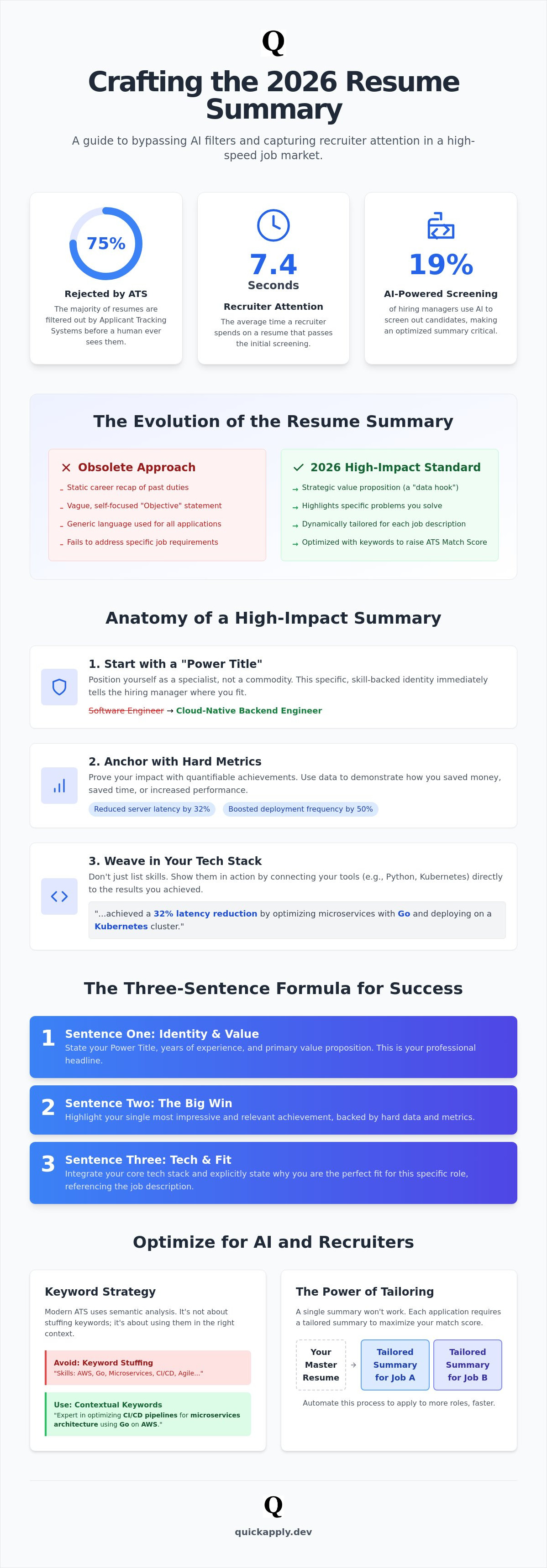
75% of resumes are rejected by an ATS before a human ever sees them, and those that survive only get 7.4 seconds of a recruiter's attention. In a 2026 market where 19% of hiring managers use AI to screen you out, you need a professional summary for resume examples that functions as a high-speed data hook. You're likely exhausted from being ghosted by algorithms or struggling to compress a decade of technical expertise into three punchy lines. It’s frustrating to feel like your best work is invisible to the systems meant to find it.
This guide changes that. We've mastered the art of the modern hook to provide examples that bypass automated filters and demand attention. You'll learn how to leverage AI-optimized phrasing to increase your match score and gain a distinct competitive advantage. We'll break down the exact formulas that align with 2026 standards and provide adaptable templates for your specific role. Stop wasting time on static summaries that don't convert. It's time to optimize your entry point and secure the interviews you deserve.
Key Takeaways
- Transform your summary from a passive career recap into a strategic value proposition designed for 2026 algorithm-first screening.
- Utilize role-specific professional summary for resume examples to ensure your technical expertise is visible to both AI filters and human recruiters.
- Implement "Power Titles" and hard metrics to immediately boost your match score and prove your professional impact.
- Master the 5-step manual tailoring process to pivot your summary for every application using a master resume framework.
- Discover how QuickApply’s AI automates the tailoring process, generating optimized hooks in seconds to maximize your application volume.
Why the Static Professional Summary is Obsolete in 2026
Your resume is a data packet, not a diary. If you're still using a static professional summary for resume examples, you're already behind. In 2026, recruiters spend an average of just 7.4 seconds scanning your file. If the first three lines don't scream "solution," your application is deleted. A modern summary is a strategic value proposition. It's a high-impact data hook designed to sync with specific job requirements. While a standard Résumé overview highlights the summary as a foundational section, its role has shifted from a career recap to a focused sales pitch. It's the prime real estate where you prove your ROI before the reader even scrolls.
Generic summaries are a liability in high-volume tech markets. When 71% of hiring managers use an ATS, and nearly 98% of Fortune 500 companies rely on them, your summary must be dynamic. A static recap of your last ten years won't trigger the Match Score needed to reach a human. You need a hook that pivots with every job description. This isn't about being dishonest. It's about being relevant. Every word in your summary must justify its existence by directly addressing a pain point mentioned in the job post.
Summary vs. Objective: The Final Verdict
Objectives are dead weight in 2026. They're selfish and outdated. Stating "I want a role where I can grow" tells a company nothing about your ability to ship code or scale infrastructure. Tech leaders want to know what you can do for them immediately. Unless you're a career changer or a fresh grad needing to explain a radical pivot, ditch the objective. Focus on your skill-backed identity. Shift the narrative from what you want to the specific problems you solve.
This shift toward a value-driven identity is a principle that applies to all forms of high-stakes matching. Just as you define your professional ROI, the experts at Dating Explained help individuals clarify their personal value proposition through professional matchmaking and relationship coaching.
The Role of AI in Resume Screening
Modern ATS platforms use semantic analysis to understand the context of your skills. They don't just look for keywords; they look for how those keywords interact within your summary. Since 19% of hiring managers now use AI to screen out applicants before a human review, your summary is the primary filter. It's the first section an AI parses to determine relevance. If your summary doesn't align with the job’s core tech stack, your Match Score will tank. High-volume hiring requires high-speed optimization. Your summary is the bridge between your talent and the opportunity, but only if it's tuned to the right frequency. This focus on algorithmic discovery is also critical for businesses; to see how similar AI-driven search and PR strategies are used to maintain organizational visibility, you can visit GR8MINDS.
The Anatomy of a High-Impact Professional Summary
Stop being generic. It's killing your conversion rate. A high-impact professional summary for resume examples in 2026 isn't a list of duties; it's a calculated architecture of your professional identity. It starts with a "Power Title." Don't just call yourself a "Software Engineer." That’s a commodity. Instead, identify as a "Cloud-Native Backend Engineer" or a "Scalable Systems Architect." This specific, skill-backed identity immediately tells the hiring manager where you fit in their ecosystem. It’s about positioning yourself as the exact solution to a high-priority problem.
Every effective summary needs at least one hard metric. If you didn't save money, save time, or increase performance, you didn't do the job. Use quantifiable achievements like "reduced server latency by 32%" or "boosted deployment frequency by 50%." For a clear look at how to structure these technical wins, consult this Technical Resume Sample. It demonstrates how to anchor your narrative in data rather than fluff. Weave your tech stack naturally into this narrative. Instead of a separate list, mention how you used Python and Kubernetes to drive those results. This shows your tools in action, proving you don't just know the syntax; you know the application.
The Three-Sentence Formula for Success
Efficiency is key. Use this rigid structure to maximize impact. Sentence one defines your identity, years of experience, and your primary value proposition. Sentence two highlights your biggest win with hard data. Sentence three integrates your core tech stack and explains why you're the right fit for this specific role. This formula ensures you cover every base without wasting a single character. If you're struggling to hit the right notes, getting a real-time match score can help you refine these three lines for maximum algorithmic impact.
Keywords: The Currency of the 2026 Job Market
Keywords are the signals that bridge the gap between you and the recruiter. You must distinguish between "Hard Skills" like AWS or Go and "Contextual Keywords" like Microservices Architecture or CI/CD Pipeline Optimization. Modern systems look for both. Avoid keyword stuffing at all costs. It's easy to spot and hurts your credibility. Instead, focus on high-value keywords that appear frequently in the job description. Mirror the exact phrasing used by the employer. If they ask for "Agile Project Management," don't write "Scrum Leadership." Precision is the only way to ensure your summary passes the initial AI gatekeeper.
Professional Summary Examples for Tech Roles
Generic templates are dead weight. In 2026, your summary must reflect a specialized tech niche to survive the 7.4-second scan. High-performing professional summary for resume examples prioritize specific tech stacks and hard ROI. Whether you're a senior architect or a career changer, your hook needs to be sharp, data-driven, and algorithmically relevant. Don't waste space on "passionate" or "motivated." Focus on what you've built and the systems you've optimized. Your summary is the entry point to your technical ecosystem. Make it count.
Software Engineering and DevOps Examples
Senior Full-Stack Developer: Scalable systems architect with 8+ years of experience specializing in React and Node.js. Optimized legacy codebases to improve frontend performance by 40% and reduced server-side latency by 25% for a high-traffic e-commerce platform. Proven track record of leading distributed teams to ship microservices-based solutions in fast-paced environments.
DevOps Engineer: Infrastructure specialist focused on AWS cloud migration and CI/CD automation. Orchestrated a full-scale migration from on-prem to cloud, maintaining 99.9% uptime during the transition. Reduced deployment cycles from bi-weekly to daily by implementing robust Kubernetes clusters and Terraform-led automation. These examples work because they blend technical authority with verifiable metrics. They give the ATS the keywords it craves while giving humans the proof they need to move you to the next stage.
Data Science and Product Management Examples
Data Scientist: ROI-focused machine learning expert proficient in Python, SQL, and TensorFlow. Developed a predictive churn model that increased customer retention by 18% and saved $1.2M in annual revenue. Skilled in translating complex data sets into actionable business intelligence for executive stakeholders.
Product Manager: "0 to 1" product leader with a focus on user growth and cross-functional synergy. Launched a mobile-first fintech application that reached 500k active users within six months. Leveraged A/B testing and data-driven roadmapping to increase conversion rates by 22%. Integrating these summaries with good resume examples ensures your entire document maintains this high-octane momentum. Consistency across your resume sections reinforces your value proposition.
Remote-First and Career Changer Variations: For distributed teams, emphasize "async communication" and "distributed system management" tools like Slack, Jira, and GitLab. If you're pivoting into tech, focus on technical logic. A former project manager might lead with: "Technical-minded strategist pivoting to Software Engineering, leveraging 5 years of Agile leadership and a recent full-stack certification to build scalable web applications." You aren't hiding your past. You're retooling it for a digital-first world. High-volume hiring requires high-speed clarity. Ensure your summary delivers both instantly.
How to Tailor Your Summary for ATS and Match Scores
Manual tailoring is a grind. If you follow common advice on platforms like Reddit, you'll spend 30 minutes on every application just to survive the initial filter. In a high-volume market, that’s an efficiency disaster. You need a systemic approach to ensure your professional summary for resume examples hits the mark every time. The process starts with a "Master Resume." This is your comprehensive data repository containing every technical win, metric, and tool you've mastered. Instead of writing from scratch, you pull specific components from this master file to build a targeted hook that addresses the employer's immediate needs.
Effective tailoring requires analyzing a job description for "latent intent." Don't just look at the list of tools. Look for the underlying problem. If a posting emphasizes "refactoring legacy code," the latent intent is technical debt management and system stability. Your summary must pivot to highlight your experience in those specific areas. By using the tailor resume to job description strategy, you align your narrative with the recruiter's specific pain points. This alignment creates instant rapport by proving you understand the challenges they face.
Identifying the "Hook" in a Job Description
The "Hook" is usually hidden in the first three bullet points of the "Responsibilities" section. These are the company’s highest priorities. If they mention "scaling microservices for 1M+ users," that is your lead. Mirror the company’s own language exactly. If they use the term "distributed systems" instead of "cloud architecture," use their terminology. This isn't just for the humans; it’s for the ATS algorithms that prioritize exact-match semantic strings.
The Match Score Benchmark
In 2026, a 90% match score is the new baseline for tech interviews. Anything lower risks being filtered out by the 19% of hiring managers using AI to prune applications before human review. You must iterate on your summary until it reaches this threshold. This doesn't mean lying. It means highlighting the most relevant 10% of your experience that matches 100% of their needs. If your score is low, swap generic phrases for the specific "Contextual Keywords" identified in the JD. To reach this benchmark without the manual headache, use QuickApply’s automated tailoring to optimize your summary in seconds.
Automating Your Career Hook with QuickApply
Manual tailoring is a bottleneck that restricts your career growth. If you spend 30 minutes tweaking every professional summary for resume examples, you're losing the volume game. QuickApply’s AI eliminates this friction by generating tailored summaries in seconds. The system doesn't just swap keywords; it analyzes the latent intent of the job description and builds a high-impact hook that mirrors the recruiter's specific requirements. This isn't just about speed. It's about precision. The AI ensures every sentence serves a purpose, driving your Match Score toward the 90% benchmark necessary to clear 2026 algorithmic filters.
Real-time optimization is the core of this system. Instead of guessing whether your tech stack alignment is strong enough, you get immediate feedback. The integrated Match Score dictates the contents of your summary, highlighting the most relevant 10% of your experience to ensure a 100% fit for the role. This systemic approach allows you to iterate on your professional identity instantly, ensuring you always present the most efficient version of your career to every unique employer. You stop wasting time on generic phrasing and start delivering data-driven value propositions that demand attention.
Stop Building, Start Tailoring
Efficiency is the only competitive advantage that scales in a high-volume tech market. QuickApply allows you to manage dozens of resume versions without the logistical nightmare of manual file management. Use the centralized dashboard to maintain a bird’s-eye view of your entire search. You can track which summary variations are converting into interviews and adjust your strategy based on real-world performance data. By reducing your time-to-apply, you increase your application frequency without sacrificing quality. This high-volume output with low-effort input is the bridge between your talent and your next opportunity.
Beyond the Summary: The Full Suite
A great summary is just the entry point for a successful application for job strategy. QuickApply connects your optimized career hook to an AI-generated cover letter that maintains the same narrative momentum. Once your resume clears the initial AI gatekeeper, our platform helps you prepare for the next phase with interview practice tools and salary negotiation guides. We provide the full suite of technology needed to move from applicant to hire with zero wasted motion. Optimize your resume summary with QuickApply today.
Execute Your 2026 Job Search Strategy
The days of the static career recap are over. To win in 2026, you must treat your resume as a high-performance data packet. You've learned how to transform a basic professional summary for resume examples into a high-octane hook that triggers AI algorithms and stops recruiters in their tracks. Precision is your only currency. By focusing on Power Titles, hard metrics, and semantic alignment, you move from being another applicant to being the obvious solution. Every character on the page must justify its existence by proving your immediate ROI.
Efficiency shouldn't be a manual grind. Don't waste hours on minor tweaks when you can optimize your entire application in seconds. Trusted by tech professionals at FAANG, our system uses AI-powered Match Score technology to ensure your summary is perfect every time. Stop guessing and start converting. Tailor resumes in less than five seconds and take control of your professional trajectory. Start Tailoring Your Resume for Free and secure your place in the modern tech landscape. You have the talent; it's time to make it visible.
Frequently Asked Questions
How long should a professional summary be in 2026?
A professional summary should be three to five sentences long. In a market where recruiters spend an average of 7.4 seconds on a resume scan, you must deliver your value proposition instantly. Aim for 50 to 100 words. This length provides enough space for the ATS to parse your core tech stack without overwhelming a human reader with unnecessary fluff.
Should I use bullet points or a paragraph for my resume summary?
Use a paragraph format to maintain a cohesive narrative and semantic flow. While bullet points are effective for the experience section, a paragraph allows modern algorithms to understand the context of your skills. It creates a stronger "hook" that frames your professional identity. You can still bold critical metrics or tools within the text to ensure they pop during a quick human review.
Do I need a professional summary if I am an entry-level candidate?
Entry-level candidates need a summary to frame their potential and technical logic. It’s your chance to define your identity as a "Junior Frontend Developer" or "Associate Data Analyst" before the recruiter sees your limited work history. Use this space to highlight high-impact projects, certifications, or internships. It proves you have the specific skills required to contribute to the team on day one.
How many keywords should I include in my resume summary?
Aim for three to five high-value keywords per summary. Don't fall into the trap of keyword stuffing; modern screening systems use semantic analysis to spot unnatural phrasing. Focus on the primary tech stack and contextual keywords found in the job description. By reviewing a professional summary for resume examples, you’ll see that the most effective versions prioritize precision over volume to maintain authority.
Can I use AI to write my professional summary?
You can and should use AI to generate your summary. Since 19% of hiring managers use AI to screen applications, using a tool like QuickApply to optimize your hook is a strategic necessity. It allows you to generate tailored versions in seconds that are tuned for a high Match Score. Always review the AI output to ensure it aligns with your actual technical achievements and specific career goals.
What is the difference between a resume summary and a LinkedIn headline?
A LinkedIn headline is a 220-character searchable tag designed for discovery, while a resume summary is a detailed value proposition. Your headline helps you appear in broad recruiter searches. Your resume summary is a targeted tool designed to solve a specific company's problem. While both should be consistent, your resume summary requires much deeper tailoring to match the specific requirements of a single job posting.
How often should I update my professional summary?
Update your summary for every single job application you submit. A static professional summary for resume examples is a liability that will tank your Match Score. Because every company has different pain points, your hook must pivot to address their specific needs. Use a master resume as your foundation and then customize the first three lines to mirror the exact language used in the job description.
Will a professional summary help me get past the ATS?
A professional summary is a critical component for bypassing the ATS. It’s often the first section the algorithm parses to determine your relevance to the role. By including the exact keywords and metrics the system is looking for, you significantly increase your Match Score. This ensures your application survives the automated filter and reaches a human hiring manager for a detailed review.


