

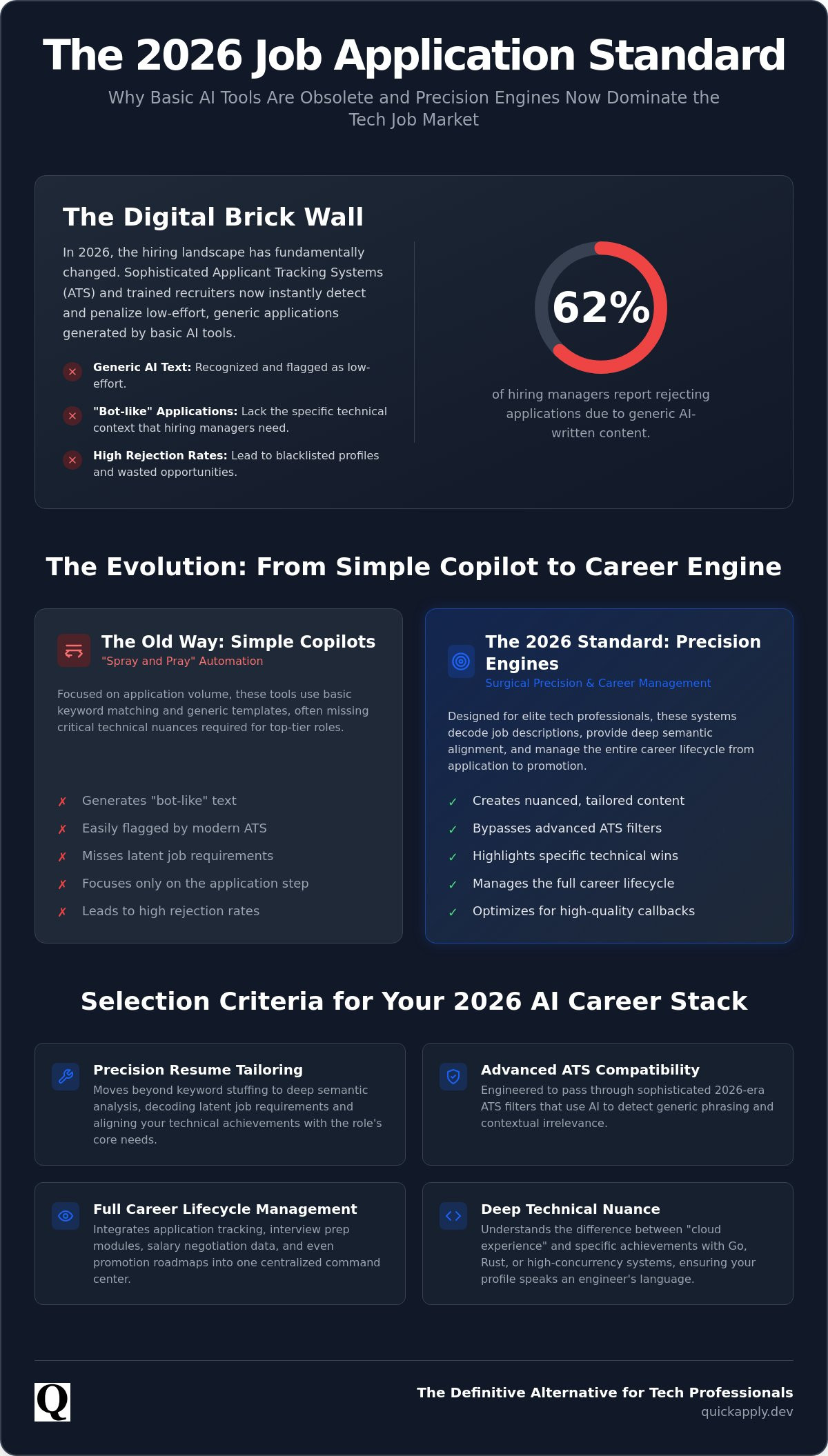
62% of hiring managers now report detecting and rejecting generic AI-written text in job applications. If you're still using basic auto-fillers, you're likely hitting a digital brick wall. Finding a high-performance jobright ai alternative isn't just about speed anymore; it's about surgical precision. Tech professionals in 2026 need more than a simple copilot. They need a system that understands the nuances of technical roles while navigating the strict new AI transparency laws in regions like Ontario and Illinois.
You're likely exhausted from sending out dozens of applications only to be met with automated silence. It's a waste of your engineering talent to spend hours on low-match postings. This article promises to reveal why tech-savvy seekers are ditching "spray and pray" tactics for high-precision career engines that deliver actual results. We'll explore the tools that automate your tracking, tailor your resume for FAANG-level scrutiny, and manage your full career lifecycle from the first application to the final salary negotiation.
Key Takeaways
- Move beyond basic job matching. Identify why simple AI copilots fail under the scrutiny of 2026 hiring standards and regulatory shifts.
- Upgrade to Precision Tailoring. Learn how modern engines decode latent job requirements to bypass advanced ATS filters and high-risk AI detection.
- Evaluate the definitive jobright ai alternative. Compare technical resume depth and cross-platform automation designed for high-level engineering roles.
- Secure your career stack. Discover how to integrate with complex career portals and maintain technical nuance across your entire professional portfolio.
- Shift from search to management. Use high-precision automation to handle everything from application tracking to promotion roadmaps.
Why Job Seekers are Moving Beyond Jobright AI in 2026
The job market in 2026 doesn't reward volume. It rewards precision. While early tools like Jobright AI focused on the "swipe right" mechanics of job matching, that novelty has worn off. Software engineers and DevOps leads are hitting a wall. They're finding that basic copilots often hallucinate technical proficiencies or generate generic summaries that look identical to every other applicant in the stack. This is why a dedicated jobright ai alternative is no longer a luxury; it's a necessity for anyone targeting high-growth tech roles.
One-size-fits-all automation is dead. Recruiters have adapted to the influx of AI-generated noise. If your resume uses the same "dynamic leader" phrasing as five hundred other candidates, you're filtered out before a human even sees your GitHub link. You need a system that manages the full career lifecycle. Simply finding a job isn't enough. You have to win the interview, navigate the salary negotiation, and plan your next promotion. Relying on basic matching algorithms is a recipe for stagnation in a market that demands technical excellence.
The 'Bot-Like' Application Trap
Recruiters in 2026 use sophisticated detection tools to spot low-effort automation instantly. When you use a basic builder, you often end up with a cover letter that lacks specific technical context. It might mention "cloud experience" but fail to connect your specific Rust implementation to the company's current infrastructure needs. This generic approach damages your personal brand. It signals that you aren't willing to do the work. Understanding the evolution of AI in the hiring process reveals that transparency and quality now outweigh sheer application numbers. High-volume, low-quality bursts lead to high rejection rates and blacklisted profiles. 62% of hiring managers now report rejecting generic AI-written text on sight.
Moving from Search Copilots to Career Engines
A copilot helps you navigate, but an engine drives you to the destination. The best jobright ai alternative focuses on the "post-apply" phase. QuickApply functions as a precision engine rather than a simple search tool. It doesn't just provide a match score. It provides the infrastructure to win the role. This includes integrated interview practice and salary negotiation guides based on real-time market data. You aren't just looking for a vacancy; you're optimizing for a career upgrade.
The 2026 Standard: Precision Tailoring vs. Simple Automation
Simple automation is a relic of the past. In 2026, the gap between a "search copilot" and a "career engine" has widened into a canyon. While early tools focused on the volume of applications, the current market demands surgical precision. This is where a dedicated jobright ai alternative proves its worth. Precision tailoring isn't just about swapping out a few keywords to please a basic algorithm. It's the technical evolution of the AI resume, moving from superficial matching to deep semantic alignment.
The mechanism is complex but the result is simple. Modern AI analyzes job descriptions to uncover latent requirements. It understands that when a lead dev role asks for "experience with high-concurrency systems," it's actually looking for your specific wins in Go or Erlang. It doesn't just look for the words; it looks for the proof. Jobright takes a broad, generalist approach that often misses these technical nuances. QuickApply is designed to decode these signals, ensuring your profile speaks the same language as the engineering manager reviewing it. You can optimize your entire search process by switching to a tool that treats resume tailoring as a data science problem rather than a formatting task.
According to Gartner's research on 2026 talent acquisition trends, the AI revolution is forcing recruiters to adopt even more sophisticated screening layers. If your tool isn't evolving as fast as the ATS, you're invisible.
How Modern ATS Detects Low-Effort AI
Keyword stuffing is officially dead. 2026 ATS software utilizes advanced semantic analysis to flag applications that lack genuine context. It looks for achievement-mapping, not just a list of nouns. AI resume tailoring is the strategic alignment of career history to specific job requirements. If your resume reads like a generic template, it's discarded instantly. You need context-aware achievements that link your past performance to the company's future goals. This high-fidelity approach ensures you bypass the "bot-speak" filters that catch low-effort automated applications.
The Role of Technical Match Scores
Time is your most limited resource. Stop wasting it on low-match postings that lead to automated rejections. QuickApply uses AI-powered match scores specifically tuned for tech roles to prioritize your efforts. It identifies the highest-probability opportunities by calculating the technical overlap between your stack and the job's infrastructure. This allows you to focus your energy on roles where you have a competitive advantage. For a complete breakdown of this strategy, read our How to Tailor Resume to Job Description with AI: The 2026 Efficiency Guide. High match scores lead to high interview rates. It's that simple.
QuickApply vs. Jobright AI: A Technical Comparison
Choosing the right jobright ai alternative requires looking past the user interface. While Jobright functions primarily as a discovery tool, tech professionals need a platform that handles the heavy lifting of technical articulation. The difference lies in the fidelity of the output. Jobright often acts as a matching wrapper, surfacing roles and providing basic auto-fill capabilities. QuickApply operates as a career engine, prioritizing the depth of technical tailoring required to survive a 2026 engineering screen.
Speed is a vanity metric if the output is generic. You can generate a hundred applications in minutes, but if they lack the specific nuance of your Rust or Kubernetes expertise, your response rate will stay at zero. QuickApply focuses on high-fidelity output. It doesn't just match your profile to a job description; it synchronizes your achievement bullets with the specific architectural challenges mentioned in the posting. This ensures your technical authority remains intact across every version of your resume.
Resume Tailoring vs. Simple Job Matching
Matching tells you a job exists. Tailoring ensures you get the interview. QuickApply goes beyond simple keyword insertion by rewriting bullet points to reflect specific tech stacks and methodologies. If a role emphasizes CI/CD pipeline optimization, the engine reframes your background to highlight those exact wins. This level of precision is essential for active seekers who need to maintain unlimited resume versions without losing technical accuracy. For a deeper look at the market, check out The 6 Best AI Resume Builders of 2026: Stop Building, Start Tailoring. High-volume search requires a command center that syncs across platforms, keeping your application tracker updated in real time.
Beyond the Application: Interview Practice and Growth
Most tools abandon you the moment you click "submit." Jobright focuses on the search, but QuickApply manages the full career lifecycle. Success in 2026 requires more than just an application; it requires a strategy for the "post-apply" phase. This is why integrated interview practice tools are mandatory for the modern stack. You need to simulate technical screenings before the high-stakes call.
Selection Criteria for Your 2026 AI Career Stack
Efficiency is the only metric that matters when your career is on the line. Choosing a jobright ai alternative requires a technical checklist that goes beyond simple job boards. You need a tool that functions as a surgical instrument, not a blunt object. If your current stack doesn't prioritize technical vocabulary, portal integration, and data security, you're operating with a significant handicap. High-level engineering roles demand a tool that understands the nuance between a React hook and a standard function, or the specific architectural implications of Rust versus C++. If the AI can't speak your language, it can't sell your talent.
Versatility is non-negotiable. A fragmented search process is a slow search process. Your chosen engine must centralize resume tailoring, cover letter generation, and interview practice in a single command center. Managing multiple subscriptions for disparate features is a productivity drain. You need a unified system that handles everything from the initial match score to the final salary negotiation guide. This holistic approach ensures your professional narrative remains consistent across every touchpoint of the hiring process.
Overcoming the 'Login Wall' Challenge
Most basic automation tools fail the moment they encounter a company-specific portal. Workday, Greenhouse, and Lever have implemented sophisticated "bot-blocks" to filter out low-quality automated submissions. A high-performance jobright ai alternative must navigate these login walls without triggering security flags. QuickApply manages this through a robust Application Tracker that keeps your search organized even when facing complex portal requirements. For a deeper dive into navigating these hurdles, see our guide on Mastering the Job Application Process: A Comprehensive How-To Guide. Staying organized is the difference between a tracked lead and a lost opportunity.
Data-Driven Re-strategizing
Data is your best ally. A centralized "Career Growth Hub" allows you to treat your job search like a sprint. You should be using your application tracking data to identify which resume versions are triggering the highest callback rates. If you haven't received an interview request in 15 days, it's time to pivot. Use the match scores to analyze whether you're targeting the right seniority level or if your technical keywords need recalibration. This continuous feedback loop allows for rapid re-strategizing, ensuring you don't waste weeks on a failing tactic. Your search should evolve as fast as the market does. Build your 2026 career stack with QuickApply and stop guessing about your application performance.
Why QuickApply is the Definitive Alternative for Tech Pros
The transition from manual labor to AI-driven precision is the most significant upgrade you can make to your professional life. QuickApply is the definitive jobright ai alternative for engineers who demand high-fidelity results. This shift isn't just about saving hours. It's about data-driven dominance. While manual efforts often lead to high rejection rates, high-precision engines fundamentally change the outcome. You stop guessing and start executing. Every second spent on manual resume tailoring is a second lost to a competitor who has already automated their path to the interview.
This platform's unapologetic focus on optimization resonates with those who build complex systems for a living. You wouldn't write production code without a robust IDE; don't search for jobs without a career engine. The Salary Negotiation Guide acts as a direct ROI booster for your efforts. It provides the specific scripts and real-time data points needed to secure the top end of a pay band. This isn't just a search tool. It's a financial instrument designed to maximize your market value through systemic efficiency.
Setting Up Your Automated Career Hub
Import your professional profile and start tailoring for elite tech roles in minutes. This process is streamlined to eliminate all unnecessary friction. Once your data is in the system, the Application Tracker becomes your command center. It monitors every interaction and status update, ensuring no follow-up is ever missed. High-volume searching requires this level of organization to prevent mental burnout. You can also utilize the AI Cover Letter Generator to maintain deep technical context without the manual grind. Efficiency isn't just a feature; it's the core architecture of your new search strategy.
Executing the Promotion Roadmap
Landing the initial offer is only the first sprint in your professional journey. QuickApply ensures continuous growth once you've joined the team. The Promotion Roadmap helps you track your achievements and prepare for high-stakes quarterly reviews from day one. It turns your career into a managed project with clear milestones and measurable deliverables. Long-term success in 2026 requires this level of strategic planning and automated tracking. Join the ranks of tech professionals who value their time and expect their tools to perform at an elite level. Stop applying blindly and start executing a career strategy that wins.
Own Your Professional Trajectory
The 2026 job market doesn't reward those who work harder; it rewards those who work smarter. You've learned that precision tailoring and semantic achievement-mapping are the only ways to bypass advanced ATS filters and high-risk AI detection. Relying on basic matching tools is a liability in a landscape where generic applications are discarded instantly. High-performance professionals need tools that match their technical depth.
When selecting a jobright ai alternative, look for a precision engine that manages your entire professional trajectory. Success requires a command center that provides AI-powered match scores and automated resume and cover letter tailoring to ensure technical accuracy. Beyond the application, you need interview practice modules and salary negotiation guides to maximize your market value. These features turn a standard job search into a systematic career upgrade.
Start Tailoring Your Tech Career with QuickApply Today.
Stop settling for low-fidelity tools that treat your expertise like a commodity. Implement a high-performance career stack that scales with your ambition. You have the talent; now use the technology that ensures the world sees it. Your next level-up is just one optimized application away.
Frequently Asked Questions
Is QuickApply better than Jobright for software engineers?
QuickApply is superior for engineers because it prioritizes high-fidelity technical tailoring over simple job matching. While Jobright acts as a basic search copilot, QuickApply functions as a precision engine. It understands the subtle differences between specific tech stacks and reframes your achievements to match architectural requirements. This ensures your profile resonates with engineering managers who look for technical depth, not just generic keywords.
Does QuickApply help with ATS detection in 2026?
QuickApply bypasses 2026 ATS filters by utilizing advanced semantic analysis to align your career history with job requirements. Modern systems now flag generic AI text, but our engine maps your specific achievements to latent job needs. This high-fidelity approach ensures your application looks like a human-crafted masterpiece. It avoids the bot-like patterns that lead to instant rejection in automated screening layers.
Can QuickApply tailor resumes for FAANG companies?
QuickApply is specifically designed to handle the rigorous screening processes of FAANG and other Tier-1 tech firms. The engine analyzes complex job descriptions to identify the exact leadership and technical competencies these companies demand. By providing infinite resume versions, it allows you to optimize every bullet point for the specific engineering culture of each target company. It's the definitive jobright ai alternative for high-stakes career moves.
How does the application tracker differ from a standard spreadsheet?
The Application Tracker is an automated command center that syncs your search data in real time. Unlike a static spreadsheet, it tracks match scores, interview stages, and follow-up deadlines without manual input. It centralizes your entire pipeline, allowing you to re-strategize every 15 days based on actual response rates. This automation eliminates the administrative overhead that slows down traditional job searches.
Does QuickApply provide interview practice for technical rounds?
QuickApply includes dedicated Interview Practice modules to prepare you for high-pressure technical rounds. You can simulate screenings and refine your responses to common engineering and leadership questions. This ensures your performance during the live interview matches the high quality of your tailored resume. It's about maintaining technical authority from the initial application through the final round.
Is there a free trial for the Jobright alternative, QuickApply?
QuickApply offers a Free Plan that allows you to experience the core functionality of our precision engine. You can test the match scores and tailoring capabilities before committing to a paid tier. This low-risk entry point lets you see the efficiency gains firsthand. As a robust jobright ai alternative, it provides the flexibility to scale your tools as your search intensity increases.
How does QuickApply handle salary negotiation?
QuickApply provides a comprehensive Salary Negotiation Guide featuring data-driven scripts and market benchmarks. This resource helps you navigate the final stages of the hiring process with confidence. You'll learn how to leverage your technical match scores to justify higher compensation packages. It turns your technical expertise into measurable financial leverage during the offer stage.
Will recruiters know I used an AI job application tool?
Recruiters only flag low-quality, generic AI text that lacks technical context. QuickApply avoids this by using achievement-mapping to create resumes that read as if they were manually crafted by an expert. The engine focuses on technical nuance and specific wins, which mimics high-level human writing. By aligning your background with company goals, you provide the value recruiters want without the bot signature.


