

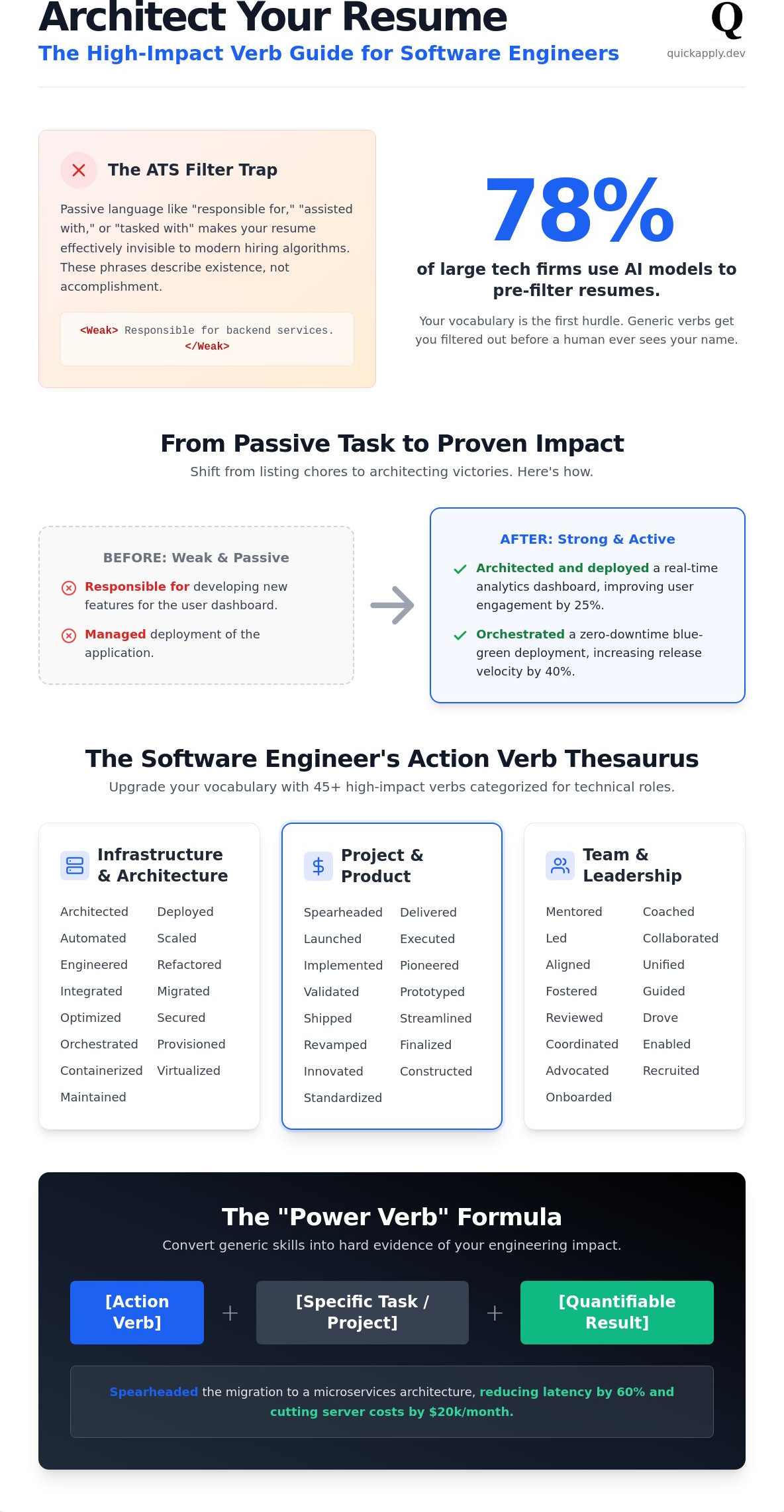
78% of large tech firms now use AI models to pre-filter resumes before a human recruiter even glances at them. If your career history is buried under passive language like "responsible for" or "assisted with," you're effectively invisible to the systems that matter. You know your code is solid and your architecture is sound, but your action verbs for software engineer resume are likely the bottleneck preventing you from reaching the interview stage. It's frustrating to watch inferior candidates land roles simply because they've optimized their vocabulary for the 2026 hiring landscape.
We're here to fix that. This guide gives you the exact technical lexicon needed to bypass semantic filters and demonstrate high-level ownership. You'll get a curated list of over 45 precision-engineered verbs that prove your impact, along with sophisticated synonyms for "organized" that highlight your systems-thinking. We'll show you how to replace weak, repetitive phrasing with high-impact words that drive your Match Score higher. It's time to stop listing tasks and start architecting a resume that commands attention.
Key Takeaways
- Eliminate passive language that triggers ATS filters by shifting from task-based descriptions to ownership-driven results.
- Upgrade your technical narrative with 45+ action verbs for software engineer resume specifically categorized by infrastructure, project, and team leadership roles.
- Master the "Power Verb" formula to convert generic soft skills into hard-skill evidence that proves your engineering impact.
- Strategically map your vocabulary across professional summaries and experience sections to maintain a high-energy rhythm and avoid repetitive phrasing.
- Leverage automated tools to instantly identify and deploy the exact technical verbs recruiters and semantic search algorithms prioritize in 2026.
The Science of Action Verbs: Why Passive Language Kills Tech Resumes
Recruiters in 2026 suffer from acute buzzword fatigue. They've seen "responsible for" and "organized" on a thousand generic templates. These phrases are dead weight. They describe a passive participant who merely existed within a department. To stand out in a hyper-competitive market, you need action verbs for software engineer resume that imply ownership and measurable execution. Your resume is a technical spec for your career. Treat it like one.
Action-Oriented Language is the bridge between raw technical skill and business value. Without this bridge, your expertise remains abstract and unproven. Passive language suggests a junior mindset. It implies you waited for tickets to be assigned and followed instructions without questioning the "why." Active language signals senior leadership. It demonstrates that you identified bottlenecks, proposed solutions, and drove projects to completion. High-impact verbs transform your bullet points from a list of chores into a record of professional victories.
When you lead with "Spearheaded" or "Architected," you aren't just saying you were present. You're claiming the result. This shift in vocabulary forces the recruiter to focus on the metric that follows. It's the difference between a resume that gets filed away and one that triggers an immediate interview request. Using strong verbs is the fastest way to build credibility before you even enter the room.
Semantic Search and the 2026 ATS Algorithm
Modern ATS platforms no longer just scan for isolated keywords. They use semantic search to identify contextual clusters. If you use the word "Architected," the algorithm expects to see mentions of scalability, microservices, or system design nearby. This helps AI models categorize your experience level instantly. Using a variety of high-impact verbs directly influences your resume match score by proving you understand the full scope of your role. It creates a narrative of competence that machines can parse and humans can respect.
The Risk of Generic Tech Vocabulary
Stop using "Developed." It's the most overused word in software engineering. It's vague and tells the recruiter nothing about your specific contribution. Did you write the code? Did you design the logic? Did you fix the bugs? For effective résumés, you must replace generic terms with verbs that signal familiarity with the Software Development Lifecycle (SDLC). Words like "Refactored," "Deployed," or "Automated" provide immediate technical context. Avoid the "Dictionary Trap" of choosing academic words that sound professional but feel out of place in a sprint planning meeting. Stick to functional, contemporary dialect that resonates with other engineers.
The Software Engineer’s Thesaurus: 45+ Synonyms for 'Organized' and 'Managed'
Generic verbs like "organized" or "managed" are too vague for a technical context. In 2026, engineering leads don't care if you keep a clean desk. They care if you can build a clean architecture. Systemic thinking is the priority. Your choice of action verbs for software engineer resume must reflect a deep understanding of how components interact at scale. Soft-skill adjectives are out. Hard-skill action verbs are in. If you're applying for a senior role, your vocabulary needs to signal that you don't just follow a process; you define it.
Describing complex software deployments requires precision. You aren't just "putting things in order." You're creating systems that endure. Using high-impact synonyms allows you to bypass the noise and speak directly to the technical requirements of the job. It's about moving from a junior mindset of task completion to a senior mindset of systemic optimization. Effective resumes don't just list responsibilities; they prove impact through specific, high-performance language. If you find yourself stuck in a loop of repetitive phrasing, you can automate your resume tailoring to ensure every bullet point hits the right technical note with zero manual effort.
The shift toward hard-skill verbs is essential for senior engineering candidates. When you say you "managed a deployment," you're being vague. When you say you "orchestrated a zero-downtime migration," you're providing a technical blueprint of your success. This level of specificity signals that you possess the high-level oversight required for complex, modern stacks. It moves the conversation from "what you did" to "how well you did it."
Systematization and Technical Architecture
When discussing backend systems or infrastructure, use verbs that imply structural integrity. These words show you understand how to build foundations that don't crumble under load. For data-heavy roles, focus on the logic behind the storage and the efficiency of the retrieval process.
- Infrastructure: Architected, Structured, Standardized, Formalized.
- Process Improvement: Streamlined, Optimized, Systematized, Refactored.
- Data and Logic: Classified, Indexed, Cataloged, Normalized.
Project Orchestration and Team Leadership
Management isn't a soft skill; it's a technical orchestration. You're aligning human resources with code deadlines and system constraints. Your action verbs for software engineer resume should highlight your ability to move a project from a blueprint to a production-ready environment. Senior engineers must demonstrate they can lead without micromanaging, focusing instead on the synchronization of efforts across cross-functional squads.
- Team Management: Orchestrated, Coordinated, Mobilized, Synchronized.
- Execution and Delivery: Spearheaded, Implemented, Executed, Dispatched.
- Strategic Planning: Strategized, Formulated, Mapped, Blueprint.
The verbs "Executed" and "Dispatched" highlight the importance of reliability in delivery, a concept that extends to sensitive real-world logistics; if you require expert help with the international transport of remains, check out SpeedLink Repatriation.
Action-Oriented Alternatives: Replacing Passive Verbs with High-Performance Words
Your resume bullet points are the unit tests of your career. If they fail to demonstrate movement, they fail the screen. Stop starting sentences with "Worked on" or "Helped with." These phrases lack intent. The "Power Verb" formula requires every bullet point to lead with a high-velocity action that implies a specific outcome. Transitioning from "Organized a team" to "Orchestrated a cross-functional sprint" immediately upgrades your perceived seniority. It signals that you didn't just attend meetings; you drove the delivery cycle.
Power verbs are only effective when followed by a quantifiable metric or specific tech stack. Without a result, a strong verb is just noise. High-performance vocabulary should always point toward efficiency, cost-savings, or speed-to-market. When you select your action verbs for software engineer resume, choose words that define the "how" and the "why" of your engineering decisions. Selecting the right action verbs for software engineer resume ensures your impact is visible to both AI filters and human hiring managers who prioritize results over activity.
From 'Developed' to 'Engineered': A Technical Comparison
The word "Developed" has become a generic placeholder. It describes everything from writing a basic script to building a complex distributed system. Use "Developed" for general tasks that don't require deep architectural thought. Use "Engineered" when you want to highlight complex problem-solving and rigorous design. Similarly, "Improved" is too vague for a technical audience. "Optimized" is the performance-focused alternative. It implies you measured a baseline and actively worked to move the needle. In 2026, "Automated" is the ultimate power verb for DevOps and Backend roles. It proves you value efficiency and know how to eliminate manual toil through systemic solutions.
Quantifying Your Impact with Data-Driven Verbs
Pairing strong verbs with data is the only way to prove you aren't just using a thesaurus. When you say you "Optimized" a service, follow it with a percentage-based latency reduction. If you "Centralized" infrastructure, follow it with a dollar amount saved on cloud bills. These combinations turn abstract skills into concrete business value. Verbs that signal growth-stage readiness, such as "Expanded" or "Accelerated," are particularly effective. They show you can handle the pressure of a scaling environment. By selecting verbs that imply scalability, you position yourself as an engineer who builds for the future, not just the current sprint.
Strategic Implementation: Mapping Verbs to Your Resume Layout
Verbs are spatial tools. They belong in different places depending on the seniority you want to project. In the professional summary, you need high-level "vision" verbs. In the experience section, you need "execution" verbs. Your choice of action verbs for software engineer resume must be intentional. Don't just scatter them. Place them where they have the most leverage to influence the reader's perception of your rank.
Follow the "Rule of Variety" to maintain engagement. Starting three consecutive bullet points with the same verb is a failure of imagination. It bores human recruiters and signals a lack of depth to semantic filters. Mix your vocabulary to show a broad range of capabilities. If you're struggling to find the right balance, leverage our resume tailoring tool to automate the selection of high-impact synonyms based on your specific target role.
Ensure your cover letter vocabulary matches the punchy, direct tone found in these good resume examples. HR screens often look for accessible action verbs, while technical leads look for specific jargon. You must balance both. Use verbs like "Collaborated" or "Facilitated" to satisfy the human element of the screen. Keep "Refactored," "Containerized," and "Provisioned" for the technical deep dive that follows. This dual-track approach ensures you pass both the automated filter and the human vibe check.
Optimizing the Professional Summary
The first three lines of your resume are prime real estate. Use "Methodical" or "Strategic" here to set a senior tone immediately. Draft a high-impact opening statement that emphasizes "Orchestration" over simple "Management." If you're targeting leadership-heavy software roles, verbs like "Visionary" or "Pioneered" carry significant weight. They suggest you don't just write code; you set the direction for the entire engineering organization.
Rebuilding the Experience Section Bullets
Success in 2026 relies on a specific formula: [Action Verb] + [Specific Tech] + [Result]. This structure provides context and proof in a single line. Remember that tailoring your resume to a job description is often more about the verbs than the nouns. If the job description emphasizes "Scaling systems," your resume should lead with "Expanded" or "Accelerated." If the focus is on "Quality," prioritize "Remediated," "Debugged," or "Validated." Matching your verbs to the employer's specific pain points triggers the semantic clusters modern ATS platforms prioritize.
Automate Your Impact: How QuickApply Optimizes Your Verb Selection
Manual synonym hunting is a poor use of an engineer's time. You wouldn't hand-code a feature that has a battle-tested library, so why manually iterate on your resume vocabulary? Searching for the right action verbs for software engineer resume shouldn't be a bottleneck in your job search. QuickApply replaces the guesswork with systemic automation, ensuring your career history is always optimized for the latest semantic search algorithms. It's about working smarter, not harder, to bridge the gap between your talent and the right opportunity.
Our platform identifies the exact high-impact verbs recruiters are searching for in real-time. By analyzing thousands of successful job placements in the 2026 market, the AI understands which words trigger positive responses from both humans and machines. The Match Score serves as your final validator. It provides instant feedback on your vocabulary choices before you hit "Apply," allowing you to refine your narrative until it hits the target. Integrating AI resume tailoring into your daily workflow ensures you never send a generic application again.
AI-Powered Precision with QuickApply
Seniority is contextual. The AI selects synonyms based on the specific requirements of the job description, ensuring a Junior Developer doesn't sound like an Architect and vice versa. This precision prevents you from over-indexing on leadership verbs when technical execution is the priority. You can generate unlimited resume versions for different tech niches, such as switching between Frontend and Embedded roles with a single click. This eliminates "The Blank Page" problem. Our automated engine generates verb-heavy bullet points that are ready for review, letting you focus on high-level strategy rather than word choice.
Mastering the 2026 Job Market at Scale
High-volume applications require high-volume organization. Use the Application Tracker to stay on top of your pipeline without ever having to use the word "organized" in a meeting. It centralizes your progress and keeps your momentum high. Once your resume clears the ATS, use our AI-driven interview practice tools to prepare for the technical screen. We provide the resources to ensure your verbal performance matches the high-performance language on your page. Efficiency is the only way to win in a crowded market. Stop searching for synonyms and start applying with QuickApply to take control of your career trajectory today.
Deploy Your Most Powerful Resume Yet
Your resume is a high-performance system designed to convert recruiter interest into interview invites. Shifting from passive descriptions to ownership-driven results allows you to bypass the noise of the 2026 job market. You've learned how to map your technical vocabulary to the SDLC and trigger semantic ATS clusters with precision. Mastering the right action verbs for software engineer resume isn't just about sounding professional; it's about proving technical impact at scale.
Don't waste another hour manually hunting for synonyms in an outdated thesaurus. Use a tool built by engineers to streamline your path to a senior role. Optimize your resume vocabulary instantly with QuickApply and leverage an AI-powered Match Score to beat 2026 ATS filters. Access unlimited resume tailoring, automated application tracking, and interview prep tools to stay ahead of the curve. Your next career breakthrough is one optimized bullet point away. Start building your future today.
Frequently Asked Questions
What is the best action verb for a software engineer resume in 2026?
"Automated" is the most effective verb for 2026 because it demonstrates a mindset focused on scalability and efficiency. Recruiters prioritize candidates who eliminate manual toil through systemic solutions. Leading with "Automated" signals that you don't just write code; you create value by streamlining workflows and reducing operational overhead.
How do I say I am 'organized' on a resume without using the word?
Use "Systematized," "Standardized," or "Structured" to describe organizational skills in a technical context. These verbs imply you built a framework or process that persists beyond your immediate task. For senior roles, "Orchestrated" or "Provisioned" are better alternatives that highlight your ability to manage complex technical environments and workflows effectively.
Is 'developed' a bad word to use on a tech resume?
"Developed" isn't inherently bad, but it's too generic to be effective on a modern tech resume. It lacks the specificity needed to distinguish your role in the SDLC. Replace it with "Engineered," "Refactored," or "Implemented" to give recruiters a clearer picture of your technical execution and your specific problem-solving depth.
Should I use 'architected' or 'built' for a senior developer role?
Choose "Architected" for senior roles because it implies high-level design and strategic ownership. While "built" focuses on the construction phase, "architected" suggests you were responsible for the system's foundational logic and long-term scalability. It signals to hiring managers that you possess the vision required for leadership and complex system management.
How many action verbs should I include in a single resume?
You should start every single bullet point in your experience section with a strong action verb. This typically results in 20 to 40 unique verbs across a standard professional resume. Using a diverse set of action verbs for software engineer resume prevents your writing from feeling repetitive and keeps the reader focused on your specific impacts.
Does the ATS really care about the specific verbs I use?
Yes, modern ATS platforms use semantic search to evaluate the context of your skills. These systems look for clusters of related terms; using a verb like "Containerized" tells the AI more about your DevOps proficiency than a list of nouns. Choosing the right action verbs for software engineer resume is critical for achieving a competitive Match Score.
Can I use 'meticulous' as a synonym for organized in software engineering?
No, "meticulous" is a soft-skill adjective that recruiters often ignore. To show you are detail-oriented, use active verbs like "Audited," "Validated," or "Debugged." These words provide concrete evidence of your precision by describing the technical processes you used to ensure system reliability, security, and high-performance code standards.
Does QuickApply automatically suggest better action verbs for my resume?
QuickApply uses AI to analyze job descriptions and suggest the most effective action verbs for your specific target role. The platform identifies the semantic keywords recruiters prioritize and swaps your passive language for high-impact alternatives. This automation ensures your resume is perfectly tailored to clear 2026 ATS filters without requiring hours of manual editing.


