

The industry average application-to-interview conversion rate for cold job board submissions has plummeted to a mere 2%. If you are wondering how to increase my application to interview ratio, the answer isn't sending more resumes. It is about fixing the math of your funnel. Most tech professionals are trapped in a cycle of manual tailoring that yields nothing but automated rejection emails. You are fighting against semantic ATS filters that process over 250 applicants per role. It is a volume game you cannot win with 20th-century tactics.
You deserve a workflow that respects your time and your talent. We are moving past the "black hole" of online portals by using a high-tech framework designed for the 2026 market. This article transforms your job search from a low-yield slog into a high-conversion engine. You will learn how to achieve a 10% to 20% interview conversion rate through AI-powered tailoring and strategic automation. We will preview the exact steps to streamline your process, bypass the keyword traps, and ensure your profile actually reaches a human decision-maker. It is time to stop guessing and start optimizing.
Key Takeaways
- Discover how to increase my application to interview ratio by shifting from low-yield volume to a data-driven conversion funnel.
- Decode how 2026 LLM-based screening tools prioritize semantic relevance and match scores over outdated keyword stuffing.
- Apply the 80/20 rule of hyper-tailoring to bridge the language gap between your technical experience and recruiter requirements.
- Manage your search as a high-velocity CRM pipeline to gain visibility and leverage the follow-up multiplier effect.
- Deploy QuickApply to automate your entire application workflow and transform hours of manual editing into seconds of high-impact output.
Understanding Your Application-to-Interview (A2I) Ratio
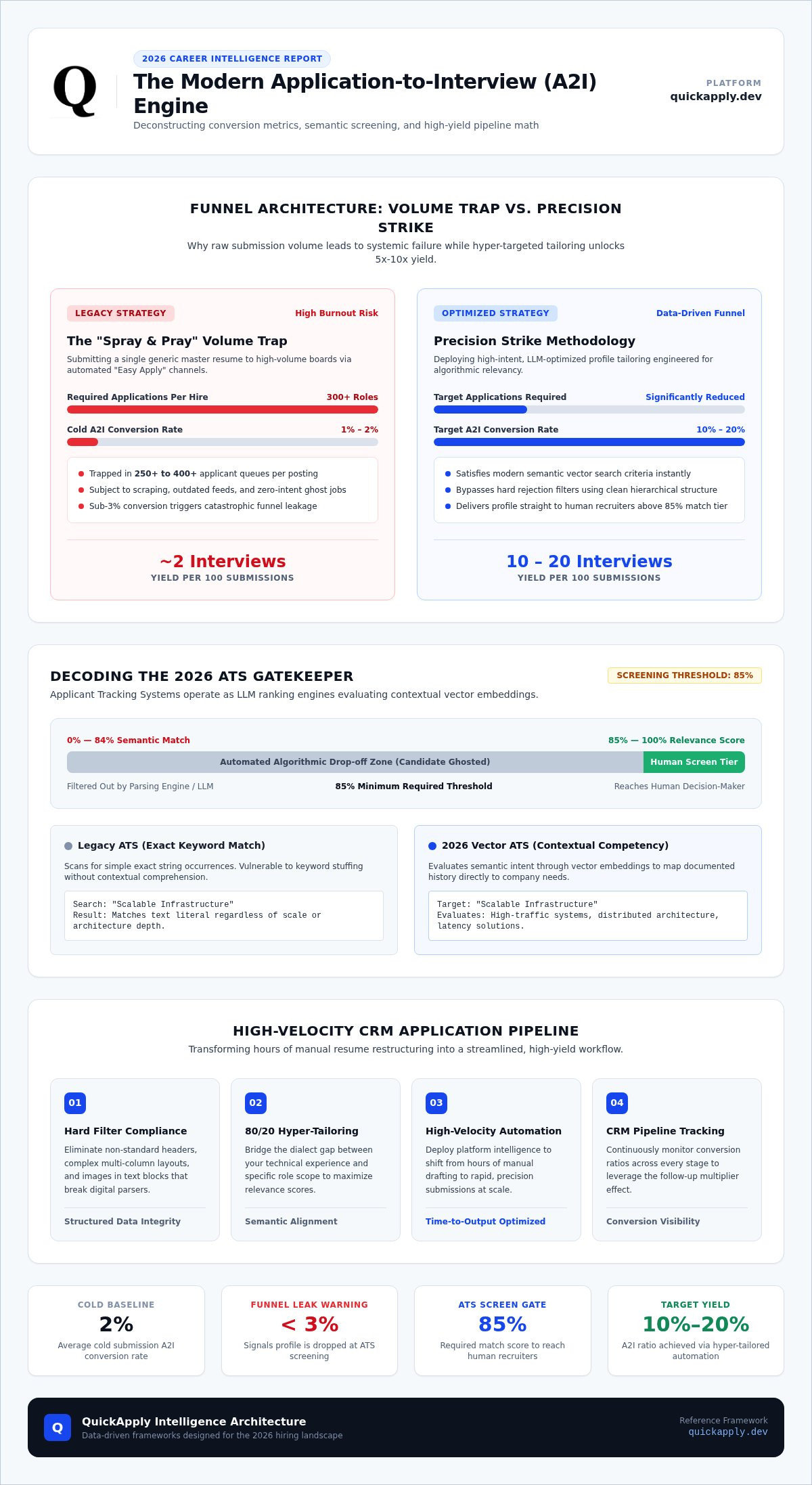
Your Application-to-Interview (A2I) ratio is the primary KPI of your career transition. It represents the percentage of submitted applications that successfully convert into a first-round interview. In the 2026 market, efficiency is the only differentiator. If you are struggling with how to increase my application to interview ratio, you must first acknowledge that your job search is a data funnel. A 1% to 2% ratio is no longer just a slow start; it is a systemic failure that signals your profile is being filtered out before a human ever sees it.
Many tech professionals fall into the "Volume Trap." They believe applying to 500 roles with a single, generic resume is a numbers game. It's not. With the average hire now requiring over 300 applications, the "spray and pray" method is a recipe for burnout. You are competing against thousands of other candidates using the same unoptimized tactics. A "Precision Strike" methodology replaces raw volume with high-intent, tailored submissions that demand attention. Career stability in the current climate requires a minimum 10% A2I ratio to ensure you aren't left behind by market shifts.
The Math of the Modern Job Search
Calculate your baseline by dividing your total interviews by your total applications and multiplying by 100. If your number is below 3%, your funnel is leaking. Most drop-offs occur at the screening layer where applicant tracking systems use vector semantic search to rank candidates. If your resume doesn't align with the specific technical scope of the role, you're rejected instantly. Identifying whether you are failing at the ATS stage or the recruiter review stage is the first step toward optimization. You need to know if your resume is being ignored by an algorithm or dismissed by a human.
Why Traditional Job Boards are Failing You
The "Easy Apply" button has commoditized the job seeker. It creates a paradox where the ease of submission leads to an overwhelming volume of low-quality noise. Recruiters are forced to deploy aggressive AI filters to manage the 400+ applicants common for entry-level and remote roles. Many listings on major boards are "ghost jobs" or scraped listings with no active intent to hire. Modern platforms now use algorithms that reward high-relevance scores. This means unedited profiles are buried under a mountain of tailored competition. You can't win a rigged game with standard tools; you need a system that places you at the top of the pile every time.
Decoding the 2026 ATS: Why Generic Resumes Die
In 2026, the Applicant Tracking System (ATS) has evolved into a sophisticated Large Language Model (LLM) gatekeeper. It no longer scans for simple keyword strings. It evaluates semantic intent. Your "perfect" master resume is statistically invisible because it lacks the hyper-specific context required for a high match score. Recruiters now rely on automated ranking layers that sort candidates by a percentage-based relevance score. If your profile doesn't hit the 85% threshold, it never reaches a human screen. This is the primary hurdle when solving how to increase my application to interview ratio.
The reality is harsh. A single master resume cannot speak the dialect of 50 different job descriptions. Each role has a unique set of constraints and expectations that generic language fails to address. Modern HR tech prioritizes structured data. It expects clean, hierarchical information that can be mapped directly into a candidate database. If your profile isn't optimized for these digital parsers, you're effectively ghosting yourself before the race even starts. This is where the conversion funnel breaks for most professionals.
Semantic Keyword Optimization
Modern hiring tech uses vector embeddings to understand "contextual competency." It maps your experience to the employer's specific problems. For example, if a job description asks for "scalable infrastructure," simply writing that phrase isn't enough. The AI looks for evidence of high-traffic environment management and distributed systems architecture. Semantic Relevance is the mathematical alignment between a candidate’s documented achievements and the specific intent-based requirements of a job description. To win, you must align your technical dialect with the recruiter's specific needs. This requires a deep dive into the nuances of each posting to mirror the hiring manager's priorities.
The ATS "Hard Filter" Checklist
Even with great content, technical debt in your resume format can trigger an instant rejection. Modern parsers require structured data to map your history correctly. Non-standard headings, complex multi-column layouts, or images within the text block break the parsing engine. A U.S. Bureau of Labor Statistics job search study highlights how volume alone doesn't guarantee success if the underlying search strategy is flawed. Beating the ATS requires a clean, machine-readable structure that prioritizes clarity over aesthetic flair. You can use automated resume tailoring to ensure your profile meets these 2026 standards instantly. This step bridges the gap between being a "strong candidate" and being a "visible candidate."
The Hyper-Tailoring Framework: Quality at Scale
Hyper-tailoring is the only way to scale quality in a market flooded by automated noise. To win, you must apply the 80/20 rule of resume optimization. Your core career history and foundational skills remain 80% of the document; however, the remaining 20% must be dynamic. This includes your professional summary, the ordering of your technical skills, and the specific phrasing of your impact bullets. This targeted adjustment is the secret to how to increase my application to interview ratio without spending hours on every submission.
AI bridges the "Language Gap" between your internal company dialect and the recruiter's specific requirements. Every organization uses different terminology for similar technical problems. One company might value "distributed systems," while another prioritizes "high-availability microservices." AI identifies these nuances and re-aligns your existing experience to match the employer's specific lexicon. This isn't about fabricating skills; it is about translating your value into a format the ATS and the recruiter recognize instantly. Data from 2026 shows that hyper-tailored resumes achieve conversion rates of 6% to 10%, while top-tier frameworks can push this to 15%, compared to the sub-3% average for generic profiles.
Automating the Customization Process
Manual tailoring is a relic of the past. You need to leverage AI resume builders to generate role-specific versions in seconds. These tools maintain your authenticity by using your verified data to rephrase accomplishments for maximum impact. The key is ensuring your "Proof of Impact" aligns with the seniority of the role. If you are applying for a Staff Engineer position, your metrics should focus on system-wide architecture and team-lead outcomes rather than individual ticket completion. AI ensures your seniority level is communicated clearly across every bullet point.
The Cover Letter as a Conversion Tool
A generic cover letter is a signal to hiring managers that you aren't serious. In 2026, recruiters use automated tools to detect unedited templates, which often lead to immediate rejection. Using an AI cover letter generator allows you to reference specific pain points mentioned in the job description. The "First Paragraph" hook is critical. It must bridge the gap between your unique skills and the company's mission within the first two sentences. This automated connection signals high intent and forces the recruiter to look closer at your resume, significantly increasing your conversion chances.
Building a High-Velocity Job Search Pipeline
Success in a 2026 job search requires a shift from a passive applicant mindset to a high-velocity sales executive mindset. You must treat your search as a CRM pipeline. Visibility is your greatest asset. Without a clear view of your active leads, you cannot identify where your funnel is stalling. This systemic approach is essential for anyone asking how to increase my application to interview ratio. It turns a chaotic process into a predictable, data-driven engine.
The "Follow-Up" multiplier is your most underutilized tool. Data shows that a single, well-timed email can double your interview chances by pulling your profile out of the digital pile. Don't wait for the ATS to move you forward. Set "Application Sprints" to maintain momentum without hitting burnout. By working in focused, 90-minute bursts, you maintain the high output required for today's market. Use the downtime between sprints to analyze "Rejection Trends." If you're seeing consistent rejections for specific role types, pivot your strategy mid-search to align with market demand.
Centralizing Your Career Data
Manual tracking is a relic that leads to data decay and missed opportunities. You need an automated job application tracker to manage high-volume pipelines effectively. A centralized system eliminates the "Did I already apply to this?" fatigue that drains your mental bandwidth. Use "Match Scores" to prioritize your efforts. Spend your high-effort energy on roles where your alignment score is 90% or higher. This ensures you aren't shouting into the void with low-probability submissions. You can automate your entire tracking workflow to ensure no lead goes cold.
Iterative Optimization
Your resume is a living document that requires constant refinement. A/B test your profile by running different versions of your professional summary or technical skill layouts. Monitor which version yields a higher response rate. When you receive interview feedback, use those insights to refine your AI tailoring prompts. This creates a feedback loop that sharpens your competitive edge with every interaction. High search velocity is the primary defense against market volatility for modern tech talent. By moving faster and tracking better, you ensure your career trajectory stays under your control.
QuickApply: The Competitive Advantage for Tech Pros
QuickApply is the execution layer for the high-velocity strategy we've outlined. While others spend hours manual-tailoring a single document, you can generate an optimized submission in seconds. This speed is the decisive factor in how to increase my application to interview ratio in the 2026 labor market. You aren't just applying; you're deploying a precision-engineered profile that matches the exact semantic requirements of the role. It is the technical ally you need to handle the tedious work of tailoring while you focus on high-value networking and interview prep.
The platform moves you beyond the initial application. It provides a full-stack suite of tools including interview practice, salary negotiation guides, and promotion roadmaps for long-term growth. While good resume examples are a useful starting point, they are static templates in a dynamic world. QuickApply makes your profile responsive, adapting your data to every new opportunity instantly. It eliminates the friction of manual editing and replaces it with a streamlined, automated workflow that ensures your resume actually reaches a human recruiter.
Your AI Career Copilot
This dashboard centralizes your entire job search into a single, high-performance system. It integrates resume tailoring, cover letter generation, and application tracking into one cohesive workflow. The match score feature is your primary strategic filter. It identifies which roles are worth your time and which are statistically "unwinnable" based on your current skill alignment. This intelligence prevents you from wasting energy on low-probability leads that would otherwise drag down your conversion metrics. You stop being a "job seeker" reacting to the market and become a "career manager" who dictates their own trajectory through data and automation.
Ready to Fix Your Ratio?
The path to a 15% conversion rate starts with a single action. Stop fighting the "black hole" of online portals with outdated, manual tools. Import your master resume today and generate your first tailored version in seconds. Join the thousands of tech professionals who have already optimized their search and secured their next role with precision. The 2026 market rewards efficiency and technical literacy. You have the skills; now you need the system to showcase them properly. Optimize your A2I ratio with QuickApply today.
Master Your Career Funnel Today
The 2026 job market does not reward persistence alone; it rewards technical optimization. You now have the framework to stop the "spray and pray" cycle and start seeing real recruiter responses. By moving from basic keyword stuffing to semantic relevance and leveraging a high-velocity pipeline, you effectively solve the puzzle of how to increase my application to interview ratio. Every hour spent on manual tailoring is an hour lost to the competition. Efficiency is your only true differentiator in a crowded digital landscape.
Stop guessing and start executing. Use the AI-driven Match Score to identify your best leads and deploy instant resume and cover letter tailoring to secure your spot at the top of the pile. With automated application tracking, you never lose sight of your pipeline's momentum. Start Tailoring Your Path to More Interviews and take absolute control of your professional trajectory. You have the talent. Now you finally have the system to prove it to the world.
Frequently Asked Questions
What is a good application-to-interview ratio in 2026?
A 10% to 20% conversion rate is the gold standard for tech professionals in 2026. While the industry average for cold applications sits between 2% and 3%, hyper-tailored submissions yield significantly higher returns. If your current metric is lower, you are likely failing the semantic screening stage. Achieving this benchmark is the primary goal when learning how to increase my application to interview ratio through strategic, automated optimization.
Does using AI to tailor resumes get you banned by recruiters?
No, recruiters don't ban candidates for using AI tools; they reject low-quality, generic outputs. Modern hiring managers appreciate the precision of semantic alignment. The key is using AI to surface your actual achievements rather than fabricating skills. By using a technical ally to handle the tedious work of tailoring, you ensure your profile remains authentic while meeting the high-risk screening requirements of modern ATS platforms.
How many jobs should I apply to per day to see results?
Focus on search velocity rather than raw daily totals. Applying to 5 to 10 hyper-tailored roles daily is more effective than blasting 50 generic resumes into the digital void. Quality submissions that achieve a 90% or higher match score have a much higher probability of human review. This precision-strike methodology prevents burnout and ensures your career trajectory remains predictable and data-driven throughout your job search.
How does an AI match score help increase my interview chances?
An AI match score acts as a strategic filter for your time. It evaluates how well your documented experience aligns with the specific technical requirements and problem-solving language of a job description. By identifying the best-fit opportunities instantly, you avoid wasting effort on roles where your profile is statistically invisible. This visibility allows you to prioritize high-yield applications, which is essential for anyone figuring out how to increase my application to interview ratio.
Can I use QuickApply for non-tech roles or career transitions?
QuickApply is optimized for tech professionals but functions effectively for any career manager targeting structured, digital-first hiring pipelines. The underlying semantic tailoring engine works by bridging the language gap between your history and any job description. Whether you are transitioning into a new industry or moving within a specialized niche, the platform’s ability to rephrase accomplishments and track applications provides a significant competitive advantage across national markets.
What happens if I apply to the same company with multiple tailored resumes?
Applying to distinct roles within the same company using tailored resumes demonstrates a versatile skill set. However, applying to identical roles simultaneously with different profiles can signal disorganization to recruiter databases. Modern ATS platforms merge candidate records, so consistency in your core data is vital. Use tailoring to highlight different aspects of your expertise that align with specific team needs rather than changing your foundational history.
Is a cover letter still necessary for tech jobs in 2026?
Yes, a tailored cover letter remains a critical conversion tool. In 2026, generic templates act as a "reject" signal, but AI-generated cover letters that reference specific pain points in the job description signal high intent. The first paragraph hook bridges your unique technical skills with the company's mission. This automated connection forces recruiters to take a closer look at your resume, effectively pulling your profile out of the digital black hole.
How do I know if my resume is actually being read by a human?
You won't receive a direct notification when a human opens your file, but high search velocity and recruiter reach-outs are your primary KPIs. If you are consistently hitting the 85% match score threshold and receiving interview requests, your profile is successfully bypassing the ATS gatekeepers. Using an automated application tracker provides the visibility needed to monitor these conversion trends, confirming that your tailored content is reaching the intended decision-makers.


