

In 2026, the average corporate job posting attracts 244 applications, a staggering 111% surge from just four years ago. You’re likely feeling the burnout of manual tailoring, only to be ghosted by an ATS that scans your credentials in less than 12 seconds. It’s a numbers game where the old "spray and pray" method leads to instant rejection, yet manual editing consumes your entire day. You need a way to outpace the competition without looking like a bot. This guide teaches you how to apply for jobs faster without sacrificing quality by mastering a high-speed, AI-driven strategy that prioritizes data-matching precision over manual labor.
We agree that the current system is broken, but you don't have to be its victim. We'll show you how to transform your search into a streamlined, 15-minute daily workflow that doubles your application volume while increasing your interview conversion rates. You'll learn to achieve elite match scores on job boards and maintain a centralized dashboard to manage 50+ active applications simultaneously. We're moving past generic automation and into the era of the AI Copilot. Stop fighting the algorithm and start using it to secure your next role with surgical efficiency.
Key Takeaways
- Ditch the "spray and pray" method. 2026 ATS filters now block generic applications, making precision a mandatory requirement for high-volume searches.
- Build a data-rich Master Profile. Structuring your technical wins for AI consumption ensures your expertise parses perfectly every time.
- Master how to apply for jobs faster without sacrificing quality by leveraging AI to surface hidden keywords that manual tailoring typically overlooks.
- Execute a 15-minute daily workflow. Shift from manual editing burnout to a high-speed system that identifies and applies to top-tier roles in seconds.
- Use match scores and integrated tracking to scale your search. Stop guessing which roles fit and start targeting opportunities with the highest conversion potential.
The Quality vs. Quantity Myth in 2026 Job Hunting
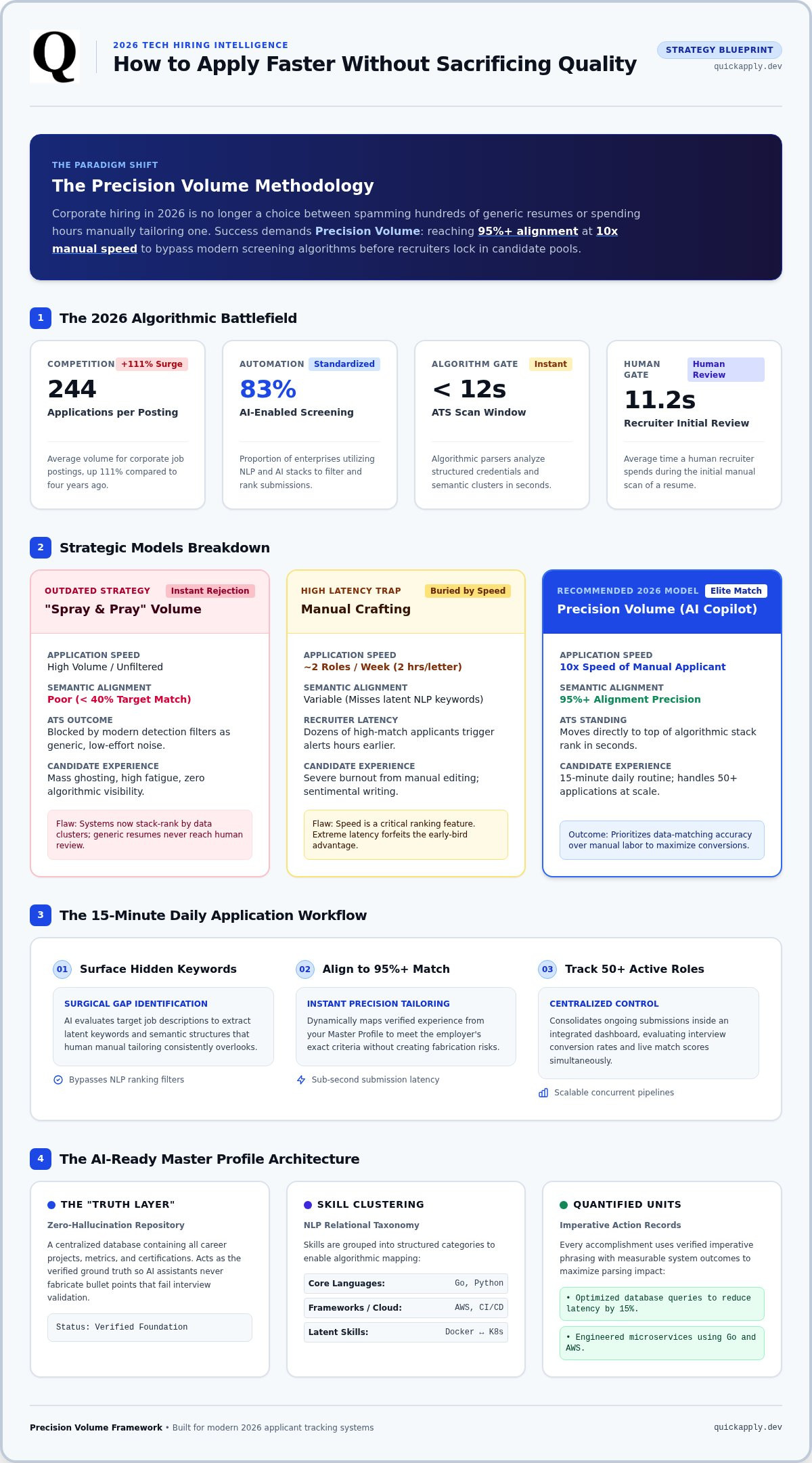
The job market in 2026 demands a total rejection of the binary choice between quality and quantity. Most candidates believe they must choose one. They either blast generic resumes to hundreds of listings or spend hours perfecting a single submission. Both strategies fail. With job postings averaging 244 applications per opening, being one of the first to apply is a mathematical necessity. However, "spray and pray" is dead because modern applicant tracking systems now use advanced detection to block low-effort, generic noise.
The "slow and steady" approach is equally dangerous. Applying to only two roles per week in a market where 83% of companies use AI-enabled screening guarantees you’ll be buried under a mountain of faster, more precise candidates. Learning how to apply for jobs faster without sacrificing quality is the only way to survive. Precision Volume is the intersection of speed and semantic relevance. It allows you to maintain 95%+ alignment with job descriptions while moving at 10x the speed of a manual applicant. Transitioning to an automated system is the only sustainable way to master how to apply for jobs faster without sacrificing quality while competing against thousands of other tech professionals.
The 2026 ATS Reality: It's a Data Matching Game
Modern systems rely on Natural Language Processing (NLP) to stack-rank candidates based on specific data clusters. Even a "perfect" manual resume can score low if it lacks the exact semantic structure the algorithm expects. You aren't just writing for a human; you're optimizing for a ranking engine. Manual tailoring often misses subtle keyword variants that AI identifies instantly. Precision Volume is the intersection of speed and semantic relevance. This strategy ensures your data matches the recruiter’s dashboard requirements every time, moving you to the top of the stack before a human ever sees your name.
Why Manual Tailoring is a Latency Issue
Speed is a feature, not a bug. Spending two hours on one cover letter creates a massive latency issue. By the time you click submit, dozens of high-match candidates have already triggered recruiter notifications. Human recruiters spend an initial scan time of only 11.2 seconds per resume. If you spend hours "writing" when you should be "optimizing," you're losing the early-bird advantage. Success in 2026 requires an Optimizer mindset. Focus on high-impact data matching rather than sentimental prose. This shift reduces the psychological toll of the search, replacing manual burnout with a high-energy, results-driven workflow that prioritizes output and accuracy.
Building Your AI-Ready Master Profile
High-speed job hunting fails without a robust source of truth. Your Master Resume is a comprehensive repository of every project, metric, and certification you have ever achieved. It isn't the document you send to recruiters; it's the database from which you pull. To ensure your foundation is solid, review Harvard's guide to creating a strong resume for principles on quantifying achievements. This approach is central to how to apply for jobs faster without sacrificing quality because it eliminates the need to recall facts mid-application.
Use clear data hierarchies to structure this document. Standard tech terminology helps 2026 ATS systems map your experience to specific job descriptions. Referencing good resume examples shows how to format these technical wins for maximum parsing efficiency. Always maintain a "Truth Layer." AI tools are powerful, but they work best when fed verified data. This prevents the "hallucination gap" where an AI-generated bullet point doesn't align with your actual experience during a live interview.
Categorizing Technical Skills for 2026 Systems
Modern NLP systems categorize skills into clusters. Don't just list "Python" in a vacuum. Group your expertise into Core Languages, Frameworks, and Latent Skills. Latent skills are adjacent technologies, like knowing Docker when a job description asks for Kubernetes. This helps the AI map your background to the role's specific needs. Use bullet points that start with strong imperative verbs:
- Engineered scalable microservices using Go and AWS.
- Optimized database queries to reduce latency by 15%.
- Deployed CI/CD pipelines to automate production releases.
The Role of a Dynamic Master Profile
Treat your profile as a living database, not a static PDF. A static document is a relic of manual hunting. By maintaining a clean, modular master profile, you provide your AI Copilot with the high-quality input it needs to generate tailored versions in seconds. Using the best ai resume builder 2025 ensures your data remains structured for 2026 standards. This setup is the secret to how to apply for jobs faster without sacrificing quality. When your source data is perfect, your output is flawless. Ready to build your high-speed career engine? Start by organizing your master experience document today.
Precision Tailoring: AI vs. Manual Comparison
Manual tailoring is a relic of the pre-automation era. Spending 45 minutes rewriting a resume for one job is a poor use of your technical talent. When you compare manual editing to AI-driven precision, the data is clear. Humans often miss up to 30% of critical keywords hidden in complex job descriptions. AI identifies these latent requirements instantly. This is the core of how to apply for jobs faster without sacrificing quality. You gain speed while actually increasing the accuracy of your submission.
The danger lies in over-optimization. In 2026, 83% of mid-to-large companies use AI-enabled systems to rank candidates. These platforms are now sophisticated enough to detect "keyword stuffing" that lacks context. To avoid red flags, focus on semantic relevance rather than just frequency. AI tailoring is about alignment, not invention. Guide the tool to surface your actual wins that match the JD's specific pain points. This preserves your unique professional voice while satisfying the algorithm's requirements.
Winning the Match Score Game
Recruiters in 2026 use dashboards that stack-rank applicants by a Match Score. In the current market, 85% is the magic number. Falling below this threshold often means your application never reaches a human eye. QuickApply’s algorithm mimics the exact screening criteria used by modern talent acquisition teams. It analyzes your Master Profile against the JD to ensure you hit the 85% mark every time. This data-driven approach is the most efficient way to master how to apply for jobs faster without sacrificing quality.
Cover Letter Automation without the 'Bot' Feel
The traditional cover letter is dead, but the personalized "hook" is more important than ever. Using an ai cover letter generator allows you to synthesize JD requirements and your background into a compelling narrative in seconds. The 2026 strategy involves using AI to identify specific company goals mentioned in the posting. It then maps your past successes directly to those goals. This creates a high-impact document that feels researched and personal, yet takes less than 60 seconds to produce. You get the competitive advantage of a custom letter without the latency of manual writing.
The 15-Minute Daily Application Workflow
Efficiency is a discipline. In the 2026 job market, you can't afford to linger on a single listing. You need a repeatable system that maximizes output. This four-step workflow is how to apply for jobs faster without sacrificing quality. It moves you from discovery to submission in minutes, not hours. By automating the heavy lifting, you focus your energy where it matters: the final review and the eventual interview. High-speed hunting is about removing friction from the process.
- Step 1: Rapid Discovery. Use match scores to filter your daily alerts. Don't look at anything below an 85% match. Identify your top 10 roles in five minutes.
- Step 2: Instant Tailoring. Generate JD-specific resumes and cover letters with a single click. Your AI Copilot pulls data from your Master Profile to align with the specific requirements of the role.
- Step 3: Quality Review. Perform a 30-second sanity check. Ensure the AI hasn't hallucinated a specific certification or tool version. This human-in-the-loop phase is the difference between a high-quality lead and bot-rejected noise.
- Step 4: Automated Tracking. Log the submission immediately. Tracking recruiter latency helps you identify which companies are moving fast and which have stalled.
Batching Your Search for Maximum Efficiency
Context switching kills productivity. Stop checking job boards every hour. Instead, apply in "sprints." Dedicate one 15-minute block per day to your search. Set up high-precision alerts to feed your funnel automatically. This keeps your momentum high and your stress low. For a deeper dive into these tactics, see our guide on mastering the job application process. Batching ensures you hit the "early bird" window for new postings without draining your mental bandwidth.
Managing the Funnel with a Job Tracker
A centralized dashboard is essential for high-volume searching. You need to see exactly where each application sits in the funnel. Move roles from "Applied" to "Interviewing" as responses come in. Use automated reminders to follow up if you haven't heard back within seven business days. This level of organization prevents active opportunities from falling through the cracks. It's the ultimate way to stay on the recruiter's radar. Ready to optimize your hunt? Start your 15-minute workflow now and take control of your career funnel.
Scaling Your Career with QuickApply
Speed is the entry requirement. Quality is the closer. QuickApply bridges the gap between submitting a high-volume funnel and signing an offer letter. By utilizing the tool to tailor resume to job description requirements, you ensure every application carries the weight of a manual submission without the associated time sink. This is the ultimate execution of how to apply for jobs faster without sacrificing quality. You aren't just sending more resumes; you're sending better ones.
The tech market moves at a high frequency. In 2026, staying competitive means having an AI Copilot that manages the logistical burden of the search. QuickApply provides the infrastructure to not only find roles but to dominate the interview phase. Beyond the initial application, you gain access to a suite of tools designed for the entire professional lifecycle. From managing active leads in your tracker to practicing for high-stakes technical rounds, the platform serves as a centralized hub for your career trajectory.
Converting Volume into Interviews
High-quality tailoring does more than pass an ATS. It reduces your time-to-interview metric by presenting recruiters with exactly what they need to see in those crucial 11.2 seconds. Use your match scores to prioritize your energy. If a role has a 98% match, it deserves your immediate attention. QuickApply’s interview practice features allow you to run simulated sessions based on the specific JD you just applied to. This turns your high-speed workflow into a high-conversion engine. You'll enter the room with a data-driven understanding of the company's pain points and how your background solves them.
The Long-Term Career Advantage
Job security in 2026 isn't about staying at one company. It's about staying market-ready. A recurring subscription to QuickApply ensures your Master Profile is always optimized and your data is ready for the next opportunity. The value extends beyond the hire. Use the Salary Negotiation Guide to secure your worth and the Promotion Roadmap to architect your internal growth. This is continuous career optimization. Don't just find a job. Build a legacy of efficiency and advancement. Start your high-speed, high-quality search with QuickApply today.
Master Your Career Velocity in 2026
The 2026 job market doesn't reward effort; it rewards efficiency. You've learned that "spray and pray" is a dead strategy and that manual tailoring creates fatal latency in your search. By treating your experience like a modular database and executing a 15-minute daily workflow, you turn the numbers game in your favor. This is the blueprint for how to apply for jobs faster without sacrificing quality while staying ahead of the algorithmic curve.
It's time to stop fighting the system and start outperforming it. QuickApply provides AI match scores updated for 2026 tech standards, ensuring you only target high-probability roles. Trusted by thousands of software engineers and tech grads, our all-in-one tracker, tailor, and interview prep suite gives you the competitive edge required for today's professional landscape. Optimize your job search with QuickApply's AI Tailoring and transform your career trajectory in seconds. You have the talent. Now you have the engine to deploy it at scale. Go secure your next win.
Frequently Asked Questions
Can recruiters tell if I used AI to apply for a job?
Recruiters generally cannot detect AI usage if the content is grounded in your actual experience. In 2026, 49% of hiring managers reject resumes they suspect are fully synthetic, but they value the precision of a tailored document. The key is to use AI for data matching rather than full generation. Always perform a 30-second sanity check to ensure the output sounds human and aligns with your verified technical wins.
Does applying to more jobs actually decrease my chances of getting hired?
High volume only hurts you if you rely on generic "spray and pray" tactics. Modern ATS filters identify and block low-quality noise. However, applying to more roles increases your interview conversion rates if you maintain 95%+ alignment with each job description. Mastering how to apply for jobs faster without sacrificing quality allows you to scale your search without triggering bot-detection filters or looking like a generic candidate.
How do I maintain my personal brand while using AI tailoring tools?
Your personal brand remains intact when you treat AI as an optimizer, not a creator. Start with a robust Master Profile that captures your unique voice and technical achievements. The AI then pulls from this verified "Truth Layer" to align your background with specific roles. This ensures every tailored resume sounds like you while meeting the technical requirements of the algorithm, protecting your professional identity at high speeds.
What is a good match score for a tech job application?
An 85% match score is the standard threshold for passing through 2026 Applicant Tracking Systems. Falling below this number often means your application is never stack-ranked for human review. QuickApply uses algorithms that mimic recruiter screening criteria to help you hit this target. Aiming for 85% to 95% ensures you are highly relevant without appearing "over-optimized," which can sometimes trigger red flags in sophisticated ranking engines.
How many jobs should I apply to per day to see results in 2026?
Aim for 5 to 10 high-precision applications per day during a focused 15-minute sprint. Because the average job search in 2026 lasts 28.5 weeks, maintaining a consistent daily volume is essential. Using high-speed tailoring tools allows you to hit this volume without burning out. Consistency beats sporadic bursts of activity. This pace keeps your funnel full while ensuring each submission meets the high-quality standards required to land interviews.
Will AI-tailored resumes pass through all Applicant Tracking Systems?
Yes, provided they use standard data hierarchies and Natural Language Processing (NLP) friendly structures. Modern platforms like Greenhouse and Workday parse keywords to create a stack-ranked dashboard. AI-tailored resumes actually perform better than manual ones because they identify specific keyword variants humans often overlook. By structuring your data for these systems, you ensure your resume parses perfectly and ranks at the top of the recruiter’s list every single time.
Is it better to use a Chrome extension or a full platform for job applications?
A full platform is superior for long-term career management. While extensions offer quick autofill, they lack the "Truth Layer" of a Master Profile and the organizational power of an integrated tracker. A centralized platform like QuickApply manages your entire funnel, from tailoring to interview practice and salary negotiation. This holistic approach ensures your data is consistent across all touchpoints, which is vital for how to apply for jobs faster without sacrificing quality.
How does an automated tracker help me get hired faster?
An automated tracker reduces recruiter latency by helping you stay organized. It moves roles from "Applied" to "Interviewing" and triggers reminders for follow-ups after seven business days. In a market where recruiters spend less than 12 seconds on an initial scan, staying on their radar is critical. A tracker ensures no lead falls through the cracks, allowing you to manage 50+ active applications with the same precision as a single submission.


