

The data is brutal. In 2026, tech candidates average 103.7 applications over nearly ten months just to land a single role. If you're spending 60 minutes per manual edit, you're fighting a losing statistical battle. It's time to stop playing by old rules and start generating tailored resumes in bulk to reclaim your time. This isn't about spamming the market with generic PDFs. It's about using smart automation to ensure every single application hits the desk with surgical precision.
You've likely felt the burnout of endless "quick apply" buttons that lead nowhere. It's frustrating to see a 2% conversion rate when you know your skills fit the stack. We're here to bridge that gap. You'll learn how to automate the tailoring process to apply for dozens of tech roles in minutes while maintaining a 90% Match Score for every submission. This approach eliminates the anxiety of ATS rejection and puts you back in control of your career trajectory.
This guide reveals the high-speed workflow used by top-tier engineers to bypass algorithmic filters and land interviews at elite firms. We will explore the shift from basic keyword stuffing to semantic alignment. You'll discover how to build a career pipeline that works as hard as you do, moving from a manual struggle to a high-output engine of professional opportunity.
Key Takeaways
- Master the art of generating tailored resumes in bulk to outpace the competition without sacrificing the quality required by 2026 ATS algorithms.
- Transition from manual editing to semantic mapping, ensuring your technical experience aligns perfectly with role requirements in seconds.
- Evaluate the efficiency gap between basic AI prompts and automated platforms to maximize your application volume and interview conversion rates.
- Implement a high-speed workflow that turns a single "Master Resume" into dozens of role-specific documents in under 30 seconds per application.
- Leverage proprietary Match Scores to gain instant feedback on your competitive advantage for every tech position you target.
The Manual Tailoring Trap: Why Bulk Generation is Mandatory in 2026
In 2026, the tech market doesn't reward effort. It rewards efficiency. The old "spray and pray" method, sending one generic PDF to 50 listings, is a fast track to the rejection pile. Recruiters now spend less than six seconds on an initial resume review. If your experience doesn't scream relevance instantly, you're out. Generating tailored resumes in bulk isn't just a shortcut. It's a survival requirement for anyone serious about a high-growth career.
Manual tailoring is a productivity killer. Most candidates still spend 30 to 60 minutes tweaking bullets for a single role. In a market where tech pros are averaging over 100 applications to land a seat, that math simply doesn't work. You can't spend 100 hours on documentation and still have the energy to code, build, or lead. Automation has shifted from a "nice to have" to a core technical skill. If you aren't automating your search, you're already behind the curve.
The costs of the manual approach are clear:
- Loss of competitive advantage as roles fill up within hours.
- Mental fatigue that bleeds into technical assessments and interviews.
- Lower application-to-interview conversion rates due to inconsistent quality.
The Math of the Modern Job Search
Think about the probability. If you apply to 10 jobs manually, you're betting everything on a tiny sample size. If you apply to 100 jobs using AI automation, you've decupled your surface area for success. Volume and quality used to be trade-offs. Now, they're partners. Manual editing leads to rapid burnout. It causes you to settle for lower salaries or suboptimal roles just to end the search. By generating tailored resumes in bulk, you maintain your standards while increasing your reach. You stay fresh for the interviews that actually matter.
ATS Evolution in 2026
Modern applicant tracking systems have moved past simple keyword matching. They now utilize semantic parsing to understand the context of your achievements. Stuffing "Python" or "Kubernetes" into a skills block won't trick these systems anymore. They look for how you applied those tools to solve specific problems. This makes tailoring your resume to a job description a non-negotiable step. Without semantic alignment, your resume never even reaches a human eye. You need a system that maps your master experience to these specific algorithmic demands instantly to ensure you pass the first cut every time.
What is Bulk Resume Tailoring and How Does it Work?
Bulk resume tailoring is the systemic process of using AI to generate multiple, job-specific versions of your resume simultaneously. It replaces the slow, manual process of editing one document at a time. This isn't just about changing a few keywords. It's about semantic mapping. The system analyzes your master career profile and the job description (JD) to identify the logical connections between your past wins and the employer's current needs. By generating tailored resumes in bulk, you ensure every application is optimized for its specific destination without the 60 minute time tax.
Generic templates are static; they don't adapt to the shifting priorities of different hiring teams. Bulk generation is dynamic. It treats your career history as a database and the JD as a query. The result is a document that feels hand-crafted for the role. In 2026, the gap between generic templates and bulk tailoring is the difference between a 3% and a 9% interview conversion rate. Success in a crowded market requires this level of algorithmic alignment.
The AI Engine Behind the Scenes
Modern Large Language Models (LLMs) do more than just read text. They decipher the hidden intent behind a JD. When a company asks for "distributed systems experience," the AI knows to highlight your work with microservices and load balancing. It rephrases technical accomplishments to match the specific dialect of the hiring firm. You maintain your authentic voice while ensuring that machine gatekeepers recognize your value. Following MIT's guide to ATS-friendly resumes helps maintain the clean formatting these engines require for accurate parsing.
Quality Control in Bulk Workflows
High volume doesn't mean high risk. Professional tools use automated verification to keep your core data locked. Your contact information, degree dates, and primary tech stack remain consistent across every version. The system only modifies the context and emphasis of your bullet points. This is why using a dedicated AI resume tailor for tech jobs is superior to raw LLM prompts. It provides a "Match Score" that quantifies your alignment with the role before you hit submit. If your score is below 80%, you know you need to adjust your master profile or find a better-fitting role. You can start optimizing your application pipeline today to see these metrics in real-time.
Comparing Strategies: Manual, Basic AI, and Automated Bulk Platforms
Choosing a job search strategy in 2026 is about managing your most limited resource: time. Manual editing is the legacy approach. It offers high quality, but it doesn't scale. You might spend an hour on one application, only for it to disappear into a black hole. Basic AI tools like ChatGPT or Claude offer a middle ground, yet they introduce new friction points. Dedicated platforms like QuickApply represent the modern tech stack for job seekers, combining high-speed execution with professional-grade quality control. If you aren't generating tailored resumes in bulk through a structured system, you're working harder than the competition for fewer results.
Manual tailoring is a recipe for burnout. It turns your job search into a full-time administrative role. While you're busy proofreading a single document, five other candidates have already applied with optimized profiles. Basic AI speeds things up, but it lacks the guardrails needed for tech roles. Raw ChatGPT resumes often fail because they hallucinate skills or use generic, detectable phrasing that triggers recruiter skepticism. You need a system that understands technical hierarchy without requiring constant supervision.
The Prompting Problem
Manual prompting for 50 different resumes is just as tedious as manual editing. You have to copy-paste the job description, upload your file, and hope the AI doesn't drift from your core brand identity. It's a manual process disguised as automation. Dedicated platforms eliminate this "prompt engineering" tax. They use standardized mapping to keep your technical accomplishments consistent across every version. Aligning with the Harvard College resume creation guide, these systems ensure your achievements remain measurable and specific while optimizing for the algorithm. You get the speed of AI without the risk of a fragmented professional brand.
Workflow Integration
A resume builder alone isn't a strategy; it's just a tool. In a 2026 search, you need a unified dashboard that handles the entire pipeline. This includes an integrated cover letter builder that syncs with your tailored resume. When you generate 50 applications in a morning, you can't rely on spreadsheets to track them. High-volume platforms provide automated tracking from the moment you hit submit to the day you sign the offer. This visibility allows you to see which versions of your resume are performing best. It turns your job search into a data-driven operation rather than a game of chance.
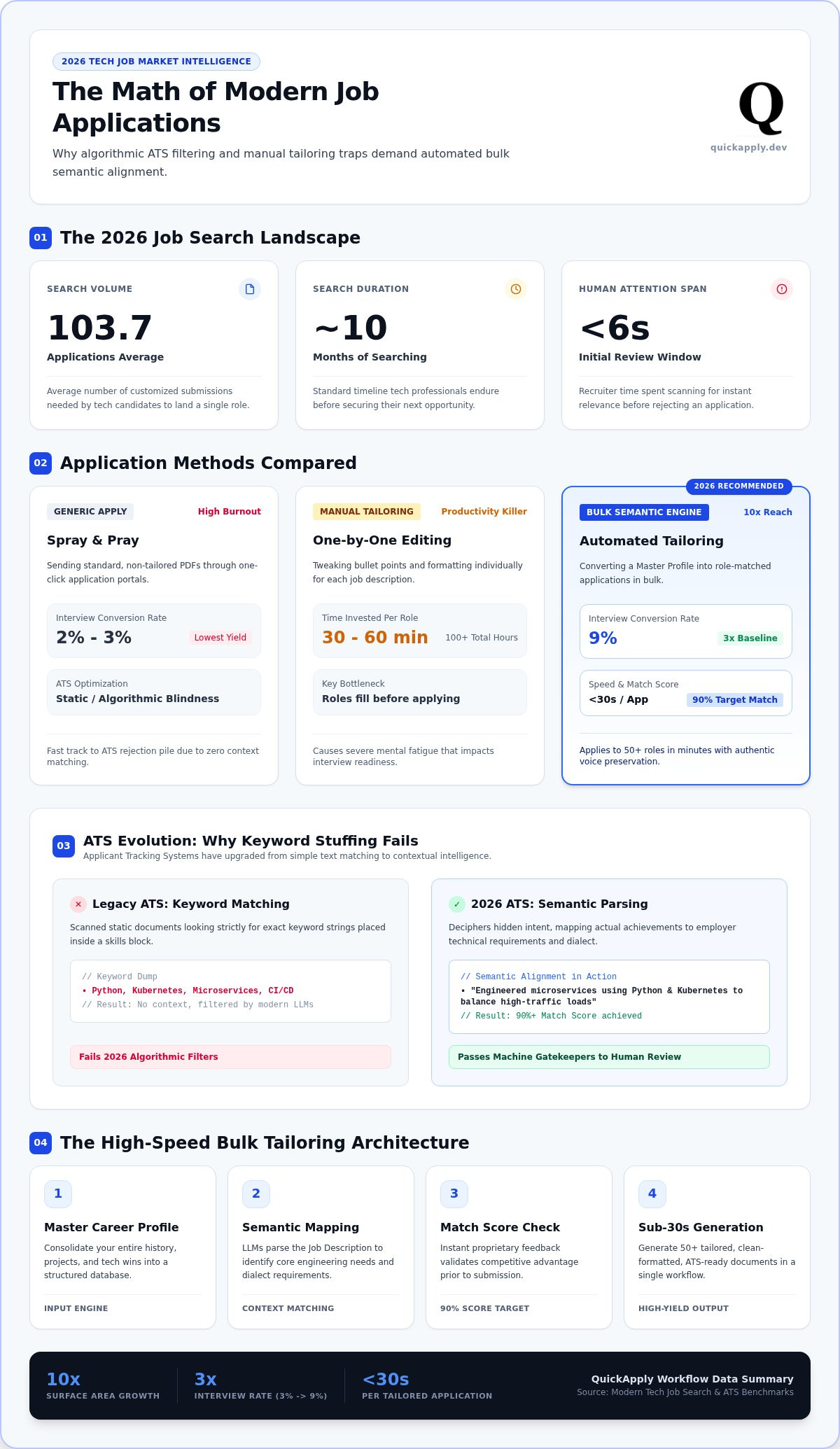
How to Generate 50+ Tailored Resumes in Minutes: A Step-by-Step Workflow
Managing a job search in 2026 requires a shift from manual drafting to pipeline management. You aren't just an applicant; you're a system architect. By generating tailored resumes in bulk, you convert a month-long search into a single morning's work. This workflow ensures that every document is a precision-engineered match for its target JD without sacrificing the technical depth required by elite firms.
Step 1: Building the Master Profile
Treat your career history like a database rather than a static document. Your master profile should contain every tech stack, metric, and project outcome you've ever touched. Include specific data points like "reduced latency by 40% using Go" or "scaled infrastructure to 1M users." This raw data provides the fuel for the AI engine to draw from. Draft one punchy sentence regarding your lead technical achievement. This acts as a priority anchor for the AI engine to emphasize across every version it generates.
Step 2: The Bulk Generation Phase
Efficiency peaks when you move from linear tasks to parallel processing. Import your target job descriptions directly via URL paste or a browser extension. The engine then runs the tailoring process for all selected roles simultaneously. This is the core of generating tailored resumes in bulk. In less than 30 seconds per role, the system produces a unique resume and matching AI cover letters. You can export the entire batch in PDF or Word format with a single click.
Step 3: Verification and Deployment
Automation doesn't mean abandonment. Review the proprietary Match Score for each generation. Prioritize applications with 85% relevance or higher. If a JD is vague, use the system's remapping tools to adjust the emphasis and fill semantic gaps. Once verified, sync your submissions to an automated job application tracker. This ensures you never lose track of a follow-up or interview request. You can launch your high-volume pipeline now and stop wasting time on manual uploads.
QuickApply: The Ultimate System for High-Volume Tech Applications
QuickApply is the definitive career operating system for the 2026 tech market. It's built for those who refuse to waste hours on administrative friction. By generating tailored resumes in bulk, you move from JD to application-ready in under 30 seconds. This isn't just about speed, it's about precision. The proprietary Match Score provides instant, quantitative feedback on your competitive advantage for every role. You no longer have to guess if your resume will pass the filter. You'll know exactly how you stack up before you even apply.
The platform scales with your ambitions. Beyond the initial application, QuickApply offers integrated interview practice and comprehensive salary guides to ensure you don't leave money on the table during negotiations. Whether you're a student entering the field or a senior lead navigating a complex pivot, the subscription tiers are engineered to support aggressive career transitions. It's about giving you the leverage you need in a crowded market.
Empowering the Tech Professional
QuickApply was built by digital natives for software engineers and data scientists who understand the power of automation. It replaces the traditional, slow job hunt with a disruptive, high-tech alternative that mirrors the speed of modern development cycles. You get continuous productivity without the active effort of manual editing. The system handles the heavy lifting of semantic alignment, allowing you to focus on high-value activities like networking and technical interview prep. It's a tool for those who value their time and expect their software to do the same.
Your Career Growth Roadmap
The value doesn't stop once you hit "submit." QuickApply acts as a CRM for your career, supporting you long after the resume stage. Use the Promotion Roadmap to plan your next vertical move once you've secured your new role. This long-term perspective ensures you aren't just finding a job, but building a trajectory. Join thousands of tech professionals who have used this system to optimize their path to FAANG and top-tier startups. By generating tailored resumes in bulk, you've already mastered the first hurdle. Now, use the platform to maintain that momentum and secure the compensation you deserve throughout your entire professional lifecycle.
Master Your Career Pipeline with High-Speed Automation
The 2026 job market doesn't wait for manual edits. You've seen the math; the only way to overcome the statistical hurdle of a ten month search is to scale your output without compromising on technical depth. By generating tailored resumes in bulk, you move from a reactive search to a proactive, data-driven operation. You're no longer just applying; you're deploying a targeted campaign designed to trigger the right algorithms and capture the attention of engineering leads.
QuickApply provides the professional-grade infrastructure you need to win. With our proprietary AI-powered Match Score and integrated Application Tracker, you gain a transparent view of your competitive advantage for every role. This is the definitive CRM for your career, built specifically for tech professionals who value efficiency above all else. It's time to stop fighting the system and start using it to your advantage. Your next FAANG-tier offer is just a few clicks away.
Stop Building, Start Tailoring with QuickApply
Take the lead in a crowded market. You have the talent; now you have the machine to show it to the world.
Frequently Asked Questions
Is it ethical to generate tailored resumes in bulk using AI?
Generating tailored resumes in bulk is ethical because it ensures your existing skills are visible to the hiring team. It isn't about fabrication; it's about translation. You're simply using technology to map your verified experience to the employer's specific dialect. In a market where recruiters use AI to screen you, using AI to present your best self is a fair and necessary strategic adjustment.
Do ATS systems penalize resumes that are clearly AI-generated?
Modern applicant tracking systems prioritize semantic relevance over the origin of the text. In 2026, over 97% of Fortune 500 firms use advanced scanners that value context and technical hierarchy. As long as your document is formatted correctly and contains factual data from your career, you won't face penalties. The goal is to pass the algorithmic filter by proving you have the specific expertise the company requires.
How does QuickApply’s Match Score actually calculate my relevance?
The Match Score utilizes a proprietary algorithm to compare your master career profile against the job description. It analyzes tech stacks, project metrics, and technical accomplishments to find logical overlaps. It doesn't just look for keywords; it evaluates the depth of your experience. A score of 85% or higher indicates that your profile has a high probability of passing initial automated screenings and human recruiter reviews.
Can I use bulk tailoring for non-tech roles, or is it only for engineers?
QuickApply is specifically engineered for software engineers, data scientists, and other digital natives in the tech sector. While the logic of semantic alignment can apply to other industries, our tools are optimized for technical dialect and complex infrastructure projects. This focus ensures the AI understands the nuances of DevOps, frontend frameworks, and backend architecture better than a generic, all-purpose writing tool ever could.
Will my master resume data be used to train other AI models?
Your master resume data is your intellectual property and is treated with high security. QuickApply uses your information exclusively to generate your tailored documents and provide career insights. We don't sell your data or use it to train external Large Language Models. Our system is built for your individual productivity, ensuring your technical repositories and project metrics remain private while you scale your application volume.
What is the ideal number of applications to send per day with an automated system?
Aim for 5 to 10 high-quality applications per day when using an automated system. While generating tailored resumes in bulk allows for massive volume, you should prioritize roles where your Match Score is 85% or higher. Sending dozens of low-relevance applications wastes your time and slows down your tracking. Focus on high-probability targets to maintain a healthy interview conversion rate and avoid application fatigue.
How do I ensure my bulk resumes still sound like a human wrote them?
The best way to maintain a human tone is to provide a detailed master profile full of specific metrics and unique project outcomes. AI sounds generic only when it lacks data. When you feed it real wins, like "reduced server costs by 30%," the output stays grounded in your actual career. This ensures your bulk resumes reflect your professional identity while still being optimized for 2026 screening algorithms.


