

The traditional career ladder is a legacy system that has officially reached its end of life. In 2026, the career path for software developer is no longer a linear climb; it's a complex architecture you must actively engineer. You're likely feeling the friction of a stagnant role or the anxiety of AI automating your entry-level task list. It's frustrating to watch the market move at 200ms while your promotion cycle takes two years. Stop waiting for a manager to notice your commits and start optimizing your trajectory.
You know the old playbook of "learn a stack, wait for seniority" is broken. With Python 3.14.6 and React 19.2.7 shifting the baseline, technical skill alone isn't your moat. We'll show you how to master the modern engineering landscape and use smart systems to automate your ascent from Junior to Staff or Management. This article provides a clear map of 2026 career tiers, a high-velocity strategy for switching tracks, and the specific tools you need to automate your transition process. It is time to treat your career like the high-performance system it should be.
Key Takeaways
- Replace tenure-based thinking with a skill-velocity trajectory to avoid the single point of failure inherent in traditional corporate ladders.
- Navigate the divide between Individual Contributor and Management tracks with a clear map of 2026's senior-tier roles.
- Engineer a high-impact career path for software developer by leveraging the "Adjacent Possible" to pivot stacks without sacrificing your seniority.
- Transition from a passive employee to an active market participant by using an automated toolkit to track your value in real-time.
- Deploy a data-driven Promotion Roadmap and Salary Negotiation Guide to secure the compensation and title you’ve already earned.
The 2026 Developer Landscape: Why the Career Ladder is Obsolete
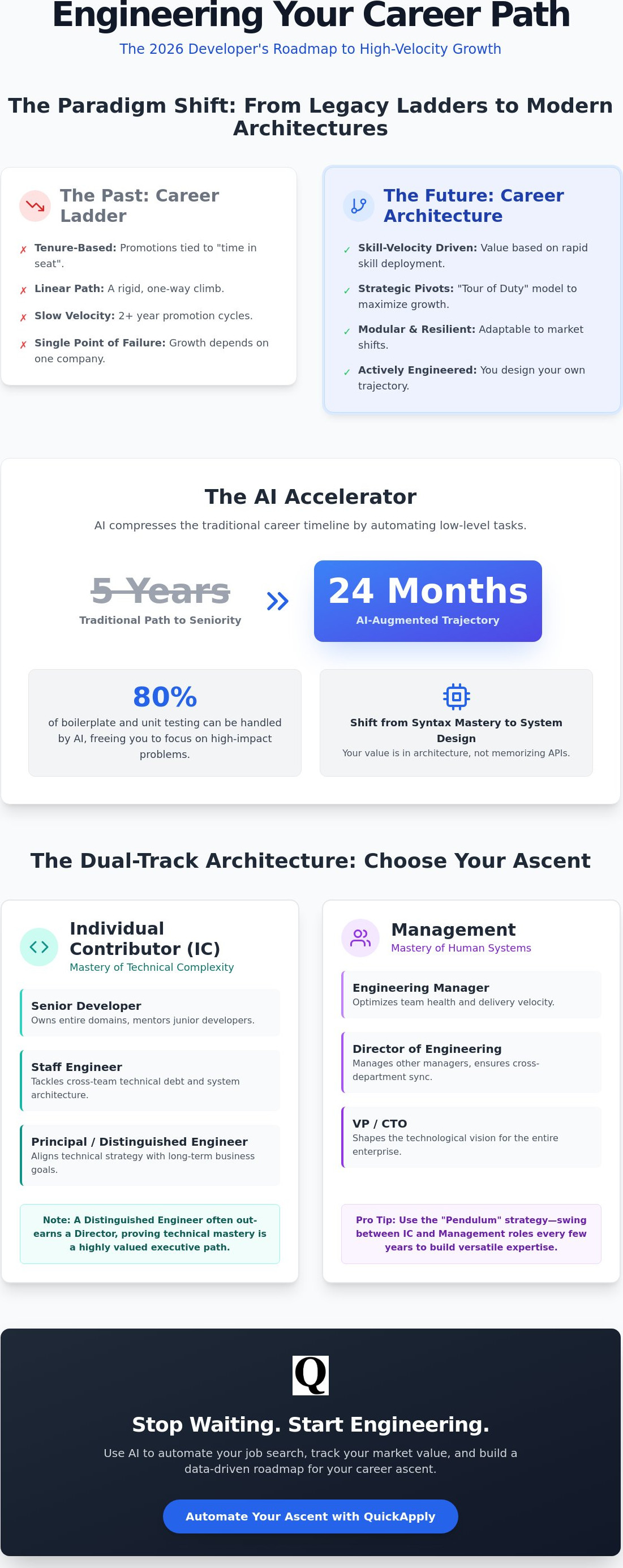
The corporate ladder is a legacy architecture. In 2026, waiting for a manager to grant you a promotion based on "time in seat" is a high-risk strategy. The market has shifted to skill-velocity trajectories. This means your career path for software developer is defined by how quickly you can master and deploy new systems, not how many years you've spent at a single desk. Tenure-based systems create a single point of failure. If your company’s growth plateaus, your professional development crashes with it. Reliance on a single employer for your growth is a bug in your professional logic.
Modern developers apply the same principles of software engineering to their careers that they do to their codebases. This is the "Engineering Mindset" for career management. You need to build a career that is modular, scalable, and resilient to market shifts. AI has accelerated this transition by obliterating the "syntax mastery" phase of junior roles. You're no longer hired to memorize API documentation; you're hired to architect solutions. This shift forces you to focus on system design and high-level logic from day one.
From Vertical Climbing to Strategic Pivoting
The 10-year gold watch is a relic. High-growth tech environments now favor the "Tour of Duty" model. You join a team to solve a specific set of challenges, level up your stack, and then evaluate the next move. This isn't job hopping; it's optimization. You must learn to identify the "local maximum." This happens when your learning curve flattens but your workload remains high. When you've extracted all the available knowledge from a role, staying longer is a technical debt you're imposing on your future self. Strategic pivots allow you to reset your growth curve and capture higher market rates.
The Role of AI in Compressing the Career Timeline
AI tools now handle 80% of boilerplate and unit testing. This allows junior developers to bypass the traditional two-year "grunt work" phase and engage with mid-level architectural problems almost immediately. To stay competitive, you must become an AI-augmented developer who treats LLMs as a high-speed compiler for intent. AI-augmented developers don't just write code faster; they think at a higher level of abstraction. You're managing a fleet of digital agents that handle the low-level implementation, allowing you to focus on scalability, security, and user experience. The 2026 career path for software developer is no longer a slow crawl through syntax, but a rapid ascent driven by system design and strategic tool integration. In 2026, the traditional five-year path to seniority has been compressed into a 24-month high-intensity sprint powered by automated co-pilots and architectural focus.
Decoding the Major Tracks: Individual Contributor vs. Management
Stop viewing management as the only destination for growth. The modern career path for software developer is a dual-track architecture. You can choose between technical depth or organizational scaling. Many elite engineers now use the "Pendulum" approach. They swing between Individual Contributor (IC) and management roles every few years. This strategy keeps your technical skills sharp while building the leadership muscles required for executive roles. The myth that managers always earn more is dead. In 2026, a Distinguished Engineer often out-earns a Director while maintaining a massive strategic impact on the codebase.
The IC Track: Mastery of Technical Complexity
The IC track is designed for those who want to solve the hardest technical problems. As a Senior Developer, you're expected to mentor juniors and own entire domains. Staff Engineers move beyond a single team, tackling cross-team technical debt and complex system architecture. By the time you reach Principal or Distinguished levels, you're aligning technical strategy with long-term business survival. It’s a high-stakes role. One architectural decision regarding your React 19.2.7 implementation or Python 3.14.6 deployment can save or cost the company millions in infrastructure spend.
The Management Track: Mastery of Human Systems
Transitioning to management is a complete context switch. Engineering Managers (EMs) optimize for team health and delivery velocity. They act as the load balancers for human capital, ensuring developers have the resources they need to ship. Directors of Engineering scale these systems, managing other managers and ensuring multiple departments move in sync. At the VP or CTO level, you’re shaping the technological vision for the entire enterprise. The job outlook for software developers remains aggressive, but the demand for leaders who can translate abstract business needs into technical execution is at an all-time high.
Building the interpersonal skills necessary for these leadership roles often starts with expanding your social horizons. To foster meaningful connections outside of the office, you can visit Truemeet to join in-person group activities that turn digital networking into real-world experiences.
The "T-Shaped" Developer vs. The Specialist
The 2026 market pays a significant premium for "Product-Minded Engineers" who understand the "why" behind the "how." You must decide whether to go deep into a niche like Rust or AI/ML, or stay a generalist. Specialists in AI/ML currently see a 56% wage premium, making deep dives highly lucrative. However, T-shaped generalists offer the flexibility needed to survive market volatility. You need to visualize your next move with precision. Use a promotion roadmap to map your current technical skills against the requirements of your target track. If you're ready to optimize your trajectory and secure your next role, leverage QuickApply to monitor your market value and find opportunities that match your chosen path.
Strategic Pivots: Navigating Stacks, Industries, and Roles
The "Adjacent Possible" is your framework for strategic movement. It suggests that the most efficient moves are to roles immediately reachable from your current position. You don't need to start over as a Junior. A Frontend Engineer moving to Full Stack or DevOps is a logical system upgrade. You're leveraging existing knowledge of the DOM or deployment pipelines to expand your scope. This approach prevents you from losing the seniority you've built. Your career path for software developer is a series of calculated expansions, not a single static track. Stop thinking of a pivot as a restart. It's a system migration.
Industry knowledge is a massive multiplier in the 2026 market. If you understand FinTech compliance or HealthTech data privacy, you're more valuable than a pure coder. You're a domain expert who happens to write code. The most significant pivot today is the shift from traditional software engineering to AI Engineering. This doesn't mean you need to become a data scientist. It means building the infrastructure that supports LLM integration and agentic workflows. You are architecting the systems that allow AI to function within a business context.
To see how these advanced architectures are applied in professional settings, you can visit SoTechnology to learn how they deliver AI-enabled digital solutions that help organizations grow and create significant impact.
The Mechanics of a Successful Pivot
Successful pivoting requires identifying the "Delta." Map your current skills against your target role's requirements. If you're moving from Java to Rust, the Delta is memory management and ownership models. Use open source contributions to prove you can handle the new stack before you even interview. When you do land that meeting, frame your legacy experience as a foundational asset. You aren't "new" to DevOps; you're an experienced engineer who has spent years optimizing the software that those DevOps systems are designed to support. This reframing preserves your market value during the transition.
Using AI to Bridge the Experience Gap
AI tools allow you to simulate the workflow of a new role. Use LLMs to generate PR reviews for a stack you're learning. This builds muscle memory for the "Adjacent Possible" before you submit your first real application. You can also analyze good resume examples to see how successful pivoters translate their skills for 2026 recruiters. When building your developer career, remember that your core engineering logic remains constant regardless of the syntax you use. Your technical foundation is stack-agnostic because clean architecture, efficient algorithms, and sound logic apply to every language from Python 3.14.6 to low-level C.
Automating Your Ascent: The Tactical Toolkit for Progression
Stop waiting for your annual review to validate your worth. In the 2026 tech economy, internal promotion cycles are often outpaced by market demand. Relying solely on your current employer to define your career path for software developer is an architectural flaw in your professional life. You need an "Always-On" strategy. This means monitoring your market value in real-time and treating your career like a product in continuous deployment. Your career path for software developer should be a series of automated upgrades, not a manual struggle against corporate inertia.
Managing this process manually is a waste of your engineering talent. Deploy an automated job application tracker to handle multiple leads without context switching. This allows you to maintain a high-velocity search while focusing on your current sprints. You need to stay visible to the market even when you aren't actively looking to jump ship.
Step 1: Audit Your Current Market Value
You can't optimize what you don't measure. Use automated match scores to see how your profile stacks up against Senior or Lead roles today. These scores reveal the specific "Skill Gaps" that act as a ceiling on your salary. Perhaps you're strong in React 19.2.7 but lack the Kubernetes 1.36.2 experience required for Staff roles. Identify these deltas early. Set automated alerts for roles that represent a 20% increase in compensation or a significant title jump to ensure you never miss a market peak.
Step 2: High-Volume Tailoring for High-Impact Roles
Generic resumes are a single point of failure in the 2026 ATS landscape. Recruiters now use sophisticated filters to find "path-specific" achievements. If you're aiming for a Management track, your resume must scream "delivery and growth," not just "syntax and commits." Use an AI resume tailor for tech jobs to highlight the relevant wins for your next step. This tool ensures your narrative matches the specific requirements of the role you want, not just the one you currently have.
Step 3: Mastering the Transition Interview
The interview for a Staff Engineer is fundamentally different from that of an Engineering Manager. One focuses on deep system design; the other on human systems and conflict resolution. Refine your narrative using interview practice tools that simulate these specific tracks. When you reach the offer stage, don't guess your value. Use real-time salary data to ensure your pivot is a financial upgrade. Ready to take control of your trajectory? Start automating your career growth with QuickApply today.
QuickApply: Your AI Architect for Continuous Career Growth
QuickApply isn't a simple job board; it's a career operating system. It shifts you from reactive searching to proactive engineering. By centralizing your career path for software developer, you eliminate the manual overhead of professional growth. You get a suite of tools designed to handle the friction of the modern market. This includes a high-fidelity Promotion Roadmap that maps your current commits to future titles. The Salary Negotiation Guide ensures you capture every dollar of your market value based on real-time 2026 data. Stop guessing what you're worth. Start proving it with data.
You need different versions of your professional identity to stay liquid in a volatile economy. QuickApply allows you to maintain unlimited resume versions. Keep one optimized for the deep technical IC track; keep another for the strategic Management path. You can switch focus instantly as market shifts create new openings. Applying with 100% precision in seconds isn't just a convenience; it's a competitive moat that keeps you ahead of the curve. While others are still editing their headers, your application is already in the recruiter's inbox.
Stop Searching, Start Engineering Your Future
Use the Application Tracker to keep your pivots organized and data-driven. It turns a chaotic job search into a structured, manageable data set. The Match Score acts as your personal "North Star." It tells you exactly when your skills align with the next tier of seniority on your career path for software developer. Successful developers in 2026 don't spend hours on "career admin." They automate it. They let software handle the tracking and tailoring while they focus on high-level system architecture and shipping code.
Join the New Era of Tech Career Management
Speed is a core feature of the modern search. Being the first to apply with a perfectly tailored profile is a disruptive advantage. Recruiters often stop reviewing applications after the first ten qualified candidates appear in their ATS. Efficiency in job hunting is now the ultimate career skill for software developers. Don't let manual processes throttle your earning potential. Manual career management is a bottleneck you can't afford.
In a world where AI/Machine Learning Engineers are commanding $300,000+ total compensation, you cannot afford to be slow. Every day you spend in a stagnant role is lost equity and missed opportunity. Optimization isn't optional; it's the baseline for survival in a high-velocity industry. It is time to treat your professional trajectory with the same rigor you apply to your production code. Build your 2026 career path with QuickApply today.
Secure Your Strategic Edge
The 2026 tech market demands a shift from passive tenure to active system engineering. You've seen that the traditional ladder is dead and that strategic pivots are the only way to maintain market velocity. Whether you choose the deep technical complexity of the IC track or the organizational scaling of management, your trajectory must be data-driven. Optimizing your career path for software developer requires more than just clean code; it requires a modular, automated approach to professional growth. Stop treating your career as a background process and start treating it as a primary product.
Don't let manual application processes throttle your potential. Leverage AI-powered Match Scores to identify your next tier and use an Automated Application Tracker to manage your leads with 100% precision. Whether you're aiming for FAANG or high-growth startups, tailored resumes are your primary deployment tool. Stop waiting for the next review cycle and start engineering your future. Engineer your career ascent with QuickApply’s AI toolkit and take command of your professional roadmap. Your next major upgrade is just one deployment away. You have the talent; now use the right tools to scale it.
Frequently Asked Questions
What is the most common career path for a software developer?
Most developers follow a Junior to Senior progression before splitting into specialized tracks. In 2026, the career path for software developer usually begins with a 24-month sprint to mid-level proficiency. From there, you branch into specialized domains like Cloud or AI. The path is no longer a fixed ladder but a series of high-impact pivots based on skill velocity.
Is it better to stay an Individual Contributor or move into Engineering Management?
Choose the track that aligns with your desired level of abstraction. IC roles focus on solving technical complexity and system architecture. Management roles focus on human systems, delivery, and team growth. Both are lucrative and strategically vital. ICs often have more autonomy, while managers have broader organizational influence. Use the Pendulum method to test both tracks throughout your career.
How many years does it take to become a Senior Software Engineer in 2026?
It takes 2 to 4 years to reach Senior level in 2026 due to AI-driven timeline compression. Automated tools handle the boilerplate tasks that used to take juniors years to master. This allows you to tackle architectural challenges much earlier in your trajectory. Your promotion depends on your ability to manage complex systems, not your total years in a seat.
Can I switch from Web Development to AI Engineering mid-career?
Yes, you can pivot to AI Engineering by leveraging your existing web development foundation. Focus on integrating LLMs and building agentic workflows rather than pure data science. Your knowledge of APIs and system design is a major asset in this transition. Mastering Python 3.14.6 and vector databases will bridge the technical gap quickly and efficiently.
What are the highest-paying software developer career paths?
AI/Machine Learning Engineers lead the market with base salaries around $160,000 and total compensation reaching $500,000 at top firms. Cloud Engineers earn between $135,000 and $152,000, while DevOps Engineers see ranges from $130,000 to $143,000. These paths reward those who manage high-scale infrastructure and complex automation. Cybersecurity engineers also command high rates, averaging approximately $122,890 as of mid-2026.
How do I know if I am ready for a Staff Engineer role?
You are ready for a Staff role when your impact extends beyond a single team. Staff Engineers solve technical debt that blocks multiple departments and align architecture with business goals. If you are already the go-to person for cross-team system design and technical strategy, you are ready. Use a Promotion Roadmap to verify your readiness against current market standards.
Does a software developer career path always end in management?
No, the career path for software developer does not have to end in management. The IC track offers senior tiers like Principal and Distinguished Engineer for those who prefer technical mastery. These roles carry the same prestige and compensation as Director or VP positions. You can remain a hands-on technical leader for your entire career without ever managing a direct report.
How can I automate my job search while still working full-time?
Use an automated Application Tracker and AI-powered resume tailoring to manage your search while working. These tools monitor your market value and apply to high-match roles with zero manual effort. Automation ensures you are always visible to recruiters without sacrificing your current sprint velocity. It turns job hunting into a high-efficiency background process that runs while you code.


