

95% of managers are dissatisfied with their organization's performance review systems. If your leadership feels the process is broken, walking in with a vague list of tasks is a strategic failure. You've spent months optimizing workflows, but quantifying those soft contributions feels like solving for X without an equation. You need to master how to show value in your first performance review before the 2026 regulatory shifts make employee accountability even more rigid.
It's frustrating when your real impact feels invisible to the system. We'll help you stop guessing at KPIs and start delivering a data-driven pitch for your future ROI. This guide promises to transform your review from a retrospective critique into a high-stakes negotiation for your career trajectory.
We'll break down a structured system to track wins, navigate new AI transparency laws, and build a Promotion Roadmap that secures your next milestone. You're about to turn a tedious HR requirement into your most powerful competitive advantage.
Key Takeaways
- Pivot from reporting basic tasks to demonstrating high-level business impact to lock in your professional trajectory early.
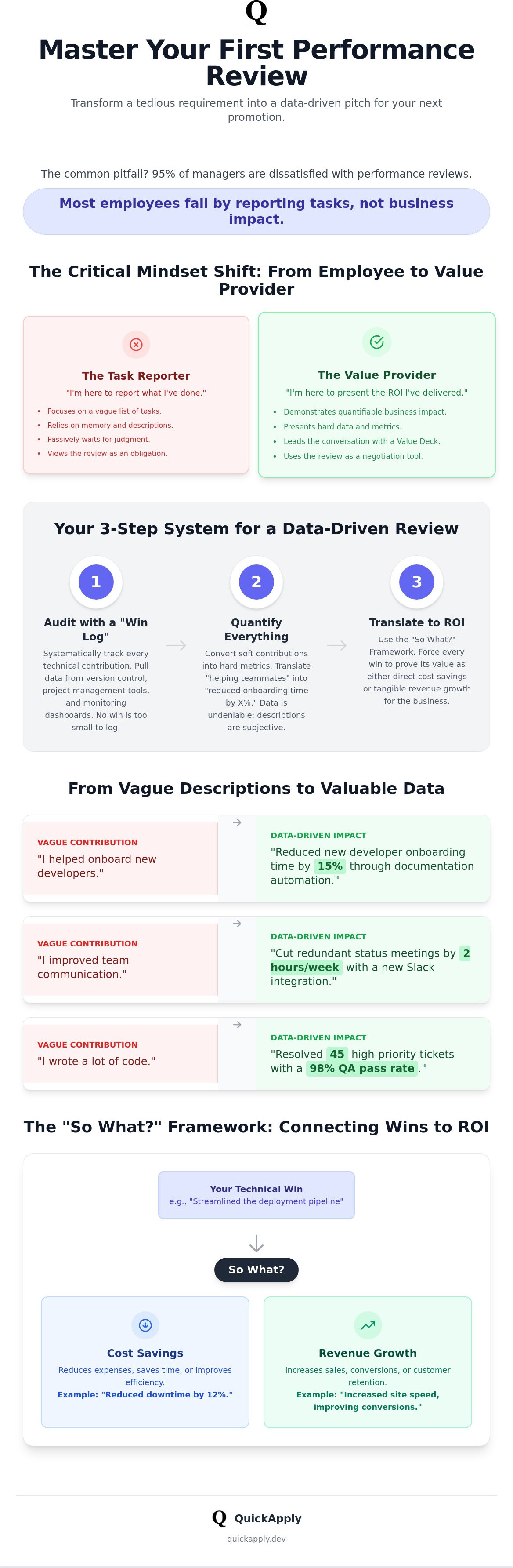
- Deploy the "Win Log" method to audit technical contributions and quantify system optimizations with data-driven precision.
- Force every technical win to prove its worth using the "So What?" Framework, categorizing results as either cost savings or revenue growth.
- Master how to show value in your first performance review by leading the meeting with a structured Value Deck that highlights your specific ROI.
- Transform the annual review into a continuous cycle of success by automating your Achievement Tracker and refining your Promotion Roadmap.
The First Performance Review: Setting Your Career Trajectory
Your first performance review is a high-stakes calibration. It's not just a chat about your first few months; it's the anchor for your entire tenure. If you treat it like a passive administrative hurdle, you're leaving your professional growth to chance. In the 2026 job market, this meeting sets the baseline for every future raise, bonus, and promotion. Understanding what is a performance review in a strategic context is the difference between being a "safe hire" and a "rising star."
Most employees fall victim to the "First Review Paradox." They believe doing their job well is the ultimate goal. It isn't. Meeting your job description is simply the baseline for employment; it's why you weren't terminated during your probationary period. To truly win, you must shift from reporting tasks to demonstrating business impact. You didn't just "manage the sprint." You "streamlined the deployment pipeline to reduce downtime by 12%." This distinction is the core of how to show value in your first performance review. You're no longer an applicant proving potential. You're an asset proving ROI.
This initial evaluation also serves as your primary leverage point for future salary negotiation. Without a documented win at the six-month or one-year mark, your request for a market adjustment lacks a data-driven foundation. Establish a high-output reputation now to ensure your trajectory remains vertical.
Defining Success in the 2026 Tech Landscape
Success in 2026 isn't about hours logged at a desk. It's about AI-augmented productivity and systemic efficiency. Managers don't care about the grind; they care about the optimized output. You need to identify the "Hidden Curriculum" of your specific team. What keeps your manager up at night? If you align your personal output with department-level KPIs, you become indispensable. Use data to prove you're solving the problems the board actually cares about.
The Emotional Shift: From Employee to Value Provider
Kill the imposter syndrome before you enter the room. You aren't there to be judged. You're there to present a progress report on a high-value asset—yourself. View your manager as a partner in your ROI, not a gatekeeper. In this environment, "bragging" is just reporting data. If you don't document your wins, they don't exist in the company's ledger. High-impact phrasing turns a list of chores into a compelling narrative of growth. This is exactly how to show value in your first performance review while securing your seat at the table.
Conducting a Personal Value Audit: Data over Description
Stop relying on your memory to build your case. Memories are subjective; data is undeniable. To effectively prepare for your first performance review, you must retroactively harvest your achievements through a systematic "Win Log." This isn't a diary. It's a technical audit of your contributions. Start by pulling your deployment frequency and average pull request cycle time from your version control system. If you reduced technical debt, don't just say the code is cleaner. Calculate the reduction in build times or the drop in post-release bug reports. These numbers provide the objective proof required to justify your seat at the table.
Mapping your contributions to the company’s core revenue drivers is the ultimate power move. Every line of code or system optimization should serve a business goal. Did your refactor increase site speed? Link that to a decrease in bounce rates or an increase in conversion. Managing your internal reputation requires the same precision as a high-stakes job search. Use an Application Tracker to log these internal milestones as they happen, ensuring you never walk into a review empty-handed.
Hard Metrics vs. Soft Contributions
Soft skills are only valuable when they produce hard results. You must translate vague collaboration into quantifiable efficiency gains. Use these conversion examples to refine your audit:
- Vague: "Helped onboard new developers." Data-Driven: "Reduced developer onboarding time by 15% through documentation automation."
- Vague: "Improved team communication." Data-Driven: "Implemented a new Slack integration that cut redundant status meetings by 2 hours per week."
- Vague: "Wrote a lot of code." Data-Driven: "Resolved 45 high-priority Jira tickets with a 98% pass rate in initial QA."
Impact Metrics are the verifiable data points that prove your work directly accelerated business objectives or reduced operational friction.
The "Peer Review" Pre-Game
Your manager isn't the only person watching your work. Gather informal testimonials from cross-functional colleagues before the formal process begins. This identifies "blind spots" in your self-assessment and provides 360-degree evidence of your influence. Leveraging good resume examples helps you find the precise, high-impact language needed to frame these internal achievements. When you present your wins using industry-standard terminology, you demonstrate a level of professional maturity that makes a promotion feel like the next logical step. This is exactly how to show value in your first performance review without sounding like you're guessing at your own worth.
Translating Technical Tasks into Business ROI
Managers aren't compilers. They don't execute code; they execute strategy. If you walk into your meeting and simply list your closed Jira tickets, you've already failed the most important test. Your manager needs to know why your work matters to the stakeholders and the bottom line. This is the core of how to show value in your first performance review. You must act as a translator, turning technical output into business outcomes. Every bullet point you present should pass the "So What?" test. If a non-technical executive can't see the financial or operational benefit, the win doesn't exist.
Categorize your achievements into two primary buckets: Cost Savings or Revenue Generation. Did you automate a manual data entry process? That's cost savings through reduced man-hours and error mitigation. Did you optimize the checkout flow? That's revenue generation through increased conversion rates. In 2026, "Efficiency" is the most valuable word in your vocabulary. With 90% of HR leaders believing traditional reviews miss the mark, providing clear ROI makes their job easier. Use a Promotion Roadmap mindset to prove that your past efficiency is the blueprint for your future leadership potential.
The ROI Translation Formula
Stop describing what you did and start describing what you solved. Use this three-step formula to rebuild your achievement list:
- Step 1: Identify the Task. Example: "Refactored the legacy API endpoints."
- Step 2: Identify the Result. Example: "Reduced latency by 200ms and decreased server load."
- Step 3: Identify the Value. Example: "Improved mobile user retention by 3% and cut infrastructure costs by $1,200 monthly."
This formula forces you to look beyond the terminal. It connects your keyboard directly to the company's bank account, making your value undeniable.
Addressing the "Only Doing My Job" Objection
Don't let a manager shrug off your work as "standard duties." Reframe your everyday consistency as "high-reliability output." If you've maintained a 100% on-time delivery rate, you've provided the stability the team needs to scale. Highlight the "extra-mile" moments you might have forgotten. Did you update the developer wiki without being asked? Did you catch a critical edge case in a peer's pull request? These aren't just tasks; they are examples of you setting new standards. Differentiating between "Meeting Expectations" and "Setting New Standards" is the most effective way to master how to show value in your first performance review. You aren't just an employee; you're a high-performing asset that the company cannot afford to lose.
To remain a high-performing asset, you must also prioritize your physical well-being and energy levels. For those balancing intense work with demanding schedules, you can find out more about specialized fitness strategies to prevent exhaustion.
The Performance Review Meeting Playbook
Preparation is the foundation, but the meeting is the execution phase. This is where your data audit becomes your leverage. Don't wait for your manager to set the agenda. Lead the conversation by opening with a collaborative, high-energy tone. State your objective clearly: you're here to review your impact and align on the roadmap for the next sprint. This proactive approach is a critical part of how to show value in your first performance review. It signals that you aren't just a passenger in the company; you're a driver of its success.
Present your summary document immediately. In 2026, managers are overwhelmed by data. They don't want a 10-page self-assessment; they want a high-impact summary of wins. Use your Value Deck to guide the narrative. If the conversation drifts toward minor administrative points, pivot back to your ROI. When you receive critical feedback, don't get defensive. Listen, acknowledge the data, and immediately ask how to optimize that specific metric. This "Future-Focus Pivot" transforms a critique into a strategy session, proving you're committed to continuous improvement.
Closing the loop requires a direct ask. If your data proves you've exceeded your initial KPIs, you've earned the right to discuss your trajectory. Use a structured Salary Negotiation Guide to ensure your request is backed by market data and internal impact. Don't leave the room without a confirmed path toward your next milestone.
Scripts for High-Stakes Moments
Silence is the enemy of promotion. Use these scripts to maintain control of the narrative:
- When a win is overlooked: "I'd like to add some context to the API refactor. That project actually reduced our server costs by 12%, which directly impacted this quarter's operational budget."
- Responding to criticism: "I appreciate that perspective on my documentation speed. I'll integrate an automated linting tool to increase my output while maintaining the quality standards we've discussed."
- The Ask: "Given the $50,000 in technical debt I've cleared this year, I'd like to discuss a salary adjustment that reflects this level of contribution."
Visualizing Your Value
Human brains process visuals 60,000 times faster than text. A single chart showing your deployment frequency increasing over six months is more persuasive than five paragraphs of description. Create a 1-page "Impact Summary" that features three key charts: your growth in output, your reduction in error rates, and your contribution to revenue-generating features. Finish by presenting a "Roadmap for the Next 12 Months." Showing you've already planned your next year of wins makes it easy for your manager to invest in your future. This level of foresight is exactly how to show value in your first performance review while others are still trying to remember what they did in January.
Beyond the Review: Automating Your Promotion Roadmap
The meeting is over, but the cycle never stops. Most professionals treat the performance review as a destination. They secure their raise, exhale, and coast until the next annual cycle. This is a tactical error. High performers understand that the 365-day performance cycle begins the second you leave the room. If you want to master how to show value in your first performance review and every subsequent one, you must automate your visibility. Don't rely on your manager's memory or your own capacity to recall wins under pressure; instead, use a Free Notes App to transcribe your thoughts and document your successes the moment they happen. Implement an automated Achievement Tracker today.
Your second year is about bridging the gap between your current duties and the next tier on the organizational ladder. You've already established your baseline ROI; now you must prove you can scale it. QuickApply’s Promotion Roadmap tool is designed for this exact transition. It eliminates the manual labor of career tracking by aligning your daily output with the requirements of your target role. By the time your next review arrives, the data will already be compiled, formatted, and ready for presentation. This systemic approach ensures your trajectory remains vertical without active effort.
Strategic Networking and Internal Visibility
Value is only recognized if it's visible. You need the right stakeholders to know about your wins long before the formal process begins. Build an internal "Board of Advisors" consisting of mentors and cross-functional peers who can advocate for your work in rooms you haven't entered yet. Use the same logic you'd use to tailor resume to job description to refine your internal status reports. Frame your updates around the specific pain points of your department. When your reporting speaks the language of their priorities, your influence expands automatically.
Preparing for the Next Leap
The preparation for your second review starts tomorrow. Waiting until the eleventh month to gather data is why 95% of managers remain dissatisfied with the review process. Identify the skills required for the next level immediately. Are you missing a specific technical certification or leadership experience? Document your plan to acquire these assets and track your progress in real-time. This proactive mindset is the ultimate answer to how to show value in your first performance review and beyond. You aren't just asking for a promotion; you're proving you've already outgrown your current role. Start your Promotion Roadmap with QuickApply today and turn your career progression into an automated system.
Secure Your Vertical Trajectory
Your first review isn't a retrospective; it's a high-stakes launchpad. You've learned to audit your technical debt reduction and bridge the gap between code and revenue. By mastering how to show value in your first performance review, you've effectively de-risked your career. You aren't just meeting expectations anymore. You're setting the standard for your entire department through data-driven precision and systemic efficiency.
Don't let this momentum stall. Thousands of tech professionals use our AI-driven systems to automate their next raise and title change. From detailed salary negotiation guides to real-time achievement tracking, we provide the tools to keep your growth on autopilot. The 2026 landscape rewards those who treat their career like a product that requires constant optimization. It's time to stop manual tracking and start leveraging smart technology.
Master your career growth with QuickApply’s Promotion Roadmap and lock in your future ROI today. You've got the data. Now use the system that makes your success inevitable.
Frequently Asked Questions
How far in advance should I start preparing for my first performance review?
Preparation starts on your first day of employment. You should document every win, system optimization, and closed ticket in real-time using an automated Achievement Tracker. Waiting until the month of the review leads to memory bias and lost data. Consistent logging ensures you have a comprehensive dataset to prove your ROI when the meeting arrives.
What if my manager gives me a negative review for my first 6 months?
Pivot to a data-driven recovery strategy immediately. Don't take the feedback personally; treat it as a system bug that requires a patch. Ask for the specific KPIs you need to hit over the next 90 days to reverse the trend. Documenting your improvement trajectory proves your resilience and commitment to high-level output.
Should I bring a physical or digital document to my performance review?
Bring a high-impact digital summary and have a one-page physical backup ready. Digital decks allow for dynamic data visualization of your growth metrics. A physical "Impact Summary" ensures the conversation stays on track even if technical glitches occur. Efficiency is your primary goal; don't waste time troubleshooting a screen share during your pitch.
How do I quantify value if I work in a role without direct revenue impact?
Focus on efficiency gains and cost-saving metrics instead. If you don't generate cash, you likely save time or reduce operational friction. Quantify how you streamlined a workflow or reduced technical debt. For instance, cutting documentation time by 15% is a concrete business win that translates directly to saved man-hours and increased department velocity.
Is it appropriate to ask for a raise during my very first performance review?
Yes, provided your data proves you've exceeded the initial job description. If your ROI outpaces your current salary, a market adjustment is a logical business request. Use a Salary Negotiation Guide to present market data alongside your specific wins. This is a core part of how to show value in your first performance review effectively.
What are the most important KPIs to track for a junior software engineer in 2026?
Track your deployment frequency, pull request cycle time, and AI-augmented output. In the 2026 landscape, efficiency is the primary currency. Beyond code quality, focus on how rapidly you move from ticket assignment to production. High-performing juniors also monitor their "error-to-resolution" ratio to demonstrate technical maturity and system reliability.
How do I handle a performance review if my manager is new to the team?
Act as the primary historical data provider for your own performance. A new manager lacks the context of your early wins and onboarding speed. Present a consolidated "Win Log" to catch them up instantly. This proactive onboarding of your manager proves your leadership potential and makes their evaluation process completely frictionless.
Can I use AI tools to help write my self-assessment for the review?
Use AI to structure your data and refine your professional phrasing. Modern tools are excellent for translating technical tasks into business ROI. Use them to ensure your self-assessment speaks the language of executive leadership. This is a strategic way to learn how to show value in your first performance review while utilizing the latest efficiency-driven technology.


