

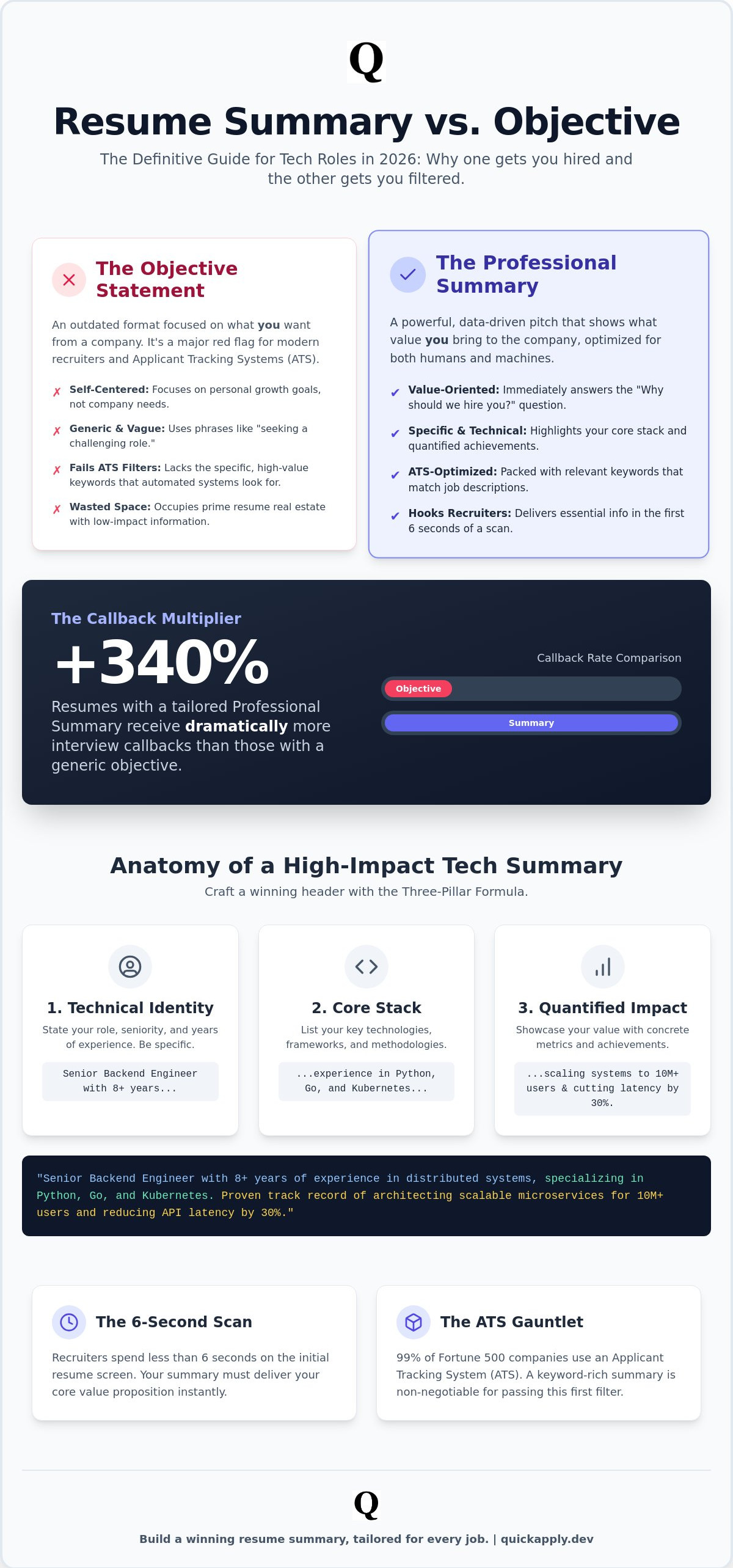
Your resume objective isn't just outdated; it's actively sabotaging your technical career. In a market where 99% of Fortune 500 companies rely on an Applicant Tracking System (ATS), sending a generic "seeking a challenging role" statement is the fastest way to get filtered out. You've likely felt the frustration of your applications disappearing into a black hole, wondering if a human ever actually sees your code or your contributions. The data is clear: resumes featuring a professional summary receive 340% more interview callbacks than those sticking to a traditional objective. This guide settles the resume summary vs objective for tech roles debate by showing you how to optimize your prime resume real estate for 2026 standards.
You deserve a system that works as hard as you do. We'll provide a clear framework for crafting a high-impact tech summary that hooks recruiters in seconds while satisfying complex AI-driven screens. Stop wasting hours on manual rewrites and start using a header that mirrors your specific tech stack and methodology. You're about to learn how to bypass the filters, leverage new regulations like New York's AEDT bias audits to your advantage, and turn your resume into a high-performance tool for your career.
Key Takeaways
- Ditch the outdated objective and adopt a professional summary to focus on solving company problems rather than stating your own needs.
- Master the Three-Pillar Formula to combine your technical identity, core stack, and quantified impact into a high-performance header.
- Optimize for 2026 semantic search filters by understanding how modern ATS platforms weigh specific tech keywords over broad industry terms.
- Navigate the resume summary vs objective for tech roles debate with specific tailoring strategies for every career stage from junior dev to staff engineer.
- Leverage AI-driven resume tailoring to automate the optimization process and maintain a competitive edge in high-volume job markets.
Resume Summary vs Objective: Why the Tech Industry Moved On
In the high-velocity tech market of 2026, efficiency is the only metric that matters. Recruiters spend less than 6 seconds on an initial screen before deciding your fate. If your header doesn't deliver instant value, you're already out. The traditional career objective is a legacy format that no longer compiles in modern hiring systems. Understanding the resume summary vs objective for tech roles shift is the first step toward optimizing your application pipeline. You need to stop telling companies what you want and start showing them what you can solve.
Modern hiring managers look for a "Summary 2.0" approach. This isn't a vague paragraph about your passions. It's a high-density data block that integrates your stack, your scale of operations, and your specific impact. You're building a narrative that proves you can execute from day one. If your resume still leads with an objective, you're signaling that you're stuck in the past. It's time to refactor your header for maximum performance.
The Death of the Career Objective
The objective statement is dead because it's self-centered. Phrases like "seeking a challenging role where I can grow my skills" are red flags for hiring managers. They signal that you're looking for a mentor, not a contributor. In a competitive landscape, companies hire for solutions to existing problems. They don't care about your personal growth goals during the initial screen. They care about your output. While a look at the history of the resume shows that objectives were once standard, 2026 demands a focus on immediate ROI.
There are rare exceptions. If you're an absolute tech novice or a student with zero internship experience, an objective can clarify your trajectory. Even then, it's often better to summarize your technical logic and project work. For anyone with even one year of experience, the objective is just wasted space. Use that real estate to highlight your most relevant skills instead of your career aspirations.
The Rise of the Tech Professional Summary
A professional summary functions as your 30-second elevator pitch. It's a strategic narrative that flags your specific tech stack and quantified impact immediately. Tech recruiters operate like human search engines. They look for specific signals: "Distributed systems," "Kubernetes at scale," or "React optimization." If these signals aren't in the top three inches of your document, you're invisible. A well-crafted summary sets the stage for the rest of your experience. It forces the recruiter to view your bullet points through a lens of proven expertise. Using Resume Tailoring ensures your summary matches the specific signals each recruiter is programmed to find.
Anatomy of a High-Impact Tech Resume Summary
Your summary isn't a biography. It's a technical specification for your career. While the resume summary vs objective for tech roles debate is settled, most candidates still fail at the execution phase. A high-performance summary requires a Three-Pillar Formula: Technical Identity, Core Stack, and Quantified Impact. This structure ensures that both human recruiters and AI filters find exactly what they need in the top three inches of your document. If you don't define your value immediately, you're forcing the reader to hunt for it. They won't.
Keyword density is the engine of your summary. You must weave in languages like Python or Rust and frameworks like React or Django naturally. Avoid "keyword stuffing" which looks like a random list of terms. Instead, integrate these technologies into active statements about your work. Seniority is proven through the "Scale Factor." Mentioning user counts, Petabytes of data volume, or infrastructure size provides the context recruiters need to verify your level. Replace passive language like "responsible for" with high-velocity verbs. Use "architected," "optimized," or "orchestrated" to signal leadership and technical authority.
Efficiency is the core of a modern job search. You can't afford to manually rewrite these pillars for every application. Utilizing a tool for Resume Tailoring allows you to swap out specific frameworks and metrics to match each job description instantly. This ensures your summary always aligns with the specific requirements of the role.
The 'Years + Stack' Identity Statement
Lead with your primary engineering persona. Don't just say "Software Engineer." Be specific: "Senior Backend Engineer with 8+ years of experience in Python and distributed systems." This single sentence defines your niche and prevents "jack of all trades" syndrome. Focus on your strongest three or four technologies. If you're applying for a Rust role, your expertise in legacy PHP is irrelevant in the header. Keep the focus sharp to maintain high relevancy scores.
Quantifying Engineering Impact
Numbers provide the evidence for your claims. Use the Google X-Y-Z formula: Accomplished [X] as measured by [Y], by doing [Z]. For example: "Reduced API latency by 40% (Y) by architecting a Redis caching layer (Z), improving the experience for 500k daily active users (X)." This approach works for all levels. Whether you're highlighting cost savings, deployment frequency, or team size, metrics turn vague claims into verifiable facts. Even soft skills like leadership should be backed by team size or project scope to provide a clear picture of your capabilities.
Passing the 2026 Tech ATS: Why Tailoring is Non-Negotiable
The technical screening process in 2026 is no longer a simple keyword search. Modern Applicant Tracking Systems (ATS) now utilize semantic search to understand the context of your experience. If a job description specifically requires an "AWS Architect," a summary that only mentions "Cloud Infrastructure" may fail to trigger a high relevancy score. These systems are programmed to find direct stack alignment. This is the primary reason the resume summary vs objective for tech roles debate favors the summary. A summary provides the space to mirror the exact technical requirements of a role, whereas an objective remains too vague for modern algorithms to categorize effectively.
Match scores are the new gatekeepers. Platforms like Workday and Greenhouse now weight the summary section higher for relevancy because it serves as the metadata for your entire document. To survive this initial filter, you must tailor your resume to a job description with surgical precision. Aiming for a 90% or higher match score is the only way to guarantee your resume reaches a human recruiter. Without this alignment, your application will likely be archived by the system before a person ever sees your name. Optimization is not about "gaming the system" but about ensuring your technical profile is readable by the machines that manage the hiring pipeline.
Avoid the trap of keyword stuffing. While you need specific terms, turning your summary into jargon-vomit will backfire during the human review. Optimization requires a balance. You need to integrate your stack naturally into statements of achievement. If you list twenty frameworks without context, you signal a lack of depth. Focus on the core technologies requested in the JD and prove your proficiency through the impact you've delivered with them.
Hard Skills vs. Cultural Fit in the Header
In a technical screen, your hard skills must occupy 80% of your summary real estate. Recruiters are looking for technical competency first. Cultural fit is important, but it should be signaled through your methodology rather than empty buzzwords. Instead of calling yourself a "team player," mention your experience with "Agile sprints" or "cross-functional DevOps collaboration." This proves you understand the environment without relying on fluff. Additionally, include high-level certifications like CKA, AWS Solutions Architect, or PMP directly in the summary. These act as immediate trust signals for high-level filtering bots.
AI-Driven Recruiting: How Your Summary is Parsed
Large Language Models (LLMs) now categorize your engineering persona based almost entirely on your header. These models extract data to build a candidate profile before the recruiter even opens the file. Complex formatting, such as icons, progress bars, or multi-column layouts, can break the parser's ability to read your summary. Plain text summaries remain the safest and most efficient choice for modern ATS extraction. Stick to standard fonts and clear headings to ensure the AI captures 100% of your data without errors.
Tailoring for Success: From Entry-Level to Staff Engineer
Seniority dictates the architecture of your summary. You can't use a junior template for a Staff role and expect a callback. The resume summary vs objective for tech roles debate becomes even more critical as you climb the ladder. For juniors, the header proves capability. For seniors, it proves leadership and scale. You need to view these good resume examples to see how the narrative shifts as you gain years in the industry. Your summary must evolve from a list of skills into a statement of technical authority.
Junior developers often fall into the trap of writing an objective because they feel they lack professional experience. Don't do it. Use the Potential + Proof approach. If you haven't held a corporate title, your summary should highlight the specific tech stacks you used in bootcamps, capstone projects, or Open Source contributions. Treat a major GitHub project like a job. If you built a full-stack CRUD app using React and Node.js, that's your proof. This signals to hiring managers that you're ready to contribute code on day one.
Senior and Staff engineers must move beyond the doing phase. Recruiters at this level aren't just looking for someone who can write Python. They want someone who can architect distributed systems and lead cross-functional teams. Your summary must reflect this shift. Focus on high-level impact. Mention architecting migrations from monolith to microservices or leading teams of engineers to deliver high-availability APIs. Quantify these achievements to prove you can handle the complexity of modern enterprise environments.
The Entry-Level Tech Summary Formula
Juniors must lead with high-velocity learning and specific project results. If professional history is thin, emphasize your contributions to Open Source or hackathons as valid experience. Your summary should combine your core stack with a tangible outcome from a project. This proof-based strategy signals to hiring managers that you're ready to contribute without extensive hand-holding. Focus on the stack you used and the problem you solved.
The Career Changer's Pivot Statement
Transitioning into tech requires a surgical Hybrid Summary. Use a 3-step formula: define your new technical identity, highlight a transferable domain skill, and provide recent technical proof. If you moved from finance to data science, lead with "Data Scientist with a background in Quantitative Finance." This anchors the recruiter's expectations while leveraging your professional maturity and analytical depth. It proves you aren't starting from zero.
Identifying transferable tech skills is the key to a successful pivot. If you were in finance, your data analysis skills are your bridge. This prevents confusion and leverages your past professional value. Start your optimization today with automated Resume Tailoring to ensure your seniority level is perfectly calibrated for the JD.
Automating the Optimization: Using AI to Win the Tech Job Hunt
Manual tailoring is a legacy bottleneck that no high-performing engineer can afford. In a market where over 83% of employers use AI or automation in their recruiting processes, fighting machines with manual labor is a losing strategy. You need a system that scales your quality. QuickApply's AI Resume Tailoring tool generates perfect summaries for every JD in seconds, ensuring your technical profile is never generic. This effectively solves the resume summary vs objective for tech roles dilemma by ensuring your header always hits the specific semantic targets required by the latest ATS algorithms.
The feedback loop is your secret weapon for 2026. Use Match Scores to refine your technical narrative before you hit 'Apply'. If your score is below 90%, the system identifies the specific gaps in your stack or scale. This optimization shouldn't exist in a vacuum. Integrating your optimized summary into AI cover letter generation creates a unified professional brand. This cohesion reinforces your expertise across every touchpoint, from the initial bot screen to the final hiring manager review.
Efficiency as a Competitive Advantage
Applying to 50 tailored roles is objectively better than blasting 500 generic ones. AI doesn't just swap keywords; it identifies 'hidden' technical requirements in a job description that human eyes often miss. This allows you to position your experience as the exact solution the company needs. QuickApply reduces resume prep time by 90% for tech pros by automating the alignment between your experience and the job description. This efficiency allows you to focus on interview preparation and skill development rather than document formatting.
- Identify specific tech stack requirements automatically.
- Generate high-velocity summaries that prioritize ROI and impact.
- Scale your application volume without sacrificing tailoring quality.
Your 2026 Career Growth Roadmap
Data-driven job hunting is the standard for modern developers. Use the application tracker to identify which summary versions get the most callbacks. This allows you to A/B test your technical persona in real time and refine your pitch based on market demand. Preparing for the interview becomes easier when your verbal pitch aligns perfectly with your resume's 'Tailored Impact Statement'. Consistency across your documents and your conversation builds the trust necessary to secure high-compensation offers. Start tailoring your tech resume with QuickApply today.
Upgrade Your Career Pipeline Architecture
The tech market doesn't reward effort; it rewards results. Leaving your resume header to chance is a technical debt you can't afford. You now have the framework to transform a static objective into a high-density summary that triggers the right signals for recruiters and AI parsers. Success in 2026 requires moving beyond manual document editing and embracing systemic automation. Mastering the resume summary vs objective for tech roles debate is just the first step in building a high-performance career engine.
Stop losing opportunities to black-hole filters. Optimize your tech resume summary in seconds with QuickApply's AI Tailoring Tool. Leverage AI-powered match score analysis to ensure your profile is calibrated for FAANG or high-growth startups instantly. With automated application tracking included, you can manage your entire pipeline with surgical precision. Your next role is waiting. Take control of your trajectory and execute your job search with the same efficiency you bring to your code.
Frequently Asked Questions
Is a resume objective ever better than a summary for tech roles?
A resume objective is only superior when you have zero technical background or are pivoting to a completely unrelated field. In almost every other scenario, the professional summary wins because it prioritizes what you can execute on day one. Tech recruiters in 2026 value immediate ROI over personal growth statements. If you have any projects or stack experience, use a summary to lead with value.
How long should a tech resume summary be in 2026?
Keep your summary between three and five lines. You're aiming for high-density data, not a biography. Modern ATS parsers and human recruiters scan for specific stack signals, so every word must earn its place. Use short, punchy sentences to maintain momentum and ensure your core value proposition is consumed in under six seconds. Efficiency is the only metric that matters in this section.
Should I include my GitHub or LinkedIn link in the summary section?
Place your GitHub and LinkedIn links in the contact header, not the summary paragraph. The summary section is prime real estate for your technical identity and quantified impact. Using this space for URLs disrupts the reading flow and wastes space that should be used for keyword-rich descriptions of your architecture or deployment successes. Keep the summary focused on the narrative of your expertise.
How many technical keywords should I include in my resume summary?
Focus on three to five core technologies that define your engineering persona. While the resume summary vs objective for tech roles debate emphasizes keywords, stuffing twenty frameworks into one paragraph triggers red flags. Select the stack most relevant to the specific job description. This ensures you pass semantic search filters without sacrificing readability for the human recruiter who sees your resume next.
Can I use the same summary for a Full Stack and a Backend role?
You cannot use a generic summary for different engineering roles without losing competitive advantage. A Full Stack summary must highlight interface optimization and API design, while a Backend summary should prioritize distributed systems and database architecture. Use Resume Tailoring to adjust your technical narrative for each specific job description. This automation ensures you maintain a high match score across different technical personas.
What are the best action verbs for a software engineer resume summary?
Utilize high-velocity verbs that signal technical authority and ownership. Replace passive language with "architected," "optimized," "refactored," or "orchestrated." These verbs describe specific engineering actions and imply a level of seniority that generic terms like "helped" or "worked on" fail to convey. Your word choice should mirror the speed and functionality of the systems you build every day.
Do recruiters actually read the resume summary, or do they skip to experience?
Recruiters scan the summary to validate your stack-match before diving into your experience. It serves as the metadata for your career. If your summary doesn't align with their requirements in the first six seconds, they likely won't read your bullet points. A strong summary forces them to view your professional history through a lens of proven expertise rather than just a list of jobs.
How do I write a tech summary if I have no professional experience yet?
Lead with your technical identity and the specific stack you've mastered through projects, bootcamps, or Open Source. Instead of professional titles, highlight the architecture of your capstone projects or your contributions to the community. This proof-based approach provides the signal that hiring managers need. It settles the resume summary vs objective for tech roles question by proving you can execute despite a lack of traditional history.


