

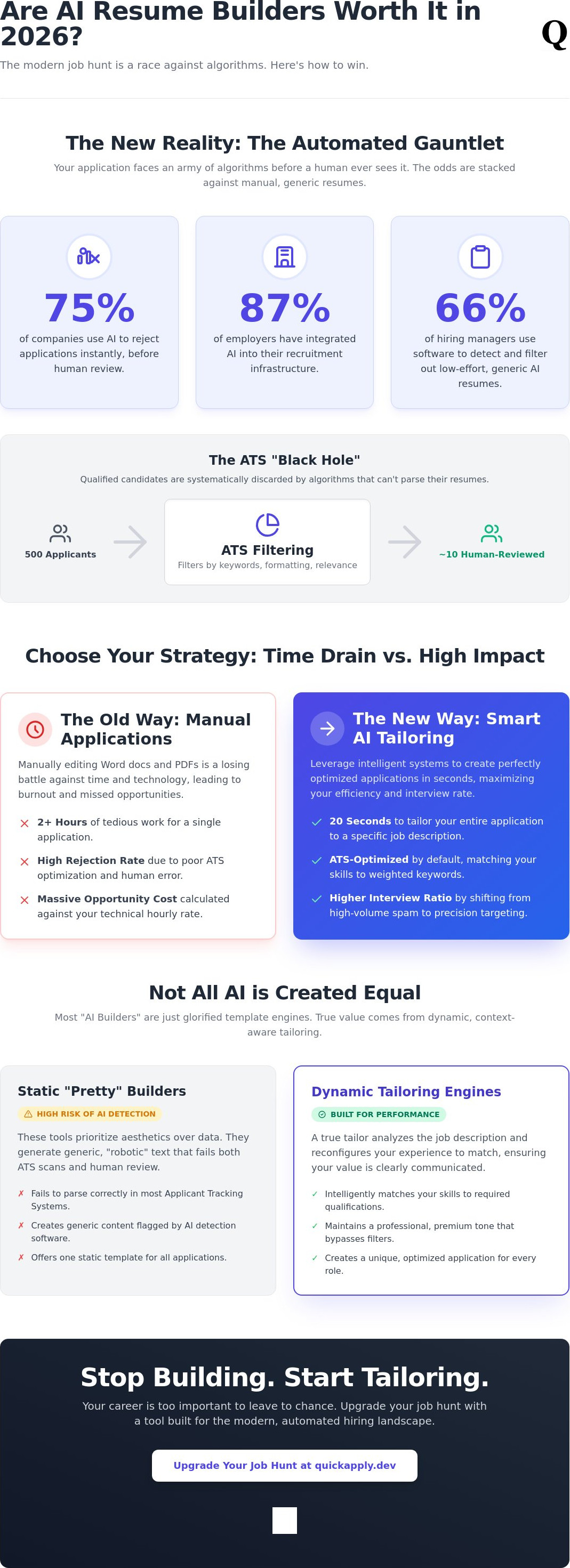
75% of companies now allow AI to reject your application before a human recruiter even sees your name. It's a cold, automated reality that makes the standard job hunt feel like a losing game. You've likely felt the burnout of manual tailoring and the frustration of subscription models that promise the world but deliver "robotic" templates. You're left wondering: are ai resume builders worth it, or are they just another monthly cost draining your budget? If you use them to generate generic blocks of text, you're just adding to the noise that 66% of hiring managers are already using detection software to filter out.
We agree that the current application process is a massive drain on your productivity. Spending hours on a single PDF for zero response is an inefficient use of your technical talent. This guide promises to reveal the real-world value of AI career tools in 2026. You'll learn how to distinguish between low-quality generators and high-impact tailoring systems that actually secure the win. We're moving past the "robot voice" myth to focus on systemic optimization. We'll analyze the 2026 ROI for tech pros, showing you how to slash your application time while drastically increasing your interview-to-application ratio.
Key Takeaways
- Ditch static templates for dynamic context-matching to bypass the 2026 algorithmic filters used by 87% of employers.
- Calculate the real-world opportunity cost of manual applications against your current technical hourly rate.
- Identify the "Robot Voice" markers that trigger AI detection software and learn how to maintain a premium, professional tone.
- Use market-driven data to decide once and for all: are ai resume builders worth it for your specific career stage?
- Shift your strategy from high-volume application spam to precision resume tailoring that drives higher interview-to-application ratios.
The ROI of AI: Is an AI Resume Builder Actually Worth It?
The traditional job application is dead. In 2026, 87% of companies have integrated AI into their recruitment infrastructure. If you're still manually editing bullet points in a Word document, you're competing with legacy systems. A modern AI resume tool isn't just a collection of templates; it's an intelligent context-matching engine. While the purpose and history of a résumé focused on static documentation, the current landscape demands dynamic optimization. To determine if are ai resume builders worth it, you must evaluate them as a bridge between your talent and an algorithmic gatekeeper.
Tech pros face a "Volume vs. Quality" paradox. Recruiters now handle 93% more applications than they did five years ago. You need to apply to more roles to stay visible, but generic applications get flagged as "lazy AI" and discarded. Manual tailoring is no longer a viable strategy for competitive roles because it consumes your most valuable resource: time. By the time you've spent two hours perfecting a single application, 500 other candidates have already hit the portal. You need speed and precision to win.
Defining the Value Proposition
Modern career tools offer a high-performance ROI by automating the tedious parts of the job hunt. Consider these three pillars of efficiency:
- Speed: Systems like Resume Tailoring reduce two hours of manual editing to 20 seconds of processing.
- Precision: Algorithms align your experience exactly with ATS-weighted keywords, ensuring you pass the initial 75% automated rejection phase.
- Confidence: You eliminate "blank page" anxiety. The software provides a professional baseline, allowing you to focus on high-level strategy rather than formatting.
The Cost of Doing Nothing
Sticking to old methods has a measurable financial and psychological cost. Generic resumes get filtered by 66% of hiring managers who now use detection software to screen for low-effort submissions. You aren't just losing time; you're losing access to the market. The ATS Black Hole is a systemic failure where qualified candidates are discarded by algorithms before a human ever reviews their credentials. This lack of response creates a psychological toll that leads to burnout and extended unemployment. When you calculate your hourly rate as a tech pro, spending weeks on a low-response marathon is a massive drain on your potential earnings. Investing in a high-impact tailoring system isn't an expense; it's a necessary upgrade to your professional stack.
Static Templates vs. Dynamic Tailoring: Why Most Builders Fail
Most job seekers fall into the "Pretty Template" trap. They prioritize aesthetic layouts and unique fonts, believing a visually striking PDF will grab a recruiter's attention. In reality, design matters far less than data structure. If your resume isn't parsed correctly by an Applicant Tracking System (ATS), no human will ever see your color palette. Many users question are ai resume builders worth it when they're paying for glorified Canva templates. If the tool only changes the layout without optimizing the logic, the answer is no. You don't need a builder; you need a tailoring engine.
Static builders generate one document and expect it to work everywhere. This is a failing strategy in 2026. Experts reviewing the top AI resume builders often miss the distinction between basic generation and dynamic tailoring. A basic generator spits out generic text based on a prompt. An intelligent tailor analyzes a specific job description and reconfigures your experience to match. For a deep dive into which tools actually offer this functionality, check out our breakdown of the best ai resume builder 2025.
The Anatomy of a Modern AI Tailor
True tailoring relies on advanced Natural Language Processing (NLP) that understands technical stacks. It doesn't just scan for keywords; it understands context. If a role requires DevOps expertise, a sophisticated tailor knows to transform a vague bullet point like "managed a team" into "led 12 engineers in a CI/CD environment." It bridges the gap between what you did and what the recruiter needs to see. This intelligence extends to Cover Letter Generation, ensuring your narrative tone remains consistent across your entire application package.
Comparison: Basic Builder vs. Intelligent Tailor
The difference between these two approaches is measurable. One creates more work; the other creates more interviews. You can see the shift in performance when you focus on tailoring your resume to a job description rather than just filling out a form.
| Metric | Basic Template Builder | Intelligent AI Tailor |
|---|---|---|
| Time-to-Apply | 45+ Minutes (Manual Edits) | Under 30 Seconds |
| Keyword Density | Generic / Static | Dynamic / Job-Specific |
| Recruiter Engagement | Low (Flagged as Generic) | High (Contextually Relevant) |
| ATS Compatibility | Hit or Miss | Optimized Data Structure |
Stop wasting energy on manual tweaks that don't move the needle. If you're ready to see how a high-performance system handles your next application, try Resume Tailoring to instantly align your profile with any tech role.
The 'Robot Voice' Myth: Can Recruiters Tell You Used AI?
Fear of the "robot voice" is the primary hurdle for tech pros deciding are ai resume builders worth it. While 66% of hiring managers now use AI-detection software, they aren't necessarily looking for a reason to reject you. They're filtering for "lazy AI." This occurs when candidates use raw prompts to generate generic text that lacks specific data points. If your resume is filled with overused adjectives like "passionate" or "synergistic" without technical context, you're triggering every red flag in the system. Recruiters report that 64% of applications now look identical because of this lack of refinement. To avoid this, you must understand that raw prompting is not a job search strategy in 2026.
The solution isn't to avoid technology; it's to adopt a "Human-in-the-Loop" strategy. You use high-impact tailoring systems to handle the structural alignment and keyword optimization. Then, you spend five minutes refining the output to ensure the technical nuances of your specific stack are accurate. This creates a document that feels premium and professional rather than automated. It bridges the gap between systemic efficiency and personal authenticity.
Avoiding the AI Stigma
Success in a tech-driven market requires you to be the editor, not just the prompter. AI can occasionally hallucinate technical details or misinterpret the scope of a project. Fact-checking every generated bullet point is non-negotiable. Injecting your personal voice into an optimized structure doesn't hurt your ATS score. It improves your interview conversion. A perfectly tailored resume isn't seen as "automated" by a savvy recruiter. It's seen as a sign of a candidate who is prepared, tech-literate, and respects the recruiter's time by presenting a clear match for the role.
Recruiter Perspectives in 2026
Recruiters are struggling with a 93% increase in application volume compared to five years ago. They use AI tools to manage this load, so they value the efficiency of a well-matched resume. The conversation has shifted from "did a machine write this?" to "does this candidate match our specific technical requirements?" When your resume aligns perfectly with their needs, the method you used to achieve that alignment becomes secondary to the result. AI is a tool for professional communication, not a replacement for talent. By leveraging Resume Tailoring, you're simply using the best available technology to prove you're the right fit for the job.
Calculating the Opportunity Cost of Manual Applications
Most tech pros analyze systems for a living but fail to audit their own job search. You must treat your time as a finite asset. When evaluating are ai resume builders worth it, look at the spread between manual labor and automated output. If your target salary is $150,000, every week of unemployment costs you roughly $2,884 in lost wages. Spending 20 hours a week manually tailoring five resumes is a massive misallocation of resources. You're trading thousands of dollars in potential earnings for a slow, manual process that offers no guaranteed return.
Subscription costs for premium tools are negligible compared to the salary bump of a faster placement. A single day of work at a new role often covers the entire cost of a year's worth of career software. Beyond the raw numbers, there's a hidden cost in "Application Burnout." Manual labor is a high-effort, low-reward cycle. It drains the energy you need for high-stakes technical interviews. Automating the top of the funnel preserves your mental bandwidth for the stages where human intuition actually matters.
The Efficiency Framework
Success in a crowded market is a numbers game backed by precision. Consider the output delta between these two strategies:
- Manual: 5 high-quality applications per week. High burnout. Low market coverage.
- AI-Powered: 50 high-quality, tailored applications per week. Low effort. Maximum market coverage.
The statistical reality of landing a FAANG or Tier-1 startup role requires high-volume visibility. You can't reach those numbers without systemic assistance—a concept well understood by businesses that use an automated SEO service to maintain their search presence. By the time a manual applicant finishes their second cover letter, an AI-powered candidate has already cleared the ATS filters for ten different roles. Speed wins in 2026.
Beyond the Resume: The Full Stack Search
A resume is just one component of a successful professional stack. You need an automated job application tracker to manage the volume you'll generate. Scaling your search shouldn't scale your stress levels. Integrated systems allow you to move seamlessly from Resume Tailoring to Interview Practice without losing momentum. This holistic approach ensures you aren't just applying faster, but also performing better when you get the call. Stop acting like a manual data entry clerk and start operating like the high-level talent you are. Optimize your workflow today by using our Application Tracker to manage every stage of your career transition.
QuickApply: Why Tailoring Beats Building Every Time
Legacy tools focus on the document. QuickApply focuses on the result. When you ask if are ai resume builders worth it, you have to look beyond the PDF. A 2026 job search requires an application engine that understands the nuances of technical recruitment. Our tech-first philosophy treats your career like a high-performance stack. We don't just provide a canvas for your experience; we provide a match score that identifies "best-fit" roles instantly. This allows you to stop guessing and start targeting roles where your technical skills have the highest probability of conversion.
The transition from a "builder" to an "engine" is the difference between manual labor and systemic automation. QuickApply handles the end-to-end lifecycle of your search. We move you from initial Resume Tailoring to a comprehensive Salary Negotiation Guide without losing a single data point. This integrated approach ensures your professional narrative remains cohesive as you scale your output. You're no longer just a candidate; you're a strategist using the most efficient path through the modern hiring system.
The QuickApply Advantage
Our platform ensures every component of your application works in perfect sync. Efficiency is built into the architecture of the tool. Consider how these features streamline your workflow:
- Seamless Integration: Your resume and AI cover letter generator output are contextually linked to ensure a unified tone.
- Intelligent Tracking: Use our Application Tracker to manage high volumes and ensure you never miss a critical follow-up window.
- Contextual Preparation: Our Interview Practice tools use your specific tailored resume as the context, generating questions that mirror real-world technical screenings.
Stop Building. Start Applying.
Efficiency is your only competitive advantage in a market saturated with look-alike applications. You don't have time to be a formatting expert or a copywriter. You're a tech professional. Your value lies in your ability to build systems and solve complex problems, not in fighting with a margins in a word processor. QuickApply empowers you to focus on the work while we handle the paperwork. It's time to stop wondering if are ai resume builders worth it and start leveraging a system designed for the 2026 landscape. Optimize your job search with QuickApply and secure your next role with surgical precision.
Scale Your Career Output
The 2026 job market is an algorithmic arms race. You can't win a high-tech game with low-tech tools. We've analyzed how dynamic tailoring beats static templates and why the "robot voice" is a myth solved by strategic refinement. The math is clear; every day you spend on manual labor is a day of lost tech wages. When asking are ai resume builders worth it, the ROI is found in reclaiming your time and landing interviews at a higher frequency. Precision beats volume every time.
Take control of your professional trajectory today. Start tailoring your resume for free with QuickApply to leverage AI-powered match scoring for tech roles, automated application tracking, and integrated salary negotiation guides. Your talent deserves a system that works as hard as you do. Stop building and start winning. You've got the skills; now get the system that proves it.
Frequently Asked Questions
Is it worth paying for an AI resume builder?
Yes, paying for a high-performance tool is a strategic investment if it offers dynamic tailoring. The value lies in bypassing the initial 75% automated rejection rate and reclaiming dozens of hours each week. When you calculate your technical hourly rate against the cost of a subscription, the ROI is immediate. Are ai resume builders worth it for your career? Only if they move you from manual data entry to systemic optimization.
Can ATS systems detect AI-generated resumes?
Most Applicant Tracking Systems prioritize keyword density and data structure over detection. However, 66% of hiring managers now use secondary AI-detection software to flag low-effort applications. You avoid these flags by using AI to handle the structural alignment while you refine the specific technical nuances of your projects. This "human-in-the-loop" strategy ensures your resume passes both the machine filter and the human review.
Do recruiters reject resumes that look like they were made by AI?
Recruiters reject "lazy AI" that relies on generic mission statements and overused adjectives. They don't reject well-organized, highly relevant resumes that match their specific requirements. In a market where recruiters handle 93% more applications than in 2021, they value the efficiency of a clear match. Use Resume Tailoring to prove you are the right fit without sounding like a generic prompt output.
How much does a professional AI resume tool usually cost?
Market data shows that professional tools generally range from $15 to $50 per month. Some services offer weekly access for around $13 or lifetime deals for approximately $149. You should watch for "trial traps" where a low-cost initial period auto-renews at a much higher rate. Evaluate the cost against the speed of placement; one extra week of unemployment costs a tech pro thousands in lost wages.
Is an AI resume better than a human-written one?
AI-tailored resumes are superior for passing algorithmic gatekeepers that human writers often ignore. A machine understands exactly how to weigh keywords and structure data for an ATS. While a human might provide better emotional storytelling, the AI ensures your resume actually reaches a human reader. Combining AI speed with a final human polish creates a premium document that outperforms traditional manual writing.
Can I use ChatGPT instead of a dedicated AI resume builder?
What is the difference between a resume builder and a resume tailor?
A resume builder creates a static document and focuses on aesthetic templates. A resume tailor analyzes a specific job description and reconfigures your experience to match those exact requirements. Building is about design; tailoring is about conversion. In a competitive tech market, a static builder is rarely enough to stand out. You need a tailoring engine that adapts your profile to every individual role instantly.
How many more interviews can I expect with an AI-optimized resume?
Candidates using precision tailoring often see a drastic increase in their interview-to-application ratio. By scaling your output from 5 manual applications to 50 tailored ones per week, you improve your statistical probability of landing a role. More high-quality applications lead directly to more recruiter callbacks. Efficiency is your only real competitive advantage in the 2026 hiring landscape.


