
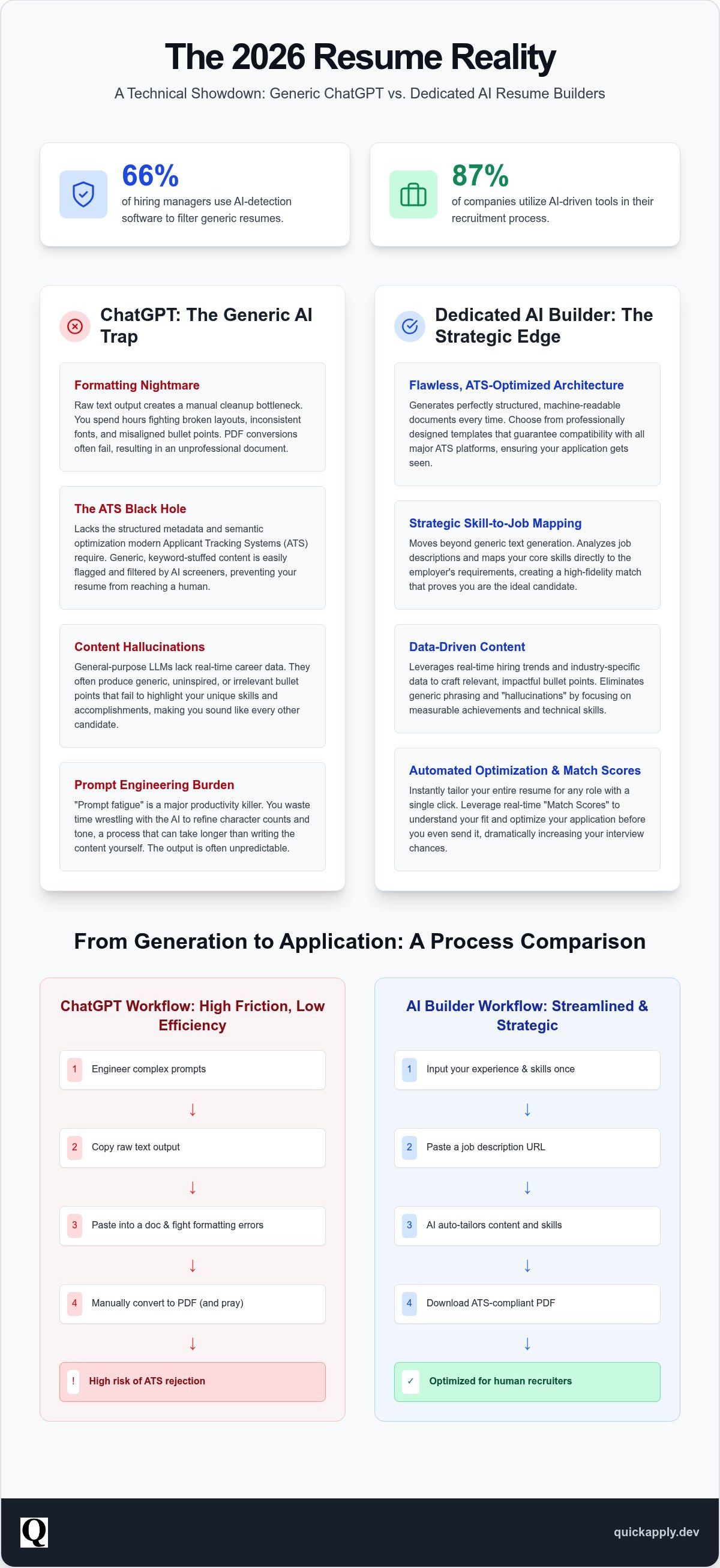
66% of hiring managers now use AI-detection software to flag and filter out the generic resumes flooding their inboxes. When you're weighing a chatgpt resume vs ai resume builder, the winner isn't the tool that writes the most words. It's the one that maps your skills to the machine's requirements. GPT-5.6 is a powerful engine, but it lacks the steering wheel required to navigate modern hiring systems. You've likely felt the frustration of pasting a perfectly crafted prompt only to end up with a formatting nightmare or a list of bullet points that sound like every other candidate in the stack.
It's exhausting to spend hours manually tailoring your experience just to be ignored by an automated filter. You need a system that doesn't just generate text, but optimizes your entire application strategy for the 2026 market. This guide breaks down the technical differences between raw LLMs and dedicated AI builders. You'll discover how to secure a perfectly formatted PDF, bypass the latest ATS filters, and use match scores to prove you're the ideal candidate before a human ever sees your name.
Key Takeaways
- Master the 2026 recruitment landscape where AI screeners demand technical precision beyond basic generative text.
- Analyze the fundamental trade-offs between a chatgpt resume vs ai resume builder to eliminate formatting friction and manual errors.
- Prioritize ATS-optimized architecture over raw content to ensure your application bypasses automated filters and reaches human recruiters.
- Shift from generic generation to strategic tailoring by mapping your core technical skills directly to specific job requirements.
- Leverage Match Scores and automated optimization to scale your application volume while maintaining a high-quality, 1:1 fit for every role.
The 2026 Job Search: Why "Just ChatGPT" Isn’t Enough Anymore
The job market has evolved into a high-stakes technological arms race. With 87% of companies now utilizing AI-driven tools in their recruitment processes, the barrier to entry has shifted. You aren't just competing against other humans; you're competing against sophisticated algorithms designed to identify the most efficient match in seconds. Using a generic resume in 2026 is a guaranteed path to instant rejection. When evaluating a chatgpt resume vs ai resume builder, you must understand that raw text generation is no longer the gold standard. It's about strategic data alignment and systemic optimization.
The "Efficiency Gap" is the primary obstacle for modern job seekers. Manual applications are too slow, yet generic AI outputs are too transparent. Recruiters are now using AI-detection software to screen out low-effort, bot-generated content. You need a solution that bridges the gap between high-volume output and high-quality tailoring. If your strategy relies on copy-pasting prompts into a chat box, you're already behind the curve.
The Rise of the AI-Powered Recruiter
Recruiters have moved beyond simple keyword filters. Modern Applicant Tracking Systems (ATS) and AI screeners now utilize semantic matching to evaluate candidate fit. They don't just look for specific words; they analyze the context of your experience and the depth of your technical skills. If your resume lacks high-fidelity data or uses outdated formatting, the machine simply ignores it. Success requires a resume built with the same level of technical sophistication as the tools used to screen it.
The Limitations of General Purpose LLMs
GPT-5.6 is an impressive engine, but it isn't a career expert. It lacks real-time data on shifting hiring trends and specific industry requirements. This is where the chatgpt resume vs ai resume builder debate becomes clear. General LLMs often produce "hallucinations" or generic bullet points that fail to highlight your unique value proposition. A chat interface is also a suboptimal environment for document management. You'll spend more time fighting with formatting and line breaks than actually applying for roles. Without a structured framework, your resume remains a collection of words rather than a strategic career asset.
Stop settling for "good enough" text. The 2026 market demands a data-driven approach that prioritizes machine readability and human impact simultaneously. You need a tool built for the modern web, not a general-purpose chatbot that treats your career like a creative writing exercise.
ChatGPT for Resumes: High-Speed Writing, Low-Speed Formatting
ChatGPT provides instant gratification. It is a text engine, not a document architect. The friction begins the second the "Generating..." bubble disappears. While you get 500 words in seconds, the chatgpt resume vs ai resume builder debate turns into a struggle the moment you try to move that text into a professional document. Raw LLMs generate strings of text without structured metadata. This creates a massive manual overhead that cancels out your initial time savings. You end up fighting the software instead of applying for jobs.
Researching why job seekers are using AI reveals a clear desire for speed. However, speed without structure is a technical liability. You enter a cycle of "copy, paste, fix, repeat" that drains your productivity and leaves you with a document that looks like an unformatted text file. The manual cleanup process is a bottleneck that prevents you from scaling your application volume effectively.
The Formatting Nightmare
ChatGPT loves Markdown. Recruiters and Applicant Tracking Systems do not. When you paste LLM-generated text into Word or Google Docs, the bolding breaks, bullet points misalign, and margins collapse. PDF converters often choke on the invisible characters and non-standard spacing generated by general-purpose bots. You'll spend forty minutes fixing a single page just to ensure it doesn't look like a technical manual from 1995. Consistent font sizing and professional white space are nearly impossible to maintain when you're working with raw chat outputs. This visual inconsistency signals a lack of attention to detail to any human reviewer who manages to see your file.
The Prompt Engineering Burden
Prompt fatigue is a real productivity killer. You spend more time arguing with the AI about character counts than you would have spent writing the content yourself. Telling a bot to "keep it under 300 characters" often results in 350. You also lack version control. If you liked a specific bullet point from three prompts ago, you have to scroll through a disorganized chat history to find it. This disorganized workflow is why professional writers avoid raw LLMs for final document layouts. You need a system that remembers your preferences and applies them across every version of your resume automatically.
Efficiency is the ultimate goal in a competitive market. If you're tired of the manual cleanup, you can use automated resume tailoring to skip the formatting wall entirely. The chatgpt resume vs ai resume builder choice comes down to how much you value your time. You can choose to be a prompt engineer struggling with margins, or you can be a candidate with a perfectly formatted, system-ready application in seconds.
Dedicated AI Resume Builders: Structure, Standards, and ATS-Friendliness
Dedicated builders operate on a fundamentally different architecture than general LLMs. While ChatGPT generates a stream of tokens based on probability, a specialized builder uses a structured database to map your professional history. This ensures that every field, from your email address to your most complex technical skill, is stored as high-fidelity data. When you compare a chatgpt resume vs ai resume builder, you're choosing between a creative writer and a precision engineer. The builder doesn't just write; it constructs a machine-readable document designed to survive the 2026 recruitment stack. It's the difference between sending a raw text file and a fully optimized data packet.
Speed is the core metric here, but not just the speed of generation. It's the speed of the entire workflow. In a chat interface, you're constantly prompting, reprompting, and manually adjusting. In a dedicated builder, you're selecting pre-validated components. This eliminates the "prompt fatigue" that slows down your application rate. You get a framework that recruiters actually want to see, hard-coded for systemic compatibility. This structural integrity is what allows your application to move through the hiring pipeline without getting garbled or misinterpreted by automated screeners.
Winning the ATS Battle
The primary goal of any resume is to be read. Modern systems use advanced parsing technology to extract data, and if your document uses non-standard headers or complex tables, the parser fails. Dedicated builders use standardized headers and contact info placements that are optimized for these systems. Many professionals are beginning to realize the limitations of using AI like ChatGPT when it comes to these technical nuances. Using a built-in ats resume checker ensures your document is technically sound before you hit submit. It's about proactive optimization rather than reactive fixing.
Recruiter-Approved Design Standards
Design isn't about decoration; it's about information hierarchy. In the tech industry, "over-designed" resumes with heavy graphics or multi-column layouts are often rejected by both machines and humans. Clean layouts that prioritize white space allow recruiters to scan your profile in the narrow window they typically allocate. Looking at good resume examples for 2026 reveals a trend toward extreme clarity and functional simplicity. A dedicated builder enforces these standards automatically. The system handles the aesthetics so you can focus on the strategy. This is the ultimate advantage in the chatgpt resume vs ai resume builder rivalry: the builder provides the guardrails that keep your application on track.
The Critical Difference: Content Generation vs. Strategic Tailoring
Writing a resume is a static event. Tailoring an application is a dynamic, repetitive process. In the 2026 job market, the "Master Resume" is a technical liability. Hiring managers and AI screeners aren't looking for a generalist; they're looking for a specific solution to a specific problem. When you evaluate the chatgpt resume vs ai resume builder landscape, the winner is the tool that moves beyond simple content generation. You need a system that performs a deep semantic alignment between your professional history and the job description. If your application doesn't provide a 1:1 match for the role, it likely won't survive the first automated pass.
Strategic tailoring is a separate skill set from creative writing. It requires an objective analysis of keywords, skill density, and experience mapping. ChatGPT can help you brainstorm, but it lacks the analytical framework to tell you exactly where your resume falls short. You need data, not just text. You need to know how to tailor resume to job description standards with mathematical precision. This is where specialized builders outpace general LLMs every single time.
The Myth of the Master Resume
Sending the same document to 100 different job postings is a statistical failure. Every job description is a unique dataset of requirements. To win, you must map your technical skills to that specific dataset. Using tailor resume to job description ai tools allows you to perform this mapping in seconds rather than hours. This automation ensures your experience is framed through the lens of the employer's needs. It eliminates the guesswork and replaces it with systemic accuracy.
Automated Skill Gap Analysis
Raw ChatGPT cannot provide objective match data. It can guess if you're a good fit, but it can't give you a quantifiable Match Score. Dedicated builders analyze the job description to identify exactly what your resume is missing. This automated gap analysis tells you which projects to highlight and which keywords to prioritize. It bridges the gap between your actual experience and the machine's requirements. Without this data, you're flying blind in a market that rewards precision over volume. The chatgpt resume vs ai resume builder choice is ultimately about whether you want a writer or a strategist.
Stop guessing and start winning with data-backed applications. You can automate your resume tailoring right now to ensure every submission hits a perfect match score. Efficiency isn't just about speed; it's about making every application count.
QuickApply: Beyond Building to Automated Career Optimization
QuickApply isn't just a document generator. It's an end-to-end career optimization engine. While the chatgpt resume vs ai resume builder debate usually centers on text, we focus on the entire lifecycle of your job search. Most tools abandon you once the PDF is downloaded. We provide a central nervous system for your professional growth. You get a suite of tools designed to eliminate manual friction from submission to salary negotiation. It's time to stop treating your career like a series of disconnected tasks and start treating it like a streamlined system.
Automation is the only way to stay competitive in a market where 93% of recruiters plan to increase their AI usage. You need a platform that moves as fast as the technology used to screen you. QuickApply bridges the gap between your raw talent and the digital-first hiring landscape. We provide the technical infrastructure you need to scale your efforts without sacrificing the quality of your personal brand. By utilizing declarative data and strategic skill mapping, we ensure you stay ahead of the curve.
The Tech-First Advantage
We built QuickApply specifically for software engineers and tech professionals. General tools try to be everything to everyone. This usually means they're mediocre for high-stakes technical roles. Our automated tailoring engine performs deep skill mapping in seconds. It doesn't just fill a template; it builds a mathematical case for your hire. This focus on results is why we are consistently ranked among the best ai resume builder 2025 options for high-growth sectors. You get the speed of an LLM with the precision of a dedicated career system.
Managing the Entire Job Hunt
The resume is only the first hurdle. Once you've submitted a perfectly tailored application, you need to track it. Our integrated Application Tracker eliminates spreadsheet fatigue. You move from being a job seeker to an empowered career manager. When the interview requests start landing, use our AI-powered interview practice tools to refine your delivery. We even provide a Salary Negotiation Guide and a Promotion Roadmap to ensure you're compensated for your true value. The chatgpt resume vs ai resume builder choice is clear: don't just buy a writer; invest in a platform that manages your entire professional trajectory.
Secure Your Competitive Edge in the 2026 Market
The 2026 job search is a systemic challenge that requires a systemic solution. Relying on raw text generation leaves you fighting formatting bugs and missing critical semantic matches. The choice between a chatgpt resume vs ai resume builder is ultimately about choosing between a creative experiment and a results-driven platform. You need a tool that handles the technical heavy lifting so you can focus on the interview. Success in this high-speed market depends on your ability to deliver precision and volume simultaneously.
Strategic tailoring is no longer optional for high-growth tech roles. General LLMs simply can't provide the match scores or the document structure needed to bypass sophisticated AI screeners. It's time to transition from a job seeker to a career manager by utilizing systems that prioritize efficiency and machine readability. Stop prompting and start applying with QuickApply to tailor resumes in seconds using recruiter-approved tech templates and manage your entire search with a built-in application tracker. Your next career move is too important to leave to unoptimized chat logs. Take control of your professional trajectory today.
Frequently Asked Questions
Is ChatGPT good for writing resume bullet points?
ChatGPT is an excellent tool for brainstorming action verbs and generating initial drafts. It struggles with specific technical context and often defaults to generic phrasing that triggers AI detectors. You must refine every output to ensure it reflects your actual contributions and unique technical impact. Use the AI for the heavy lifting, but add the specific metrics yourself.
Will recruiters know if I used an AI resume builder?
Recruiters focus on the quality of the content rather than the tool used to create it. However, 66% of hiring managers now use AI-detection software to filter out generic, low-effort applications. A high-quality builder helps you avoid the "robotic" patterns that trigger these filters by focusing on strategic skill mapping and high-fidelity data rather than just generating text.
Can ChatGPT format my resume for ATS?
ChatGPT cannot reliably format a resume for ATS. It generates raw text or Markdown that lacks the structural metadata required by modern hiring systems. In the chatgpt resume vs ai resume builder comparison, the builder wins on formatting because it utilizes hard-coded, recruiter-approved templates. These templates ensure your contact info and headers are parsed correctly every time.
What is the best AI tool for tailoring resumes to job descriptions?
The most effective tools for tailoring are those that provide objective Match Scores and gap analysis. You need a system that compares your experience directly to a job description to identify missing keywords. This data-driven approach ensures your application is optimized for the specific requirements of the role. Look for platforms that prioritize semantic matching over simple keyword stuffing.
Are free AI resume builders actually free?
Most free builders operate on a freemium model. You can typically build a basic document for free, but advanced features like ATS checking or unlimited downloads often require a subscription. Always check the export options before investing time into a specific platform to avoid hidden paywalls at the final step. Professional tools often provide more value by saving you hours of manual work.
How does QuickApply differ from a standard AI resume builder?
QuickApply moves beyond simple document generation to offer a full-stack career management suite. Unlike standard builders, it includes an integrated application tracker, interview practice tools, and automated tailoring specifically for tech roles. It acts as a bridge between your talent and the complex 2026 hiring landscape. It's a complete system designed for professionals who value their time.
Should I use ChatGPT to write my cover letter as well?
You can use AI for cover letters, but general-purpose bots often produce generic results. Effective cover letters in 2026 require a 1:1 match with the job's pain points. A specialized tool that understands your resume data will produce a more persuasive, tailored document than a raw chat prompt. Always ensure the tone aligns with your personal brand and the company culture.
How do I avoid sounding robotic when using AI for my resume?
Avoid the "robotic" trap by focusing on quantifiable results rather than just listing responsibilities. Use AI to structure your bullet points, then manually inject specific project names and unique outcomes. This hybrid approach ensures your chatgpt resume vs ai resume builder strategy results in a document that feels authentic to human recruiters while still passing through automated filters.


