Your cover letter isn't getting read. That's not pessimism; that's how modern hiring pipelines work. Recruiters spend seconds scanning applications, ATS systems filter out qualified candidates before a human ever sees the file, and the generic cover letter examples you've been copying from outdated blog posts aren't doing you any favors. You already know this. You've felt it every time you spent two hours crafting a letter and heard nothing back.
Here's the shift that changes everything: in 2026, the best cover letter examples aren't just templates you copy and paste. They're training data. They show you the structure, the tone, and the keyword density that actually converts, and when you feed that intelligence into an AI-powered workflow, you stop writing from scratch entirely. You start shipping tailored, high-impact applications in seconds.
This guide gives you exactly that. You'll get a curated library of high-performing tech cover letter examples, a clear framework for adapting them to any job description, and a look at how platforms like QuickApply use match scores to verify your letter actually fits the role before you hit send.
Key Takeaways
- Generic cover letter examples are obsolete in 2026—ATS filters and time-pressed recruiters demand role-specific, keyword-optimized letters that speak directly to a company's pain points.
- High-conversion tech cover letters follow a precise anatomy, from portfolio-integrated headers to hooks that address the employer's specific challenges within the first 30 words.
- You'll get role-specific cover letter examples for Software Engineers and Data Scientists that are structured to pass ATS screening and land in human hands.
- A two-step tailoring framework shows you how to deconstruct any job description and align your project history to the company's current technical challenges—fast.
- AI tools like QuickApply eliminate blank-page syndrome entirely, using match scores to verify your letter fits the role before you ever hit send.
Beyond Static Templates: Why Traditional Cover Letter Examples Fail in 2026
The one-size-fits-all cover letter is dead. Not declining, not fading. Dead. The tech sector in particular has moved so fast that the generic "Dear Hiring Manager, I am excited to apply" format now signals one thing to recruiters: this candidate didn't do the work. In a market where hundreds of applications hit a single job posting within hours of it going live, generic is invisible.
The real problem isn't that job seekers lack effort. It's that the old playbook, built around static cover letter examples you copy and tweak by hand, was never designed for the volume and velocity of modern job searching. It was designed for a world where you applied to five roles a month, not fifty.
The Efficiency Gap in Modern Job Searching
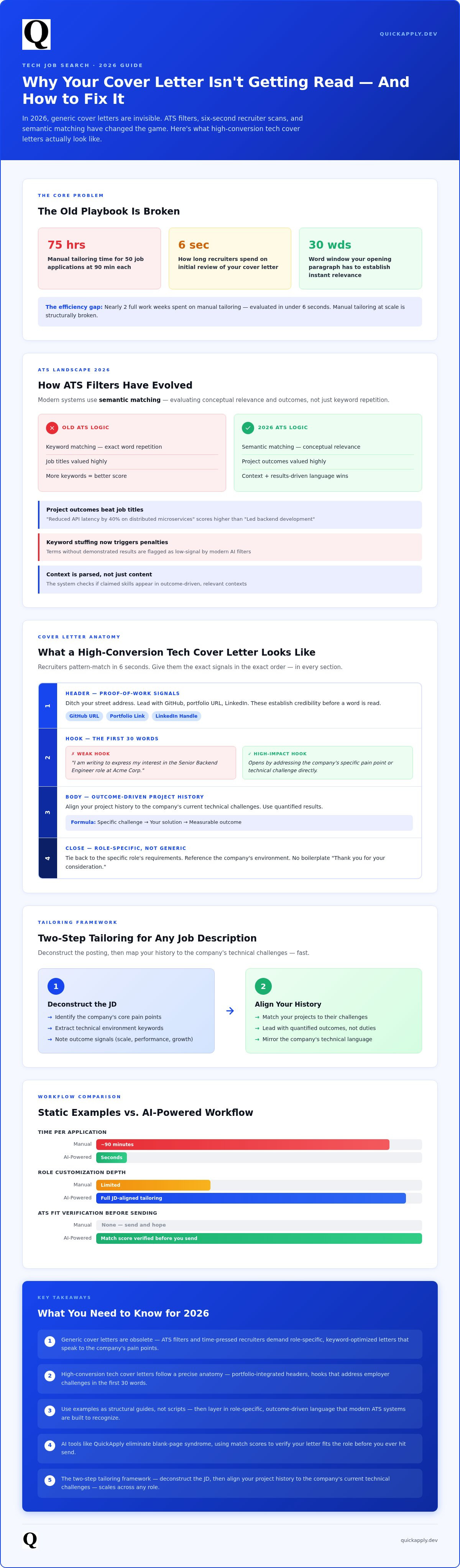
Run the numbers. If you're targeting fifty roles, and each manual tailoring pass takes ninety minutes of reading the job description, rewriting your opening paragraph, and adjusting keyword density, that's seventy-five hours of work before you've sent a single application. That's nearly two full work weeks, spent on a process that recruiters evaluate in under six seconds on initial review.
Six seconds. That's the window your opening paragraph has to establish instant relevance. If your first sentence doesn't mirror the company's specific pain point or technical environment, the review is over. The letter goes into the no pile, and those seventy-five hours become sunk cost.
This is the efficiency gap. Manual tailoring at scale is structurally broken, and no amount of discipline closes it.
How ATS Algorithms Have Evolved
The 2026 ATS landscape isn't the keyword-stuffing game it was five years ago. Modern filters use semantic matching, meaning they evaluate conceptual relevance, not just literal word repetition. Semantic match, in 2026 recruitment terms, means the ATS assesses whether your described experiences map to the actual outcomes the role requires, not just whether your text contains the same words as the job posting.
Practical implications of this shift:
- Job titles matter less than project outcomes. "Led backend development" gets filtered differently than "reduced API latency by 40% on a distributed microservices architecture."
- Keyword stuffing now triggers penalties. Overloading a letter with terms that don't connect to demonstrated results reads as low-signal to modern AI filters.
- Context is parsed, not just content. The system evaluates whether your claimed skills appear in relevant, outcome-driven contexts.
This is precisely why static cover letter examples pulled from generic job boards fail so consistently. They're built around old filter logic. Using them in 2026 is like submitting a fax number on a digital application form. Technically it's there. Functionally, it means nothing.
The fix isn't to abandon examples entirely. It's to use them as structural guides, not scripts, and to layer in role-specific, outcome-driven language that modern ATS systems are actually built to recognize.
The Anatomy of a High-Conversion Cover Letter for Tech Professionals
Structure isn't optional. In a six-second scan, recruiters aren't reading your letter. They're pattern-matching. A high-conversion tech cover letter gives them exactly the pattern they're looking for, in exactly the order they expect it, loaded with signals that trigger a "keep reading" response instead of a click to the next candidate.
Header and Hook: Capturing Immediate Attention
Your physical address is dead weight. No recruiter in 2026 needs your street number. What they do need is your GitHub profile URL, your portfolio link, and your LinkedIn handle. These aren't nice-to-haves; they're proof-of-work signals that establish credibility before a single sentence is read. A header that leads with a live GitHub repo communicates more than three paragraphs of self-description ever could.
The hook is where most tech candidates lose the game. Weak hooks sound like this:
- "I am writing to express my interest in the Senior Backend Engineer role at Acme Corp."
- "With five years of experience in software development, I believe I am a strong fit."
High-impact hooks look like this instead:
- "After Acme's Q1 announcement about migrating to a Kubernetes-native architecture, I mapped your posted requirements directly to the distributed systems work I shipped at [Company]."
- "Your engineering blog's recent post on latency bottlenecks in real-time data pipelines describes exactly the problem I solved at scale last year."
The difference is specificity. Reference a recent product launch, a tech-stack shift mentioned in their job description, or a public engineering post. Thirty words that prove you did the research outperform three paragraphs of generic enthusiasm every time.
The Tech-Stack Body Paragraph
Don't list your stack. Narrate it. There's a critical difference between "Proficient in Python, Kubernetes, and PostgreSQL" and "Rebuilt a Python-based ingestion pipeline on Kubernetes that cut processing time by 60% and reduced infrastructure costs quarter-over-quarter." The second version uses the Action-Context-Result framework: what you did, where you did it, and what it produced in measurable terms.
Two virtues dominate tech hiring conversations right now: scalability and efficiency. Every result you quantify should connect to one of them. Use percentages, sprint velocity improvements, or reduced error rates. Concrete numbers give ATS semantic filters the outcome-driven context they're built to recognize, and they give human reviewers something to anchor a conversation around in the interview.
Your closing statement should be assertive, not apologetic. Replace "I hope to hear from you" with "I'd welcome a 20-minute call to walk through the architecture decisions behind this work." You're not requesting permission. You're proposing a next step.
Applying these principles across dozens of roles manually is where the process breaks down. Tools like QuickApply's cover letter generator apply this exact framework automatically, using match scores to verify your letter's structure and keyword alignment before you send it. The anatomy stays consistent. The tailoring happens in seconds.
The best cover letter examples aren't just models to admire. They're blueprints to systematize.
2026 Cover Letter Examples: Role-Specific Samples That Beat the ATS
Generic tech templates don't cut it. A DevOps Engineer and a Frontend Developer operate in entirely different technical realities, and a cover letter that tries to serve both serves neither. The role-specific cover letter examples below are built for precision: each one targets the exact signals that ATS systems and hiring managers in that discipline are trained to look for.
Software Engineering: Focus on Architecture
Architecture decisions are where senior engineering candidates separate themselves. Don't just name your stack. Show how you've made it scale. Here's how that looks in practice:
- Microservices and cloud-native: "Decomposed a monolithic Rails application into twelve independently deployable microservices on AWS EKS, reducing deployment cycle time from three days to under four hours."
- Legacy migration without sounding dated: Frame it as a modernization win, not a rescue job. "Led a phased migration of a 10-year-old Java codebase to a containerized Go architecture, maintaining 99.97% uptime throughout the transition." The word "phased" signals maturity. The uptime stat signals execution.
- Cloud-native specificity: Name the services. "Terraform-managed infrastructure across three AWS regions" reads as lived experience. "Cloud experience" reads as a checkbox.
For more role-specific inspiration, check out these cover letter examples built specifically for tech job applications in 2026.
Data Science and AI: Focus on Insights
Most data science candidates bury their best work. They describe models. They should be describing outcomes. Recruiters don't hire models; they hire the person who made the model matter to the business.
Reframe ML work in ROI terms: "Deployed a churn prediction model using XGBoost that identified at-risk accounts 45 days earlier, enabling the retention team to recover an estimated 12% of flagged revenue." That sentence does three things at once: it names the method, quantifies the lead time, and connects directly to business impact.
Don't underestimate pipeline work either. Data cleaning and ingestion engineering are consistently undervalued in cover letters, yet they're the hidden constraint on every model's performance. Calling it out signals real-world experience: "Reduced inference latency by 40% by rebuilding the feature engineering pipeline with vectorized Pandas operations and caching at the preprocessing layer."
Product Managers and Cybersecurity Analysts follow the same logic. PMs should anchor every claim to user-centric metrics and cross-functional delivery velocity. Cybersecurity candidates need to lead with threat mitigation outcomes and compliance frameworks, not just tool lists. MITRE ATT&CK familiarity, SOC2 audit experience, and mean-time-to-detect improvements are the signals that move those applications forward.
The pattern across all four roles is identical: action, context, measurable result. That's what modern ATS semantic filters are built to reward, and it's what human reviewers remember when they're deciding who gets the call.
How to Tailor Your Cover Letter Examples for Maximum Impact
Having the right cover letter examples is only half the equation. The other half is knowing how to systematically adapt them to each role without burning hours you don't have. This is a five-step process, and every step compounds the one before it.
Deconstructing the Job Description
Start with the job description itself. Most candidates skim it for the obvious requirements and stop there. Don't. The "nice-to-have" section is where the real signal lives. Those items aren't throwaway wishes; they're the skills the hiring manager actually wants but couldn't justify listing as hard requirements. A candidate who addresses three "nice-to-haves" with concrete proof points immediately separates from the field.
Map your skills to the JD using the same logic behind tailoring a resume to a job description: pull the exact phrases the company uses, not synonyms you prefer. If the JD says "distributed systems observability," don't write "monitoring infrastructure." Semantic ATS filters are sophisticated, but they still reward precision. Aim to match roughly 80% of the JD's core keyword set. Hit 100% and your letter reads as copy-paste. Hit 60% and you're leaving ATS score points on the table. Eighty percent is the sweet spot where relevance registers without triggering spam-pattern detection.
Next, pull the company's engineering blog. Look for recurring pain points, the stack they're actively migrating toward, the architectural debates they're having in public. Those phrases belong in your third paragraph, not as flattery, but as proof you're already thinking in their context.
Injecting Social Proof and Portfolio Links
Social proof reduces hiring risk. That's the entire logic. A recruiter who can click through to a live GitHub repo, a shipped product, or a documented open-source contribution doesn't have to take your word for anything. The evidence does the persuasion.
Place your portfolio links in the header, not buried in the closing paragraph. By the time a recruiter reaches your closing, they've already formed an opinion. Front-load the proof. When referencing a specific open-source contribution, be surgical about it: name the project, describe your commit's impact in one sentence, and link directly to it. "Contributed query optimization logic to [Project], reducing average response time by 30% across 400+ active forks" is a sentence that closes loops before an interview even starts.
Once your tailoring logic is locked in, use a cover letter builder to automate the formatting and structure. It keeps your layout consistent across every application without the manual overhead. Then do one final human pass. Read it out loud. If it sounds like software wrote it, it'll read that way too. Your professional brand has a voice; make sure it survives the automation layer.
Run your finished letter through QuickApply's match score tool before you hit send. If the score doesn't reflect the tailoring work you put in, the ATS won't either.
Scaling Your Job Search: Moving from Static Examples to AI Automation
Spray and pray is dead. Sending identical applications to two hundred companies and hoping something sticks isn't a strategy; it's noise. What wins in 2026 is high-volume precision: the ability to apply to a large number of roles with letters that are individually calibrated to each job description. That's not a contradiction. It's an automation problem, and automation problems have solutions.
The first-mover advantage is real and quantifiable. Applications submitted within the first 24 hours of a posting going live consistently receive higher engagement rates, simply because recruiters review applications in chronological order before the volume overwhelms them. Every hour you spend manually rewriting a cover letter from static cover letter examples is an hour your competition is using to get to the top of that stack first.
The QuickApply Advantage for Tech Seekers
QuickApply's AI cover letter generator eliminates blank-page syndrome entirely. Paste in the job description, and the platform tailors every sentence to that specific role in seconds, not the generic output you'd get from a basic text tool, but keyword-aligned, outcome-driven language built around the JD's actual requirements.
The Match Score feature is where the real leverage lives. Instead of guessing whether your letter hits the right signals, you get a concrete alignment score before you send anything. Low score? The platform tells you where the gaps are. High score? Ship it. This turns a subjective, anxiety-driven process into a data-driven decision. You stop wasting energy on applications that were never going to convert and concentrate your effort on roles where your profile genuinely fits.
Managing 100+ applications without losing track is its own challenge. QuickApply's automated application tracker keeps your pipeline organized so you always know what's been sent, what's pending, and what needs a follow-up. At scale, that visibility is the difference between a managed funnel and controlled chaos.
From Application to Interview Practice
Your cover letter isn't just an application document. It's a script. The specific outcomes and architecture decisions you wrote into that letter are exactly what you should be pulling from when a recruiter asks "Tell me about yourself." Your letter already contains your tightest, most relevant narrative. Use it.
The loop closes with interview preparation. Once you've landed the call, use AI to drill on the technical questions most likely to come from the stack and challenges you referenced in your letter. The same intelligence that tailored your application can prepare you for what comes next.
Start the full cycle now: tailor your resume and cover letter with AI and compress the entire process from hours to minutes. Static cover letter examples got you to the starting line. Automation is how you win the race.
Your Next Application Should Take Minutes, Not Hours
The old approach to cover letters is broken. Static templates don't pass modern ATS filters, manual tailoring doesn't scale, and generic enthusiasm doesn't convert. You've seen the framework that does work: role-specific language, outcome-driven proof points, and keyword alignment that maps directly to what hiring managers are actually screening for.
The best cover letter examples are blueprints, not scripts. They show you the structure. AI handles the execution. That's the shift that compresses hours of work into seconds.
QuickApply is built specifically for tech professionals who need to move fast without sacrificing precision. Tailor cover letters in seconds, hit a 95%+ ATS match rate, and know your letter actually fits the role before you send it. No guesswork. No blank pages. Just a pipeline that works.
Your next role is already posted. Don't let a slow application process cost you the interview. Start tailoring your cover letters for free with QuickApply and get to the top of the stack first.
Frequently Asked Questions About Tech Cover Letters in 2026
Are cover letters still necessary for tech jobs in 2026?
Yes, but the bar has shifted. Many companies use cover letters as a secondary filter after ATS screening, meaning a weak letter won't cost you the interview, but a strong one can actively win it. For senior and specialized roles, hiring managers frequently cite the cover letter as the deciding factor between equally qualified candidates. Skipping it entirely is a gamble that's rarely worth taking.
How long should a tech cover letter be?
Three paragraphs, one page, under 400 words. That's the ceiling. Recruiters aren't reading novels; they're scanning for signals. A hook that references the company's specific technical challenge, a body paragraph with two quantified proof points, and a confident closing with a proposed next step. Everything beyond that is noise that dilutes your strongest claims.
Can ATS read AI-generated cover letters?
Yes, ATS systems parse AI-generated text the same way they parse human-written text. The real risk isn't the generation method; it's generic output. AI tools that produce boilerplate language without role-specific tailoring will score poorly on semantic matching regardless of how they were written. Tools like QuickApply address this by aligning every generated letter to the actual job description, then verifying alignment with a match score before you send.
Should I include my tech stack in the cover letter or just the resume?
Include it in both, but differently. Your resume lists the stack. Your cover letter contextualizes it. Don't write "proficient in Python and Kubernetes." Write "rebuilt a Python ingestion pipeline on Kubernetes that cut processing time by 60%." The cover letter is where your stack becomes a story with measurable outcomes, which is exactly what ATS semantic filters and human reviewers are built to reward.
How do I mention a career gap in a tech cover letter example?
Address it briefly and pivot fast. One sentence is enough: "Following a planned career break, I spent the past year completing [specific certification or project] and contributing to [open-source project or freelance work]." Don't apologize. Don't over-explain. What hiring managers actually want to know is whether your skills are current. Show them the evidence and move on to your strongest proof points.
Is it okay to use a generic cover letter for high-volume applications?
No. A generic cover letter examples approach might feel efficient, but it's structurally broken. Modern ATS semantic matching evaluates whether your described experience maps to the specific outcomes a role requires. A generic letter scores poorly across the board, meaning it gets filtered out before a human ever sees it. High-volume precision, tailoring each letter to its specific job description at speed, is the only approach that actually scales.
What is the best format for a cover letter in 2026?
Clean, single-column, ATS-safe formatting. Use a standard font like Arial or Calibri at 11-12pt, with clear section breaks. Lead with a header that includes your portfolio URL, GitHub profile, and LinkedIn handle instead of a street address. Avoid tables, columns, text boxes, or graphics; ATS parsers frequently misread them and drop critical content. PDF is the safest file format unless the application specifically requests a Word document.
How do I tailor a cover letter if I don't have direct experience in a specific language?
Lead with transferable architecture and problem-solving experience, then close the gap explicitly. If a role requires Go but you've shipped production systems in Rust, say so: "My distributed systems work in Rust maps directly to Go's concurrency model; I've been actively building in Go through [specific project] over the past three months." Demonstrating adjacent competence plus active upskilling is more persuasive than silence on the gap.


